How to Start a Small Business in 2026: Complete Guide
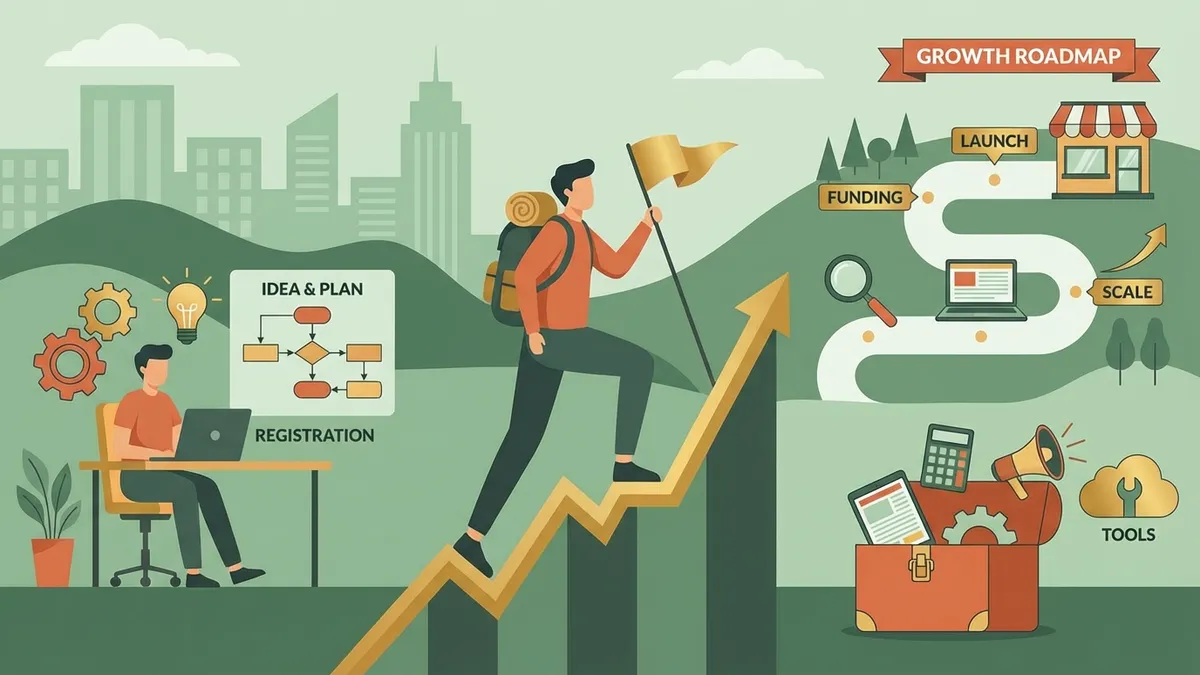
Starting a business in 2026 is more accessible than ever. Cloud software has eliminated the need for expensive infrastructure. Remote work has expanded the talent pool. AI tools have given solo founders capabilities that used to require entire teams. But accessibility doesn't mean easy — the fundamentals of building a sustainable business haven't changed. This guide walks you through every step, from validating your idea to opening day and beyond.
Why Start a Business in 2026?
The economic case for entrepreneurship has never been stronger. The SBA reports that small businesses account for 43.5% of U.S. GDP and create two-thirds of net new jobs in the private sector. Beyond the economics:
- AI tools have dramatically lowered the cost of marketing, content creation, and operations
- E-commerce and digital delivery let you serve customers nationally from day one
- Remote work means you can build a team without a physical office
- Gig economy platforms let you test concepts with minimal commitment
- SBA loan programs provide access to capital that didn't exist a generation ago
The barriers to entry are lower. The competition is real. The businesses that win in 2026 are those that solve a genuine problem for a specific customer, execute consistently, and adapt quickly.
Step 1: Validate Your Idea
The most expensive mistake in business is building something nobody wants. Before registering your LLC or spending money, validate that real people will pay for your product or service.
Talk to 10 potential customers before building anything. Schedule 20-minute calls with people who match your target customer profile. Ask about their problems, what solutions they've already tried, and what they'd pay for something better. Listen far more than you talk.
Look for proof of demand. Are competitors making money in this space? Competitors are validation, not obstacles. If nobody is doing what you want to do, ask whether that's an opportunity or a warning sign.
Run a minimum viable test. Before building a full product, offer the service manually or sell pre-orders. If you can't get 5-10 people to pay you money for your idea before you've built it, reconsider the concept or the pricing.
Validate your pricing assumption. Ask potential customers what they currently spend to solve the problem you're addressing. Price anchored to the value you deliver, not your costs. Many new businesses undercharge significantly — and raising prices after you've established a customer base is painful.
Step 2: Write a Business Plan
A business plan doesn't need to be a 50-page document with five-year financial projections. For most small businesses, a focused one-page lean plan is more useful than a detailed report that collects dust.
Your lean plan should cover:
Value proposition: What problem do you solve and for whom? In one sentence.
Target customer: Who specifically is your best customer? A "40-year-old female homeowner in Phoenix who has a dog and a full-time job" is more useful than "homeowners."
Revenue model: How do you make money? Per project, monthly subscription, percentage of transaction, product markup?
Startup costs: What do you need to spend before you generate your first dollar? List every item.
Break-even analysis: How many customers or transactions do you need per month to cover your costs?
Marketing channels: How will your first 10 customers find you?
If you're seeking an SBA loan or bank financing, you'll need a full business plan with market analysis, management bio, and 3-year financial projections. SCORE (score.org) offers free mentorship and business plan templates from retired executives.
Step 3: Choose a Business Structure
Your legal structure affects your taxes, personal liability, and administrative requirements. Here's how the main options compare:
| Structure | Liability Protection | Tax Treatment | Setup Cost | Best For |
|---|---|---|---|---|
| **Sole Proprietorship** | None — personal assets at risk | Pass-through (Schedule C) | $0 | Testing an idea before committing |
| **LLC** | Yes — personal assets protected | Pass-through by default | $50-$500 | Most small businesses |
| **S-Corporation** | Yes | Pass-through, but can reduce SE tax | $500-$1,000 | Profitable businesses ($50K+ profit) |
| **C-Corporation** | Yes | Double taxation | $500-$2,000 | VC-funded startups, complex equity |
For most new small businesses, an LLC is the right choice. It provides personal liability protection (your house, car, and savings stay protected if the business is sued), is taxed as a pass-through entity by default, and has minimal ongoing administrative requirements.
When to consider an S-Corp: Once your business generates more than $50,000-$80,000 in profit annually, electing S-Corp status can save significant money on self-employment taxes. Consult a CPA — the savings can be $5,000-$15,000/year for a profitable small business.
Sole proprietorships are risky: Many freelancers and contractors operate as sole proprietors to avoid the hassle of forming an LLC. This is a mistake. A single lawsuit can expose your personal assets. The $50-$500 to form an LLC is among the best money you'll ever spend.
Step 4: Register and Get Licensed
Once you've chosen a structure, here's the registration checklist:
Form your LLC (if applicable): File Articles of Organization with your state. Costs and processing times vary:
| State | LLC Filing Fee | Processing Time |
|---|---|---|
| Wyoming | $102 | 1-3 business days |
| Delaware | $90 | 1-3 business days |
| New Mexico | $50 | 1-2 weeks |
| Florida | $125 | 1-3 business days |
| Texas | $300 | 1-2 weeks |
| California | $70 + $800 franchise tax | 1-2 weeks |
| New York | $200 + publication requirement | 2-4 weeks |
Wyoming and Delaware are popular for their business-friendly laws and low costs, even if you operate in another state. However, if you operate locally (a restaurant, retail store, service business), register in your home state to avoid double-registration fees.
Get an EIN: Apply for a free Employer Identification Number at IRS.gov/EIN. Takes 5 minutes online and is issued immediately. You need this to open a business bank account, hire employees, and file taxes.
Register for state taxes: Depending on your state and business type, you may need to register for state income tax withholding, sales tax collection, or both.
Get business licenses and permits: Requirements vary widely by industry and location. Common needs include a general business license (city or county), professional licenses (required for contractors, healthcare workers, food handlers, real estate agents), health permits (for food businesses), and building permits (for renovations).
Check your state's one-stop business licensing portal and contact your local city clerk's office to identify every permit required before you open.
Step 5: Set Up Finances
Mixing personal and business finances is the most common and most costly mistake new business owners make. It creates accounting nightmares, eliminates liability protection for LLCs, and makes tax preparation expensive. Set up proper financial infrastructure before your first transaction.
Open a dedicated business bank account: Open a separate checking account in your business name. Mercury Bank (mercury.com) and Relay Financial offer free business checking with no minimum balance — both are excellent for new businesses. Traditional banks charge $10-$25/month.
Set up accounting software: You need to track income, expenses, and taxes from day one.
| Software | Best For | Cost |
|---|---|---|
| **Wave** | Bootstrapped businesses, solopreneurs | Free |
| **QuickBooks Simple Start** | Self-employed and freelancers | $30/month |
| **QuickBooks Online** | Growing businesses with employees | $60-$200/month |
| **FreshBooks** | Service businesses and invoicing | $19-$55/month |
| **Xero** | Businesses needing strong reporting | $15-$78/month |
For a brand-new business, Wave (free) or QuickBooks Simple Start ($30/month) handles everything you need. Graduate to a more robust system when you have employees or need inventory management.
Get a business credit card: A business credit card builds business credit separately from your personal credit, keeps expenses organized, and often offers cash back or travel rewards. Apply for one through your bank or check options like Chase Ink Business Cash (5% back on office supplies and internet) or American Express Blue Business Cash (2% on all purchases up to $50K/year).
Set up a simple invoicing process: If you're service-based, you need a consistent way to send invoices and collect payment. Wave, FreshBooks, and QuickBooks all include invoicing. For instant payment collection, add Stripe or Square to accept cards.
Reserve for taxes: Self-employed business owners pay 15.3% self-employment tax plus income tax. Set aside 25-30% of every profit dollar for taxes. Open a separate savings account and move money there monthly.
Step 6: Build Your Brand
Your brand is more than a logo — it's the entire impression customers have of your business. Strong brands command higher prices, generate more referrals, and create customer loyalty that's hard for competitors to steal.
Choose a great business name: Your name should be easy to spell, easy to pronounce, available as a .com domain, and not already trademarked. Use our free Business Name Generator to find creative options, then check availability on Namecheap or GoDaddy and search the USPTO trademark database.
Create a memorable slogan: A tagline distills what makes your business different into a few memorable words. "We're open late" is a feature. "When everyone else has closed, we're just getting started" is a brand. Use our Slogan Generator to generate and refine options.
Design a professional logo: Platforms like 99designs (from $299), Fiverr ($50-$300), or Canva (free templates) give every budget a path to a professional mark. Don't use a generic stock icon — your logo will be on everything you ever produce.
Build a simple website: In 2026, your website is your storefront, your brochure, and your 24/7 salesperson. Use Squarespace ($16/month), Wix ($17/month), or WordPress + Bluehost ($3-$10/month). Focus on five pages: Home, About, Services, Testimonials, and Contact.
Claim your social media profiles: Even if you're not active on every platform yet, claim your business name handles on Instagram, Facebook, LinkedIn, TikTok, and YouTube before someone else does.
Step 7: Launch and Market
A soft launch lets you work out operational issues before going wide. For the first 2-4 weeks, serve a small group of customers — friends, family, early adopters — and refine your processes based on real feedback.
Your pre-launch marketing checklist:
- Google Business Profile created and verified
- Website live with clear contact information
- Email list set up (even a simple Mailchimp free account)
- 3-5 Google reviews from early customers
- Social media profiles active and professional
- Business cards printed
Your launch marketing priorities (in order of cost-effectiveness):
- Tell everyone you know — personal outreach to your network
- Ask for referrals from your first customers
- Optimize your Google Business Profile
- Start posting on 1-2 social media platforms consistently
- Begin collecting email addresses for a monthly newsletter
- Run a small Google Ads campaign targeting local search terms
For a comprehensive marketing strategy, see our 50 Marketing Ideas for Small Business guide.
Step 8: Get Business Insurance
Insurance is not optional once you're operating a real business. A single claim without coverage can bankrupt a small business. The priority coverages:
General liability insurance covers bodily injury and property damage claims from customers or third parties. Required by most commercial landlords and many clients. Cost: $400-$800/year.
Professional liability / E&O insurance covers claims that your work or advice caused a client financial harm. Essential for consultants, accountants, IT professionals, and anyone providing expertise. Cost: $500-$2,000/year.
Workers' compensation is required in most states the moment you hire your first employee. Cost: 0.75%-2.5% of payroll.
Business Owner's Policy (BOP) bundles general liability and commercial property insurance at a discount. The smart starting point for most small businesses. Cost: $500-$1,500/year.
For quotes, compare Next Insurance, Hiscox, and The Hartford. You can get multiple quotes online in minutes. For a complete breakdown of every coverage type, see our Small Business Insurance Guide.
Step 9: Get Business Financing
Most small businesses are self-funded initially, but understanding your financing options before you need money is smart planning.
SBA 7(a) loans: The most popular small business loan program in the U.S., with loan amounts up to $5 million and interest rates of prime + 2.25%-4.75%. Requires 2 years in business and good credit for most programs.
SBA Microloans: Loans up to $50,000 for new businesses and underserved entrepreneurs. Average loan is $13,000. Administered through nonprofit intermediaries.
Business lines of credit: A revolving credit line you draw on as needed and repay. Better for managing cash flow gaps than funding large one-time purchases. Available from banks and alternative lenders like Kabbage, OnDeck, and BlueVine.
Equipment financing: Loans or leases specifically for equipment purchases. The equipment serves as collateral, making approval easier. Rates from 4%-30% depending on creditworthiness.
Business credit cards: Good for day-to-day expenses up to $25,000-$50,000. The Chase Ink and American Express Business lines are popular for rewards and useful features.
For a complete breakdown of small business loan options and how to qualify, see our Small Business Loans Guide.
Common Mistakes New Business Owners Make
Learning from others' mistakes is cheaper than making them yourself:
Underpricing: Most new owners price too low out of fear. Low prices attract price-sensitive customers who are hard to retain and rarely refer. Price at the value you deliver, not the minimum you'd accept. You can always run a promotion — it's very hard to raise prices on existing customers.
Skipping the legal setup: Operating as a sole proprietor without an LLC exposes your personal assets to any business liability. A $100 LLC filing is the best insurance policy you can buy.
Not separating finances: Mixing personal and business accounts creates a bookkeeping nightmare, makes it impossible to measure profitability, and eliminates your LLC's liability protection.
Trying to serve everyone: "Everyone" is not a target market. The most successful small businesses serve a specific person with a specific problem. Specialization commands higher prices and generates better referrals.
Scaling too fast: Hiring employees, signing leases, and taking on overhead before you have predictable revenue is one of the most common paths to failure. Stay lean until your revenue is consistent.
Ignoring cash flow: Profitable businesses go bankrupt all the time because they run out of cash. Revenue and profit are accounting concepts; cash is what you actually spend. Track your cash position weekly, not monthly.
Not asking for referrals: Satisfied customers will refer — if you ask. Most business owners are too shy to ask. Build a referral request into your standard customer follow-up process from day one.
Business Resources for New Entrepreneurs
These free and low-cost resources can save you thousands of dollars and years of learning:
SCORE (score.org): Free mentorship from retired executives. Over 10,000 volunteer mentors across 300 chapters nationwide. One of the most underused resources in small business.
SBA Small Business Development Centers (SBDCs): Free and low-cost business advising, training, and research from government-funded centers at universities. Find your local center at sba.gov/sbdc.
Local Chamber of Commerce: Networking, referrals, advocacy, and often exclusive discounts on business services. Annual membership typically $200-$500.
IRS Small Business Center (irs.gov/businesses/small-businesses-self-employed): Free tax education resources specifically for small business owners. The "Starting a Business" section is essential reading.
Coursera and Udemy: Affordable online courses on accounting, marketing, legal basics, and management. Many university-level business courses are free to audit.
Public Library: Free access to IBISWorld industry reports, ReferenceUSA business databases, and LinkedIn Learning — resources worth thousands of dollars if purchased directly.
Starting a business is one of the most challenging and rewarding things a person can do. The path is rarely linear, the obstacles are real, and the learning curve is steep. But the rewards — financial, professional, and personal — are available to anyone willing to do the work systematically and persistently. Start with one step. Take the next one tomorrow.
Frequently asked questions
How much does it cost to start a small business?
Startup costs vary widely, but many small businesses can launch with $5,000-$10,000. Online businesses can start for under $1,000.
Do I need an LLC to start a business?
While not required, an LLC provides liability protection and tax flexibility, making it recommended for most small businesses.
How long does it take to start a business?
You can legally form an LLC and get an EIN in as little as one day in most states. However, building a business that generates reliable revenue typically takes 6-18 months. Plan for a 3-6 month runway before expecting consistent income.
Do I need a business plan to start a small business?
A formal business plan is required if you're seeking a bank loan or investor funding. If you're self-funding, a 1-2 page lean plan covering your value proposition, target customer, revenue model, and startup costs is sufficient to get started.
What is the most profitable type of small business to start?
Service businesses (consulting, cleaning, landscaping, home repair) typically have the highest profit margins because startup costs are low. Software and digital products have nearly infinite margins once built. Retail and food businesses have thin margins and high overhead — though high revenue potential.
What are the biggest mistakes new business owners make?
The biggest mistakes include: underpricing services (hard to raise prices later), skipping legal setup (operating as a sole prop without an LLC creates personal liability), not separating business and personal finances from day one, and trying to serve everyone instead of a specific target customer.