Generative Engine Optimization Benefits: Why GEO Matters
Generative engine optimization is becoming a practical marketing discipline because search is no longer only a list of blue links. Buyers now ask ChatGPT, Perplexity, Gemini, Claude, Google AI Overviews, and voice assistants for direct recommendations, comparisons, and summaries.
That shift creates a new visibility problem. A brand can rank well in traditional search and still be absent from the answer a customer actually reads.
GEO helps close that gap.
What generative engine optimization actually improves
Traditional SEO asks: can a search engine crawl, understand, and rank this page?
GEO adds another question: can an AI system confidently use this page as part of an answer?
That means content needs to be clear, factual, structured, cited, and easy to summarize. It also means your brand needs credible signals outside your own site, because AI tools often weigh third-party mentions, reviews, communities, videos, and independent publications when forming answers.
For marketers, the upside is not just more traffic. The real benefit is better visibility inside the decision layer.
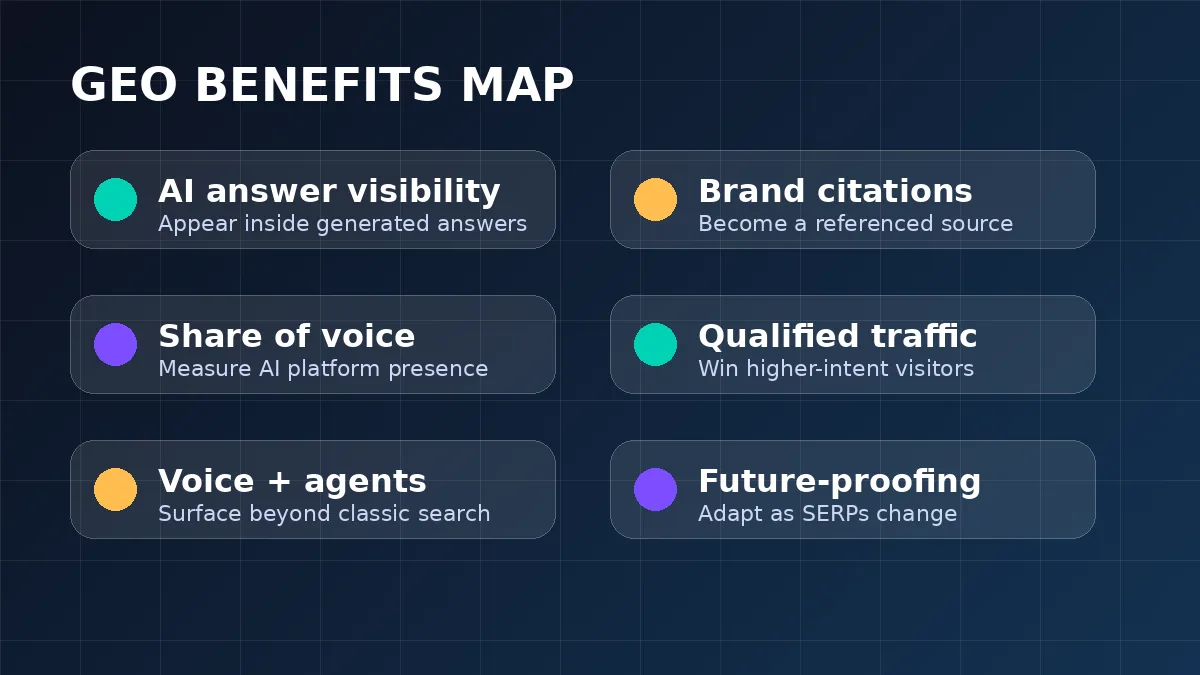
1. Visibility inside AI-generated answers
The most obvious benefit of GEO is appearing inside generated answers. When someone asks an AI system for “best CRM tools for small businesses,” “email automation platforms,” or “how to choose marketing software,” the answer may include a short list of brands and sources.
If your company is not mentioned there, the user may never reach the traditional search results page.
GEO increases the chance that your content becomes part of the answer by making your pages easier to quote, summarize, and trust. Strong pages use direct explanations, comparison sections, current examples, original insights, and clear source context.
2. More brand citations and authority signals
AI search tools tend to favor content that looks reliable. That includes pages with specific facts, definitions, comparisons, expert context, original data, and supporting mentions from other places on the web.
This makes brand citations more valuable. A citation in an AI answer can work like a condensed trust signal: the system is not only surfacing your page, it is presenting your brand as relevant to the user’s question.
Marketers should therefore track more than backlinks. Unlinked mentions, product reviews, community discussions, podcast notes, YouTube descriptions, and credible third-party references can all influence how a brand is represented in AI-generated responses.
3. AI share-of-voice tracking
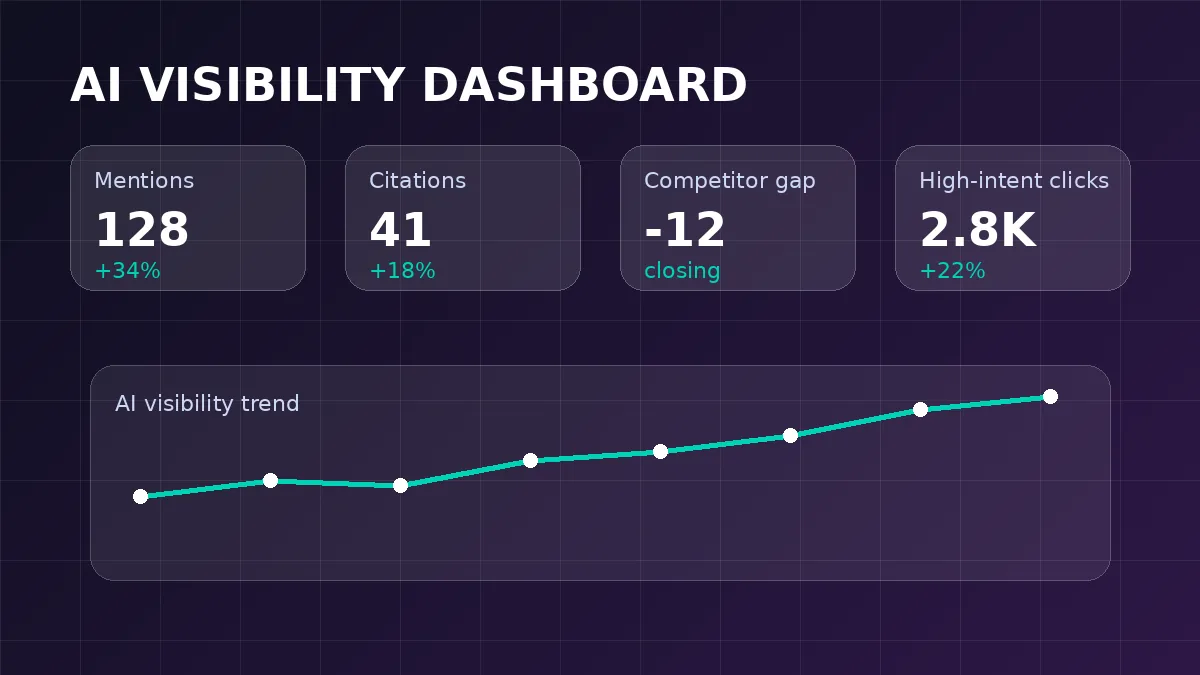
GEO gives teams a new way to measure competitive visibility. Instead of only tracking keyword rankings, marketers can track how often their brand appears in AI answers compared with competitors.
This is AI share of voice.
A practical GEO report might ask:
- Which brands appear most often for our highest-value buying questions?
- Which competitors are cited when we are not?
- Which sources does the AI system rely on?
- Do we appear as a recommended option, a source, or not at all?
- Which topics have the largest visibility gap?
This gives content, SEO, PR, and product marketing teams a shared map of where authority is missing.
4. More qualified traffic from answer-driven discovery
AI-generated answers often reduce low-intent clicks. Users get quick summaries without visiting every source.
That sounds scary, but it can improve traffic quality. When someone clicks after reading an AI summary, they often have a clearer reason to visit. They want details, pricing, examples, templates, implementation help, or proof.
This makes GEO traffic potentially more qualified than broad informational traffic. The visitor arrives with context and intent already shaped by the answer.
To capture that value, the page behind the citation must be strong. It should not repeat a generic definition. It should offer depth: examples, frameworks, comparison tables, checklists, original data, or next-step tools.
5. Better visibility across voice assistants and AI agents
Search is expanding beyond the browser. Voice assistants, smart devices, and AI agents increasingly answer questions or complete research tasks on behalf of users.
A well-structured GEO strategy helps a brand surface in these environments because it focuses on machine-readable clarity. Pages with concise definitions, descriptive headings, schema markup, strong internal linking, and factual consistency are easier for systems to retrieve and summarize.
As agentic commerce grows, this matters even more. If an assistant is helping a user compare software, book a service, or shortlist vendors, the brands that are easiest to verify may have an advantage.
6. Future-proofing as search interfaces change
GEO also protects marketers from relying too heavily on one search interface. Google rankings still matter, but discovery is fragmenting across AI summaries, chat assistants, social search, Reddit, YouTube, niche communities, and vertical tools.
The brands that win across these surfaces usually have the same fundamentals:
- clear positioning
- strong topical authority
- useful content that answers real questions
- credible mentions outside their own website
- fresh pages that stay accurate
- structured content that can be extracted cleanly
Those fundamentals are durable even when the interface changes.
SEO vs GEO: the practical difference
SEO and GEO share a foundation, but they optimize for different outcomes. SEO earns the click on a results page; GEO earns the citation inside an AI-generated answer. If you want the precise split and a comparison table, read GEO vs SEO: what's the same, what changes.
The technical prerequisite for the citation side is that AI crawlers can actually read the site. GPTBot, ClaudeBot, PerplexityBot, and Google-Extended need to be allowed in robots.txt. See how to configure robots.txt for AI crawlers for the exact rules and verification steps.
| Area | Traditional SEO | Generative Engine Optimization |
|---|---|---|
| Main goal | Rank in search results | Appear in AI-generated answers and citations |
| Visibility metric | Keyword position and organic traffic | AI mentions, citations, and share of voice |
| Content need | Useful, crawlable pages | Useful, extractable, evidence-backed pages |
| Authority signal | Backlinks and topical relevance | Backlinks, mentions, reviews, sources, and consensus |
| Best next action | Improve rankings and CTR | Improve answer inclusion and citation quality |
How to start a GEO program
Start small. You do not need a separate department to benefit from GEO.
- List your highest-value buying questions. Focus on the questions prospects ask before choosing a product, service, or vendor.
- Test those questions in AI tools. Record which brands, sources, and claims appear.
- Find missing authority signals. Look for topics where competitors are mentioned and your brand is absent.
- Improve cornerstone pages. Add clearer definitions, comparison sections, examples, FAQs, and evidence.
- Earn credible third-party mentions. Invest in PR, partnerships, reviews, community participation, and useful thought leadership.
- Track visibility monthly. Measure mentions, citations, sentiment, competitor presence, and downstream traffic quality.
Before step one, run the GEO visibility checklist to baseline which of these signals your site already passes.
Common GEO mistakes
The biggest mistake is writing for machines and forgetting humans. AI systems are more likely to use content that is useful, but real users still judge the page after they click.
Avoid these traps:
- publishing shallow pages full of buzzwords
- inventing statistics without source context
- copying competitor definitions with no original value
- hiding key content behind heavy JavaScript
- treating GEO as separate from SEO, PR, and brand strategy
- optimizing only your website while ignoring third-party mentions
Good GEO is not a shortcut. It is a better way to make trustworthy information easy to find and reuse.
Bottom line
Generative engine optimization matters because AI answers are becoming part of the customer journey. The benefit is not just more impressions. It is presence at the moment when a user asks for help, comparison, recommendation, or proof.
For marketers, GEO turns visibility into a broader discipline: search rankings, AI mentions, citations, brand authority, and answer quality all matter together.
The best time to start is before your competitors become the default names inside every AI-generated answer.
Frequently asked questions
What is generative engine optimization?
Generative engine optimization, or GEO, is the practice of making content easier for AI search systems to find, understand, cite, and summarize in generated answers.
Does GEO replace SEO?
No. GEO builds on SEO fundamentals such as crawlability, authority, clarity, and useful content, but it adds a focus on citations, AI visibility, and answer extraction.