AI Marketing Strategy for Small Business (Workflow + 30-Day Plan)

Small businesses do not need a massive marketing department to benefit from AI. They need a simple system: clear positioning, reliable customer data, repeatable prompts, and a review process that protects the brand.
AI marketing works best when it removes repetitive work. It should not replace judgment.
Start with the marketing jobs AI can actually improve
The best early use cases are practical:
- turning customer reviews into messaging themes
- creating first drafts of email campaigns
- generating ad angle variations
- summarizing competitor positioning
- building content briefs from keyword research
- repurposing one strong idea into social, email, and landing page copy
- analyzing campaign results and finding next actions
The goal is not to publish more random content. The goal is to create more useful assets from the same strategy.
Build a simple AI marketing workflow
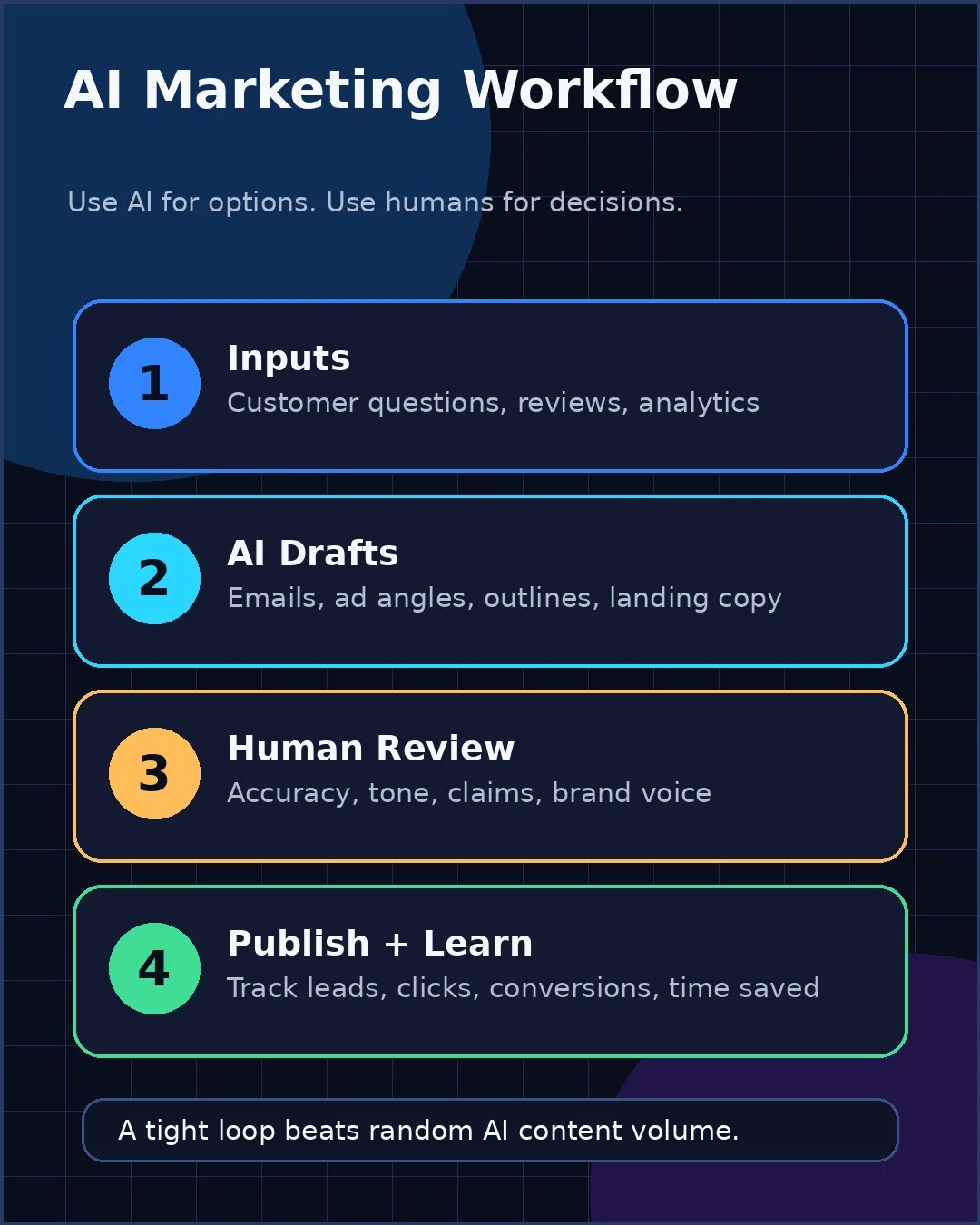
A small business can start with a four-step workflow:
- Define the customer, offer, and brand voice.
- Use AI to generate options, not final answers.
- Review every asset for accuracy, tone, and claims.
- Track what performs and feed those results back into the next prompt.
This keeps AI from becoming a content machine with no direction.
Protect brand voice with rules
Before using AI for marketing, write a short brand guide. Include:
- words the business uses often
- words the business avoids
- the main promise to customers
- examples of good headlines
- examples of bad or off-brand copy
- proof points that can be used in ads
The more specific the rules, the better the output. If you still need a starting line, draft options in the business slogan generator, then turn the winner into a hero and offer with the landing page copywriting framework.
Use AI for research, then verify claims
AI can speed up research, but it should not be treated as a source of truth. Claims about pricing, regulations, medical outcomes, financial results, or legal requirements need verification.
For most small businesses, the safest approach is to use AI for structure and drafts, then confirm facts from primary sources, official documentation, analytics, or direct business records.
Connect campaign work to AI search visibility
AI marketing is not only ads and emails. Buyers also ask ChatGPT, Gemini, Perplexity, and Google AI Overviews for recommendations. The same pages you draft with AI should be crawlable and citation-ready.
- Keep GPTBot and other AI crawlers allowed. See how to configure robots.txt for AI crawlers.
- Write standalone facts in the first paragraphs, not only in later sections. GEO vs SEO explains what changes.
- Run the GEO visibility checklist after you publish a cornerstone page.
Measure the right outcomes
AI marketing should be judged by business metrics, not output volume. Track:
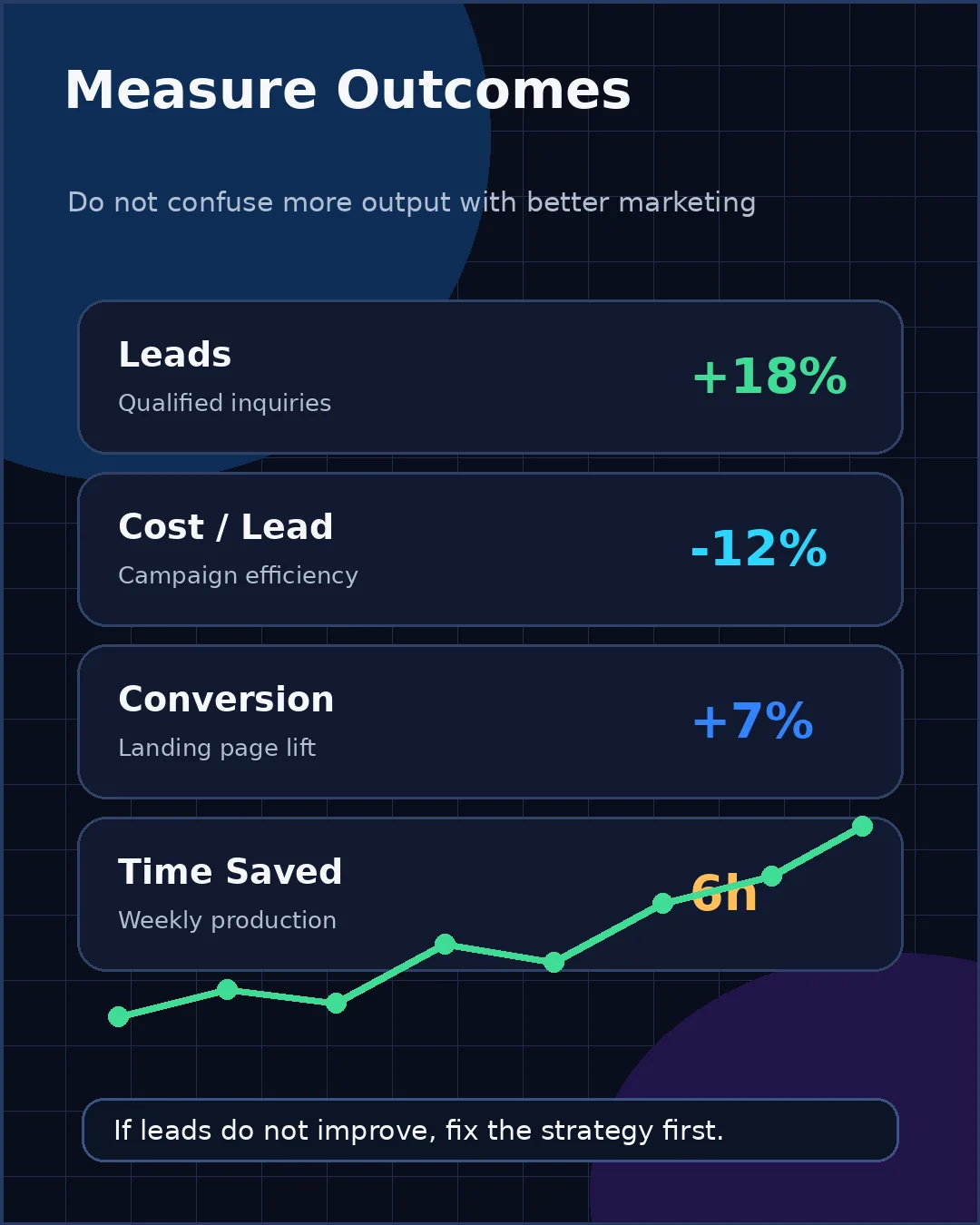
- leads generated
- cost per lead
- conversion rate
- email click rate
- organic traffic quality
- booked calls or purchases
- time saved by the team
If AI helps produce twice as many posts but none of them convert, the system is not working. Put spend and return into the Marketing ROI Calculator, plan the next month in the Digital Marketing Budget Planner, and keep source fields clean with the attribution and CRM workflow.
A practical first 30 days
In the first month, focus on one repeatable workflow:
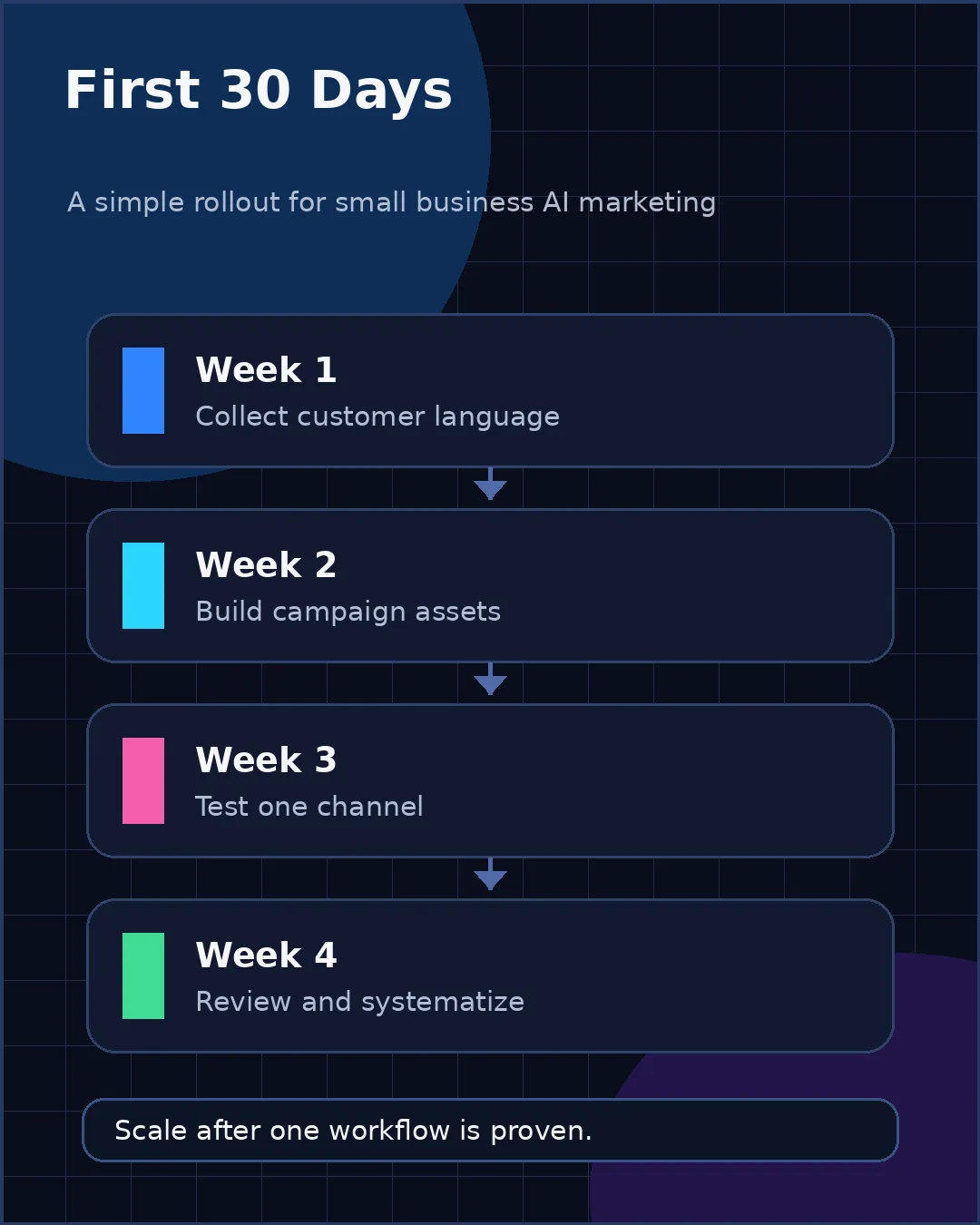
- Week 1: collect customer questions, reviews, and objections.
- Week 2: turn those insights into landing page and ad message options.
- Week 3: test email or ad variations.
- Week 4: review performance and document what worked.
That creates a feedback loop. Once the loop is working, expand into SEO, social content, and sales enablement. For the full path from a tagline to a measured campaign, use the slogan-to-ROI campaign workflow.
AI is most valuable when it makes a good marketing process faster. It is least valuable when it helps a business publish without thinking.
Frequently asked questions
Can small businesses use AI for marketing without a large team?
Yes. The highest-leverage use cases are research, content briefs, ad variations, customer segmentation, landing page drafts, and reporting workflows. One owner plus a review checklist is enough to start.
Should AI write every marketing asset?
No. AI works best as a production assistant. Strategy, positioning, claims, review, and final approval should stay human-led.
What should a small business measure after adding AI to marketing?
Measure leads, cost per lead, conversion rate, booked calls or purchases, and time saved. Do not judge the system by how many posts it produced.
How does AI marketing connect to GEO?
The same brand rules and proof points that keep AI drafts on-voice also make pages easier for answer engines to cite. Pair campaign work with crawl access, citation-ready copy, and the GEO visibility checklist.