Landing Page Copywriting Framework: Hero, Proof, Offer, CTA
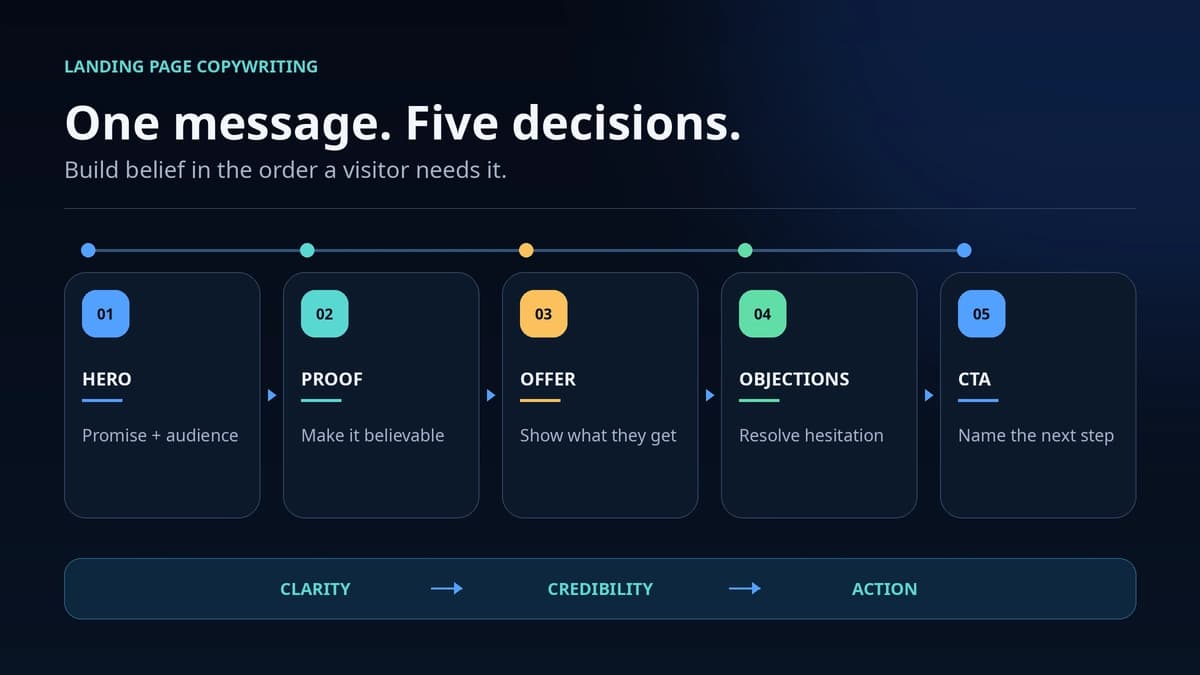
A good slogan gives a campaign a memorable angle. A good landing page turns that angle into a decision.
Use this framework when you already have a name, slogan, tagline, or campaign concept and need to turn it into page copy that can convert visitors into leads, trials, calls, or purchases. If you do not have a line yet, draft options in the business slogan generator or the tagline generator, then come back here.
The five-part landing page message stack
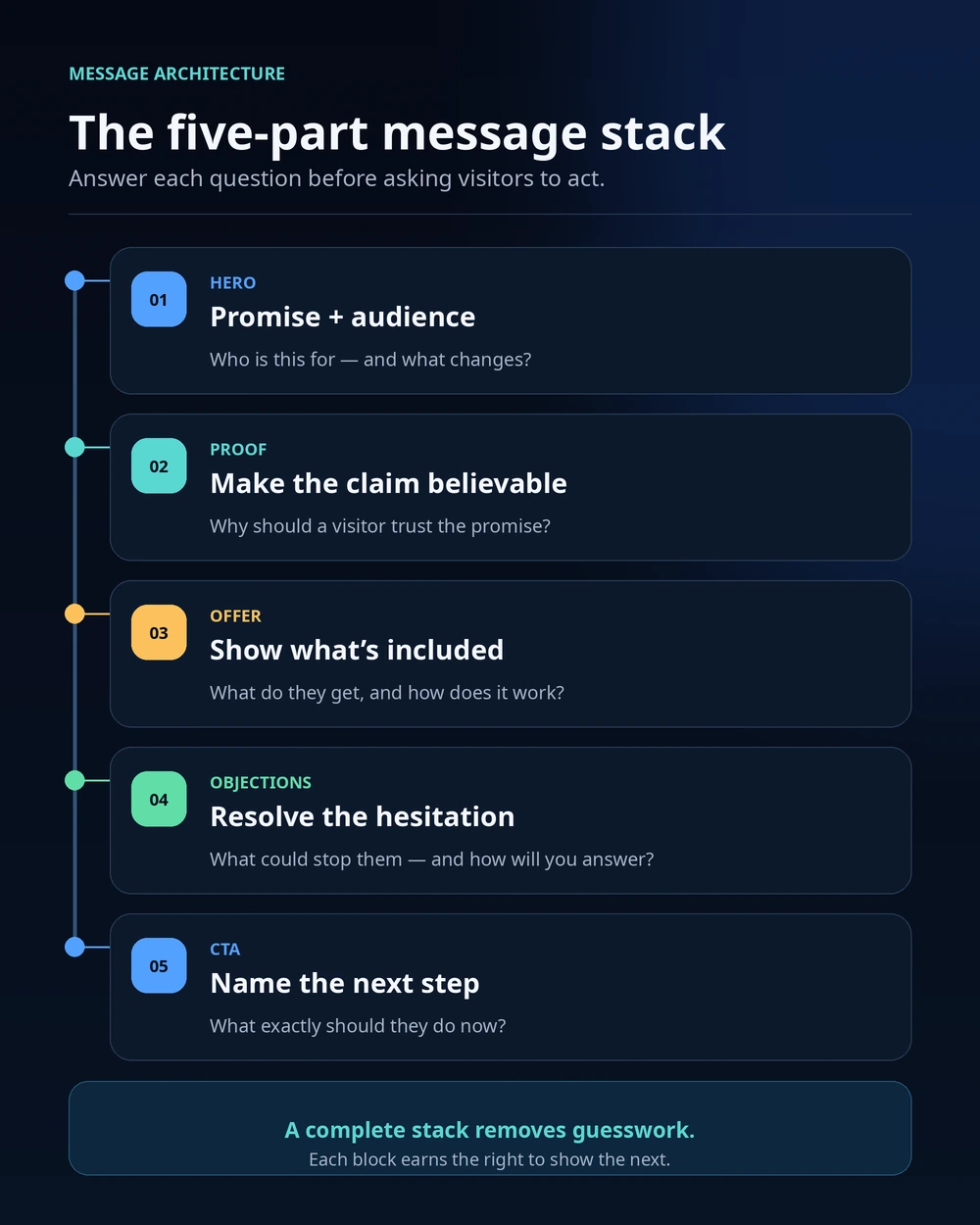
A landing page should answer five questions in order:
- Who is this for?
- What outcome do they get?
- Why should they believe it?
- What risk or objection might stop them?
- What should they do next?
If the page skips one of these questions, visitors have to fill in the gap themselves. Most will not.
1. Hero: promise plus audience
The hero section should be specific enough that the right visitor recognizes the offer quickly.
Use this formula:
Get [specific outcome] for [specific audience] without [common pain or tradeoff].
Examples:
- Book more local roofing jobs without relying on discount leads.
- Launch a clean service website for your clinic without managing freelancers.
- Turn customer reviews into ads, emails, and landing page copy in one workflow.
A slogan can sit above or below this promise, but the hero still needs plain-language clarity.
2. Proof: make the claim believable
After the promise, show why the visitor should trust it. Useful proof includes:
- customer results
- before and after examples
- screenshots or demos
- named methodology
- credentials or years in market
- reviews and testimonials
- transparent process steps
For early-stage offers, proof can be process-based: show the checklist, audit method, or sample deliverable.
3. Offer: explain what is included
Do not make visitors infer the deliverable. List what they get and how it works.
A simple offer block can include:
- what is delivered
- how long it takes
- what the customer needs to provide
- what happens after purchase or sign-up
- who it is best for
- who it is not for
This reduces uncertainty and improves lead quality.
4. Objections: handle the hesitation before the CTA
Most landing pages lose visitors because they ignore obvious doubts. Add a short section that handles questions like:
- Is this too expensive?
- Will this work for my industry?
- How much time will this take?
- What if I already tried something similar?
- Do I need technical knowledge?
- What happens if I am not ready to buy?
Write these answers directly. Avoid defensive copy. Clear answers build trust.
5. CTA: make the next step concrete
A call to action should describe the action, not just the emotion.
Weak CTAs:
- Get started
- Learn more
- Submit
Stronger CTAs:
- Generate slogan ideas
- Get the landing page checklist
- Book a 20-minute strategy call
- Calculate campaign ROI
- Download the budget template
If the commitment is high, add a lower-friction secondary CTA such as viewing examples, using a calculator, or downloading a checklist. The Marketing ROI Calculator and Digital Marketing Budget Planner are useful secondary steps when the primary CTA is a call or proposal.
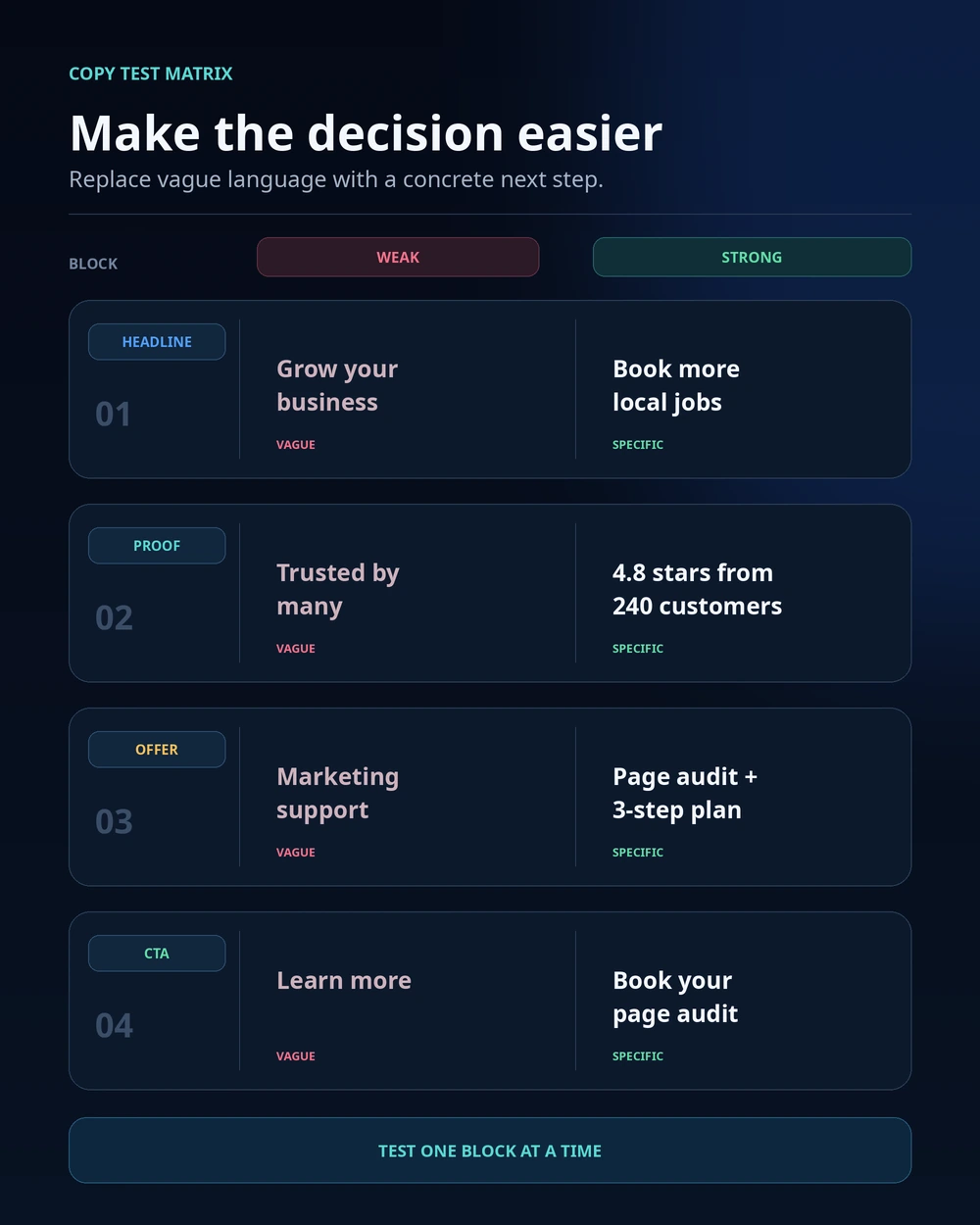
Weak copy versus decision-ready copy
Use the stronger version only when you can substantiate it. Specific copy reduces uncertainty; unsupported precision creates a credibility problem.
| Page block | Weak copy | Decision-ready copy |
|---|---|---|
| Headline | Better marketing for your business | Book qualified roofing estimates without buying shared leads |
| Proof | Trusted experts | Show a verified rating, named process, demo, or relevant result |
| Offer | Everything you need | List the deliverable, timeline, inputs, and who it fits |
| CTA | Submit | Request a 20-minute estimate review |
Quick copy template
Use this outline for a first draft:
Headline
Get [outcome] for [audience] without [pain].
Subheadline
[Product/service] helps [audience] do [specific job] with [method, tool, or proof point].
Proof strip
Trusted by [audience], built from [proof], or based on [framework].
How it works
- Share [input].
- Get [deliverable].
- Use [result] to [business outcome].
Objection block
If you are worried about [objection], here is how the process handles it: [answer].
CTA
[Action verb] [specific next step].
Worked example: local HVAC offer
Slogan draft: "Comfort you can count on."
That line is memorable but too vague as a hero. A stronger stack:
- Hero: Book same-week AC repair for homeowners in Austin without waiting on a national call center.
- Proof: 4.8-star reviews, licensed techs, and a written diagnostic fee credited to the repair.
- Offer: Diagnostic visit, parts quote before work starts, and a 90-day labor warranty.
- Objection: If you already have a maintenance plan elsewhere, we still quote the repair separately.
- CTA: Schedule a diagnostic visit.
Reuse the same outcome language in ads and emails so the click matches the page. The campaign message workflow shows how to keep that stack consistent from slogan to ROI.
Connect the page to the rest of the campaign
Landing page copy should not live alone. Reuse the same message in:
- ad headlines
- email subject lines
- social posts
- sales scripts
- search snippets
- onboarding emails
This keeps the slogan, offer, and conversion path aligned. If you use AI to draft variations, keep the AI marketing review workflow in place so claims stay accurate. If the page also needs to be easy for answer engines to interpret, use the GEO visibility checklist to review entity clarity, crawlability, and answer-ready sections.
When the copy is clear, the page is easier to test. Change one message at a time, measure the result, and keep the version that attracts better leads instead of just more clicks.
Frequently asked questions
What should a landing page say first?
Lead with the customer outcome, the audience, and the reason to trust the offer. Avoid opening with vague adjectives or internal company language.
Can a slogan become a landing page headline?
Sometimes, but most slogans need a supporting subheadline that explains the offer, audience, proof, and next step.
How do I test landing page copy without a big traffic budget?
Change one block at a time — usually the hero or CTA — and compare booked calls, form quality, or revenue, not only click-through rate. Use the Marketing ROI Calculator to keep cost and return in the same view.
Where should the slogan sit on the page?
A slogan can sit above or below the hero promise. The hero still needs a plain-language outcome for a specific audience. If the slogan is vague, keep it as a brand line and let the headline do the selling.