Marketing Attribution for Small Businesses: A Practical CRM Workflow
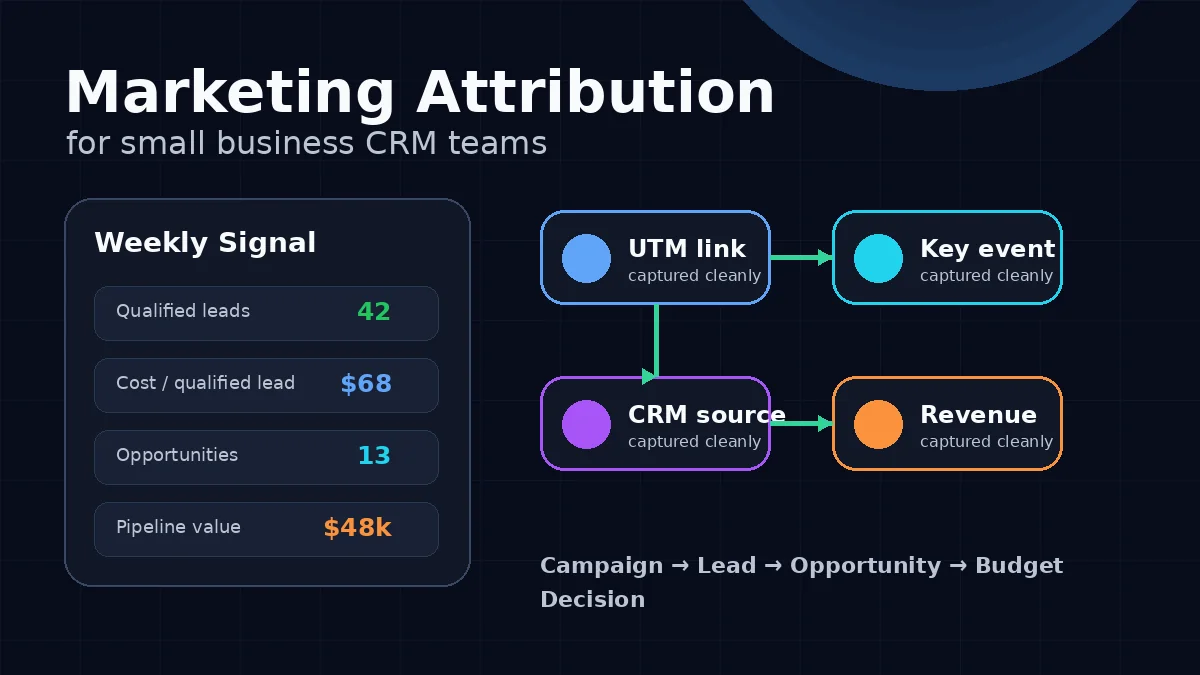
Small businesses do not need an enterprise attribution suite to understand which marketing is working. They need a clean naming system, a short list of meaningful conversion events, and a CRM workflow that connects campaign activity to pipeline outcomes.
Attribution becomes useful when it improves budget and follow-up decisions. If the report only says that paid search, email, referrals, and organic content all touched a lead at some point, it may be interesting but not operational. A better first goal is simpler: which channels are creating qualified leads that sales can actually convert?
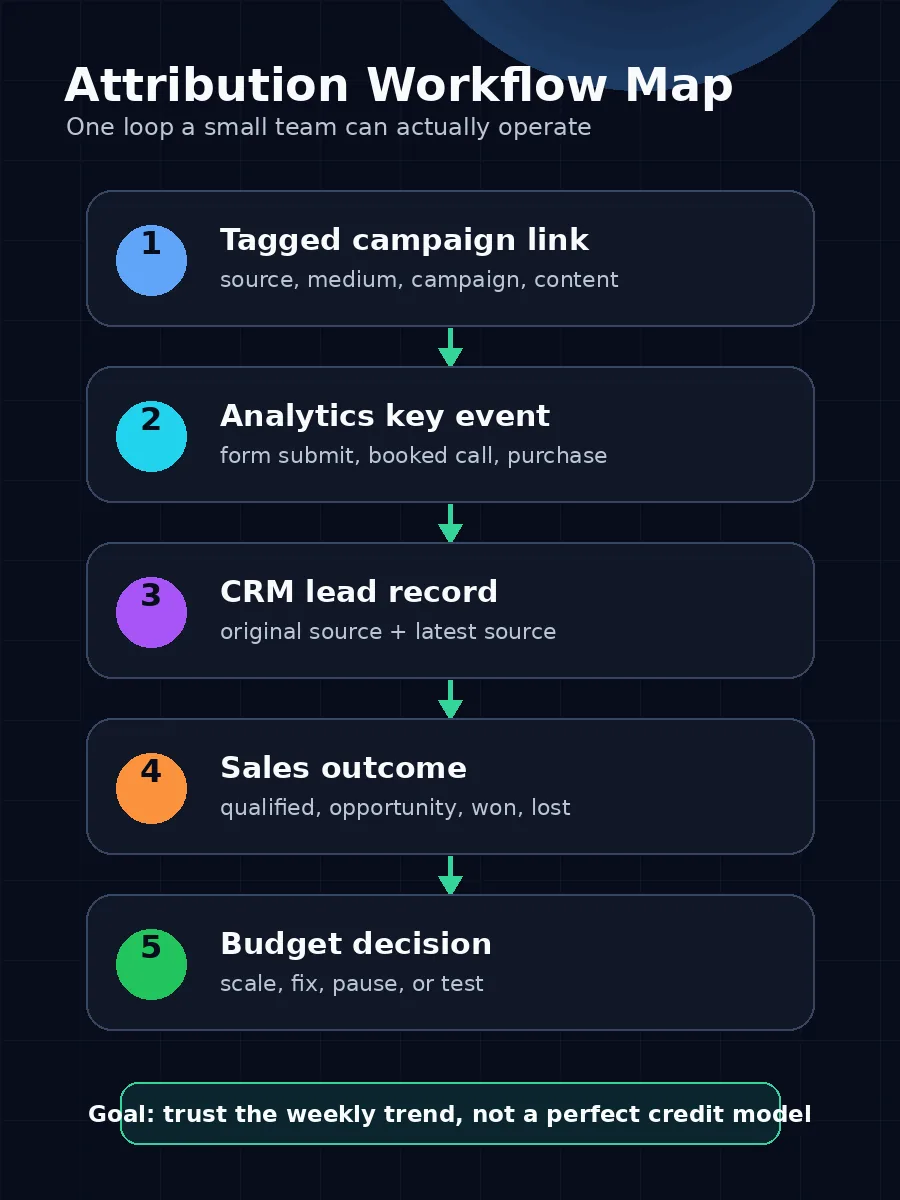
Start with the decision attribution should improve
Attribution can answer many questions, but a small business should start with one or two decisions:
- Which channels deserve more budget next month?
- Which campaigns create leads that become real opportunities?
- Which landing pages produce calls, demos, or quote requests?
- Which email or ad variations attract better-fit prospects?
- Which lead sources should trigger faster follow-up?
Avoid building a reporting system before deciding how the business will act on it. A local service business may only need to decide where the next $2,000 in ad spend goes. A B2B consultant may need to know which webinars and search campaigns create qualified discovery calls. An ecommerce brand may care more about campaign-specific revenue and repeat-purchase behavior.
The best first attribution model is not the most sophisticated one. It is the one the team trusts enough to use every week.
Use a simple measurement stack
A practical small-business attribution stack has four layers: tagged campaign links, analytics events, CRM source fields, and revenue or sales-stage outcomes.
| Layer | What it records | Why it matters |
|---|---|---|
| Campaign links | Source, medium, campaign, content, and other UTM values | Prevents email, paid social, partner links, and ads from blending into vague traffic buckets |
| Analytics events | Important actions such as form submits, booked calls, purchases, or trial starts | Separates meaningful conversions from ordinary page views |
| CRM fields | Original source, latest source, campaign, landing page, lead quality, and owner | Keeps marketing context attached after the lead becomes a sales conversation |
| Pipeline outcomes | Qualified lead, opportunity, won customer, lost reason, revenue, or deal size | Shows whether a channel is creating business value, not just form fills |
Google Analytics documentation explains that campaign parameters can be added to destination URLs so campaign values appear in acquisition reporting, and it recommends using utm_source, utm_medium, and utm_campaign when adding UTM parameters (Google Analytics Help). That is the right starting point: make the source data consistent before arguing about attribution models.
Create UTM rules the team can follow
UTM tracking fails when every person names campaigns differently. A small business needs a short naming convention that is easy to apply.
Use lowercase values, hyphens instead of spaces, and stable channel names. Decide whether paid social is paid-social, paidsocial, or cpc-social once, then keep it consistent. Because UTM parameter values are case sensitive in Google Analytics, Facebook and facebook can create separate reporting rows if the team is not careful.
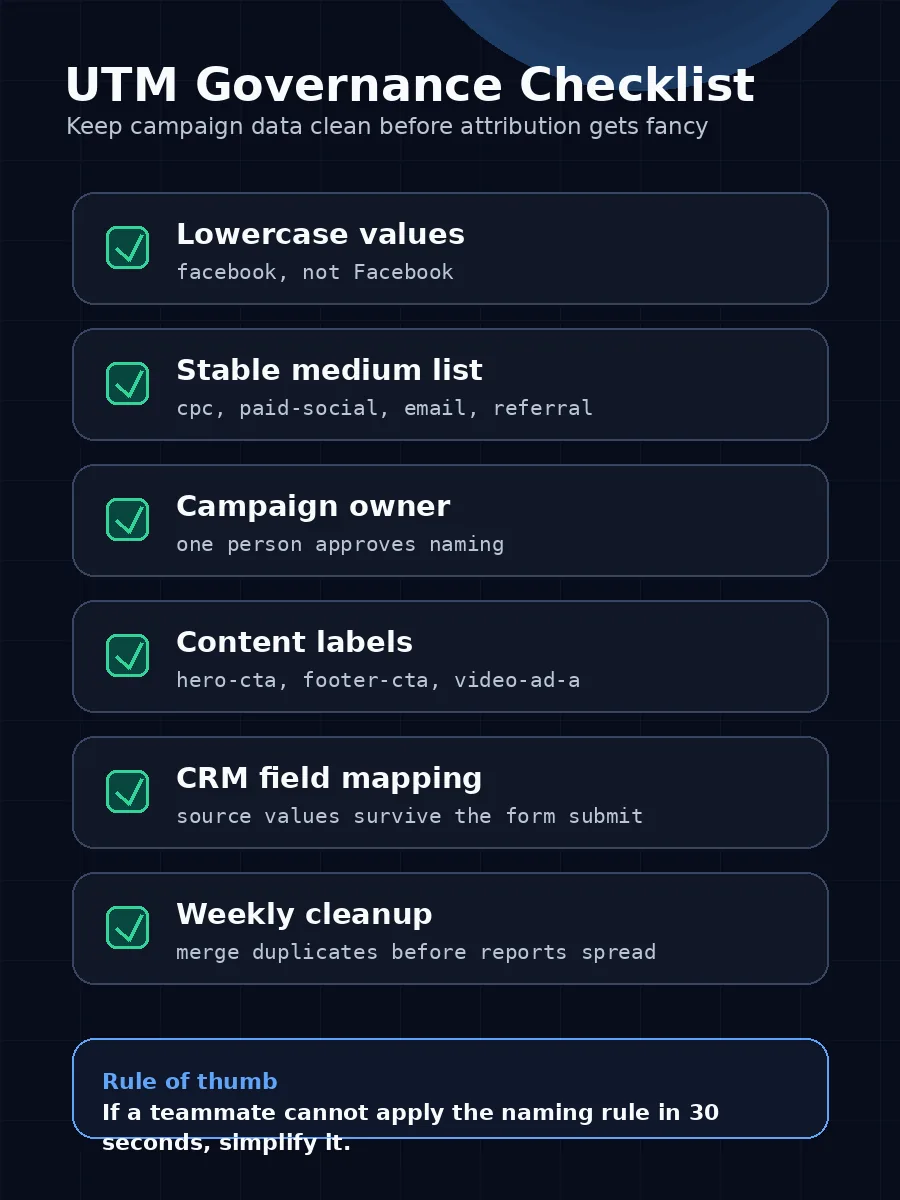
A clean first convention can look like this:
| Parameter | Purpose | Example rule |
|---|---|---|
| utm_source | The platform, publisher, partner, or referrer | Use values such as google, facebook, linkedin, newsletter, or a partner name |
| utm_medium | The channel type | Use values such as cpc, paid-social, email, referral, or affiliate |
| utm_campaign | The campaign or offer | Use a stable campaign name such as spring-consultation-offer |
| utm_content | The creative, placement, CTA, or email link | Use it to compare hero-cta, footer-cta, video-ad-a, or testimonial-ad-b |
| utm_term | Keyword or audience detail when needed | Reserve it for paid search terms, audience names, or another agreed detail |
HubSpot's tracking URL documentation describes tracking URLs as URLs with parameters attached and explains that HubSpot saves those parameter values when visitors arrive from a tracked URL, with performance reviewed in analytics tools including UTM reports (HubSpot Knowledge Base). Whether the business uses HubSpot, another CRM, or a simpler form tool, the principle is the same: campaign data must survive the click.
Mark only business-critical actions as key events
Not every event deserves attribution attention. A scroll, video play, or ordinary page view can help with UX analysis, but it should not receive the same weight as a quote request or booked consultation.
Start with three to six actions that clearly matter:
- quote request submitted
- consultation booked
- product purchased
- trial or demo requested
- inbound call from a landing page
- application or intake form completed
Google defines a key event as an event that measures an action important to business success and explains that any collected event can be marked as a key event in Analytics (Google Analytics Help). For attribution, that distinction matters. A channel that generates many visits but few key events may be good for awareness, but it should not be treated as a proven lead generator.
Store original source and latest source in the CRM
Analytics can show how users arrived at the website. The CRM shows what happened after the lead entered the sales process. Attribution becomes more useful when those two views are connected.
Use at least two source fields:
- Original source: the first known channel or campaign that created the contact.
- Latest source: the most recent campaign or conversion path before the lead became active again.
Original source helps show what introduced the business to the prospect. Latest source helps explain what prompted the current hand raise. Both can be useful, especially for longer sales cycles where a buyer may first read an article, later click a retargeting ad, then finally book a consultation from an email.
A simple CRM attribution record should include:
- original source and medium
- latest source and medium
- original campaign and latest campaign
- first landing page
- conversion page or form
- lead status and qualification result
- opportunity stage or customer status
- revenue or estimated deal value when available
The goal is not to capture every possible touch. The goal is to keep enough context to make better decisions.
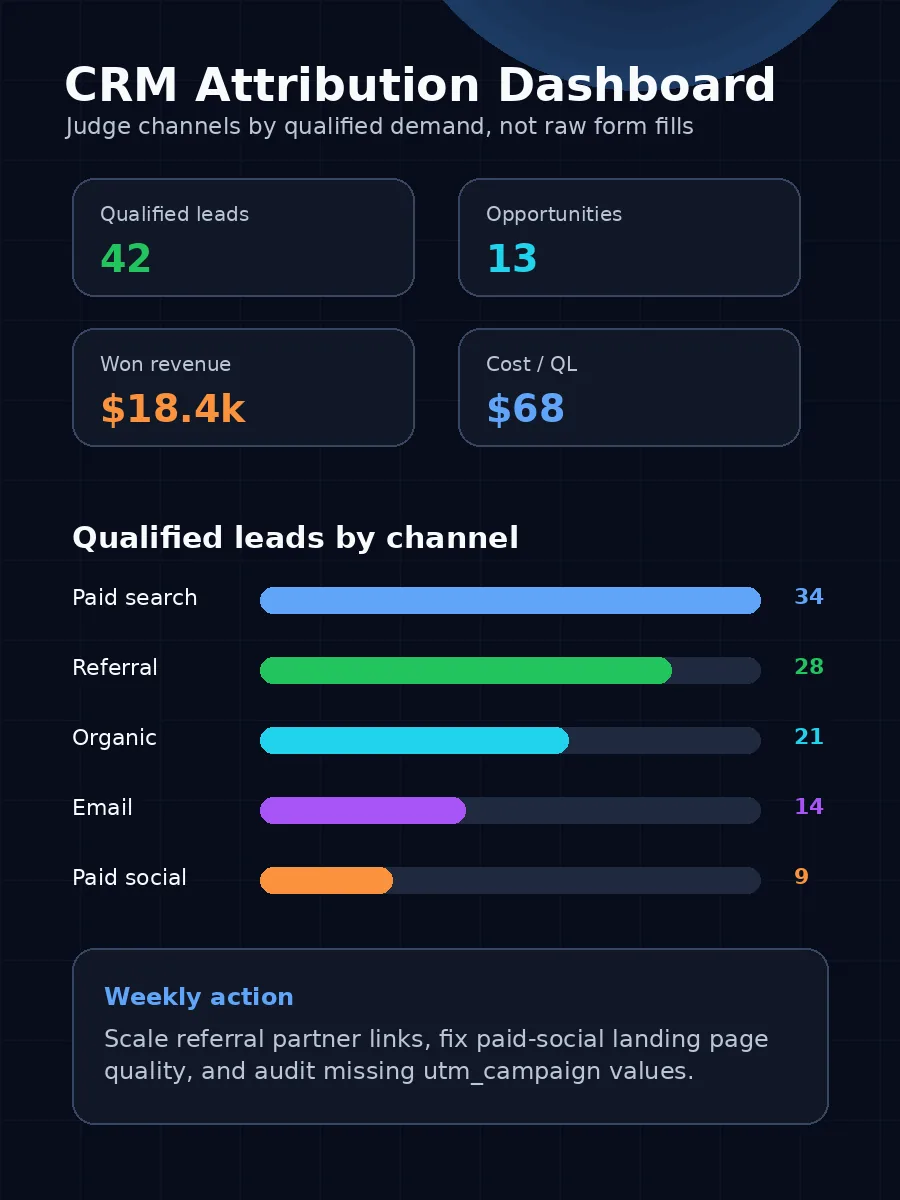
Choose a first-touch and last-touch review before multi-touch
Multi-touch attribution is attractive because real buyers rarely convert after one interaction. But small businesses often do not have enough clean data, volume, or tracking maturity to make a complex model reliable.
Begin with two simple views:
| View | Best question | Risk if used alone |
|---|---|---|
| First touch | Which channels introduce new qualified prospects? | Can undervalue nurture campaigns, retargeting, referrals, and sales follow-up |
| Last touch | Which campaigns trigger the final conversion action? | Can overvalue bottom-funnel channels that harvest demand created elsewhere |
| Sales-qualified view | Which sources create leads that pass qualification? | Requires consistent CRM stage discipline from the team |
| Revenue view | Which sources create customers and revenue? | Can lag behind current campaigns, especially in longer sales cycles |
Review first touch and last touch side by side. If paid search owns the last touch but organic articles and partner referrals own first touch, the budget decision should reflect both. If a newsletter rarely creates first touch but repeatedly revives qualified leads, it deserves credit as a nurture channel.
Salesforce describes Campaign Influence as a way to understand how campaigns affect the opportunity pipeline and attribute a percentage of opportunity success to influential campaigns (Salesforce Help). That kind of model is useful later, but only after the business has reliable campaign, contact, and opportunity data.
Build the weekly attribution review
A report is only useful if someone reviews it and changes behavior. For most small businesses, a weekly 30-minute attribution review is enough.
Use this agenda:
- Review leads by source, medium, and campaign.
- Separate raw leads from qualified leads.
- Check cost per qualified lead for paid campaigns.
- Compare first-touch and last-touch patterns.
- Identify one campaign to scale, fix, pause, or test.
- Log data-quality problems for cleanup.
The last step is important. Attribution problems often come from messy operations, not bad analytics tools. Missing UTM tags, duplicate CRM sources, unqualified forms, and inconsistent sales stages can make the report unreliable.
Watch for common attribution mistakes
The most common mistake is judging channels by lead volume alone. A campaign that produces 100 low-fit inquiries may look stronger than a referral source that creates six serious opportunities. The CRM must show quality, not only quantity.
Other mistakes include:
- changing UTM naming rules every month
- counting every form fill as equal
- ignoring offline calls or booked consultations
- letting sales reps overwrite source fields manually
- comparing campaigns before enough data exists
- using last-touch only and cutting top-of-funnel channels too early
- treating attribution as exact when tracking gaps are inevitable
Attribution should guide decisions, not pretend to be perfect. Use it to find patterns, ask better questions, and spend with more discipline.
A practical 30-day rollout
For the first month, keep the project focused.
Week 1: Define the naming rules. Create a UTM template, source list, medium list, and campaign naming format. Audit current campaigns for inconsistent names.
Week 2: Fix conversion events. Choose the key events that matter, verify forms and calls are tracked, and make sure confirmation pages or form events are reliable.
Week 3: Clean CRM fields. Add original source, latest source, campaign, landing page, and conversion action fields. Map forms into the CRM so those values are not lost.
Week 4: Run the first review. Compare raw leads, qualified leads, opportunities, and revenue by source. Pick one action: scale a campaign, repair a landing page, pause weak spend, or improve follow-up speed.
Do not wait for perfect reporting. A clean enough attribution workflow can improve budget decisions quickly, especially when the business currently relies on gut feeling, platform dashboards, or disconnected spreadsheets.
Marketing attribution is not about giving a trophy to one channel. It is about building a reliable feedback loop from campaign to customer, then using that loop to invest in the work that creates real demand. When organic or AI-answer discovery is part of that mix, run the GEO visibility checklist on the landing pages you attribute before scaling spend.
Frequently asked questions
What is marketing attribution for a small business?
Marketing attribution is the practice of connecting leads, opportunities, and customers back to the campaigns or channels that influenced them, so the business can invest more confidently in the sources that produce qualified demand.
Does a small business need multi-touch attribution software?
Usually not at first. A small business should begin with consistent UTM tracking, clean CRM lead-source fields, key events in analytics, and a simple first-touch plus last-touch review before considering specialized attribution tools.
What should small businesses track before attribution?
Track source, medium, campaign, landing page, form or call action, lead quality, sales stage, revenue outcome, and date created. Without those basics, attribution reports can look precise while still being misleading.