Directors and Officers (D&O) Insurance: Complete Guide for 2026
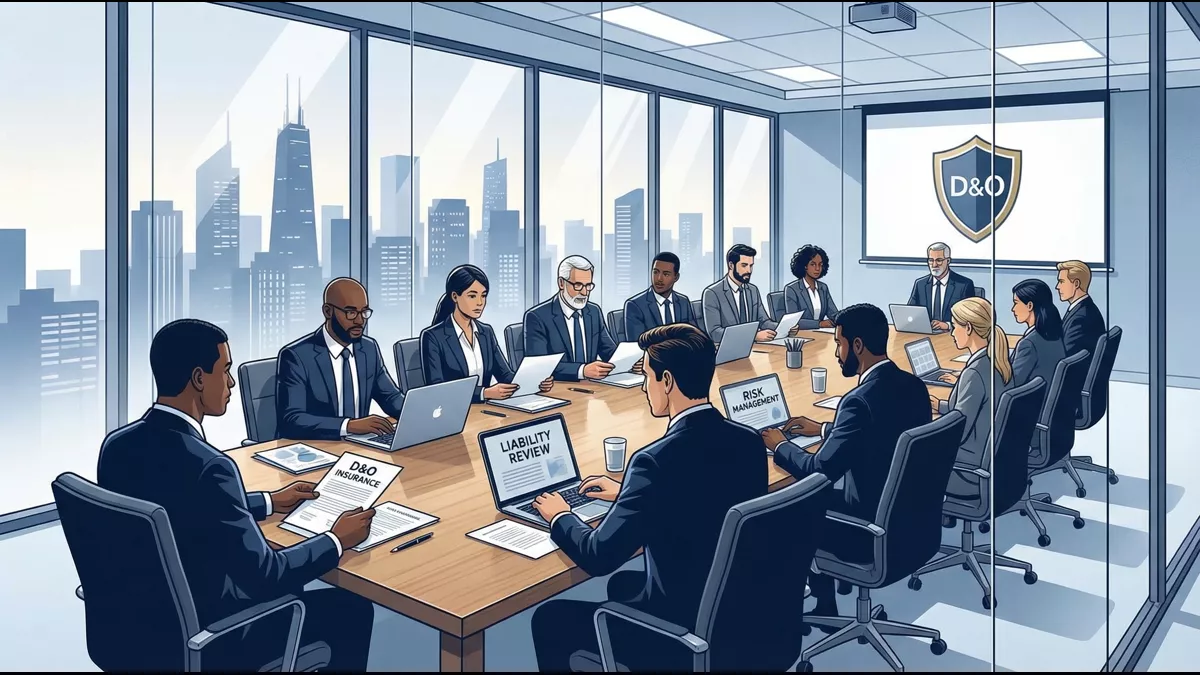
A startup CEO is personally sued by investors who claim she misrepresented the company's growth metrics during a fundraising round. A nonprofit board member faces a $2 million lawsuit from a major donor alleging misuse of funds. A public company's CFO is hit with an SEC enforcement action for accounting irregularities.
In each case, the person targeted isn't just a company — it's an individual. Their personal savings, their home, their financial future are all on the line.
This is exactly why Directors and Officers (D&O) insurance exists. It's one of the highest-stakes and most misunderstood business insurance products — and one of the most important you can buy.
What Is Directors and Officers Insurance?
Directors and Officers insurance protects the personal assets of corporate executives, board members, and officers when they are personally sued for decisions made in their professional capacity. It also protects the company itself from the costs of indemnifying those leaders.
Unlike general liability (which covers physical harm to third parties) or professional liability (which covers service errors), D&O insurance targets a specific exposure: the personal liability of decision-makers.
When a shareholder sues your board for a failed acquisition. When a fired employee claims the CEO discriminated against them. When a regulator investigates your CFO's financial disclosures. D&O insurance is the policy that responds.
The Three Sides of D&O Insurance
D&O policies are structured around three coverage components, universally referred to as "sides":
Side A: Individual Coverage (Non-Indemnified Losses)
Side A is the most critical component. It covers directors and officers directly when the company cannot or will not indemnify them.
This happens when:
- The company is bankrupt and cannot cover legal costs
- The company is legally prohibited from indemnifying an individual (e.g., derivative suits or certain criminal investigations)
- The company refuses to indemnify for strategic or reputational reasons
Side A protects personal assets — bank accounts, investment portfolios, real estate — from being seized to pay legal judgments. For this reason, many experienced executives require Side A coverage as a condition of joining a board.
Side B: Corporate Reimbursement Coverage
Side B reimburses the company after it has advanced legal fees or paid a settlement on behalf of a director or officer. When the corporation steps up to defend its leadership, Side B gets the company's money back.
Most D&O claims flow through Side B: the company pays for the defense, indemnifies the individual, and the insurer reimburses the corporation.
Side C: Entity Coverage (Securities Claims)
Side C — also called "entity coverage" — protects the company itself from securities litigation. This applies when the company (not just an individual) is named as a co-defendant in a securities claim.
Side C is standard in public company D&O policies. For private companies and nonprofits, entity coverage is more limited and often restricted to employment practices claims.
Who Needs D&O Insurance?
Publicly Traded Companies
Public companies have the greatest D&O exposure. With thousands of shareholders, mandatory SEC disclosures, and active plaintiffs' attorneys looking for securities fraud claims, public companies face D&O litigation regularly.
The average cost of a securities class action settlement for a public company exceeded $30 million in recent years. Even companies that win in court often spend $10–20 million on defense.
Venture-Backed Startups
Venture capital firms almost universally require D&O insurance as a condition of investment. Their partners often sit on the portfolio company's board — and they are not willing to expose their personal wealth to startup-related lawsuits.
For startups, D&O insurance is often triggered during:
- Founder disputes over equity and decision-making
- Failed acquisitions or mergers
- Investor claims of misrepresentation during fundraising
- Employee lawsuits targeting executives personally
Private Companies
Private company executives face the same exposures as their public counterparts — just with fewer shareholders. Common D&O claims for private companies include:
- Minority shareholder disputes — Minority owners suing the board for decisions that unfairly benefit majority shareholders
- Employment disputes targeting executives — Employees naming the CEO or COO personally in discrimination or wrongful termination suits
- Creditor claims — Lenders suing directors for misrepresenting the company's financial health
- Regulatory actions — Government agencies investigating officers for compliance failures
Nonprofit Organizations
Nonprofit directors are personally exposed to lawsuits from donors, employees, members, and regulators. Because nonprofit boards are often volunteer-based, board members may not realize they have personal liability exposure. Common claims include:
- Misuse of donated funds
- Employment discrimination by staff
- Breach of fiduciary duty in investment decisions
- Regulatory violations
Many nonprofits purchase a combined package called Directors, Officers, and Organization Liability (DOOL) that covers the entity, its directors, and its officers under one policy.
Family-Owned and Closely Held Businesses
When family members share ownership but disagree about business direction, D&O claims can get personal fast. A minority shareholder (perhaps a sibling or cousin) may sue majority shareholders on the board for self-dealing, excessive compensation, or mismanagement.
What D&O Insurance Covers
Breach of Fiduciary Duty
Directors and officers owe legal duties to the company and its shareholders — primarily the duty of care (making informed decisions) and the duty of loyalty (putting the company's interests first). When they're accused of violating these duties, D&O insurance pays for the defense and any resulting liability.
Errors in Judgment
Executives make tough calls with incomplete information. A strategic decision to enter a new market, acquire a competitor, or restructure operations might work out badly — and shareholders might sue. D&O insurance covers these business judgment errors.
Misrepresentation and Misleading Statements
If a director or officer is accused of making misleading statements in financial reports, investor presentations, regulatory filings, or public statements, D&O insurance covers the resulting claims.
Failure to Comply with Regulations
SEC violations, OSHA penalties, environmental regulations, labor law compliance — executives who oversee these functions can be named personally in regulatory actions. D&O insurance provides defense coverage.
Employment Practices Claims (in some policies)
Some D&O policies include or can be endorsed to cover Employment Practices Liability (EPLI) — claims of discrimination, harassment, wrongful termination, or retaliation that target executives by name. Others keep D&O and EPLI separate.
Mergers and Acquisitions Disputes
Corporate transactions are a major source of D&O claims. Shareholders frequently sue boards over M&A decisions, alleging the deal was priced too low (seller) or too high (buyer). These "merger objection" lawsuits are so common they're essentially expected in major transactions.
What D&O Insurance Does NOT Cover
- Intentional fraud and criminal acts — No policy covers knowingly illegal behavior. If a director is convicted of intentional fraud, the insurer will seek to recover any amounts paid.
- Bodily injury and property damage — Covered by general liability, not D&O.
- Pollution and environmental damage — Requires specialized environmental liability.
- Personal profit obtained illegally — If a director profits from insider trading, D&O won't cover the consequences.
- Prior known claims — Claims or circumstances the company knew about before the policy started are excluded.
- Major shareholder exclusions — Some policies reduce coverage for claims brought by shareholders who own more than a certain threshold (often 15–25%).
- Insured vs. Insured exclusions — Claims by the company against its own directors are often excluded, though exceptions exist for bankruptcy trustees and derivative suits.
How Much Does D&O Insurance Cost?
D&O insurance premiums vary widely based on company type, size, industry, and risk profile.
Typical Premium Ranges
| Company Type | Coverage Limit | Annual Premium |
|---|---|---|
| Early-stage startup (pre-revenue) | $1M | $3,000–$6,000 |
| Startup (Series A–B, $5M–$25M ARR) | $3M–$5M | $8,000–$20,000 |
| Private mid-market company ($25M–$100M revenue) | $5M–$10M | $15,000–$50,000 |
| Private mid-market ($100M–$500M revenue) | $10M–$25M | $40,000–$150,000 |
| Public company (small cap) | $25M–$50M | $150,000–$500,000 |
| Nonprofit (small, $1M–$10M budget) | $1M | $2,500–$7,000 |
| Nonprofit (large, $10M+ budget) | $3M–$5M | $5,000–$20,000 |
Key Premium Drivers
Industry and risk profile — Financial services, biotech, and technology companies pay more than manufacturing or retail. Industries with heavy regulation or high litigation frequency carry higher base rates.
Company financials — Revenue, assets, and profitability all factor in. Companies with thin margins, high debt loads, or recent losses are higher risk.
Claims history — A prior D&O claim, even one that was resolved in the company's favor, will increase premiums significantly.
Governance quality — Companies with independent boards, strong internal controls, clean audit opinions, and documented risk management practices get better rates.
Coverage structure — Higher limits, lower retentions (deductibles), and broader policy forms all increase premium.
IPO plans — Companies planning a public offering within 12–24 months will face much higher premiums — and more scrutiny — as the prospect of public company litigation approaches.
Best D&O Insurance Providers for 2026
1. Chubb
Best for: Large private and public companies
Chubb is the market leader in D&O insurance by premium volume. Their policy forms are consistently among the broadest in the market, with favorable Side A coverage. Chubb's claims team has deep experience with complex D&O litigation. Premium: higher than average, but the breadth of coverage often justifies the cost.
2. AIG (American International Group)
Best for: Public companies and complex structures
AIG has been a D&O market leader for decades. Their "Cornerstone" D&O product is widely recognized in the industry. Strong for companies with international operations or complex ownership structures.
3. Woodruff Sawyer / Embroker (via carrier access)
Best for: Startups and growth-stage companies
Platforms like Embroker have streamlined D&O purchasing for venture-backed startups. Coverage can be quoted and bound in hours rather than weeks. Typical startup policies come from carriers like Berkley, Markel, or Tokio Marine.
4. Travelers
Best for: Mid-market private companies
Travelers offers competitive D&O pricing for private companies with revenues between $10M and $500M. Strong customer service and claims experience.
5. Great American Insurance
Best for: Nonprofits and social sector organizations
Great American has specialized nonprofit D&O programs that bundle directors, officers, employment practices, and fiduciary liability into a single policy at competitive rates.
| Provider | Best For | Strengths | AM Best |
|---|---|---|---|
| Chubb | Large companies | Broadest coverage forms | A++ |
| AIG | Public companies | International reach | A |
| Embroker | Startups | Speed, online quoting | Varies by carrier |
| Travelers | Mid-market private | Pricing, service | A++ |
| Great American | Nonprofits | Bundled programs | A+ |
How to Buy D&O Insurance
Step 1: Determine Your Coverage Needs
Start with your largest potential exposure. What's the value of the assets your directors are making decisions about? What's the size of your investor base? Have there been any prior disputes or near-misses?
Most startups and small businesses start with $1M–$3M in coverage. Growing companies often step up to $5M–$10M as they take on outside investors or employees.
Step 2: Prepare Your Application
D&O applications are more detailed than most insurance applications. Expect to provide:
- Audited financial statements (2–3 years)
- Current capitalization table
- List of current and recent directors and officers
- Details on any prior claims or circumstances
- Description of pending litigation
- Business plan and strategic direction
Step 3: Engage a Specialist Broker
D&O insurance is a specialty product. Work with a broker who specializes in management liability insurance, not a generalist who also sells auto policies. Specialist brokers access better markets, negotiate policy forms, and provide valuable claims advocacy.
Step 4: Negotiate Policy Terms, Not Just Price
The biggest mistake buyers make is optimizing for premium rather than policy quality. Two D&O policies at the same price can have very different coverages based on:
- The breadth of the definition of "wrongful act"
- Exclusion language and carve-backs
- Side A coverage structure
- Advancement of defense costs (before or after final adjudication)
- Consent to settle provisions (does the insurer need your consent?)
Step 5: Review Annually
Your D&O exposure changes as your company evolves. Annual renewal reviews should consider changes in revenue, headcount, governance structure, M&A activity, and any new regulatory requirements.
D&O Insurance for Startups: Special Considerations
Venture-backed startups have a unique D&O risk profile. VC firms sitting on your board have deep pockets and experienced lawyers. If they believe management made a serious error, they have both the motivation and resources to sue.
Key startup-specific issues:
Founder vs. investor disputes — The most common D&O claim in early-stage companies comes when a founder and investor disagree about company direction, a sale, or a down round. Ensure your policy doesn't have an "insured vs. insured" exclusion that would bar coverage for these disputes.
Down rounds and liquidation events — When a company is sold for less than investors put in, or when a down round significantly dilutes earlier investors, D&O claims often follow.
SAFE and convertible note controversies — Cap table complexity creates fertile ground for claims that officers misrepresented conversion terms or dilution impact.
Side A standalone policies — Some sophisticated investors require founders to carry a separate Side A policy that cannot be eroded by corporate entity claims. This "difference in conditions" policy adds an extra layer of personal protection.
The Cost of Going Without D&O Insurance
The personal financial exposure without D&O insurance is substantial:
- Average D&O defense costs: $250,000–$1 million per claim, even for cases that are ultimately dismissed
- Average D&O settlement (private company): $4 million–$10 million
- Average D&O settlement (public company): $30 million+
- Personal bankruptcy filings by uninsured executives: common in failed startup disputes
For a startup where the founders' primary assets are their company equity, a personal judgment in a D&O suit could be financially catastrophic — even if the business survives.
Frequently Asked Questions
What does D&O insurance cover?
D&O insurance covers legal defense costs, settlements, and judgments arising from claims that a director or officer made a wrongful act — including mismanagement, breach of fiduciary duty, errors in judgment, misleading statements, failure to comply with regulations, or employment practices violations.
Do small businesses need D&O insurance?
Yes. Any company with a board of directors, outside investors, or employees can face D&O claims. Startups backed by venture capital almost always require D&O coverage as a condition of investment. Even small LLCs with advisory boards benefit from D&O protection.
How much does D&O insurance cost?
Small businesses and startups typically pay $3,000–$10,000 per year for $1M in D&O coverage. Mid-market companies pay $10,000–$50,000 annually. Premiums are driven by company revenue, industry, claims history, and coverage limits.
What is Side A, Side B, and Side C D&O coverage?
Side A covers individual directors and officers when the company cannot indemnify them. Side B reimburses the company when it indemnifies its directors and officers. Side C (entity coverage) protects the company itself from securities claims.
Is D&O insurance required by law?
D&O insurance is not legally mandated, but it is often required by investors, lenders, and board members as a condition of doing business. Delaware corporate law and similar statutes allow companies to indemnify directors, but D&O insurance backs up that promise.
What is not covered by D&O insurance?
D&O policies typically exclude intentional fraud, criminal acts, personal profit gained illegally, bodily injury and property damage (covered by general liability), and claims that were known before the policy was purchased.
How is D&O insurance different from general liability?
General liability covers bodily injury, property damage, and advertising injury caused to third parties. D&O insurance covers financial losses resulting from management decisions — it protects people, not property. A company needs both.
Can I be personally sued as a board member?
Yes. Even as an outside or volunteer board member, you can face personal liability for decisions made in your board role. Directors have been personally sued for millions in cases involving business failure, M&A transactions, regulatory violations, and employment disputes. D&O insurance is your primary personal protection.