27 HVAC Marketing Ideas to Book More Calls in 2026
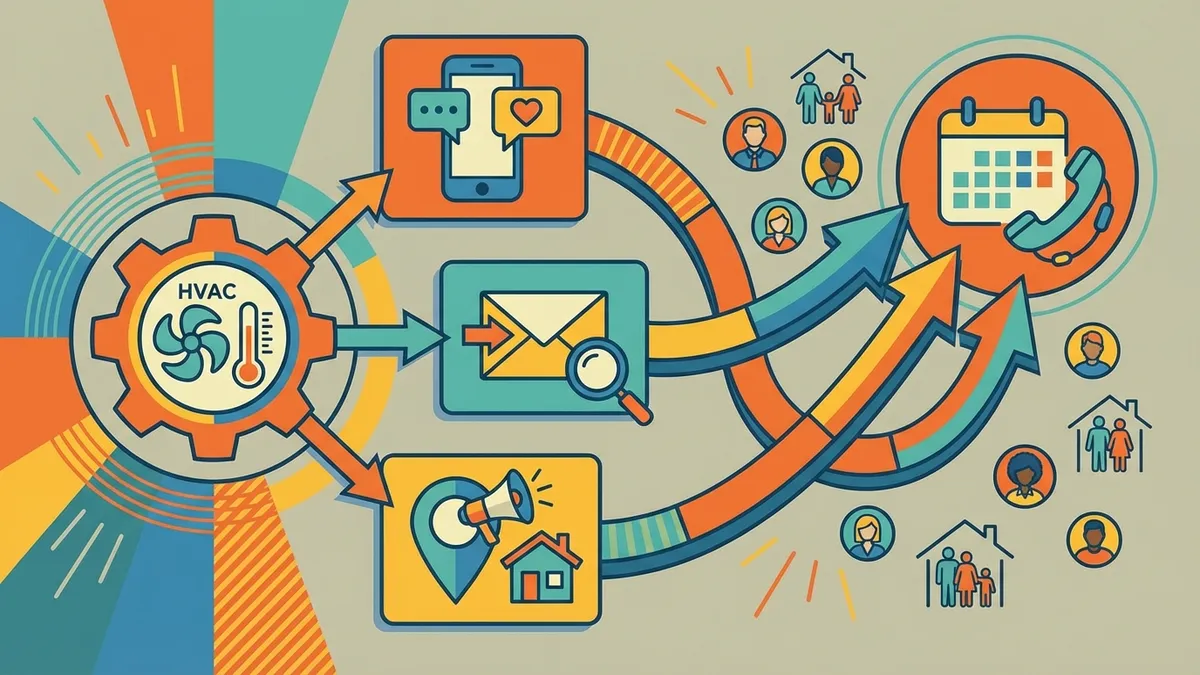
Running an HVAC company means you're competing with every other contractor in your service area for the same emergency calls and seasonal maintenance jobs. The companies that win aren't necessarily the biggest — they're the ones that show up first when a homeowner's AC dies at 2 AM in July.
This guide covers 27 HVAC marketing ideas organized by channel, with real numbers on what to expect and step-by-step implementation details.
Table of Contents
- Local SEO & Google Business
- Paid Advertising
- Website Optimization
- Social Media Marketing
- Email & Direct Marketing
- Referral & Partnership Programs
- Seasonal & Event-Based Campaigns
- Reputation & Review Management
- FAQ
Local SEO & Google Business
Local search is the single most important marketing channel for HVAC companies. When someone searches "AC repair near me," Google's Local Pack (the map results) captures over 44% of clicks. If you're not in those top 3 spots, you're invisible.
1. Optimize Your Google Business Profile
Your Google Business Profile (GBP) is your most valuable free marketing asset. Complete every section:
- Business category: Set "HVAC contractor" as primary. Add "Air conditioning repair service," "Furnace repair service," and "Heating contractor" as secondary categories.
- Service area: Define your exact service radius. Most HVAC companies cover 25–50 miles.
- Business hours: Include emergency/after-hours availability. Google highlights "Open 24 hours" in search results.
- Photos: Upload 15–20 photos minimum — trucks, team, completed installations, before/after shots. Businesses with 100+ photos get 520% more calls than average.
- Services & products: List every service with descriptions and price ranges where possible.
Post weekly updates using Google Business posts. Share seasonal tips, promotions, or completed jobs. Posts expire after 7 days, so consistency matters.
2. Build Local Citations
Submit your business to the top 40 directories that matter for HVAC:
- Yelp, Angi (formerly Angie's List), HomeAdvisor, Thumbtack
- BBB, Chamber of Commerce
- Industry-specific: ACCA member directory, NATE certified contractor list
- Data aggregators: Data Axle, Neustar Localeze, Foursquare
Critical rule: Your Name, Address, and Phone number (NAP) must be identical everywhere. "123 Main St" and "123 Main Street" count as inconsistencies that hurt your ranking.
3. Create Location-Specific Landing Pages
If you serve multiple cities, create a dedicated page for each one. Don't just swap the city name — include:
- Local landmarks and neighborhoods you serve
- Response time from your shop to that area
- Reviews from customers in that specific city
- Local permits or licensing info relevant to that municipality
A company serving 8 cities should have 8 unique pages, each with 500+ words of genuinely localized content.
4. Target "Near Me" and Emergency Keywords
Build content around high-intent search terms:
- "Emergency AC repair [city]" — CPC: $15–45, conversion rate: 8–12%
- "Furnace not working [city]" — CPC: $12–35
- "HVAC installation [city]" — CPC: $20–50
- "AC tune-up [city]" — CPC: $8–20
These pages should include your phone number above the fold, a click-to-call button, and your average response time.
Paid Advertising
5. Google Local Services Ads (LSAs)
LSAs appear above standard Google Ads with a "Google Guaranteed" badge. For HVAC, they're the highest-ROI ad format available.
- Cost: $25–75 per lead (you pay per lead, not per click)
- Setup: Pass Google's background check, provide proof of insurance and licensing
- Pro tip: Respond to leads within 5 minutes. Google tracks response time and rewards fast responders with more visibility.
Average HVAC companies using LSAs report 15–30 qualified leads per month in mid-size markets.
6. Google Search Ads for High-Intent Keywords
Run search campaigns targeting emergency and installation keywords. Structure your campaigns by service type:
- Emergency repair campaign: "AC not cooling," "furnace won't turn on," "no heat"
- Installation campaign: "new AC unit cost," "furnace replacement," "HVAC installation"
- Maintenance campaign: "AC tune-up," "furnace inspection," "HVAC maintenance plan"
Budget recommendation: Start with $1,500–3,000/month. Expect $30–80 per lead for emergency keywords and $50–120 per lead for installation keywords. With an average ticket of $350 for repairs and $5,000–12,000 for installations, the math works.
7. Facebook and Instagram Ads for Seasonal Offers
Social ads work best for HVAC when tied to seasonal urgency or maintenance offers, not emergency services (people don't scroll Facebook when their AC breaks).
Effective ad formats:
- Spring: "AC tune-up special — $79 (regular $129). Book before May 1st."
- Fall: "Furnace safety inspection — $59. Don't wait for the first freeze."
- Video ads: 15-second clips of your team on a job. These outperform stock imagery by 3–4x.
Target homeowners within your service area, ages 30–65, with interests in home improvement. Budget: $500–1,000/month.
8. Retargeting Campaigns
Only 2–4% of website visitors call on their first visit. Retargeting ads follow the other 96% around the web, keeping your brand top of mind.
Set up Google Display and Facebook retargeting pixels. Show ads with:
- The specific service they viewed ("Still need AC repair?")
- A time-sensitive offer ("10% off if you book this week")
- Social proof ("Rated 4.9 stars by 500+ homeowners")
Cost: $300–500/month for retargeting typically delivers 3–5x ROI.
Website Optimization
9. Make Your Phone Number Unmissable
Your phone number should appear in:
- The header (sticky on mobile)
- Every service page (above the fold)
- A floating click-to-call button on mobile
HVAC websites with prominent phone placement see 40–60% higher call rates. Test: open your site on your phone. Can you call within 2 seconds? If not, fix it.
10. Add Online Booking
38% of consumers prefer booking services online rather than calling. Integrate a scheduling tool like Housecall Pro, ServiceTitan, or Jobber directly on your site. Let customers:
- Select their service type
- Choose a date and time window
- Describe their issue
- Get an instant confirmation
This captures leads at midnight when your phones are off.
11. Publish Helpful Blog Content
Content marketing for HVAC targets informational searches that build trust before someone needs emergency service. Write about:
- "How often should you change your air filter?" (12,000 monthly searches)
- "What size AC unit do I need for my house?" (8,500 monthly searches)
- "Why is my furnace blowing cold air?" (6,200 monthly searches)
- "How long do HVAC systems last?" (4,800 monthly searches)
Each article should end with a soft CTA: "If you're in [service area], our team can help. Call [number] or book online."
12. Create a Pricing Transparency Page
Homeowners hate calling for quotes. A pricing page that shows ranges builds trust and pre-qualifies leads:
| Service | Typical Range |
|---|---|
| AC tune-up | $75–150 |
| Furnace repair | $150–500 |
| AC installation | $3,500–7,500 |
| Furnace installation | $2,500–6,000 |
| Duct cleaning | $300–500 |
Add a disclaimer that prices vary by system and home size, then offer a free in-home estimate.
Social Media Marketing
13. Post Before/After Installation Photos
Nothing sells HVAC work like visual proof. Photograph:
- Old vs. new units side by side
- Ductwork repairs (the dirtier the before shot, the better)
- Thermostat upgrades and smart home integrations
Post these on Facebook, Instagram, and your Google Business Profile. Tag the neighborhood (not the customer's address).
14. Share Quick Maintenance Tips on Video
Short-form video works extremely well for HVAC. Create 30–60 second clips:
- "3 signs your AC refrigerant is low"
- "How to reset your furnace in 60 seconds"
- "The #1 mistake homeowners make with their thermostat"
Post on YouTube Shorts, Instagram Reels, and TikTok. You don't need professional production — a phone and a technician who can talk on camera is enough. One HVAC company in Texas grew from 0 to 45,000 followers on TikTok in 8 months doing exactly this.
15. Run a "Meet the Team" Series
People hire people, not companies. Feature one team member per week:
- Their specialty and certifications
- How long they've been in HVAC
- A fun personal fact
This builds trust and makes your company feel approachable rather than faceless.
Email & Direct Marketing
16. Build a Maintenance Plan Email Sequence
Maintenance agreements are the backbone of recurring HVAC revenue. The average maintenance plan generates $180–300/year per customer and increases equipment sale conversions by 40%.
Create a 5-email sequence for new customers:
- Day 1: Welcome + what to expect from your service
- Day 3: "5 ways to lower your energy bill this season"
- Day 7: Introduce your maintenance plan with pricing
- Day 14: Customer testimonial about their maintenance plan
- Day 30: Limited-time discount on annual plan sign-up
17. Send Seasonal Reminder Emails
Email your customer list 4 times per year:
- March: "Spring AC tune-up — book early and save"
- June: "Beat the heat — emergency AC tips + our number"
- September: "Fall furnace check — prepare before the cold"
- December: "Holiday heating safety tips"
Keep emails short (150–200 words), with one clear CTA. Average HVAC email campaigns see 20–25% open rates and 3–5% click-through rates.
18. Direct Mail to New Homeowners
New homeowners are 3x more likely to need HVAC services in their first year. Purchase new mover lists from services like USPS AMSMA or InfoUSA and send:
- A welcome postcard with a first-service discount ($50 off first repair)
- A refrigerator magnet with your phone number (old school, but 60% of people keep them)
Cost: $0.50–1.50 per piece. Send 500/month for consistent lead flow.
Referral & Partnership Programs
19. Launch a Customer Referral Program
Offer $50–100 credit for every referral that books a service. Promote it on:
- Every invoice and receipt
- A follow-up email after service completion
- Business cards your technicians leave behind
Track referrals with a simple code system or CRM. Top HVAC companies generate 20–35% of their business through referrals.
20. Partner with Real Estate Agents
Real estate agents constantly need HVAC inspections for home sales. Offer:
- Discounted pre-sale HVAC inspections ($75 instead of $150)
- Priority scheduling for their clients
- Co-branded home maintenance checklists
Target 10–15 agents in your area. One strong relationship can generate 3–5 leads per month.
21. Build Relationships with Home Warranty Companies
Register as a preferred contractor with American Home Shield, First American, and Choice Home Warranty. The per-job pay is lower ($75–150 for a service call vs. your normal $150–300), but the volume is consistent and customers often upgrade to full replacements at retail pricing.
Seasonal & Event-Based Campaigns
22. Run a "First Heat / First Cool" Campaign
The first day temperatures drop below 40°F or rise above 85°F, launch a same-day campaign:
- Google Ads: Increase budget by 50%, activate emergency keywords
- Social media: Post "Is your [heat/AC] ready?" with your phone number
- Email blast to full customer list
These 48-hour windows generate 3–5x normal call volume. Prepare your team and your budget in advance.
23. Sponsor Local Events and Youth Sports
A $500–2,000 sponsorship of a local Little League team or community 5K puts your name on banners, jerseys, and programs seen by thousands of local homeowners.
Choose events that match your customer demographic — family-oriented community events over bar crawls.
24. Offer Holiday and Seasonal Promotions
Structure promotions around natural HVAC buying cycles:
- January: "New year, new system — 0% financing on installations"
- April: "Spring tune-up special — $79"
- July 4th: "Freedom from the heat — free diagnostic with any repair"
- Black Friday: "Biggest sale of the year — $500 off new system install"
Reputation & Review Management
25. Systematize Review Collection
After every completed job, send an automated text or email with a direct link to your Google review page. Timing matters — send within 2 hours of service completion.
Tools like Podium, Birdeye, or even a simple Zapier automation can handle this. Target: 10–20 new reviews per month. Companies with 100+ Google reviews dominate local search.
26. Respond to Every Single Review
Reply to every review — positive and negative — within 24 hours.
- Positive reviews: Thank them by name, mention the specific service. "Thanks, Sarah! Glad we could get your furnace running before the cold snap."
- Negative reviews: Apologize, take responsibility, offer to resolve offline. Never argue publicly.
Google confirms that businesses that respond to reviews rank higher in local search.
27. Showcase Reviews on Your Website and Ads
Don't let your reviews live only on Google. Feature them on:
- Your homepage (rotating testimonial slider)
- Service-specific pages (AC repair page shows AC repair reviews)
- Google Ads extensions (seller ratings appear when you have 100+ reviews)
- Social media posts (screenshot a great review, add your branding)
FAQ
How much should an HVAC company spend on marketing?
Industry benchmarks suggest 5–10% of gross revenue for established HVAC companies and 10–15% for those in growth mode. For a company doing $1 million in annual revenue, that's $50,000–150,000/year across all channels. Start with Google LSAs and local SEO — they deliver the fastest ROI.
What is the best marketing channel for HVAC companies?
Google Local Services Ads and Google Business Profile optimization deliver the highest ROI for most HVAC companies. LSAs generate leads at $25–75 each with high intent, and a well-optimized GBP drives free organic calls. Social media and content marketing are important for long-term brand building but slower to produce direct leads.
How do I get more HVAC leads in the off-season?
Focus on maintenance agreements, indoor air quality services, and duct cleaning during slow months. Run promotions on tune-ups (spring for AC, fall for heating). Email your customer base about off-season specials. Offer financing on system replacements — homeowners are more likely to plan a big purchase when they're not in emergency mode.
Should HVAC companies use social media?
Yes, but with realistic expectations. Social media won't generate emergency calls, but it builds brand awareness and trust over time. Focus on Facebook and Instagram for reaching homeowners. Post job photos, maintenance tips, and team highlights 3–4 times per week. Paid social ads work well for seasonal promotions and maintenance plan signups.
How long does it take for HVAC SEO to work?
Expect 3–6 months before seeing significant organic traffic improvements. Google Business Profile optimization can show results faster — within 4–8 weeks. Blog content targeting long-tail keywords (like "why is my AC freezing up") can rank within 2–3 months. Competitive keywords like "HVAC installation [major city]" may take 6–12 months. Start with local SEO while running paid ads for immediate leads.
How do I track which marketing channels are working?
Use call tracking numbers (CallRail, CallTrackingMetrics) to assign unique phone numbers to each marketing channel. Set up Google Analytics goals for online form submissions and bookings. Ask every new customer "How did you hear about us?" and log it in your CRM. Review your cost-per-lead and cost-per-acquisition monthly — cut channels that cost more than $100 per booked job.
Final Takeaway
HVAC marketing isn't about doing all 27 of these at once. Start with the highest-ROI channels — Google Business Profile, Local Services Ads, and review collection — then layer in content, social, and referral programs as you grow. The companies booking the most calls in 2026 are the ones that show up first, respond fastest, and have the reviews to back it up.