How to Start a Cleaning Business in 2026
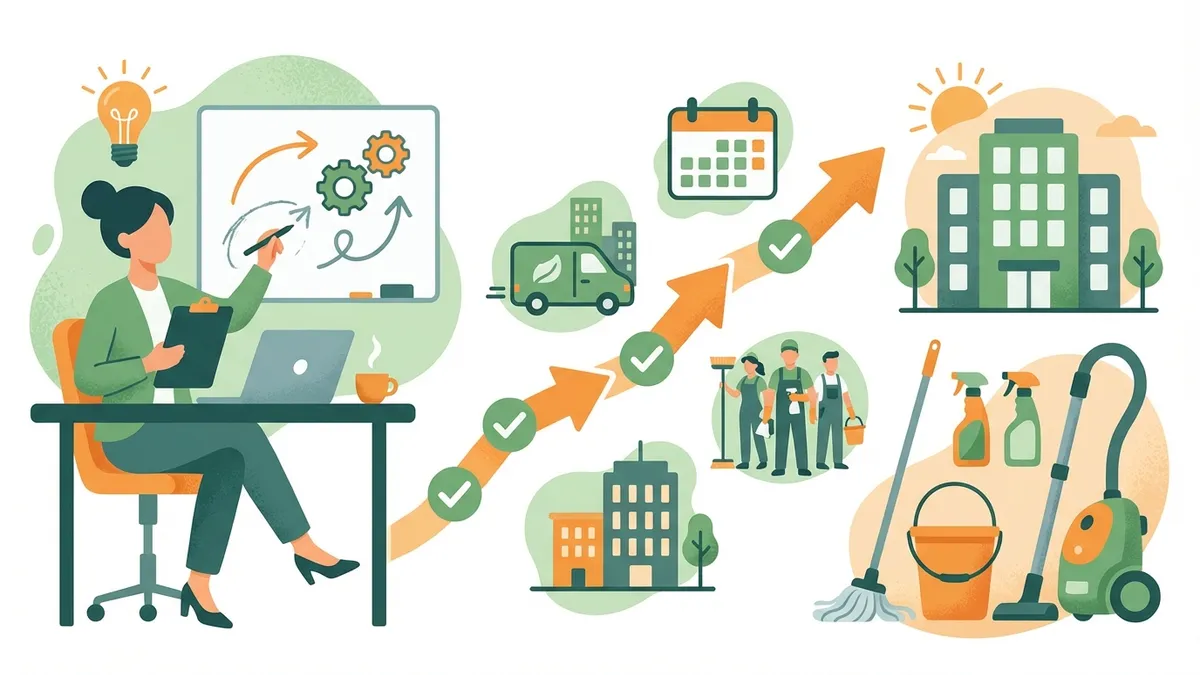
The cleaning industry generates over $90 billion annually in the United States, and it's one of the most accessible businesses to start. The startup costs are low ($2,000–$6,000), there are no degree requirements, demand is constant, and you can start earning within your first week.
But "accessible" doesn't mean "easy." Most cleaning businesses fail within the first two years — not because cleaning is hard, but because running a business is. This guide covers every step from registering your business to landing your first clients.
Step 1: Choose Your Cleaning Niche
Not all cleaning is created equal. Your niche determines your startup costs, pricing, target market, and growth potential.
Residential Cleaning
Cleaning homes — regular weekly/biweekly cleaning or one-time deep cleans. Lowest barrier to entry. Average hourly rate: $25–$50/hour per cleaner.
Commercial/Janitorial Cleaning
Offices, retail spaces, medical facilities. Higher revenue per contract, more consistent income, but typically requires evening/night work. Average rate: $0.05–$0.20 per square foot.
Specialty Cleaning
Move-in/move-out cleaning, post-construction cleanup, carpet cleaning, window cleaning, pressure washing. Higher rates because of specialized skills or equipment. Average rate: $200–$500+ per job.
Green/Eco-Friendly Cleaning
Residential or commercial cleaning using non-toxic, environmentally friendly products. Growing demand, commands a 10-20% premium over standard cleaning.
Step 2: Write a Simple Business Plan
You don't need a 50-page MBA-style plan. Answer these questions:
- What services will you offer? (residential, commercial, or specialty)
- Who is your target customer? (busy families, property managers, small offices)
- What's your service area? (start with a 15-20 mile radius)
- How will you price your services? (hourly, per square foot, flat rate)
- How will you find clients? (online marketing, referrals, door-to-door)
- What are your startup costs? (see below)
- When will you break even? (most cleaning businesses break even within 3-6 months)
Step 3: Handle the Legal Stuff
Register Your Business
- Choose a business structure (LLC is recommended for liability protection — costs $50–$500 depending on state)
- Register with your state's Secretary of State office
- Get an EIN (Employer Identification Number) from the IRS — free and takes 5 minutes online
Get Licensed
Most states don't require a specific cleaning license, but you may need:
- A general business license from your city/county ($25–$100)
- A sales tax permit if your state taxes cleaning services
- A home occupation permit if you run the business from home
Get Insurance
At minimum, you need:
- General liability insurance: $30–$60/month — covers property damage and injuries
- Bonding: $100–$300/year — protects clients against employee theft
- Workers' comp: Required once you hire employees (varies by state)
Step 4: Set Up Your Finances
- Open a dedicated business bank account (don't mix personal and business money)
- Get a business credit card for supplies and expenses
- Set up accounting software — Wave (free) or QuickBooks Self-Employed ($15/month)
- Set aside 25-30% of income for taxes (quarterly estimated payments)
Step 5: Buy Equipment and Supplies
Startup Equipment List
| Item | Cost | Notes |
|---|---|---|
| Vacuum cleaner (commercial) | $200–$400 | Invest in quality — cheap vacuums die fast |
| Mop and bucket | $30–$50 | Microfiber flat mop recommended |
| Cleaning caddy | $15–$25 | Carry supplies room to room |
| Microfiber cloths (20-pack) | $15–$25 | Reusable and streak-free |
| Spray bottles | $10–$15 | For custom cleaning solutions |
| Cleaning chemicals | $50–$100 | All-purpose, glass, bathroom, floor cleaners |
| Rubber gloves (box) | $10–$15 | Protect your hands |
| Trash bags | $15–$20 | Commercial grade |
| Step stool | $25–$40 | For ceiling fans and high shelves |
| Uniforms/polo shirts | $50–$100 | Professional appearance matters |
| **Total** | **$420–$790** |
Total Startup Costs
| Category | Low Estimate | High Estimate |
|---|---|---|
| Equipment & Supplies | $420 | $790 |
| LLC Registration | $50 | $500 |
| Insurance & Bonding | $500 | $1,000 |
| Marketing (initial) | $200 | $500 |
| Website | $0 | $500 |
| Business Cards & Flyers | $50 | $150 |
| Vehicle expenses | $100 | $300 |
| Software (scheduling, accounting) | $0 | $50/mo |
| **Total Startup** | **$1,320** | **$3,790** |
Step 6: Set Your Pricing
Residential Pricing Methods
Per hour: $25–$50/hour per cleaner. Simple but unpredictable for clients.
Flat rate: $120–$250 for a standard clean of a 3-bedroom home. Clients prefer knowing the total upfront.
Per square foot: $0.05–$0.15/sq ft. Good for quoting without a walkthrough.
Pricing Guidelines
| Home Size | Standard Clean | Deep Clean |
|---|---|---|
| Studio/1-bedroom | $80–$120 | $150–$250 |
| 2-bedroom | $100–$160 | $200–$300 |
| 3-bedroom | $120–$200 | $250–$400 |
| 4-bedroom | $150–$250 | $300–$500 |
| 5+ bedroom | $200–$350 | $400–$700 |
How to Estimate Time
Plan on 1–1.5 hours per 1,000 square feet for a standard cleaning with one cleaner. Deep cleans take 2–3x longer. As you gain experience, your speed will increase — don't underprice to compensate for being slow at first.
Step 7: Get Your First Clients
Online Presence
- Google Business Profile — Free. Show up in local search results. Ask every client for a review.
- Simple website — Even a one-page site with services, pricing, and contact info helps. Use Carrd ($19/year) or WordPress.
- Social media — Before/after photos on Instagram and Facebook work well for cleaning businesses.
Offline Marketing
- Nextdoor — Post in your neighborhood (free)
- Flyers — Distribute in neighborhoods you want to serve
- Business cards — Leave with every client for referrals
- Word of mouth — Offer a $25 referral bonus for each new client
- Property managers — Cold call or email local property management companies
Lead Generation Platforms
- Thumbtack — Pay per lead ($5–$30 per lead)
- Housecall Pro — Scheduling + marketing platform
- Angi (formerly Angie's List) — Profile listing
- Yelp — Free listing; paid advertising optional
Referral Strategy
Referrals are the lifeblood of cleaning businesses. After every job:
- Ask for a Google review
- Leave business cards
- Offer a referral discount ($25 off their next clean for each referral who books)
Step 8: Deliver Exceptional Service
Cleaning is a commodity. Your service experience is the differentiator.
- Show up on time — Every single time
- Communicate proactively — Confirm appointments 24 hours ahead
- Be consistent — Use a cleaning checklist for every home
- Pay attention to details — Wipe light switches, clean baseboards, fold toilet paper
- Handle problems gracefully — If you break something, tell the client and offer to replace it
- Follow up — Text after the first clean to ask if everything met expectations
Step 9: Grow and Scale
When to Hire
Hire your first employee when you're consistently booked at 30+ hours per week and turning away work. Start with part-time cleaners and train them using your checklists.
Pricing Increases
Raise prices annually (5-10%). Notify existing clients 30 days in advance. Most will stay — especially if your service is excellent. The ones who leave over a $10 increase weren't your best clients anyway.
Adding Services
Expand your offerings over time: deep cleaning, move-in/out cleaning, carpet cleaning, window cleaning, organizing services. Each additional service increases your revenue per client.
Systems and Software
As you grow, invest in:
- Scheduling software — Jobber ($49/mo), Housecall Pro ($65/mo), or ZenMaid ($49/mo)
- Client management — Track preferences, access codes, and special instructions
- Payroll — Gusto ($40/mo + $6/employee) or Square Payroll ($35/mo + $6/employee)
FAQ
How much can I make with a cleaning business?
Solo cleaners typically earn $30,000–$60,000/year working full-time. Cleaning business owners with 2-5 employees can earn $50,000–$100,000+ in profit. Top operators with 10+ employees and commercial contracts generate $200,000+ annually.
Do I need a vehicle for a cleaning business?
Yes — you need reliable transportation to get to clients and carry equipment. Your personal car works fine to start. As you grow, consider a branded vehicle for marketing visibility.
Should I be an LLC or sole proprietor?
An LLC is strongly recommended. It protects your personal assets from business lawsuits (a real risk in cleaning — you're working in people's homes). Formation costs $50–$500 depending on your state.
How do I handle keys and alarm codes?
Use a lockbox system or have clients leave a spare key. For alarm codes, store them securely in your scheduling software or a password manager. Never share access information between employees working at different properties.
What should my cleaning checklist include?
A standard residential checklist should cover: kitchen (counters, appliances, sink, floor), bathrooms (toilet, shower/tub, mirror, floor), bedrooms (dust, vacuum, make beds), living areas (dust, vacuum, mop), and general (empty trash, wipe light switches and door handles). Customize for each client's preferences.
How do I compete with established cleaning companies?
Compete on reliability, quality, and personal service — not price. Big companies have high turnover and inconsistent service. Your advantage is that clients get the same person every time, you remember their preferences, and you actually care. That's worth more than a $10 price difference.