How to Start a Junk Removal Business: Complete Guide 2026
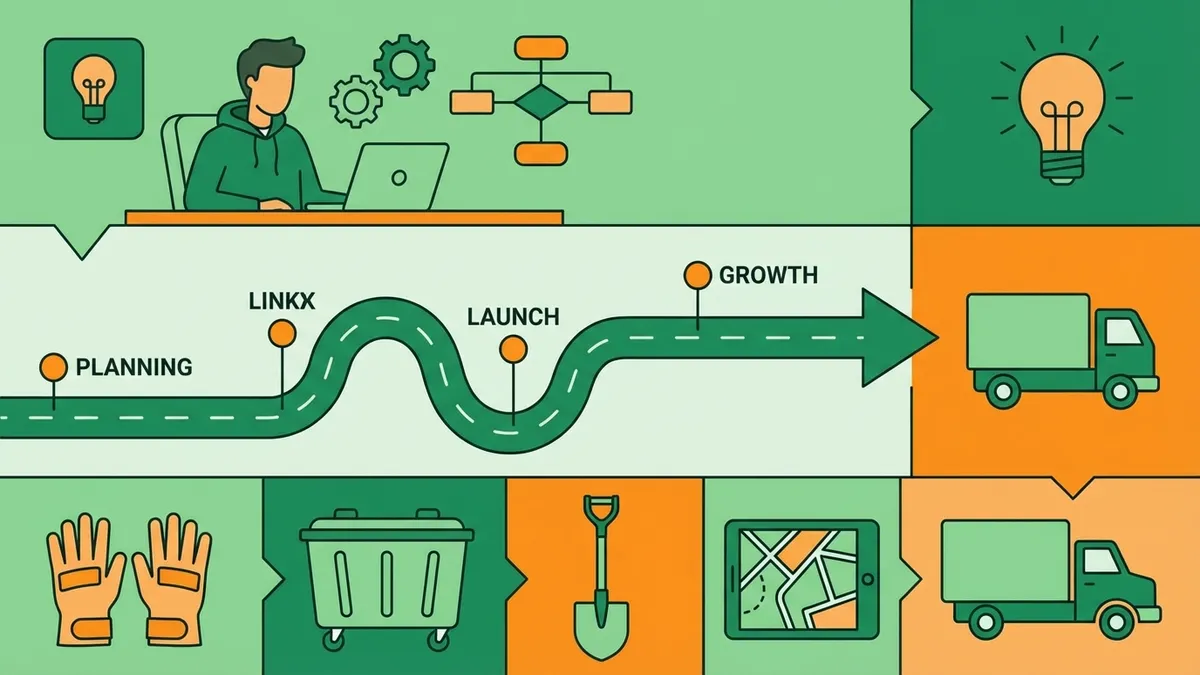
The junk removal industry generates over $12 billion annually in the United States, and it's growing at roughly 5% per year. With relatively low startup costs, flexible scheduling, and strong demand in virtually every market, a junk removal business is one of the most accessible service businesses you can launch in 2026.
Whether you're looking for a side hustle or a full-time operation that can scale to six or seven figures, this guide covers everything you need to get started — from legal requirements and equipment to pricing strategies and customer acquisition.
Table of Contents
- Why Junk Removal Is a Great Business in 2026
- Startup Costs Breakdown
- Step 1: Create a Business Plan
- Step 2: Register Your Business and Get Licensed
- Step 3: Get Insurance
- Step 4: Buy Equipment and a Truck
- Step 5: Set Your Pricing
- Step 6: Build Your Brand
- Step 7: Market Your Junk Removal Business
- Step 8: Hire and Scale
- Common Mistakes to Avoid
- How Much Can You Make?
- FAQ
Why Junk Removal Is a Great Business in 2026
Several factors make junk removal especially attractive right now:
- Recession-resistant demand. People accumulate stuff regardless of the economy. Estate cleanouts, move-outs, renovations, and hoarding situations happen year-round.
- Low barrier to entry. You can start with a pickup truck, a trailer, and one helper. No specialized degree or certification required.
- High margins. Average job revenue ranges from $150 to $600+. After dump fees and labor, margins of 50–60% are realistic.
- Repeat and referral heavy. Real estate agents, property managers, and contractors become ongoing referral sources once you prove reliability.
- Scalable. Start solo, then add trucks and crews. Franchise-level operators hit $1M+ in annual revenue with 3–5 trucks.
Startup Costs Breakdown
Here's what to budget for a bootstrapped launch vs. a more established setup:
Bootstrapped Start ($3,000–$8,000):
- Used pickup truck (if you already own one): $0
- Utility trailer (6x12 or larger): $1,500–$3,500
- Business registration and licenses: $100–$500
- General liability insurance: $500–$1,200/year
- Basic tools (shovels, dollies, straps, gloves): $200–$400
- Google Business Profile + basic website: $0–$500
- Marketing (yard signs, door hangers, first month ads): $200–$500
Professional Start ($15,000–$35,000):
- Used box truck or dump truck: $8,000–$20,000
- Commercial auto insurance: $1,500–$3,000/year
- General liability + workers' comp insurance: $2,000–$4,000/year
- Branded uniforms and vehicle wrap: $1,500–$3,500
- Professional website with booking: $500–$2,000
- CRM software: $30–$100/month
- Initial marketing budget: $1,000–$3,000
Most successful operators start bootstrapped and reinvest profits into better equipment within the first 6 months.
Step 1: Create a Business Plan
You don't need a 50-page MBA-style document. Focus on these essentials:
Define Your Services
Not all junk removal is the same. Decide what you'll handle:
- Residential junk removal — furniture, appliances, garage cleanouts, yard waste
- Commercial junk removal — office cleanouts, retail fixture removal, warehouse clearing
- Construction debris — drywall, lumber, roofing materials (may require special disposal permits)
- Estate cleanouts — full-home clearing after a death or downsizing
- Hoarding cleanups — specialized, higher-priced, requires sensitivity and sometimes biohazard training
- Appliance and e-waste recycling — TVs, computers, refrigerators
Starting with residential junk removal is the safest bet. Add specialty services as you gain experience.
Identify Your Market
Research your local area:
- How many competitors are listed on Google Maps for "junk removal near me"?
- What are they charging? (Call 3–5 competitors for quotes.)
- What's the population density? (You need at least 50,000 people within your service area for consistent volume.)
- Are there underserved niches? (Many areas lack reliable estate cleanout specialists.)
Set Revenue Goals
A solo operator with one truck can realistically complete 2–4 jobs per day. At an average of $250 per job:
- 2 jobs/day × $250 × 22 working days = $11,000/month
- After expenses (dump fees, fuel, insurance): $6,000–$8,000/month net
That's a realistic first-year target for a full-time solo operator.
Step 2: Register Your Business and Get Licensed
Choose a Business Structure
- Sole proprietorship — simplest, but no liability protection
- LLC — recommended for most junk removal businesses. Costs $50–$500 depending on your state. Protects personal assets if something goes wrong on a job.
- S-Corp election — consider once you're earning over $60,000/year for tax savings on self-employment tax
Register Your Business Name
File a DBA (Doing Business As) or register your LLC with your state's Secretary of State office. Check that the name is available as a .com domain before you commit.
Get an EIN
Free from the IRS at irs.gov. Takes 5 minutes. You'll need it for business bank accounts and tax filing.
Local Permits and Licenses
Requirements vary by city and county. Common ones include:
- General business license — required almost everywhere ($50–$200/year)
- Waste hauling permit — some cities and counties require a specific permit to transport waste to landfills
- Vehicle weight permits — if your loaded truck exceeds certain weight thresholds (typically 26,000 lbs GVWR), you may need a DOT number
- Zoning permits — if you're parking a commercial truck at your home
Call your city clerk's office and county waste management department. They'll tell you exactly what you need.
Step 3: Get Insurance
This is non-negotiable. One injury on a customer's property without insurance can bankrupt you.
Required Coverage
- General liability insurance ($1M/$2M): Covers property damage and bodily injury to third parties. Costs $500–$1,500/year for a new business.
- Commercial auto insurance: Your personal auto policy won't cover business use. Expect $1,200–$3,000/year per vehicle.
- Workers' compensation: Required in most states once you hire employees. Costs vary by state but budget $2,000–$5,000/year per employee for junk removal (classified as a moderate-risk trade).
Recommended Additional Coverage
- Inland marine insurance: Covers your tools and equipment on the truck. $200–$500/year.
- Umbrella policy: Extra liability coverage beyond your base policy. Worth it once you're doing 100+ jobs per month.
Get quotes from at least 3 providers. Companies like Next Insurance, Thimble, and Hiscox specialize in small service businesses and offer online quotes in minutes.
Step 4: Buy Equipment and a Truck
Vehicles
Your vehicle is your biggest asset. Options ranked by budget:
- Pickup truck + trailer ($0–$5,000 if you own the truck). Best for starting out. A 6x12 or 7x14 enclosed trailer handles most residential jobs.
- Used box truck ($8,000–$18,000). The 14–16 ft box truck is the industry workhorse. More professional appearance, no trailer to maneuver.
- Used dump truck ($15,000–$30,000). Fastest unloading at the dump. Saves 15–20 minutes per trip. Worth it at scale.
Pro tip: A 16-ft box truck holds roughly 450–500 cubic feet of junk — equivalent to about 8 pickup truck loads. This is why the box truck is the sweet spot for most operators.
Essential Tools and Supplies
- Heavy-duty work gloves (buy in bulk)
- Steel-toed boots
- Furniture dollies (2 minimum)
- Appliance dolly (for refrigerators, washers)
- Moving blankets (protect customer property)
- Ratchet straps and bungee cords
- Shovels, rakes, brooms
- Sledgehammer (for breaking down large items)
- Bolt cutters
- First aid kit
- Hand sanitizer and dust masks
- Tarps (for open trailers)
Budget $300–$600 for a complete tool kit.
Step 5: Set Your Pricing
Pricing Models
Volume-based pricing (most common):
Price by how much space the junk takes up in your truck. This is the industry standard:
- 1/8 truck load: $100–$150
- 1/4 truck load: $175–$250
- 1/2 truck load: $275–$400
- 3/4 truck load: $400–$525
- Full truck load: $450–$650
Item-based pricing:
Charge per item for common removals:
- Couch: $75–$150
- Mattress: $50–$100
- Refrigerator: $75–$150
- Hot tub: $250–$500
- Piano: $200–$500
Hourly pricing:
Less common but useful for labor-intensive jobs like hoarding cleanups: $100–$175/hour for a 2-person crew.
How to Calculate Your Minimum Price
For every job, account for:
- Dump fees — $30–$80 per load at most transfer stations. Some items (mattresses, TVs, tires) have surcharges.
- Fuel — $15–$40 per job depending on distance.
- Labor — if you have a helper, $15–$25/hour.
- Your time — target at least $75/hour for your time as the owner.
- Overhead — insurance, truck payment, phone, marketing divided across monthly jobs.
A minimum job price of $100–$125 ensures you're never losing money, even on small loads.
Step 6: Build Your Brand
Naming Your Business
Good junk removal business names are:
- Memorable and clear — people should know what you do from the name alone
- Locally relevant — including your city or region helps with SEO
- Professionally toned — avoid overly cute names if you want commercial contracts
Examples: "CleanSlate Junk Removal," "Metro Haulers," "[City] Junk Pros"
Branding Essentials
- Logo: Use Canva or hire on Fiverr ($20–$50). Keep it simple — bold text with an icon works best.
- Vehicle branding: A full vehicle wrap costs $1,500–$3,500 but generates 30,000–70,000 impressions per day. Even magnetic signs ($50–$100) are a good start.
- Uniforms: Matching branded t-shirts ($10–$15 each) make you look professional. This matters for getting into higher-end neighborhoods and commercial accounts.
Online Presence
At minimum, you need:
- Google Business Profile — this is your #1 lead source. Complete every field, add photos of your truck and completed jobs, and respond to every review.
- Website — a simple 3–5 page site with service areas, pricing info, before/after photos, and an online booking form. Use WordPress, Wix, or Squarespace.
- Facebook business page — many local customers still discover businesses through Facebook.
Step 7: Market Your Junk Removal Business
Free and Low-Cost Strategies
Google Business Profile optimization:
This is where 60–70% of your leads will come from. To rank higher:
- Get 10+ five-star reviews as fast as possible (ask every happy customer)
- Post weekly updates with job photos
- Respond to all reviews within 24 hours
- Add all your service areas as separate locations or service area entries
Nextdoor and Facebook Groups:
Join every neighborhood group in your service area. Don't spam — answer questions, offer helpful advice, and mention your services when relevant. Many operators get 5–10 leads per month from Nextdoor alone.
Craigslist:
Post in the "services" section weekly. Free and still effective in many markets.
Referral partnerships:
Build relationships with:
- Real estate agents (cleanouts before listings)
- Property managers (tenant move-outs)
- Estate attorneys (estate cleanouts)
- Contractors (construction debris removal)
- Storage facility managers (abandoned unit cleanouts)
Drop off business cards, introduce yourself, and offer a 10% referral fee or discount.
Paid Marketing
Google Ads:
"Junk removal near me" keywords cost $5–$15 per click. With a 10% conversion rate, that's $50–$150 per customer. Given average job values of $250+, the ROI is strong. Start with $500/month and scale what works.
Google Local Service Ads (LSA):
Pay-per-lead (not per click). Leads cost $20–$50 each. You only pay for actual calls. These ads appear above regular Google Ads — highly valuable placement.
Facebook Ads:
Target homeowners in your zip codes. Before/after photos and "$50 off your first pickup" offers convert well. Budget $300–$500/month to start.
Booking and CRM
Use a simple CRM to manage leads and schedule jobs. Options:
- Jobber ($49/month) — built for service businesses, includes scheduling, invoicing, and GPS tracking
- Housecall Pro ($65/month) — similar features with better customer communication tools
- Google Calendar + Google Sheets — free option that works fine for solo operators
Step 8: Hire and Scale
When to Hire
Hire your first helper when you're:
- Consistently booked 3+ weeks out
- Turning away jobs due to capacity
- Doing 15+ jobs per week solo
Who to Hire
Your first hire should be a laborer, not a manager. Look for:
- Physical fitness and reliability
- Valid driver's license (CDL not required for most junk trucks)
- Clean background (you're entering people's homes)
- Positive attitude — customer interactions matter
Pay $15–$22/hour depending on your market. Offer performance bonuses ($25–$50 per day) for exceeding job targets.
Scaling to Multiple Trucks
The playbook for scaling:
- One truck, one crew — you're on the truck, doing sales and labor ($8K–$15K/month revenue)
- Two trucks — you step off the truck, focus on sales and operations ($20K–$30K/month revenue)
- Three to five trucks — hire an operations manager, invest in marketing infrastructure ($50K–$100K/month revenue)
Each additional truck adds roughly $8,000–$15,000/month in revenue with $3,000–$6,000 in added costs (labor, fuel, insurance, dump fees).
Common Mistakes to Avoid
- Underpricing to "get started." Cheap prices attract bad customers and kill your margins. Price fairly from day one.
- Skipping insurance. One property damage claim without coverage can cost more than a year of premiums.
- Not tracking dump fees. Every dollar spent at the landfill comes off your profit. Log every receipt.
- Ignoring online reviews. In junk removal, the business with more 5-star reviews wins. Make it your obsession.
- Trying to do everything yourself. Hire help sooner than you think you need it. Burnout is the #1 reason service business owners quit.
- No-showing or arriving late. This industry has a reputation problem. Just showing up on time puts you ahead of 50% of competitors.
- Not separating personal and business finances. Open a business bank account on day one. Use it for everything business-related.
How Much Can You Make?
Realistic income projections based on operator data:
- Part-time solo (weekends only): $2,000–$4,000/month
- Full-time solo: $6,000–$10,000/month
- Solo + 1 helper: $10,000–$15,000/month
- 2 trucks with crews: $20,000–$35,000/month revenue
- 5 trucks (owner-operated business): $50,000–$100,000/month revenue
Net profit margins typically range from 40–60% for solo operators and 25–40% for multi-truck operations.
The top 10% of independent junk removal operators earn $150,000–$300,000+ per year in owner income.
FAQ
How much does it cost to start a junk removal business?
You can start for as little as $3,000–$8,000 if you already own a pickup truck. A more professional setup with a box truck, insurance, and branding typically costs $15,000–$35,000. Most operators start lean and reinvest profits to upgrade equipment within the first 6 months.
Do I need a special license to haul junk?
In most areas, you need a general business license and potentially a waste hauling permit from your county or city. If your vehicle exceeds 26,000 lbs GVWR, you may need a DOT number and CDL. Check with your local city clerk and waste management department for specific requirements in your area.
Is a junk removal business profitable?
Yes — junk removal is one of the more profitable service businesses due to low overhead and high per-job revenue. Solo operators typically earn $6,000–$10,000/month with profit margins of 40–60%. The key is pricing correctly, managing dump fees, and maintaining high job volume through strong marketing.
What should I do with the junk I collect?
You have several options: municipal landfills and transfer stations (most common), recycling centers (for metals, electronics, and appliances), donation centers like Goodwill or Habitat for Humanity ReStore (for items in good condition), and scrap yards (for metals, which can generate additional revenue of $50–$200 per load). Smart operators sort items to maximize recycling revenue and minimize dump fees.
How do I get my first customers?
Start with your Google Business Profile — optimize it completely, add photos, and ask friends and family for initial reviews. Post your services on Nextdoor, Facebook Marketplace, and Craigslist. Reach out to 10 real estate agents and 10 property managers with a simple introduction and business card. Most new operators book their first paying job within the first week using these methods.
Can I run a junk removal business part-time?
Absolutely. Many operators start part-time on weekends while keeping their full-time job. Weekend-only operations typically generate $2,000–$4,000/month. The key is being responsive to leads even during the week — use a CRM or virtual assistant to handle scheduling so you don't lose potential customers.
What's the difference between junk removal and dumpster rental?
Junk removal is a full-service model — you show up, load everything, and haul it away. Dumpster rental is self-service — you drop off a container and the customer fills it. Junk removal commands higher prices ($250–$600 per job vs. $300–$500 per dumpster rental) because you're providing labor. Many operators eventually offer both services to capture different customer segments.