How to Start a Mobile Car Detailing Business in 2026
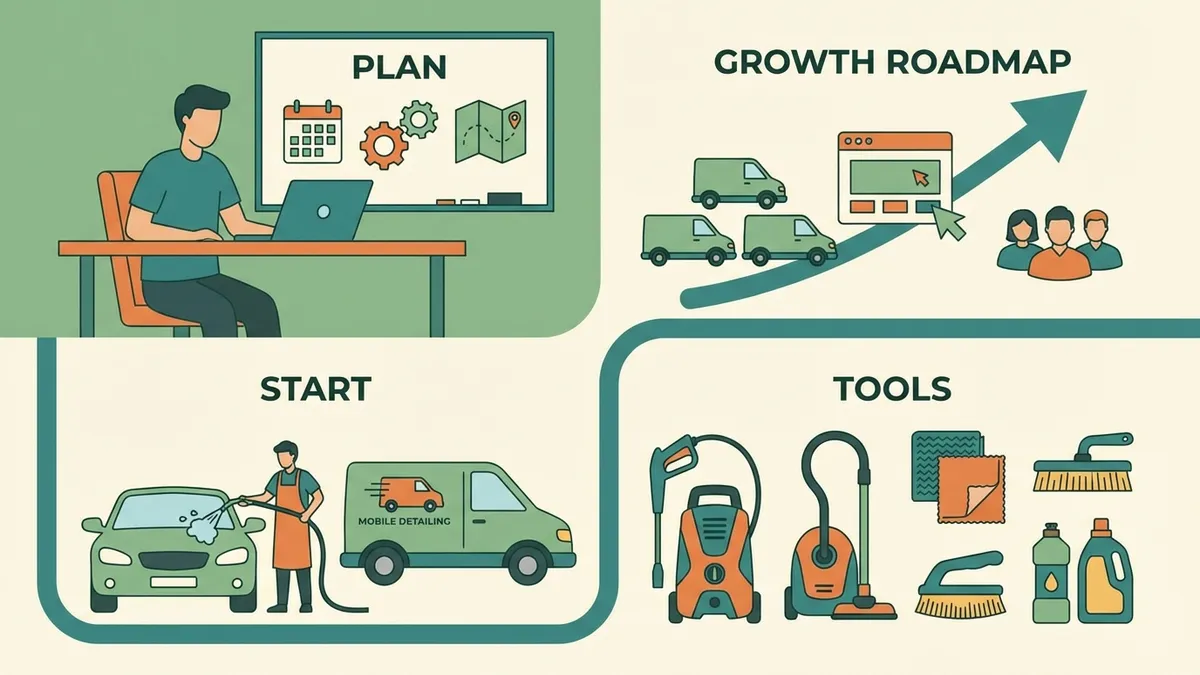
Mobile car detailing is one of the lowest-barrier, highest-margin service businesses you can start right now. With startup costs between $2,000 and $10,000, profit margins of 50–75%, and growing demand from busy professionals who'd rather not drive to a car wash, it's a realistic path to $75,000–$150,000 per year within 12–18 months.
This guide covers everything: equipment lists with real costs, pricing strategies that actually work, how to get your first 20 clients, and how to scale past six figures.
Table of Contents
- Why Mobile Car Detailing Is a Smart Business in 2026
- Startup Costs Breakdown
- Essential Equipment and Supplies
- Legal Requirements and Business Setup
- How to Price Your Services
- Getting Your First 20 Clients
- Marketing Your Detailing Business
- Scaling to Six Figures and Beyond
- Common Mistakes to Avoid
- FAQ
Why Mobile Car Detailing Is a Smart Business in 2026 {#why-mobile-car-detailing}
The U.S. car wash and detailing industry generates over $15 billion annually, and mobile detailing is the fastest-growing segment. Here's why the numbers work:
Low startup costs. You don't need a storefront, a lease, or employees on day one. A reliable vehicle, a pressure washer, and quality products get you started for under $5,000.
High profit margins. A basic exterior detail takes 60–90 minutes and commands $75–$150. A full interior/exterior detail runs $200–$400. Your material cost per job? $5–$15. That's 80%+ gross margin before fuel and time.
Recurring revenue. The average detailing client books 4–6 times per year. Build a base of 150 regular clients and you're looking at $100,000+ annually from repeat business alone.
Recession-resistant demand. People keep driving. Cars keep getting dirty. During economic downturns, consumers cut dealership visits but still pay for maintenance-level detailing. The 2020–2023 period actually saw mobile detailing grow as people avoided indoor car washes.
Growing addressable market. The average new car price hit $48,000 in 2025. When people spend that much on a vehicle, they protect the investment. Fleet managers, real estate agents, ride-share drivers, and luxury car owners all need regular detailing.
Startup Costs Breakdown {#startup-costs}
Here's a realistic budget at three levels:
Budget Start ($2,000–$3,500)
| Item | Cost |
|---|---|
| Pressure washer (1,500–2,000 PSI electric) | $250–$400 |
| Wet/dry vacuum (6-gallon) | $80–$150 |
| Foam cannon + lance | $40–$70 |
| Wash supplies (soap, clay bar, wax, tire shine, interior cleaner) | $200–$350 |
| Microfiber towels (50-pack) | $40–$60 |
| Buckets, brushes, applicators | $75–$100 |
| Water tank (35–65 gallons) | $50–$120 |
| Business registration + insurance | $300–$500 |
| Business cards + basic website | $100–$200 |
| Fuel and misc | $200 |
| **Total** | **$1,335–$2,150** |
This assumes you already have a vehicle (SUV, truck, or van). Add $3,000–$8,000 if you need to buy one.
Mid-Range Start ($5,000–$7,000)
Everything above, plus:
- Dual-action polisher (Griots G9 or similar): $200–$300
- Polishing pads and compounds: $100–$150
- Extractor for deep carpet cleaning: $200–$400
- 100-gallon water tank with 12V pump: $200–$350
- Professional branding (vehicle wrap, uniform): $500–$1,500
- Google Ads initial budget: $300–$500
Premium Start ($8,000–$12,000)
Everything above, plus:
- Gas-powered pressure washer (3,000+ PSI): $400–$700
- Ceramic coating supplies and training: $500–$1,000
- Ozone generator for odor removal: $150–$300
- Steam cleaner: $300–$500
- Professional website with booking system: $500–$1,000
- Larger water tank setup (200+ gallons): $400–$600
Our recommendation: Start at the mid-range level. The polisher unlocks paint correction services that command $300–$500+ per vehicle, which dramatically increases your average ticket.
Essential Equipment and Supplies {#equipment}
Must-Have Equipment
Pressure washer. For mobile work, electric is more practical — quieter for residential neighborhoods, lighter, and no gas fumes. The Ryobi 2,000 PSI or Sun Joe SPX3000 are popular starter choices ($150–$300). If you'll do fleet work or commercial lots, upgrade to a gas-powered unit.
Foam cannon. Attaches to your pressure washer and lays down thick soap foam. This is what makes you look professional and actually cleans better than hand-washing alone. Budget $40–$70 for a quality one.
Dual-action polisher. This is your money-maker. A DA polisher removes swirl marks, light scratches, and oxidation — transforming a car's appearance. The Griots Garage G9 ($200) or Rupes LHR15 ($400) are industry favorites.
Wet/dry vacuum. The Ridgid 6-gallon or Craftsman equivalent ($80–$150) handles interior work. For serious interior detailing, add a hot water extractor like the Bissell SpotClean Pro ($150–$200) for carpet and upholstery stains.
Water supply. You need 30–50 gallons per car. A 65-gallon tank with a 12V transfer pump fits most SUVs and gives you 1–2 details before refilling. Some detailers carry two tanks for full-day routes.
Consumable Supplies (Monthly Restock: $100–$200)
- Car wash soap: Meguiar's Gold Class or Chemical Guys Mr. Pink ($15–$25/gallon, lasts 30–50 washes)
- Clay bar: Removes embedded contaminants ($10–$15 per bar, lasts 10–15 cars)
- Compound and polish: Meguiar's Ultimate Compound + Polish ($20–$30, lasts 15–20 corrections)
- Wax/sealant: Collinite 845 or Turtle Wax Hybrid Solutions ($15–$25, lasts 20+ applications)
- Interior cleaner: All-purpose cleaner diluted to different strengths ($10–$15/gallon)
- Tire and trim dressing: $10–$15 per bottle
- Microfiber towels: Budget $30–$50/month for replacements. Never reuse a dropped towel on paint.
Optional but Profitable Add-Ons
- Ceramic coating ($50–$80 material cost, charge $500–$1,500): Highest-margin upsell in detailing
- Headlight restoration ($5 material cost, charge $50–$75 per pair): Takes 15 minutes
- Engine bay cleaning ($3 material cost, charge $50–$75): Easy upsell
- Odor removal (ozone generator, $150 one-time): Charge $75–$150 per treatment
Legal Requirements and Business Setup {#legal-setup}
Business Structure
Register as an LLC. It costs $50–$500 depending on your state (Wyoming and New Mexico are cheapest at $100 or less) and protects your personal assets if something goes wrong. File online through your state's Secretary of State website — skip the $300+ formation services.
Licenses and Permits
Requirements vary by city and state, but typically you'll need:
- Business license: $25–$100 annually from your city or county
- Sales tax permit: Free in most states (required if you charge sales tax)
- Water discharge permit: Some cities regulate where wash water goes. Check your local environmental regulations. Many mobile detailers use water reclamation mats ($200–$500) to stay compliant.
- Home occupation permit: If you're operating from home, some HOAs and municipalities require this ($0–$50)
Insurance (Non-Negotiable)
You're working on other people's $30,000–$100,000+ vehicles. Insurance isn't optional.
- General liability insurance: $30–$75/month. Covers property damage if you scratch a car, break a mirror, or damage a driveway. Get at least $1 million in coverage.
- Commercial auto insurance: $100–$200/month if you're using your vehicle for business. Your personal auto policy won't cover business use.
- Inland marine/tools insurance: $15–$30/month. Covers your equipment if stolen from your vehicle.
Total insurance cost: $145–$305/month. Companies like Next Insurance, Thimble, and Hiscox offer policies specifically for mobile detailing businesses with online quotes in minutes.
Business Bank Account
Open a separate business checking account immediately. Chase, Novo, and Mercury all offer free business checking. This keeps your finances clean for tax time and looks professional when clients pay you.
How to Price Your Services {#pricing}
Pricing Framework
Price by vehicle size and service level, not by the hour. Here's a competitive pricing structure for most U.S. markets:
Basic Wash & Wax (Exterior Only)
- Sedan/Coupe: $75–$100
- SUV/Truck: $100–$135
- Large SUV/Van: $125–$160
Full Detail (Interior + Exterior)
- Sedan/Coupe: $200–$275
- SUV/Truck: $250–$350
- Large SUV/Van: $300–$425
Paint Correction + Ceramic Coating
- Single-stage correction: $300–$500
- Multi-stage correction: $500–$800
- Ceramic coating (add-on): $400–$1,200
Recurring Maintenance Plans (Monthly)
- Bi-weekly exterior wash: $120–$180/month
- Monthly full detail: $175–$300/month
Pricing Tips
- Research your local market on Google and Yelp. Price 10–15% above the cheapest competitors — you don't want to compete on price.
- Charge more for first-time details. A neglected car takes 2x longer. Add a "first-time deep clean" surcharge of $50–$100.
- Bundle services. Offer a "New Car Protection Package" (detail + ceramic coating + interior protection) at a slight discount to increase average ticket size.
- Raise prices every 12 months. A 5–10% annual increase is expected and rarely loses clients.
Getting Your First 20 Clients {#first-clients}
This is where most people stall. Here's a proven sequence:
Week 1–2: Friends, Family, and Neighbors Detail 5–10 cars for free or at a deep discount. Take dramatic before/after photos of every single one. These photos are your entire marketing foundation.
Week 3–4: Google Business Profile Set up your Google Business Profile immediately. This is the single most important marketing asset for a local service business. Add your before/after photos, list your services and prices, and ask every person you've detailed for to leave a 5-star review. Five genuine reviews puts you ahead of 80% of local competitors.
Week 5–6: Nextdoor and Facebook Groups Post your before/after photos in local community groups. Don't spam — offer a "new business" introductory rate. Nextdoor especially converts well for home services. Offer $25 off the first detail.
Week 7–8: Local Business Partnerships Visit real estate offices, car dealerships, and auto repair shops. Real estate agents need cars detailed for showings. Dealerships need overflow detailing. Offer a business rate 15% below retail. One dealership relationship can mean 10–20 cars per month.
Target: 20 paying clients within 60 days. If you're doing 3–4 details per day, 5 days per week, that's 15–20 cars per week — $2,000–$5,000+ in weekly revenue.
Marketing Your Detailing Business {#marketing}
High-ROI Marketing Channels
1. Google Business Profile + Local SEO (Free) Optimize for "[city] mobile car detailing" and "[city] auto detailing." Post weekly updates with photos. Respond to every review. This alone can generate 5–15 leads per week once you have 20+ reviews.
2. Before/After Content on Instagram and TikTok (Free) Detailing content is inherently satisfying to watch. A 30-second time-lapse of a filthy car getting transformed can get 50,000–500,000 views organically. Post 3–5 times per week. Use hashtags like #cardetailing #satisfying #autodetailing #[yourcity]detailing.
3. Google Ads ($300–$500/month) Run search ads for "mobile car detailing near me" and "car detailing [your city]." Cost per lead is typically $15–$40, and conversion rates for detailing services run 15–25%. At a $250 average ticket, the ROI is massive.
4. Vehicle Wrap ($1,500–$3,000 one-time) Your vehicle is a mobile billboard. A professional wrap with your business name, phone number, and website generates passive leads every day. Most detailers report 2–5 leads per month from their wrap alone.
5. Referral Program Offer $25 off the next detail for every referral that books. Word-of-mouth is the number one driver of local service businesses. Make it easy — give clients referral cards or a simple link.
Low-ROI Channels to Avoid
- Groupon/LivingSocial: Attracts bargain hunters who never return at full price
- Print advertising: Too expensive per lead for a local service
- Cold calling: Time-intensive with low conversion
Scaling to Six Figures and Beyond {#scaling}
The Path to $100K
Here's the math:
- Average ticket: $200
- Cars per day: 3
- Working days per week: 5
- Weekly revenue: $3,000
- Monthly revenue: $12,000
- Annual revenue: $144,000
- Minus expenses (~30%): $100,800 net
Three full details per day, five days a week, gets you past $100K. Most solo detailers hit this within 12–18 months.
Scaling Past $150K
Hire your first employee when you're consistently booked 2+ weeks out. Pay $15–$20/hour for a helper (you keep the margin on their labor). One employee doubles your capacity immediately.
Add a second vehicle and route optimization. Two trucks running simultaneously in different zones can push revenue to $250,000–$350,000.
Introduce premium services. Ceramic coating, paint protection film (PPF) installation, and fleet contracts have higher margins and increase average ticket to $400–$800+.
Build recurring revenue. Monthly maintenance plans at $150–$250/month create predictable income. 50 maintenance clients = $7,500–$12,500/month in guaranteed revenue.
Common Mistakes to Avoid {#mistakes}
-
Underpricing. Charging $50 for a full detail because you're "new" trains clients to expect bargain rates. Start at market rate — your work quality justifies it.
-
Skipping insurance. One scratch on a Porsche can cost $3,000–$10,000. General liability insurance is $30–$75/month. Just get it.
-
Buying too much equipment upfront. You don't need a $2,000 Rupes polisher on day one. Start with essentials, reinvest profits into upgrades.
-
Ignoring online reviews. Reviews are currency in local services. Ask every satisfied client. Make it frictionless — text them the Google review link.
-
No systems for scheduling. Use a booking tool from day one. Square Appointments (free), Jobber ($50/month), or Housecall Pro ($65/month) prevent double-bookings and no-shows.
-
Working without a contract. For paint correction and ceramic coating jobs ($500+), always get written approval. Document existing damage with photos before starting.
-
Neglecting water regulations. Some cities fine businesses for discharging wash water into storm drains. A water reclamation mat and proper disposal keeps you legal.
FAQ {#faq}
How much does it cost to start a mobile car detailing business?
A basic setup costs $2,000–$3,500 if you already have a vehicle. A mid-range setup with a polisher and professional branding runs $5,000–$7,000. A premium setup with ceramic coating capabilities and a full marketing budget is $8,000–$12,000.
How much can you make mobile detailing?
Solo operators typically earn $50,000–$80,000 in their first year and $80,000–$150,000 by year two. Top performers doing paint correction and ceramic coatings report $150,000–$250,000 annually. With employees and multiple vehicles, revenue can exceed $500,000.
Do I need a special license to detail cars?
No special detailing license exists in most states. You'll need a general business license ($25–$100), and some cities require water discharge permits. Check your local city and county requirements.
Is mobile car detailing profitable?
Yes. Gross margins range from 50–80% depending on services offered. A basic wash with $5 in materials commands $75–$150. Paint correction using $10 in compound generates $300–$500. Few service businesses match these margins at this startup cost.
How do I get clients for my detailing business?
Start with friends and family for before/after photos and reviews. Set up Google Business Profile immediately. Post content on Instagram and TikTok. Partner with local real estate agents and dealerships. Run Google Ads once you have 10+ reviews. Most detailers reach full booking within 3–6 months using this approach.
What's the best vehicle for mobile detailing?
A cargo van (Ram ProMaster, Ford Transit) offers the most storage and a professional look. An SUV or pickup truck with a bed cover works well for starting out. Avoid sedans — you need space for tanks, equipment, and supplies.
Should I offer ceramic coating services?
Yes, once you're comfortable with paint correction. Ceramic coating is the highest-margin service in detailing — material cost of $50–$80 supports a $500–$1,500 charge. Take a training course ($200–$500) and practice on your own vehicles first. It's the fastest way to increase your average ticket.
How do I handle water supply for mobile detailing?
Carry a 50–100 gallon water tank with a 12V pump. A rinseless wash method (like Optimum No Rinse) reduces water usage to 2–5 gallons per car and eliminates runoff concerns. Many successful mobile detailers use a hybrid approach — rinseless for maintenance washes, full water for deep details.