Adobe tops $500 million in AI-first ARR as Semrush sharpens enterprise brand visibility
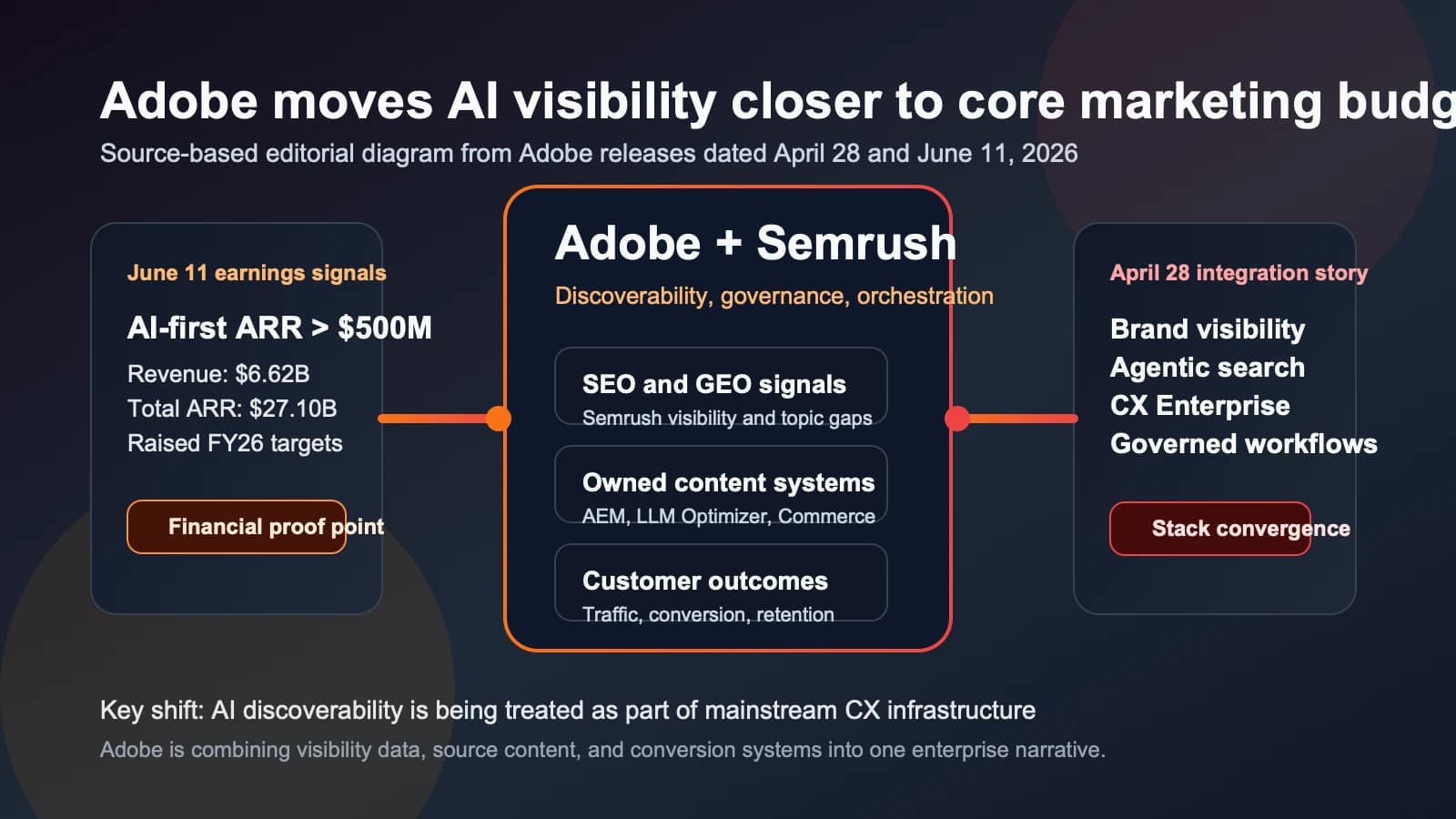
Adobe gave marketers a more concrete signal on June 11, 2026: its AI business is no longer being framed only as product vision. In the company’s second-quarter earnings release, Adobe said AI-first ARR tripled year over year and exceeded $500 million, while total Adobe ARR reached $27.10 billion. That matters more after Adobe’s April 28, 2026 completion of the Semrush acquisition, which Adobe says strengthens its customer-experience stack with brand visibility, SEO, GEO, and agentic-search capabilities.
For enterprise and upper-midmarket teams in the United States, Canada, the United Kingdom, Australia, and Europe, this is the clearest sign yet that Adobe wants AI visibility, owned-content governance, and downstream customer orchestration to sit inside one operating model. The story is not simply that Adobe had a strong quarter. It is that the company is starting to show financial proof behind a broader claim: discoverability in AI surfaces is becoming part of mainstream marketing operations rather than a side experiment.
What changed
Adobe’s official Q2 FY2026 earnings release says record revenue reached $6.62 billion, up 13% year over year, and that the company raised its full-year revenue and non-GAAP EPS targets. More relevant for operators, Adobe also said AI-first ARR now exceeds $500 million, while Business Professionals and Consumers subscription revenue reached $1.85 billion and Creative and Marketing Professionals subscription revenue reached $4.54 billion.
The Semrush angle makes those numbers more strategically interesting. Adobe’s April 28 acquisition announcement says Semrush is being folded into Adobe’s CX Enterprise push so brands can connect SEO, GEO, and agentic search optimization with Adobe Experience Manager, Adobe LLM Optimizer, Adobe Commerce, Adobe Experience Platform, and Adobe Brand Concierge. In the earnings release, Adobe also said total ARR includes approximately $480 million from Semrush and total customer-group subscription revenue includes approximately $40 million from Semrush.
| Confirmed 2026 Adobe signal | Primary source | Why it matters for operators |
|---|---|---|
| AI-first ARR exceeded $500 million and tripled year over year. | Adobe Q2 FY2026 earnings release, June 11, 2026 | Adobe can now point to measurable AI monetization, not just roadmap language. |
| Total Adobe ARR reached $27.10 billion, including about $480 million from Semrush. | Adobe Q2 FY2026 earnings release | Semrush is already material enough to show up directly in Adobe’s recurring-revenue base. |
| Adobe says Semrush strengthens CX Enterprise with SEO, GEO, and agentic search optimization. | Adobe Semrush acquisition close, April 28, 2026 | Brand visibility is being positioned as part of customer experience infrastructure. |
| Adobe raised FY2026 revenue and non-GAAP EPS guidance. | Adobe Q2 FY2026 earnings release | Management is signaling confidence that demand is holding up even as the AI stack expands. |
Why it matters
The practical implication is that Adobe is trying to turn AI-era discoverability into a budgeted systems problem. If Semrush contributes the search and visibility layer, and Adobe contributes content, data, workflow, and personalization layers, then large teams have a clearer path to manage how their brands are found, summarized, and converted after the click or citation.
That matters because AI visibility work has often been hard to defend internally. Many CMOs and digital leads can see that search behavior is shifting, but they still struggle to connect GEO, AI referral traffic, brand mentions, and content governance to revenue planning. Adobe is explicitly trying to collapse that gap. Its Semrush announcement says marketers now need to build content and experiences that educate both humans and AI agents. The June 11 earnings release then backs that strategic pitch with financial momentum.
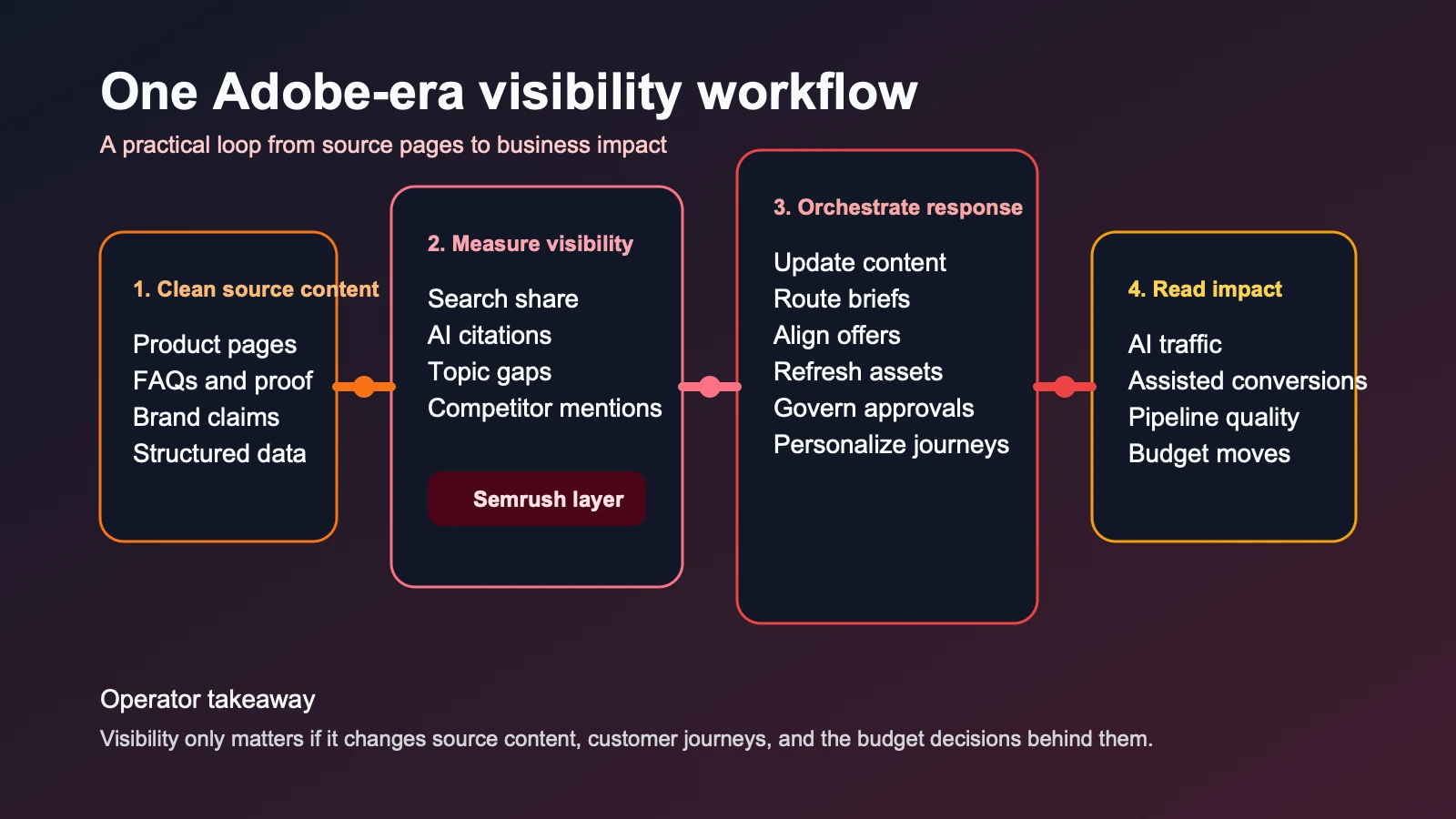
For Slogan.website readers, the useful lesson is broader than Adobe itself. Whether or not a team buys Adobe, the operating pattern is becoming clearer: own the source content, make it machine-readable, measure where AI systems surface or ignore it, and connect visibility work to conversion and lifecycle outcomes. That is the same discipline behind the GEO Visibility Checklist, the Generative Engine Optimization guide, and the framework for tracking brand mentions and visibility.
Who is affected
The first group is enterprise marketing and digital-experience teams already running Adobe plus third-party SEO or visibility tools. They now have stronger reason to map what should stay point-solution based versus what may move into Adobe’s combined stack.
The second group is agencies and consultants managing organic visibility, content operations, and performance reporting for larger clients. If Adobe makes discoverability part of the broader customer-orchestration budget, service scopes and measurement expectations will change with it.
The third group is smaller software and ecommerce teams that will not buy the full Adobe stack but still need to understand where the market is moving. When platform leaders start bundling AI visibility into mainstream CX tooling, the standards they normalize often influence everyone else.
What to do next
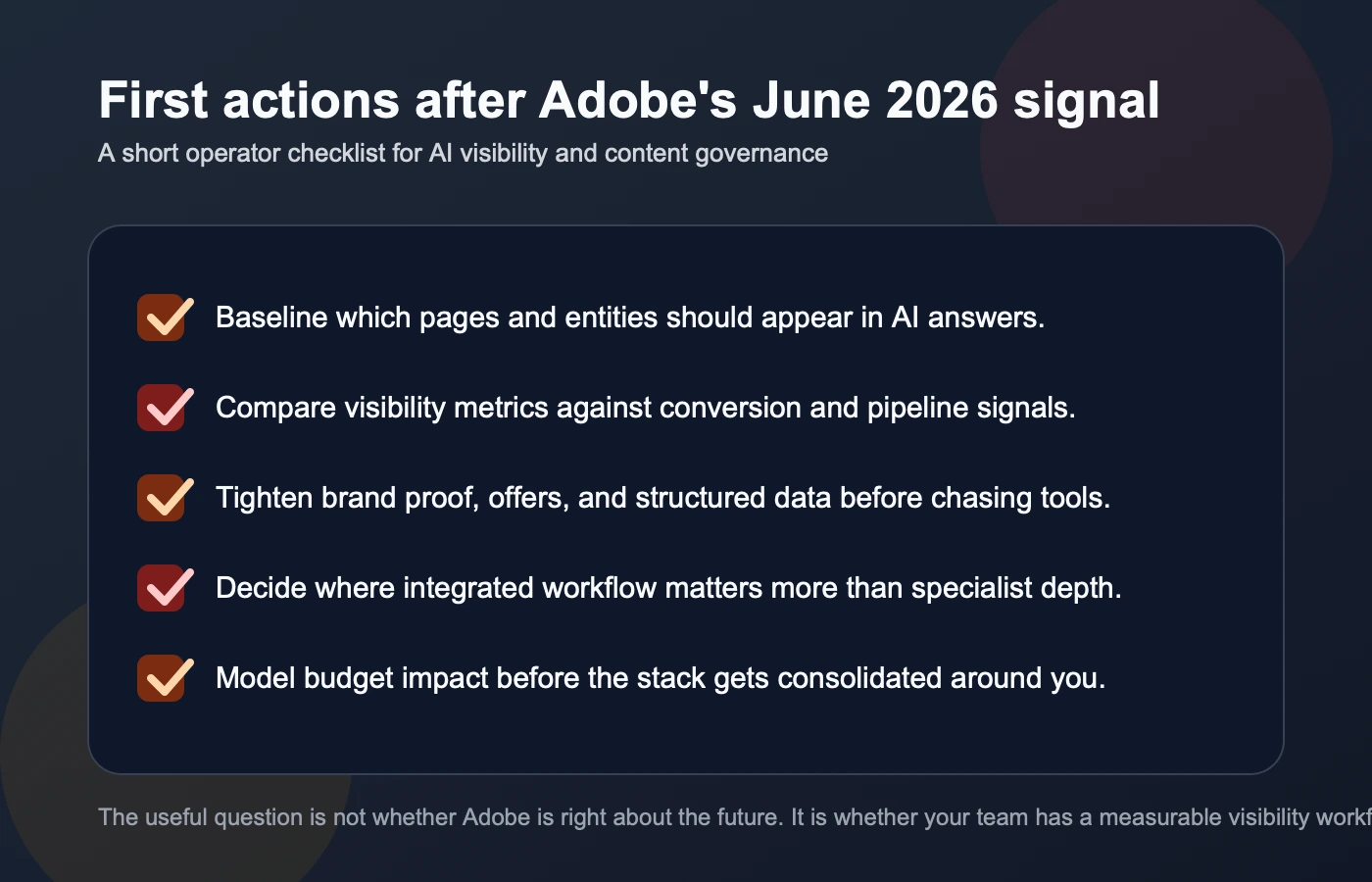
- List the pages, product entities, and proof assets that should be visible in AI answers and agentic shopping or research flows.
- Audit whether your search, GEO, and content teams still work in separate tools with separate definitions of visibility, authority, and conversion.
- Set a baseline for AI-referred traffic, assisted conversions, branded search lift, and content freshness before more budget gets assigned to AI visibility programs.
- Pressure-test the commercial case in the Marketing ROI Calculator and model budget tradeoffs in the Digital Marketing Budget Planner.
- Decide where you need integrated workflow more than point-tool depth, because that is the tradeoff Adobe is asking buyers to make.
What remains uncertain
Important questions are still open. Adobe has not yet shown how deeply Semrush workflows will integrate into day-to-day Adobe operator experiences, how pricing will shift once bundles mature, or how quickly customers outside the largest enterprises will adopt the combined visibility-and-orchestration model.
There is also organizational risk inside the same earnings release. Adobe disclosed on June 11, 2026 that CFO Dan Durn is departing on June 15, 2026, with Steve Day stepping in as interim CFO. That does not undermine the product direction by itself, but it adds one more variable while Adobe is trying to prove that its AI and search-visibility strategy can scale operationally as well as financially.
The near-term conclusion is practical. Adobe has not settled the AI-era marketing stack. But by mid-June 2026, it has made the enterprise case harder to dismiss: AI visibility is moving out of the lab, Semrush is now part of a larger orchestration story, and budget owners should start treating discoverability as a governed growth workflow rather than a loose collection of experiments.