Adobe turns brand visibility into an enterprise workflow for the agentic web
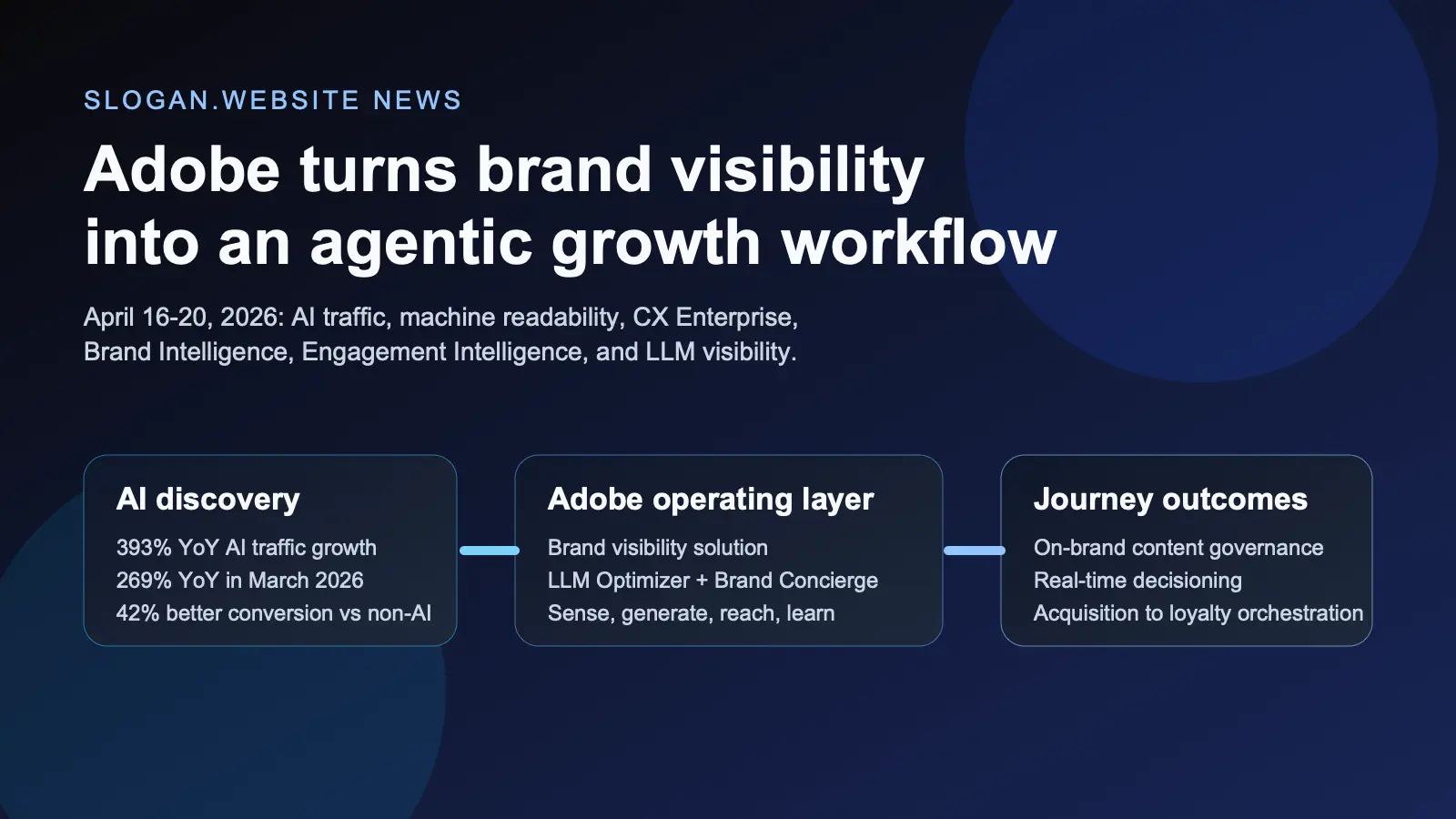
Adobe said on April 20, 2026 that it is launching a brand visibility solution for the AI era, and on the same day it introduced Adobe CX Enterprise, an end-to-end agentic system for customer lifecycle orchestration. Read with Adobe's April 16, 2026 Digital Insights report, the announcement is more than a product rename. Adobe is arguing that AI search visibility, owned-site machine readability, brand governance, and customer journey decisioning now need to live inside one operating model.
That matters to high-value operators in the United States, Canada, the United Kingdom, Australia, and Europe because AI interfaces are no longer just traffic referrers. They are becoming the front door to discovery, evaluation, and in some cases purchase intent. Adobe is trying to package the response: improve how AI systems understand your brand, connect that to governed content production, and then optimize how real customers move through the journey after they arrive.
What changed
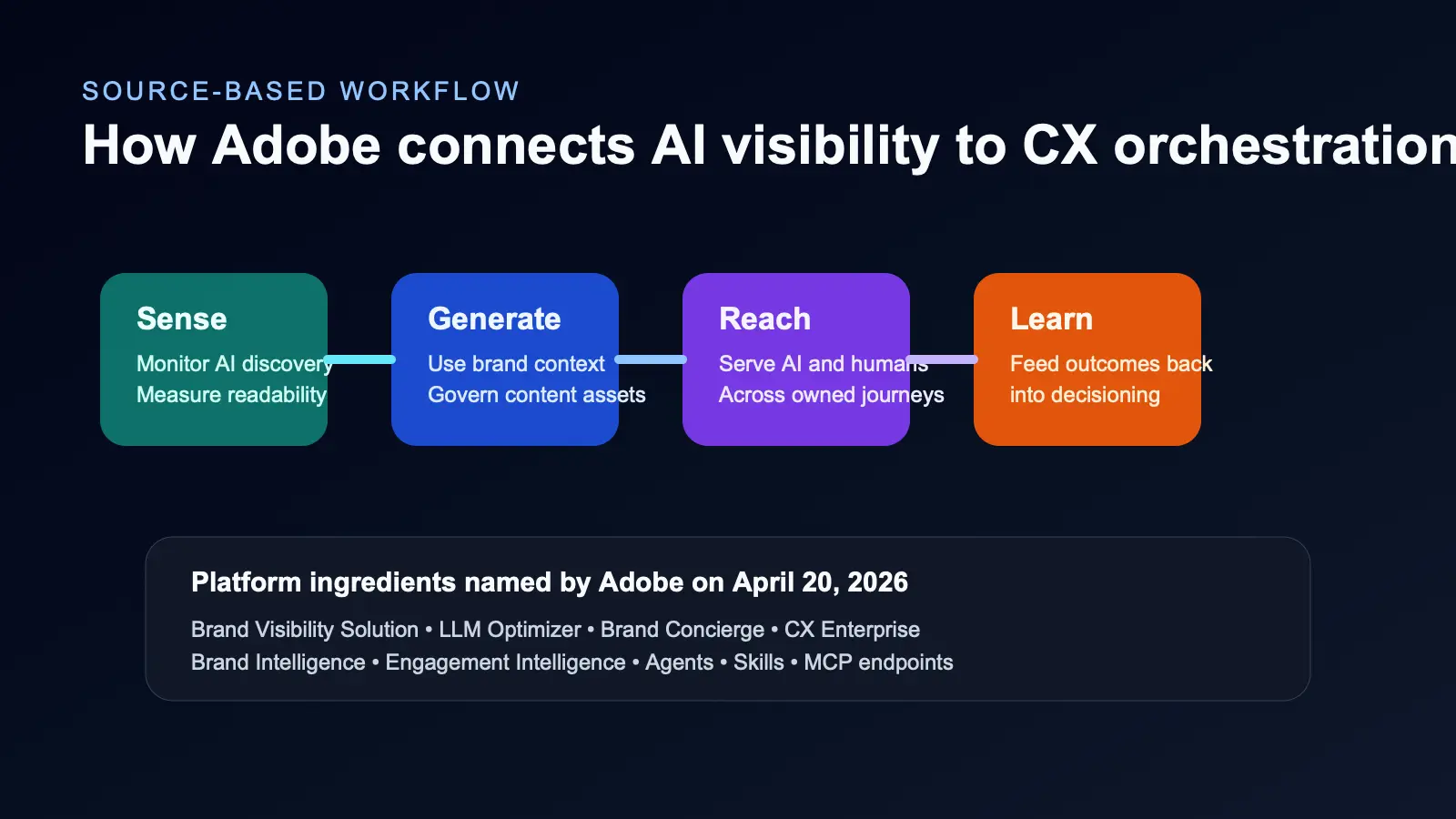
Adobe's April 20 brand visibility announcement says AI interfaces and agents are becoming a primary way customers discover and evaluate brands. Adobe positions the new solution as a response to that shift, built around Adobe Experience Manager plus new capabilities across Adobe Commerce, Adobe LLM Optimizer, and Adobe Brand Concierge. The company also says the system works as a continuous operating model across four vectors: sense, generate, reach, and learn.
The business case tightened four days earlier. In Adobe's April 16 Digital Insights post, the company said traffic from AI sources to U.S. retail sites grew 393% year over year in the first quarter of 2026 and 269% year over year in March 2026. Adobe also said AI-sourced traffic in March converted 42% better than non-AI traffic, while average product-page machine readability across the U.S. retail sector sat at 66%.
Adobe paired that visibility story with a broader orchestration story. In its April 20 CX Enterprise launch, the company said CX Enterprise brings together AI agents, agent skills, and Model Context Protocol endpoints with governance and intelligence layers. Adobe also tied the platform to Brand Intelligence, which it describes as a continuously learning brand ontology built from guidelines, approved assets, briefs, reviewer decisions, and feedback, plus Engagement Intelligence, which expands AI-powered decisioning for offers, ranking, send-time optimization, experimentation, and real-time personalization.
| Confirmed detail | Official source | Practical takeaway |
|---|---|---|
| Adobe launched its brand visibility solution on April 20, 2026 | Adobe press release | AI discovery is now being treated as a formal enterprise workflow, not an SEO side project. |
| Adobe says AI traffic to U.S. retail sites grew 393% year over year in Q1 2026 and 269% in March 2026 | Adobe Digital Insights report | Traffic from AI surfaces is large enough to justify dedicated operational changes now. |
| Adobe says AI traffic converted 42% better than non-AI traffic in March 2026 | Adobe Digital Insights report | AI visibility is not only about impressions; it is also about downstream conversion quality. |
| CX Enterprise combines agents, skills, and MCP endpoints with governance | Adobe CX Enterprise launch | Adobe wants AI discovery, content production, and lifecycle orchestration on one stack. |
| Brand Intelligence and Engagement Intelligence sit underneath the new model | Adobe Brand Intelligence and Adobe Engagement Intelligence | Governance and decisioning are becoming core inputs, not bolt-on controls. |
Why it matters
The practical shift is that Adobe is treating AI visibility and customer experience orchestration as the same problem. If AI assistants are summarizing your brand before a human clicks, then the quality of structured content, approved claims, product data, and brand context directly affects both discoverability and conversion readiness. That narrows the gap between GEO work, content operations, and lifecycle marketing.
This is especially relevant for enterprise marketing teams that operate across regions, regulated categories, or multiple product lines. Adobe's Brand Intelligence page says the system is designed to learn not only from guidelines and assets but also from reviewer feedback and approval signals. That suggests Adobe sees agentic marketing as a governance problem as much as a generation problem.
It also supports a more defensible internal business case for GEO. Many teams still frame AI-search visibility as experimental or too top-of-funnel to justify process change. Adobe's April 16 data points in the other direction. If AI traffic is rising sharply and converting better, then machine readability, source-of-truth content, and entity consistency are no longer optional hygiene. They become performance infrastructure, similar to how Slogan.website approaches the GEO Visibility Checklist, AI search analytics tooling, and the guide to tracking brand mentions and visibility.
Who is affected
The immediate audience is large enterprise and upper-midmarket teams already managing complex content and customer journey stacks.
- Marketing leaders responsible for AI-search discoverability, SEO, and brand consistency across many markets.
- Ecommerce and digital experience teams that need owned sites to be readable by both people and machines.
- CRM and lifecycle operators who want stronger decisioning across acquisition, conversion, and loyalty.
- Creative operations and governance teams reviewing more AI-assisted content without lowering compliance standards.
- Agencies and consultants that need a clearer answer when clients ask how GEO, brand governance, and personalization fit together.
What to do next
Use Adobe's April releases as a prompt to tighten operating discipline before buying into any full-stack pitch.
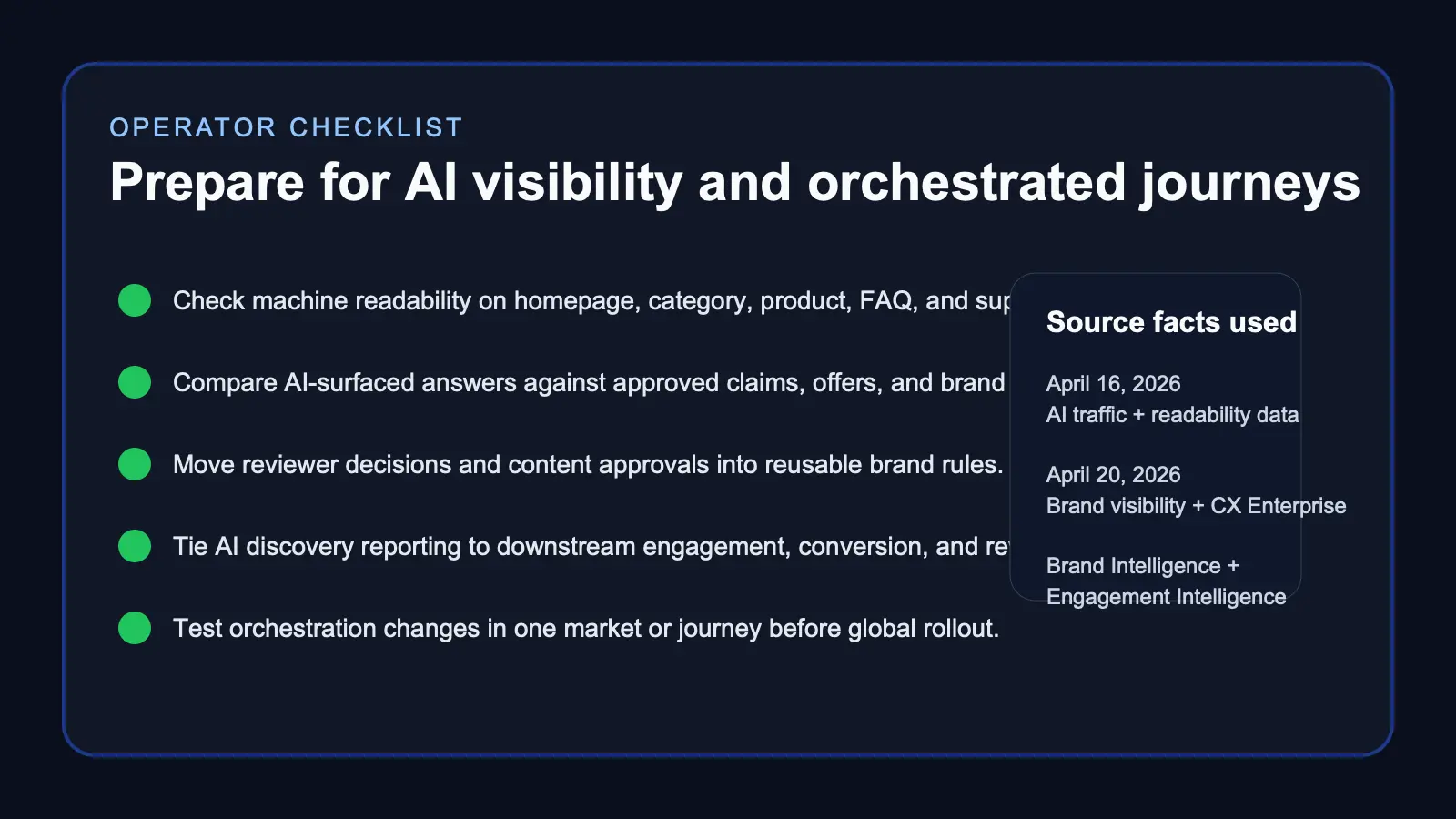
- Audit which pages matter most for AI discovery first: homepage, category pages, product or service pages, FAQ, and support content.
- Compare what your brand says on owned pages with what AI tools currently surface, then log gaps in accuracy, stale claims, and missing context.
- Identify where brand review still depends on manual tribal knowledge instead of explicit rules, approved assets, and reusable decision frameworks.
- Model whether better AI visibility could change pipeline or revenue assumptions in the Marketing ROI Calculator and the Digital Marketing Budget Planner.
- Build a simple workflow that connects source content, AI visibility checks, brand-governance review, and post-click engagement measurement before scaling more automation.
What remains uncertain
Adobe's case is compelling, but important unknowns remain. The company has not publicly detailed broad customer adoption, pricing structure, or how quickly the full system will be available outside early enterprise buyers. Some capabilities are also presented as part of a broader direction rather than a fully mature, widely deployed bundle today.
There is also a measurement risk. Adobe's April 16 data is strong, but it is still Adobe's own dataset and benchmarks. Teams should treat those numbers as credible directional evidence, then verify whether the same machine-readability and AI-traffic patterns hold in their own category, geography, and funnel mix.
The more durable takeaway on June 2, 2026 is strategic. Adobe has made the enterprise case that GEO, brand governance, and lifecycle orchestration are converging. Whether a team buys Adobe or not, the operating model behind the launch is harder to ignore: make content machine-readable, make brand context reusable, and make AI-era discovery accountable to downstream business outcomes.