Adobe turns Marketo AI and MCP into a governed workflow for program QA, lead operations, and campaign build
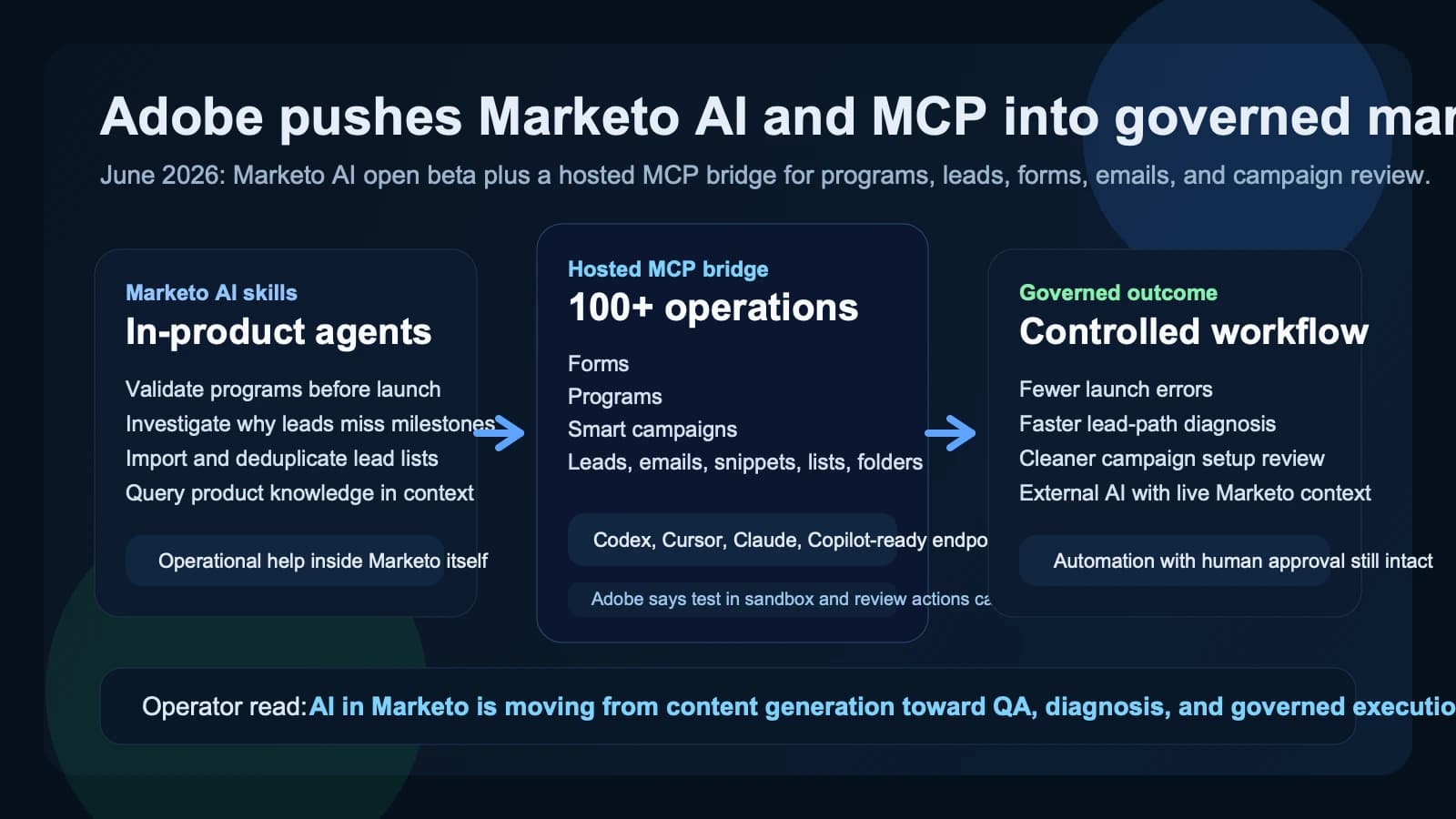
Adobe made a more operational AI move in Marketo than the usual "write me a subject line" story. In its current Marketo Engage release notes, updated June 18, 2026, Adobe says Marketo AI is now in open beta and that the Marketo Engage MCP Server is also available in open beta. The direct implication for demand generation and lifecycle teams is that Adobe is trying to move AI deeper into program QA, lead investigation, imports, and campaign orchestration, not only content assistance.
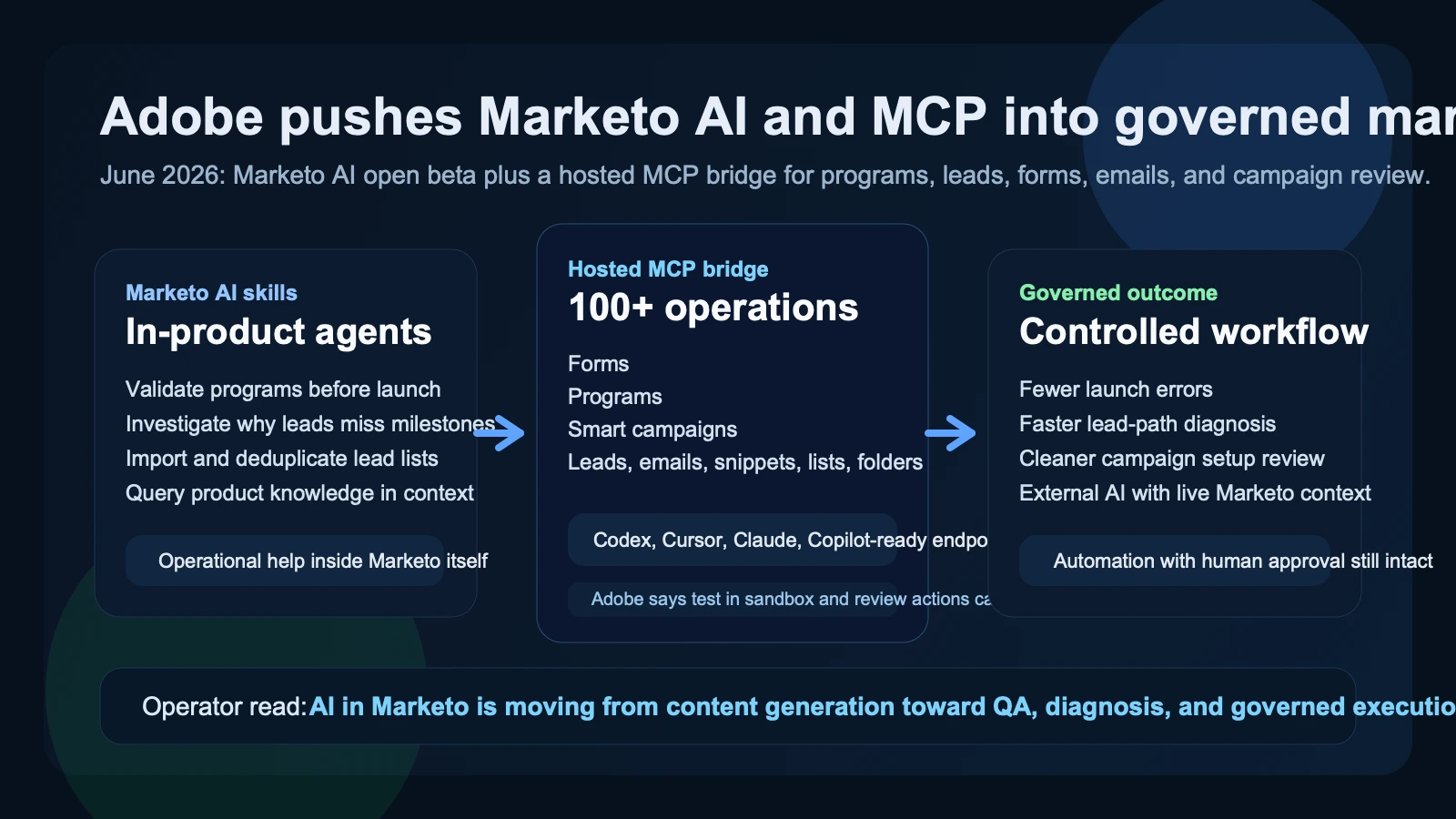
The most important detail is in the product documentation. Adobe's Marketo AI overview, updated June 18, says the product currently offers purpose-built skills such as Investigate leads, Validate programs, Import leads, and Product knowledge. In parallel, Adobe's Marketo Engage MCP Server documentation says marketers and developers can connect external AI tools to Marketo through a hosted server that exposes more than 100 operations across forms, programs, smart campaigns, leads, emails, snippets, lists, and folders. That combination is what makes this news useful: Adobe is assembling an AI control layer around marketing operations work.
What changed
| Confirmed June 2026 point | Primary source | Why it matters operationally |
|---|---|---|
| Adobe lists Marketo AI in open beta, with two agents available now and more coming soon. | Marketo release notes, updated June 18, 2026 | The feature set is live enough to evaluate, but still early enough that teams should expect phased rollout and uneven maturity. |
| The Marketo AI overview names Investigate leads, Validate programs, Import leads, and Product knowledge as current skills. | Marketo AI overview, updated June 18, 2026 | Adobe is focusing AI on operational bottlenecks that usually burn team time before launch and after handoff. |
| Adobe says the Marketo MCP server exposes more than 100 operations across forms, programs, smart campaigns, leads, emails, snippets, lists, and folders. | Marketo MCP server docs, updated April 27, 2026 | External AI tools can access live marketing objects instead of working from static exports or prompts alone. |
| Adobe explicitly tells customers to test MCP integrations in sandbox environments and review MCP-initiated actions carefully. | Marketo MCP server docs, updated April 27, 2026 | Adobe is signaling that governance and review are part of the rollout, not optional cleanup. |
| Adobe's supported-operations page says the AI system is generally limited to read-only or non-destructive endpoints and that destructive operations are not available. | Marketo MCP operations, updated June 2, 2026 | The current design favors inspection, setup assistance, and controlled changes over blind automation. |
The release notes also say the standard-cycle May '26 features began rolling out on May 22, 2026 and that the remaining features are being phased in over subsequent weeks. That matters because enterprise Marketo teams should not assume every skill or integration is fully visible in every subscription on the same day.
Why it matters
The marketing-ops problem Adobe is targeting is familiar. Teams can already use AI to brainstorm emails and landing pages, but many of the highest-friction tasks still happen in brittle manual steps: checking whether a program is configured correctly, figuring out why a lead never reached MQL, mapping fields during imports, or tracing which campaign asset needs attention before launch.
Marketo AI aims directly at that layer. Adobe's documentation says Validate programs checks setup against best practices before launch, while Investigate leads explains why a lead did not hit a milestone such as MQL or program qualification. For teams managing complex nurture flows, regional programs, and revenue-stage reporting, that is more strategically important than one more content copilot.
The MCP angle expands the scope further. Adobe's MCP documentation says the hosted endpoint works with AI tools such as Codex, Cursor, Claude Desktop, Claude Code, and GitHub Copilot, and that it can operate across forms, smart campaigns, and program objects through standard REST-backed actions. In practical terms, that means Marketo is becoming easier to interrogate from the same AI environment where teams already plan workflows, document launch checklists, and compare channel impact with tools like the Marketing ROI Calculator, the Digital Marketing Budget Planner, and the GEO Visibility Checklist.
Who is affected
The first group is B2B demand generation and lifecycle marketing teams running high-volume programs across regions, segments, or product lines. They are the most likely to benefit from automated pre-launch QA, lead-path diagnosis, and cleaner import workflows.
The second group is marketing operations and RevOps teams that already sit between campaign owners, CRM admins, and analytics stakeholders. Adobe's MCP documentation makes clear that these teams need API access, credentials, and review processes before they can safely connect external AI tools to Marketo. The gain is not magic autonomy. The gain is faster access to live system context.
Agencies and consultants supporting enterprise Marketo instances are also affected. If an AI assistant can inspect forms, smart campaigns, and programs through the MCP layer, audits and troubleshooting can become more repeatable. But the same documentation also makes it clear that configuration quality, permissions, and human review still define the ceiling.
What to do next
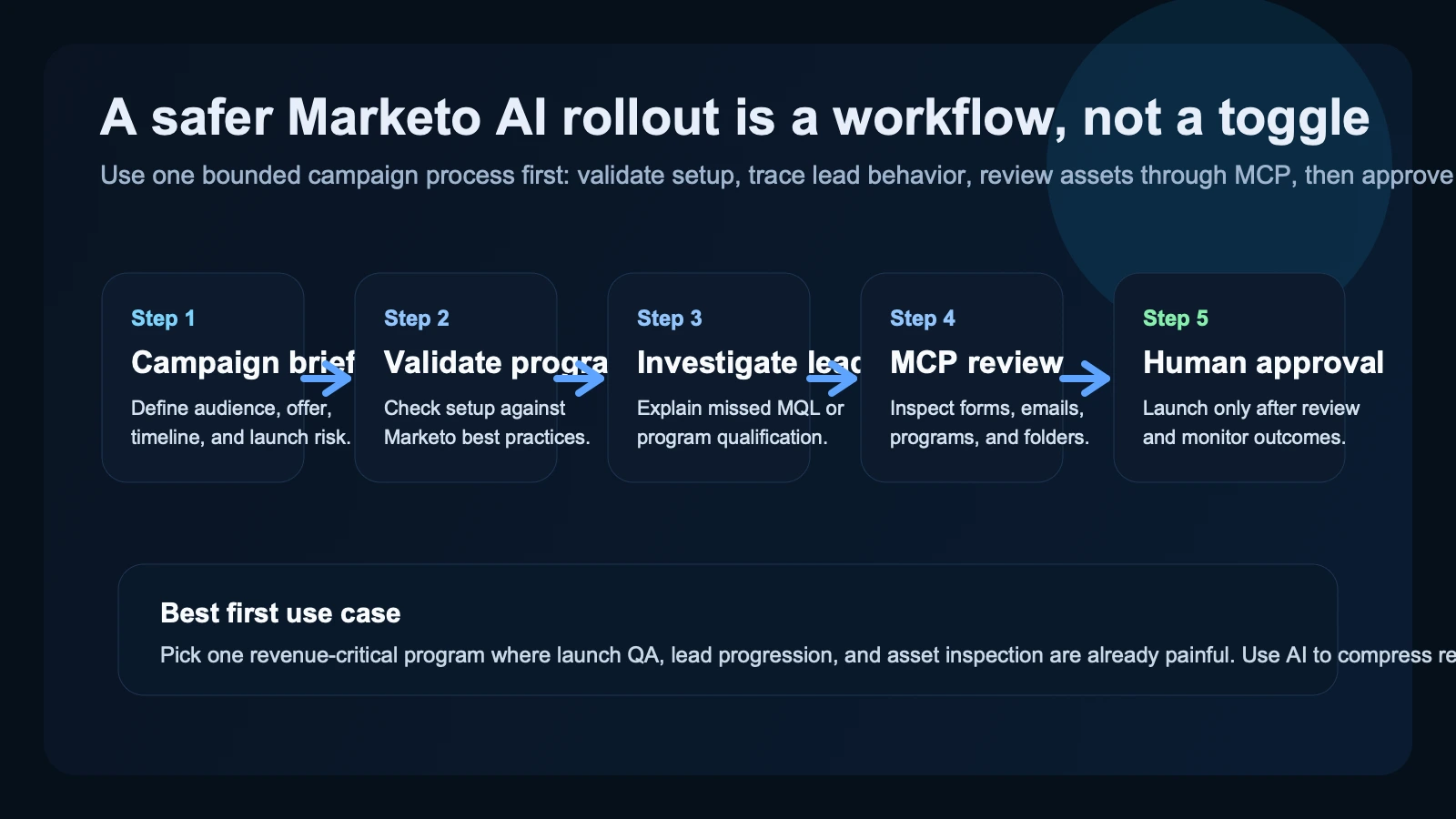
- Separate the two layers in your rollout plan: in-product Marketo AI skills versus the external-tool MCP connection.
- Start with one bounded operations use case, such as pre-launch program QA or diagnosing why a lead did not progress to MQL.
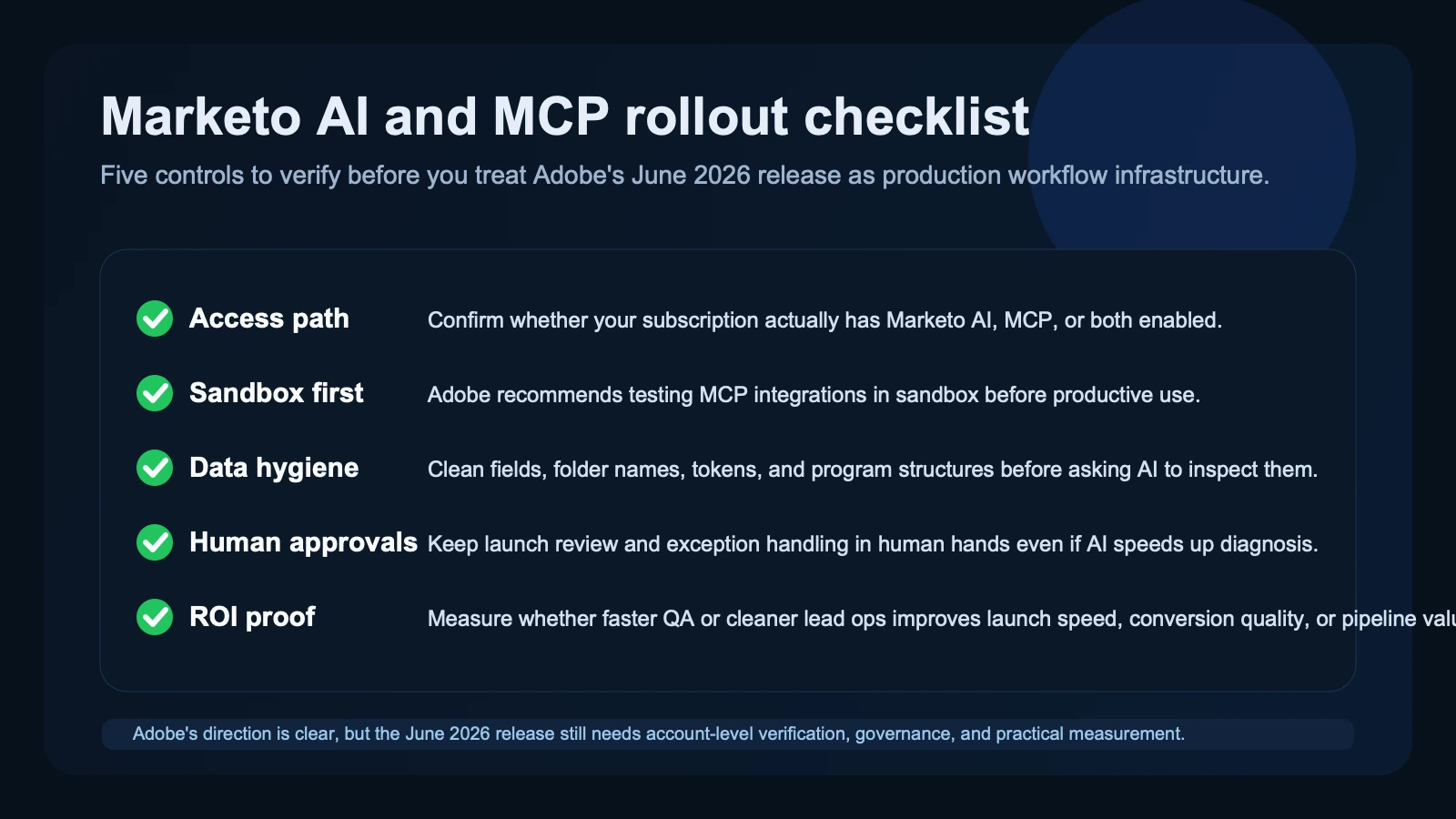
- Review whether your Marketo instance naming, folder structure, field hygiene, and API-user model are clean enough for AI-assisted inspection.
- Use a sandbox first, because Adobe explicitly recommends testing MCP integrations before productive use.
- Model the cost of faster launch review or cleaner lead operations against actual pipeline value with the Marketing ROI Calculator and the Digital Marketing Budget Planner.
What remains uncertain
Important limits remain on June 18, 2026. Adobe says Marketo AI is in open beta and tells customers to contact their account manager for access, which implies availability can still vary by account and contract. The MCP server documentation still labels the feature as limited availability even while the release notes position it as open beta, so buyers should verify what is actually enabled in their subscription rather than assuming universal access.
Adobe also says additional agents are still coming, including future help for diagnosing why a lead failed to progress and for generating entire Marketo programs from a campaign brief. That tells you the platform direction, but it also shows the current release is incomplete. The current opportunity is not "hands-off AI marketing." It is governed assistance for QA, lead operations, and campaign setup in systems where mistakes are expensive.
That is enough to matter. Adobe's June 2026 Marketo changes push AI closer to the operating core of B2B marketing teams. The winners will be the teams that treat those capabilities as controlled workflow infrastructure, then connect them back to planning, measurement, and visibility discipline instead of treating them as another content gimmick.