Amazon Ads makes unified reporting the default measurement path and starts the clock on report migration
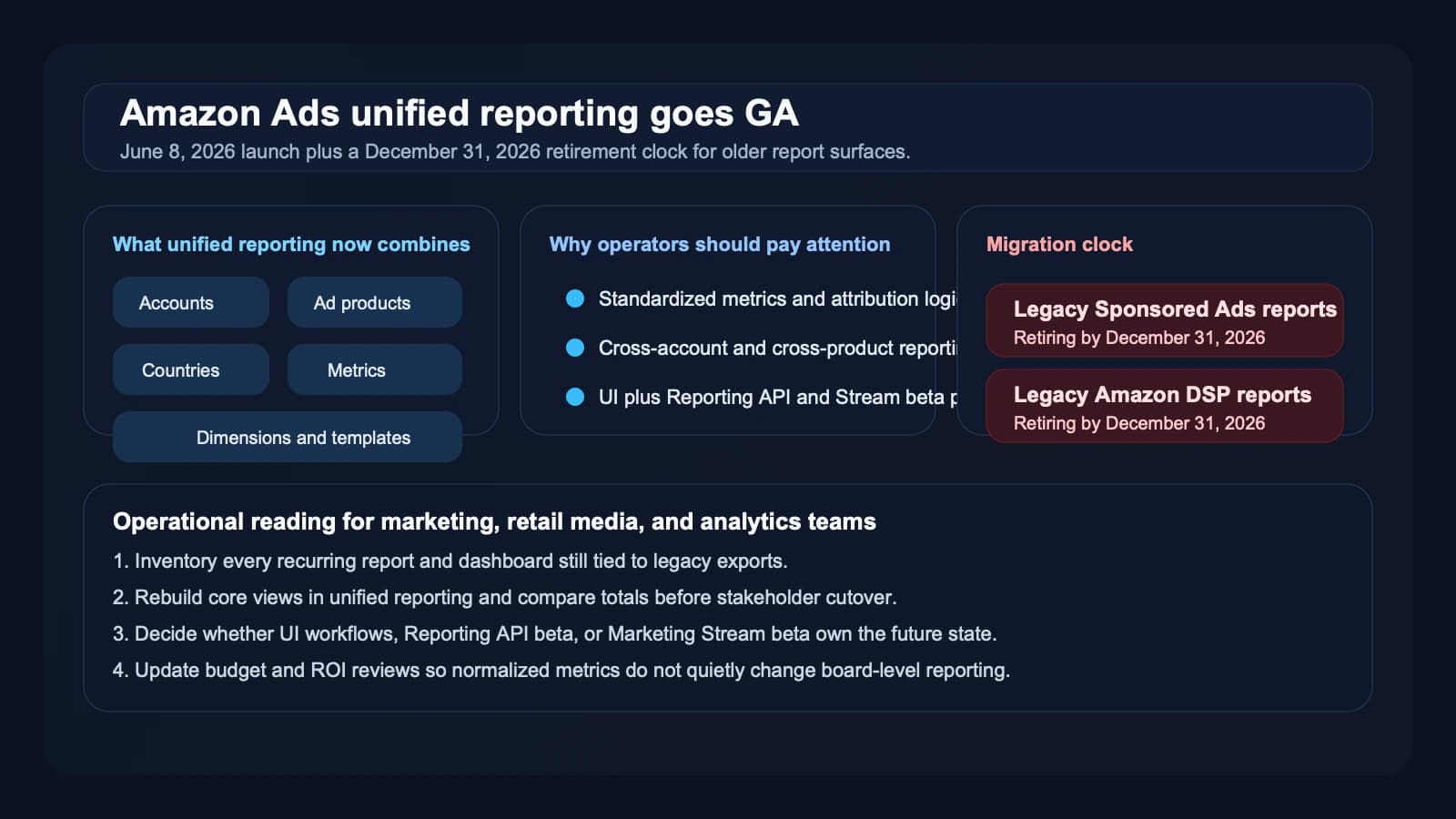
Amazon Ads created a practical measurement deadline on June 8, 2026 when it made unified reporting generally available inside Ads Console. The launch itself matters because Amazon says advertisers can now build one report across multiple accounts, ad products, countries, metrics, and dimensions instead of stitching together separate exports. The bigger operational detail is what comes next: Amazon says the older Sponsored Ads reports and Amazon DSP reports surfaces are being shut down by December 31, 2026, according to the launch announcement and its support documentation.
For agencies, in-house retail media teams, measurement leads, and adtech vendors, this is not just a convenience upgrade. It changes where reporting work happens, how metrics are standardized, and which workflows need to be rebuilt before year-end. Amazon also says unified reporting is available through the Ads Console, Amazon Marketing Stream in beta, and the new reporting API in beta, which means the migration is relevant both for people operating in the UI and for teams that automate reporting downstream.
What changed
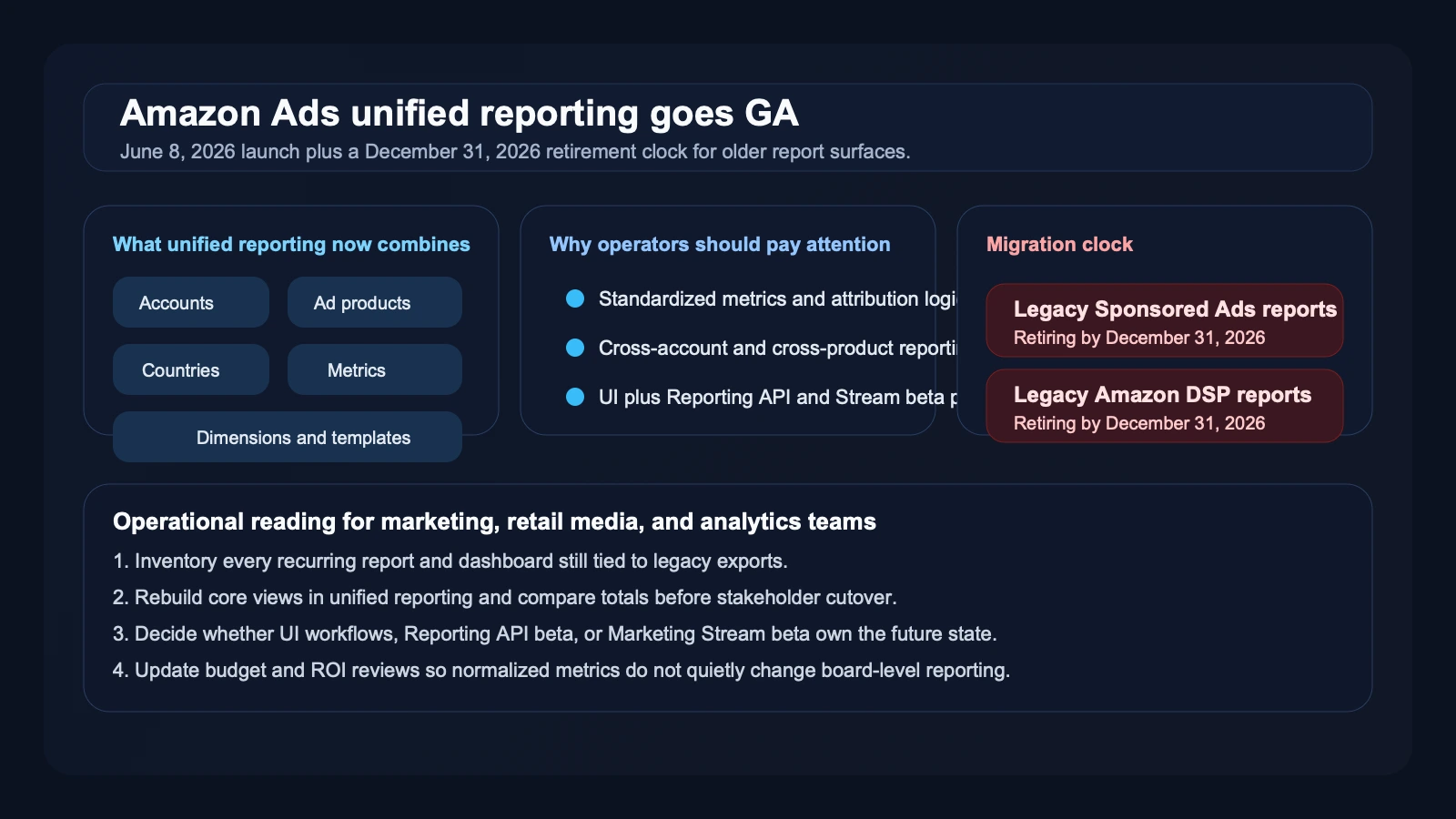
Amazon's official June 8 launch post says unified reporting is now generally available in Ads Console and can pull campaign data across multiple manager or advertiser accounts, ad products, countries, metrics, and dimensions in one place. Amazon also says the release includes standardized metrics and attribution methodology, report templates, single-account workflow improvements, and managed-service support based on beta feedback.
The migration impact becomes clearer in Amazon's own help materials. Its support article for unified reporting says Amazon is shutting down Sponsored Ads reports and Amazon DSP reports by December 31, 2026. That means teams cannot treat this as a passive UI enhancement. If scheduled exports, executive dashboards, finance reviews, or partner deliverables still depend on legacy report surfaces, they now sit on a retirement path.
Amazon is also expanding the programmatic side around the same model. The official Amazon Ads Advanced Tools Center describes its reporting API as a new cross-account, cross-ad-product interface with standardized metrics for ad-hoc use cases, and the API release notes show new unified reporting fields continuing to land, including a custom deal name dimension added on June 3, 2026. Read together, the message is straightforward: Amazon wants reporting to become one consolidated surface, not a collection of separate product-specific exports.
| Confirmed change | Primary source | Why operators should care |
|---|---|---|
| Unified reporting became generally available on June 8, 2026. | Amazon Ads launch announcement | Teams can now consolidate reporting across accounts, ad products, and countries in one workflow. |
| Amazon says standardized metrics, dimensions, and attribution methodology are part of the GA release. | Amazon Ads launch announcement | Legacy reporting assumptions may no longer match the normalized logic used in the new layer. |
| Sponsored Ads reports and Amazon DSP reports are being shut down by December 31, 2026. | Amazon Ads support documentation | Any workflow still tied to old report surfaces now has a migration deadline. |
| Amazon says unified reporting can also be accessed through Amazon Marketing Stream beta and the reporting API beta. | Amazon Ads launch announcement and Amazon Ads API documentation | Data teams and software vendors need to plan both UI and API changes, not only analyst retraining. |
| New unified reporting dimensions are still shipping in API release notes. | Amazon Ads API release notes | The schema is alive, so brittle downstream mappings will age badly if teams treat this as a one-time migration. |
Why it matters
This matters because fragmented reporting creates false confidence. One team exports sponsored ads data, another exports DSP data, finance looks at a blended spreadsheet, and leadership sees a dashboard that depends on several hand-built joins nobody wants to touch. When Amazon pushes measurement into one normalized surface, the upside is obvious: faster reporting, fewer copy-paste workflows, and cleaner cross-product visibility. The risk is also obvious: teams that do not migrate intentionally can spend the second half of 2026 rebuilding reports under deadline pressure.
For operators in the United States, Canada, the United Kingdom, Australia, and Europe, the market coverage is wide enough to make this relevant now rather than "later." Amazon's launch page lists availability across North America, much of Europe, and Australia, among other regions. That makes the change practical for multinational advertisers, agencies with regional account structures, and software teams that need one measurement model spanning several markets.
There is also a business-layer effect. Standardized reporting is only useful if marketers can translate it into budgeting and decision-making. That is why this story connects naturally to the Marketing ROI Calculator, the Digital Marketing Budget Planner, and the guide to tracking brand mentions and visibility. Better reporting infrastructure should reduce ambiguity between spend, visibility, and revenue. If it only creates a shinier export screen, teams have not captured the value.
Who is affected
The most exposed group is agencies and enterprise retail media teams running recurring client or stakeholder reporting across Sponsored Ads and DSP. They are the ones most likely to have brittle scheduled workflows, custom spreadsheets, or legacy dashboard logic that assumes older report surfaces stay available.
The second group is adtech vendors, internal data teams, and analytics engineers that ingest Amazon Ads data programmatically. The reporting API direction matters to them because schema standardization and field additions will affect warehouse models, dashboard definitions, and QA rules.
The third group is finance and planning stakeholders. If old and new report surfaces calculate attribution or dimensions differently, budget reviews can drift unless teams document the cutover clearly. That is especially important for operators already benchmarking Amazon against Google, Meta, TikTok, Instacart, or other paid media systems.
What to do next
Use the remainder of 2026 as a controlled migration window, not as a waiting room.
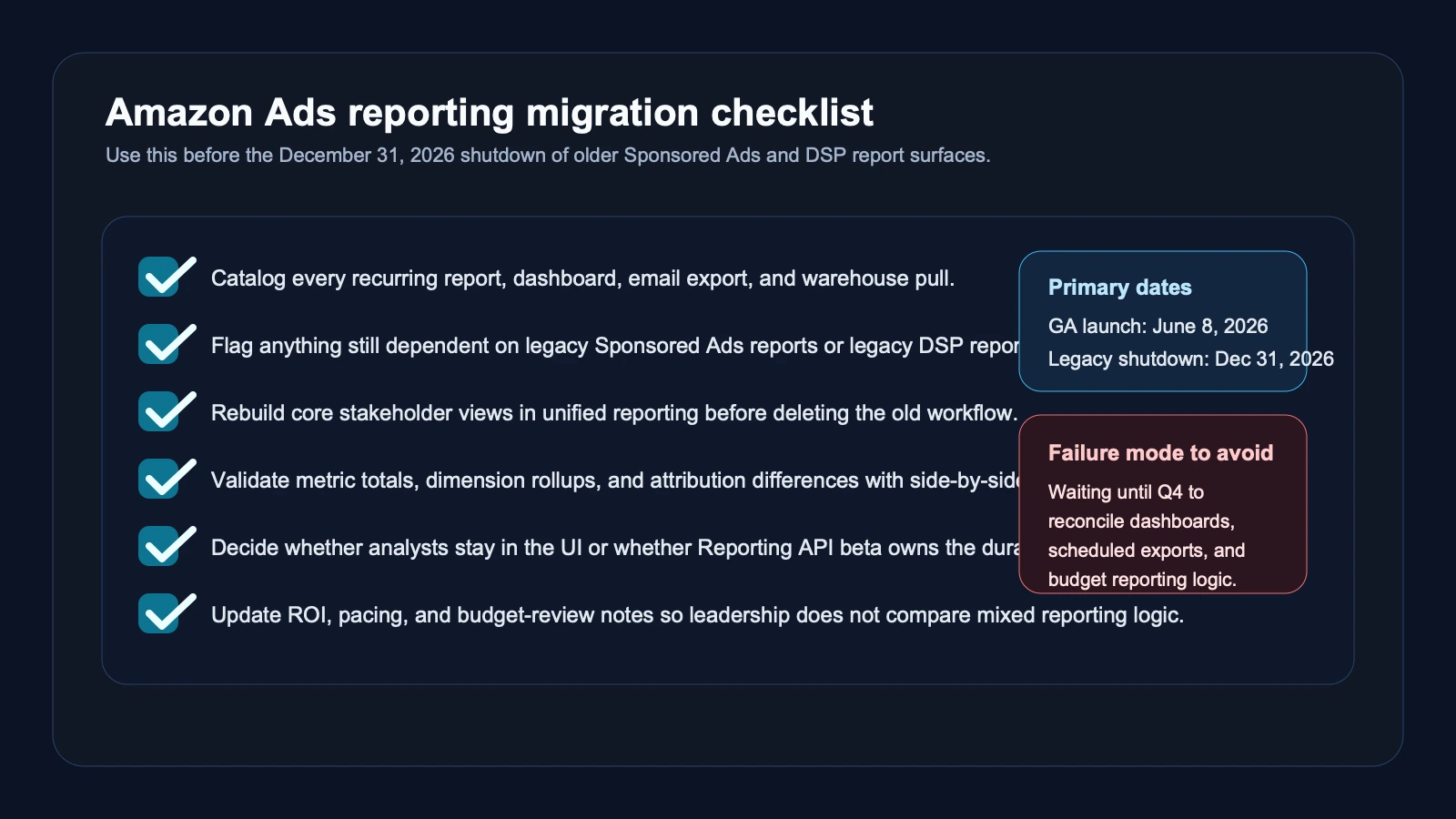
- Inventory every recurring Amazon Ads report your team depends on, including UI exports, scheduled emails, partner deliverables, warehouse pulls, and executive dashboards.
- Mark which ones still rely on Sponsored Ads reports or Amazon DSP reports so the December 31, 2026 shutdown does not surprise anyone.
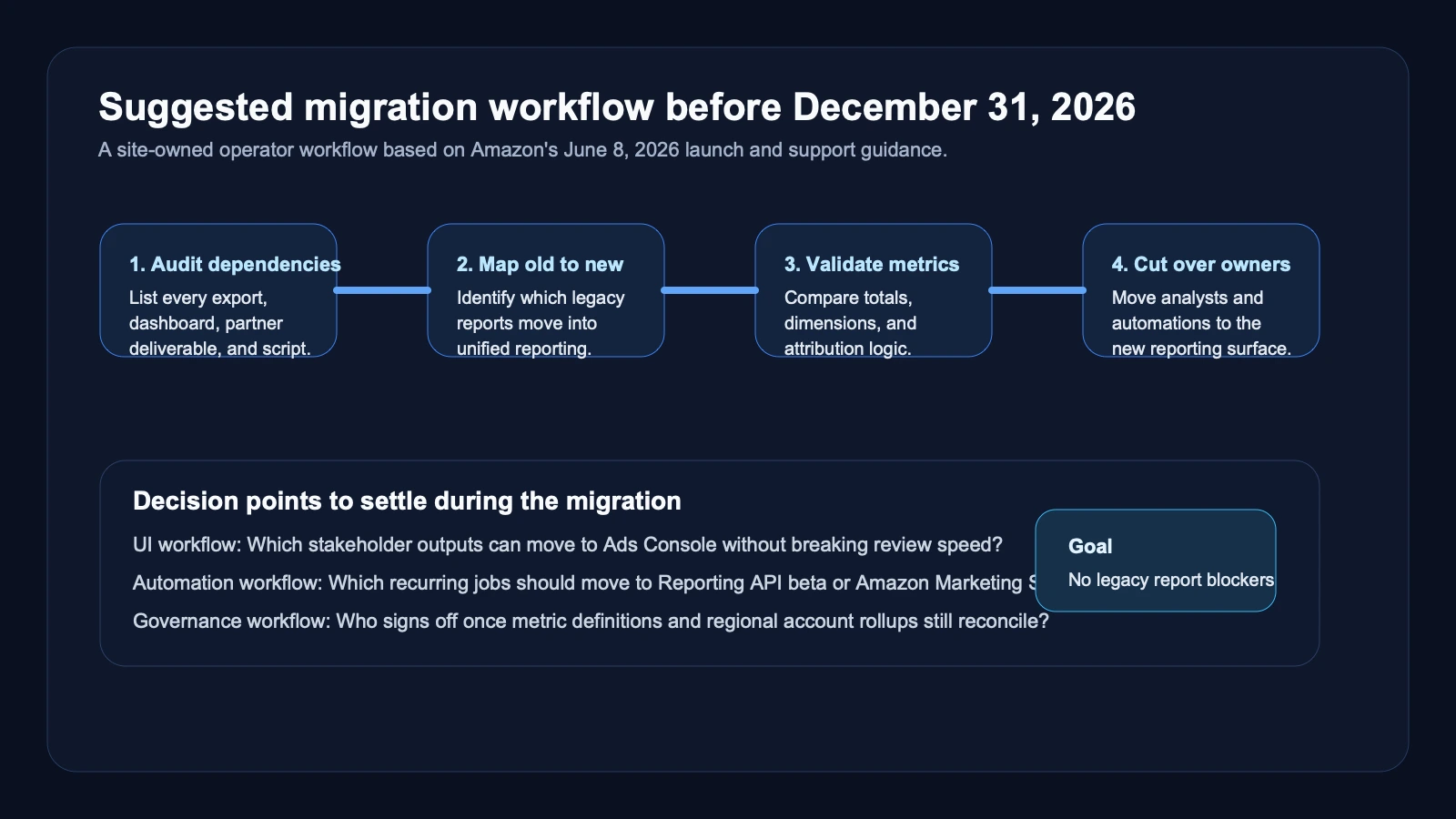
- Rebuild your core reporting views in unified reporting first, then compare totals, dimensions, and attribution logic before replacing stakeholder-facing outputs.
- Check whether your technical stack should use the reporting API beta or Amazon Marketing Stream beta for more durable automation instead of manual exports.
- Update your ROI and budget review process in tools like the Marketing ROI Calculator and Digital Marketing Budget Planner so any metric definition changes are visible to decision-makers.
- Document the cutover date, metric caveats, and remaining gaps in one place so analysts, buyers, and finance teams are not comparing mixed reporting regimes.
What remains uncertain
Amazon's public materials leave some boundaries open. The company does not publish every metric-level difference teams may encounter when moving from older report surfaces into the normalized unified reporting model. It also does not guarantee that every partner's custom workflow can be recreated one-for-one immediately, especially if that workflow depends on niche fields, partner-side joins, or legacy stakeholder expectations.
There is also the usual beta caveat on the technical layer. Amazon explicitly describes Amazon Marketing Stream access and the reporting API access in this context as beta, so automation teams should assume capabilities and field support will continue to evolve through 2026. That is not a reason to wait. It is a reason to migrate with testing and documentation instead of assuming the first rebuilt report is final.
The defensible conclusion on June 11, 2026 is narrower than hype but stronger than a product update. Amazon has made unified reporting the center of its measurement direction and attached a real retirement date to older report surfaces. Teams that migrate early can use the rest of the year to improve cross-product visibility and reduce reporting friction. Teams that ignore the shift will likely end up doing rushed repair work closer to December 31.