Anthropic turns Claude implementation into a tiered partner market for agencies and enterprise operators
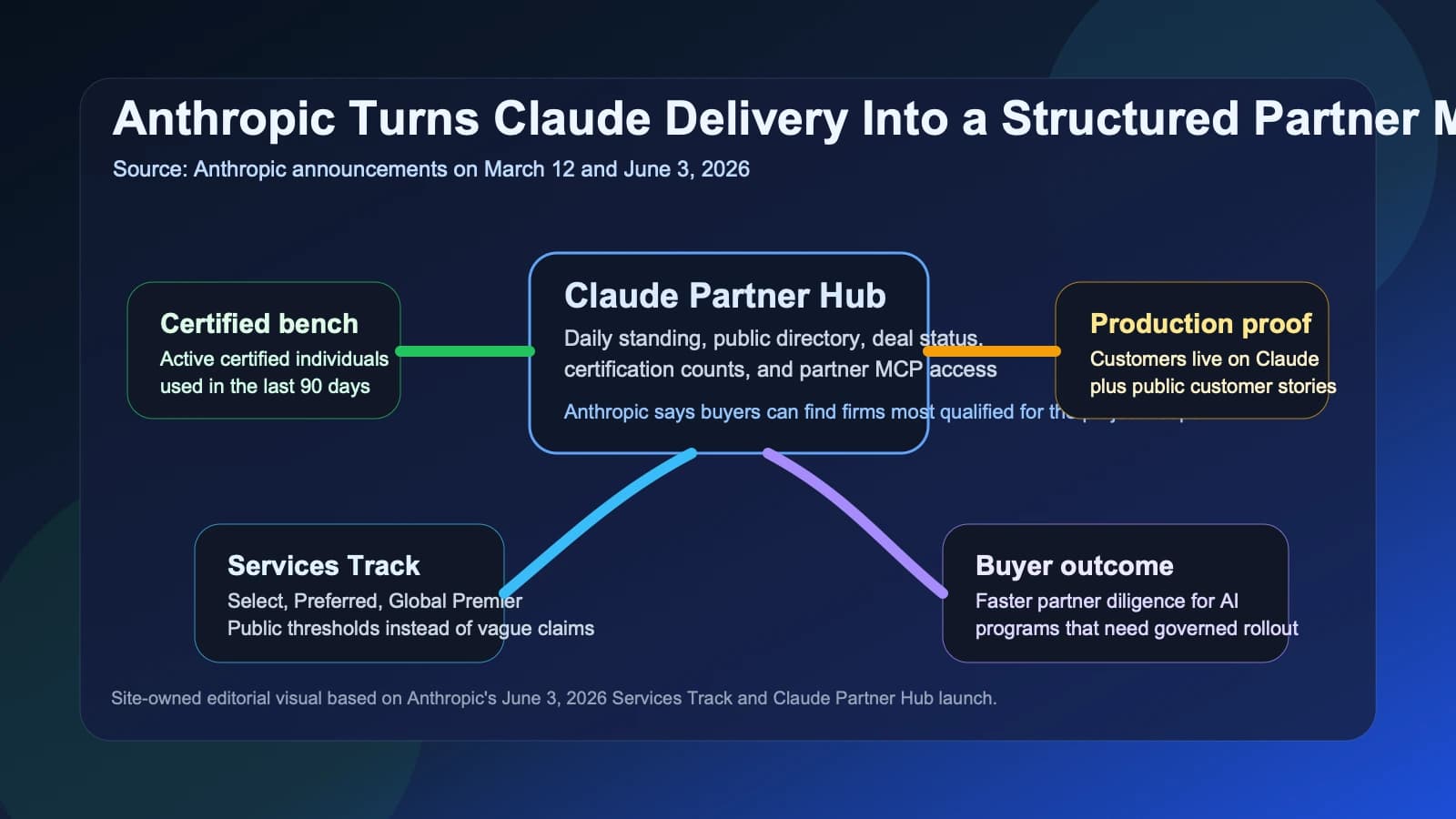
Anthropic said on June 3, 2026 that it is adding a Services Track and a Claude Partner Hub to the Claude Partner Network, turning Claude implementation into a more structured market for buyers, agencies, consultancies, and enterprise transformation teams. For operators deciding who should own AI deployment, this matters because Anthropic is publishing a ranking system, daily partner telemetry, and a visible buyer directory tied to what firms have actually delivered in production.
The timing is commercially relevant. Anthropic's earlier March 12, 2026 network launch committed $100 million to partner training, technical support, and joint market development. The June 3 update adds the measurement layer that tells the market which firms are building a real Claude practice versus which ones are still selling slides and pilot rhetoric.
What changed
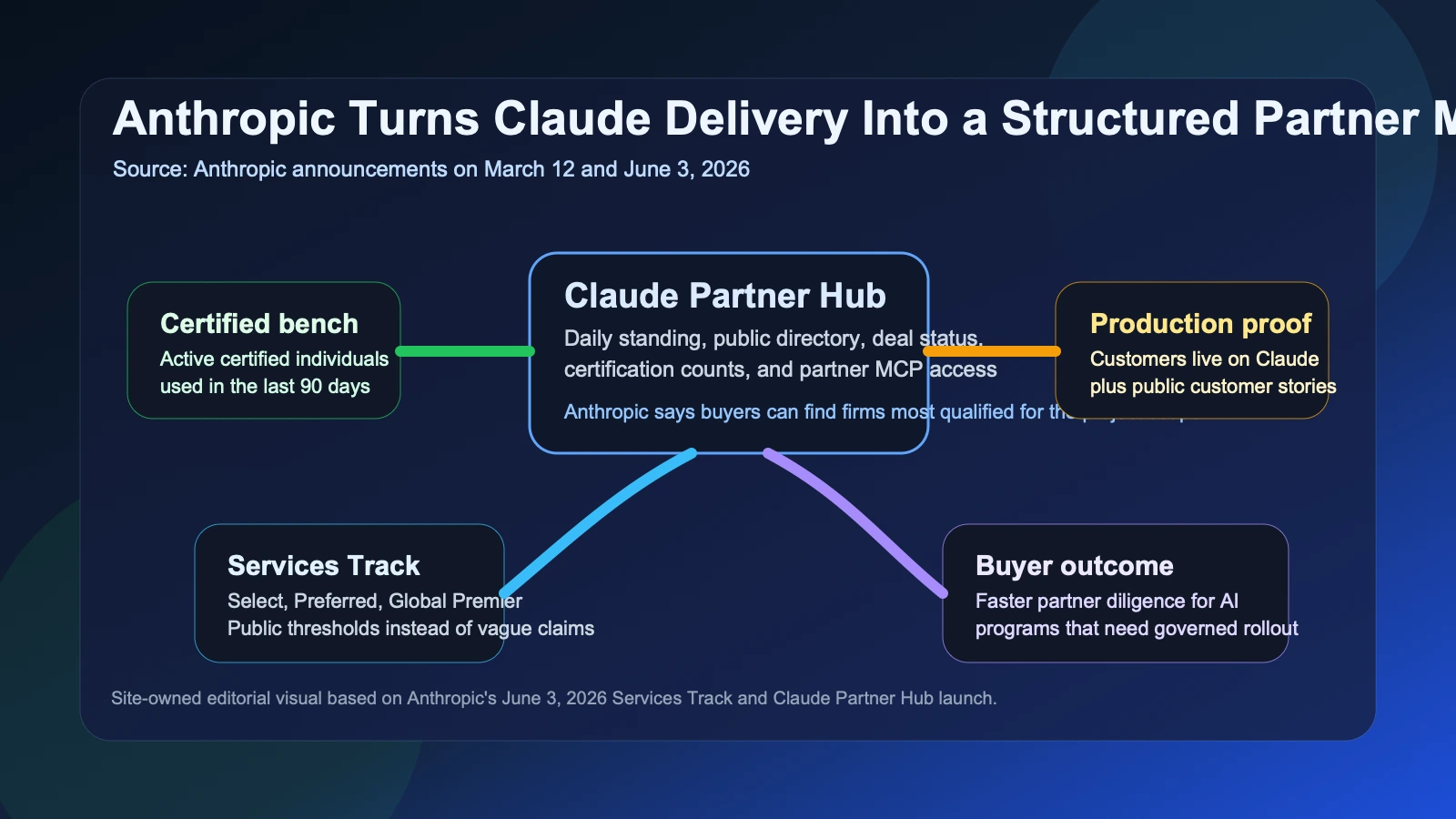
Anthropic's June 3 announcement creates two practical layers: the Services Track ranks partner firms by tier, and the Claude Partner Hub exposes the evidence behind those rankings.
| Confirmed June 3 detail | Official source | Why it matters |
|---|---|---|
| Anthropic says more than 40,000 firms have applied to the Claude Partner Network and more than 10,000 consultants have earned a Claude certification. | Anthropic, June 3, 2026 | The services layer around Claude is already large enough that buyers need a filtering mechanism. |
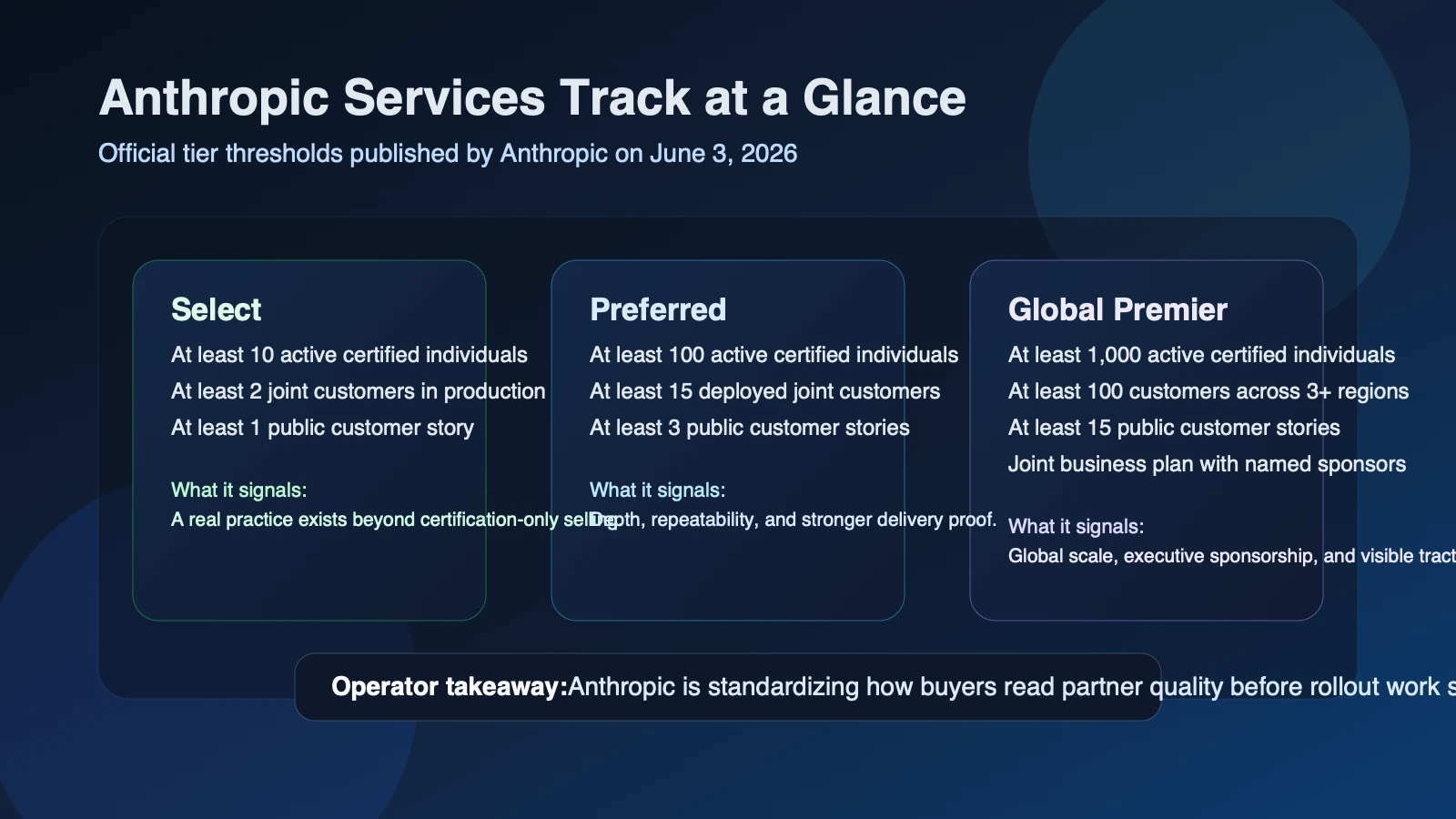
| The Services Track now has three tiers: Select, Preferred, and Global Premier. | Anthropic, June 3, 2026 | Partner quality is being translated into public market signals instead of informal claims. |
| Select requires at least 10 active certified individuals, 2 deployed joint customers, and 1 public customer story. | Anthropic, June 3, 2026 | Even entry-level credibility now depends on live delivery evidence, not only headcount. |
| The Claude Partner Hub refreshes partner standing daily and shows tier, certified team, customer deployments, and public references. | Anthropic, June 3, 2026 | Procurement and partner selection can become faster and more evidence-driven. |
| Anthropic's March 12 launch committed $100 million to training, technical support, and joint market development for partners. | Anthropic, March 12, 2026 | The June structure sits on top of a larger go-to-market investment, not a one-off directory. |
Anthropic also says the Hub is both a partner console and a public directory where buyers can find firms "most qualified for the scope of their project," while partners can ask Claude about tier progress, deal status, and certification counts through a new MCP connector. That shifts the ecosystem from general partner branding toward an operational workflow inside the product layer itself.
Why it matters
This matters because the bottleneck in enterprise AI is increasingly implementation quality, not awareness. Anthropic says in the same June 3 announcement that "a successful pilot is not the same as a system a business can run on." That is a practical buying signal for CMOs, COOs, RevOps leaders, digital transformation heads, and agency principals who are being asked to operationalize AI without creating new governance debt.
For agencies and consultancies, the update changes positioning. A firm can no longer rely only on generic "we build with AI" messaging if enterprise buyers can compare active certifications, production deployments, and public case studies in one official directory.
For buyers, the update makes partner diligence more concrete. Anthropic's March 12 launch already framed partners as the groups that help enterprises navigate deployment, compliance, and change management. The June 3 update adds public thresholds and a visible upgrade ladder, so procurement teams have a better way to separate experimentation support from production-grade enablement.
Who is affected
The first group is service firms building around Claude: AI consultancies, system integrators, software implementation shops, and agency groups expanding into automation or workflow design. The second is enterprise operators evaluating outside help for marketing operations, analytics, customer support, and product enablement. The third is smaller firms trying to compete up-market; Anthropic says the same requirements apply to a ten-person AI-native shop and a global consultancy.
What to do next
- If you sell AI services, map your current Claude work against Anthropic's three public proof signals: active certified people, customers live in production, and customer stories you can publish.
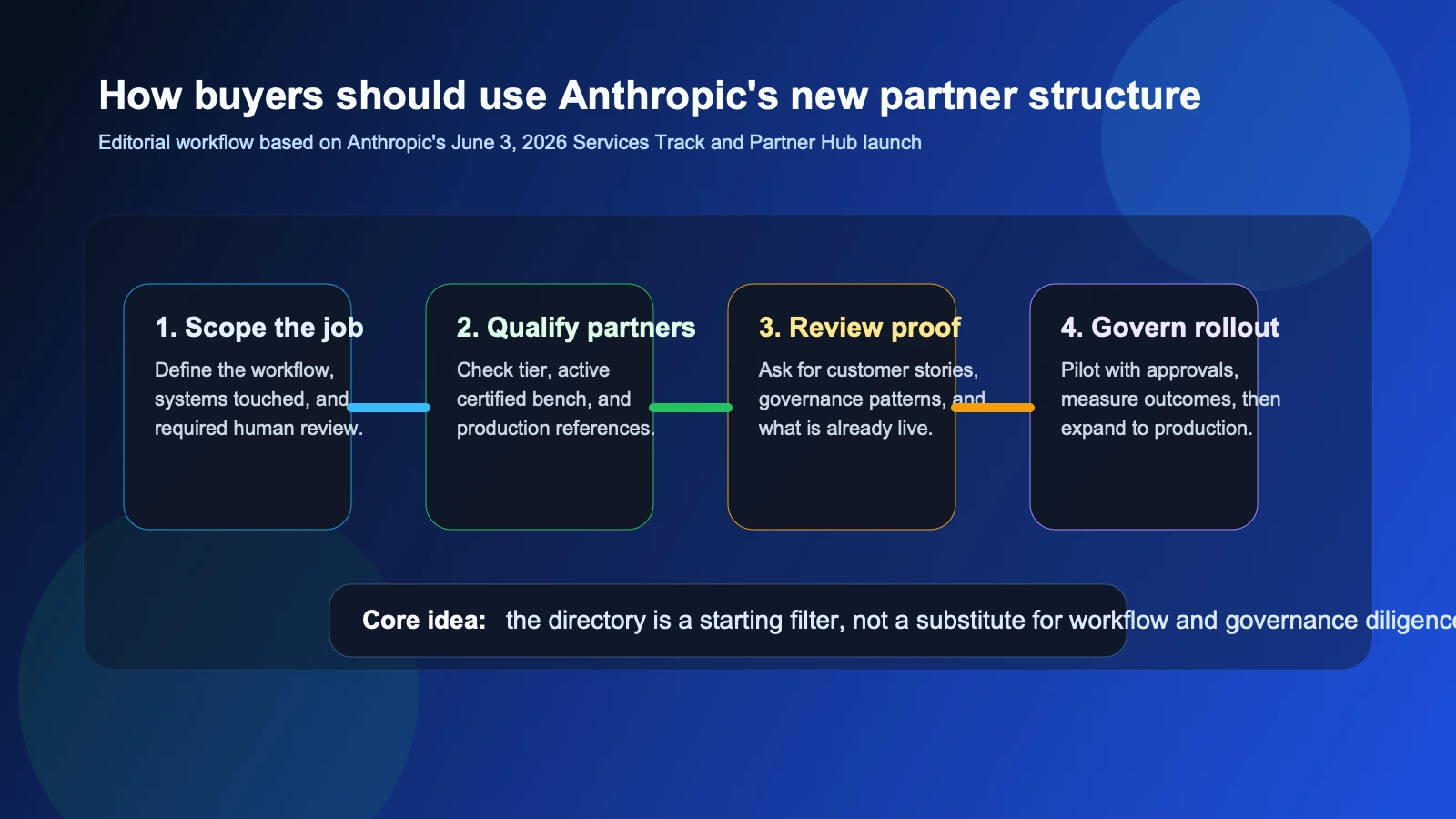
- If you buy AI implementation, stop evaluating partners only on pitch decks. Ask how many certified practitioners they have, what they have deployed in production, and which public references they can show.
- Audit whether your AI roadmap depends on one-time pilots or a repeatable operating model with approvals, source-of-truth data, and measurable outcomes.
- Use the GEO Visibility Checklist and the guide to tracking brand mentions and visibility if your Claude use case touches search, content, or answer-engine workflows.
- Run the commercial case through the Marketing ROI Calculator or Digital Marketing Budget Planner so the AI services budget is tied to operating outcomes instead of vague transformation language.
For many teams, the most useful next step is defining the workflows that must reach production, the controls that must stay human-reviewed, and the evidence a partner would need to show before winning the work.
What remains uncertain
Several limits still matter as of June 9, 2026. Anthropic has published the tier structure and some operating rules, but it has not publicly shown conversion rates inside the directory, partner win rates, or how much faster top-tier firms actually move customers into production. It is also unclear how buyers will weigh Anthropic's official signals against multi-model consultancies or rival ecosystems from Microsoft, Google, and OpenAI.
The safest conclusion is that Anthropic has made partner quality more legible, not fully solved. Still, the June 3 move is one of the clearer signs in 2026 that enterprise AI buying is shifting from model fascination toward delivery discipline.