Anthropic packages Claude for small businesses around connectors, approvals and ready-to-run workflows
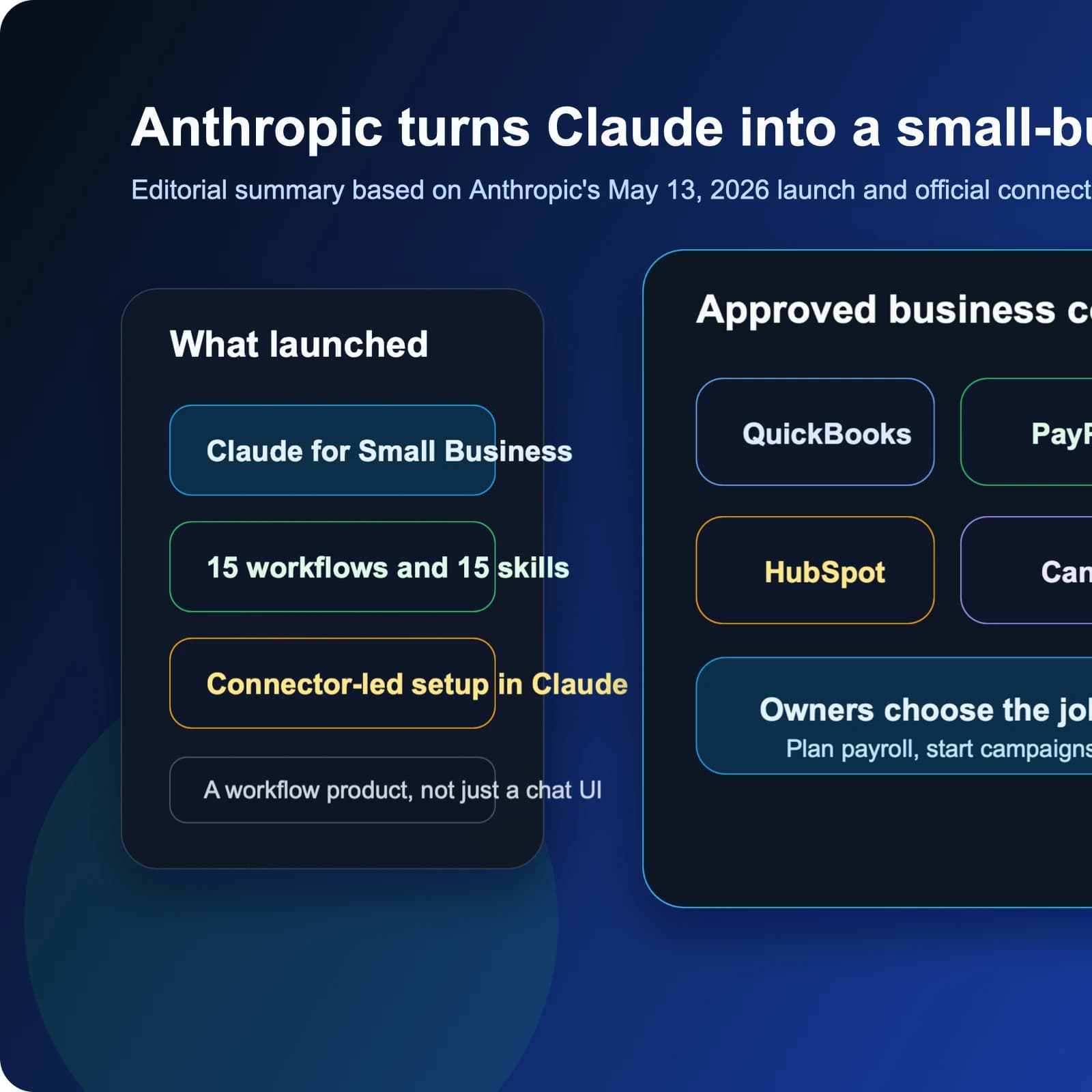
Anthropic said on May 13, 2026 that it is packaging Claude for small businesses as a connector-driven workflow product, not just a chat assistant. The launch combines a toggle install inside Claude Cowork, access to business tools such as QuickBooks, PayPal, HubSpot, Canva, Docusign, Google Workspace, and Microsoft 365, plus 15 ready-to-run workflows and 15 skills for finance, operations, sales, marketing, HR, and customer service. For lean marketing and operations teams, the important shift is practical: Claude is being positioned as a system that works with approved business context and human approvals, rather than one more blank prompt box.
That matters because Anthropic is explicitly aiming this product at companies that do not have large ops, analytics, or automation teams. In the same May 13 launch note, Anthropic says small businesses account for 44% of U.S. GDP and nearly half of private-sector employment, but AI adoption often stalls at "the chat window." The gap is not raw model access. It is whether a business can connect the right systems, choose repeatable jobs, and keep approvals and permissions intact.
What changed
Anthropic's launch adds structure where many small teams still have improvisation.
| Confirmed launch detail | Official source | Why it matters |
|---|---|---|
| Claude for Small Business launched on May 13, 2026. | Anthropic launch announcement | This is a packaged product motion for smaller operators, not just an enterprise message. |
| Anthropic says the package includes 15 ready-to-run workflows and 15 skills. | Anthropic launch announcement | Small teams can start from jobs, not from scratch. |
| The launch connects Claude to tools including QuickBooks, PayPal, HubSpot, Canva, Docusign, Google Workspace, and Microsoft 365. | Anthropic launch announcement | Actual business context can sit inside the workflow instead of being pasted into chat. |
| Anthropic says users approve the plan before anything sends, posts, or pays. | Anthropic launch announcement | The product is trying to reduce autonomy risk for SMB operators. |
| Claude's connector tutorial says connectors can retrieve project data and take actions in connected tools. | Claude connectors tutorial | The value proposition is workflow execution with context, not generic drafting. |
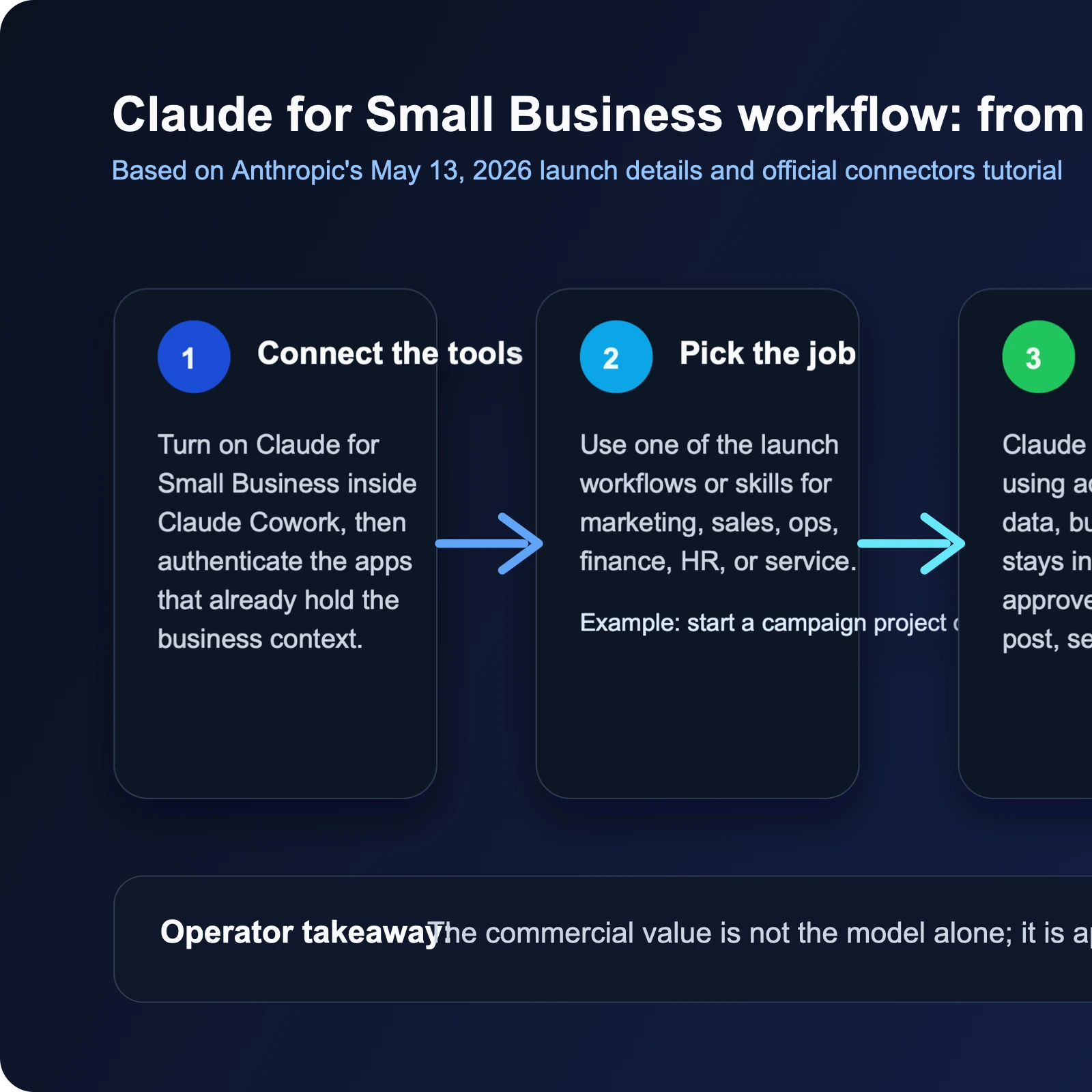
Anthropic's launch page says owners can toggle the package on inside Claude Cowork, connect the tools they already use, pick a job, and review the plan before anything goes live. The companion connector tutorial describes the operating model more clearly: connectors give Claude access to actual project data, let it make connections across tools, and allow it to take actions on a user's behalf where access has been granted.
The same tutorial says the connectors directory includes web connectors for remote services and desktop extensions for local desktop apps and files. That sounds technical, but the business meaning is simple. Anthropic is trying to remove the old manual glue work of exporting data, rewriting context, and moving outputs between apps every time a team wants help from AI.
Why it matters
For many small businesses, the real AI bottleneck is not content generation. It is operating discipline. A founder or small marketing lead may already have access to strong models, but still lose hours every week to KPI summaries, invoice chasing, campaign handoffs, and fragmented customer context.
Anthropic is directly targeting that gap. Its May 13 announcement says Claude can use connected tools to plan payroll, close the month, run a sales campaign, or kick off a marketing project. The connector tutorial adds that users can ask Claude to summarize real content, create tasks, and build professional content from connected documents and design tools.
That is relevant to the same operators who use Slogan.website's Digital Marketing Budget Planner, Marketing ROI Calculator, and GEO Visibility Checklist. Those resources all assume one thing: small teams need clearer operating systems, not more disconnected dashboards. Claude for Small Business is notable because it tries to package AI around repeatable jobs and approvals instead of around isolated prompts.
There is also a governance angle. Anthropic says on the launch page that existing permissions still hold, meaning if an employee cannot see something in a source tool now, they cannot see it through Claude. For small firms without a security team, that may be the difference between a realistic pilot and another stalled experiment.
Who is affected
The groups most affected are smaller commercial teams that already live inside a few core systems but have not yet turned them into a reliable AI workflow stack.
- Founder-led businesses that need help turning finance, sales, and marketing admin into repeatable processes.
- Small marketing teams that want campaign briefs, reporting summaries, and content tasks grounded in live business data.
- Agencies and consultants serving SMB clients who need faster weekly reviews and cleaner client-facing deliverables.
- Operations leads who want AI help, but only inside approval paths that people can still control.
What to do next
Treat this launch as a workflow-audit opportunity, not as a blanket invitation to automate everything.
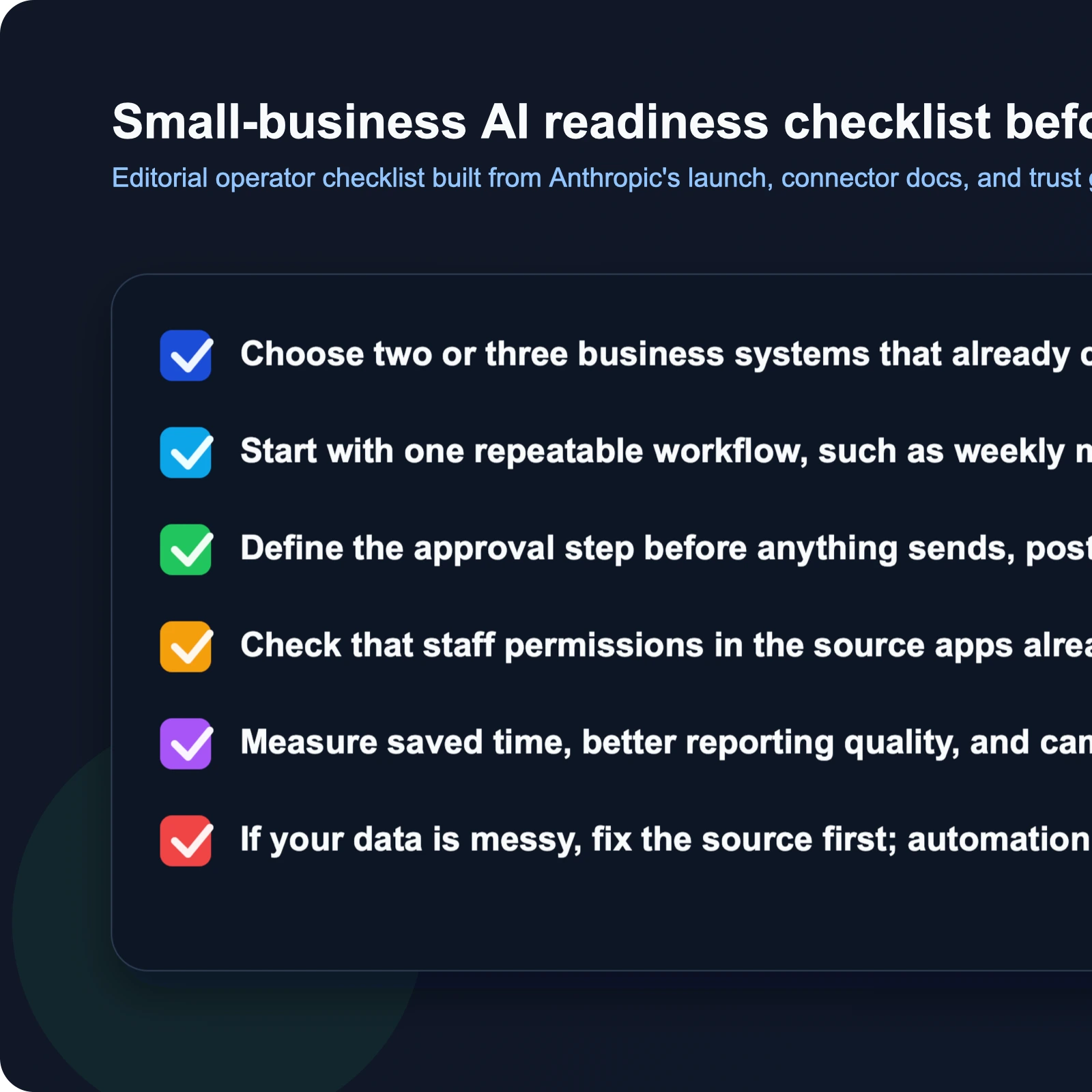
- Pick one weekly or monthly task that is annoying, repetitive, and easy to verify, such as a campaign performance recap or an invoice follow-up queue.
- Check whether the required data already lives in a small number of systems and whether those systems have clean user permissions.
- Define the review step before any output could email customers, update records, or trigger spending.
- Compare the result against your current baseline with concrete metrics such as hours saved, reporting quality, and campaign turnaround using the Marketing ROI Calculator.
- If the workflow touches discovery or content planning, pair it with the brand visibility tracking guide or the GEO checklist so the connected assistant works from cleaner inputs.
What remains uncertain
The launch still leaves open questions. Anthropic has defined the structure, but not every small business will have the data hygiene or process clarity to benefit immediately. If the underlying records are messy, the connector tutorial makes clear that Claude will simply gain access to that messy context faster.
There is also a maturity gap between workflow availability and workflow value. Anthropic has shipped 15 jobs and 15 skills, but the company has not said that every SMB use case will be ready on day one or that every connected workflow will generate measurable ROI immediately. Businesses still need to decide which jobs deserve AI help, which systems are trustworthy enough to connect, and where human review must remain mandatory.
The strongest takeaway is narrower than the hype. On May 13, 2026, Anthropic moved Claude closer to an operating system for small businesses by combining connectors, prebuilt workflows, and approval-aware execution. Teams that benefit most will likely be the ones that already know their core systems, keep permissions tight, and use AI to compress real work instead of generating more unchecked output.