AppsFlyer brings mobile-grade attribution to the web with one cross-platform ROAS layer
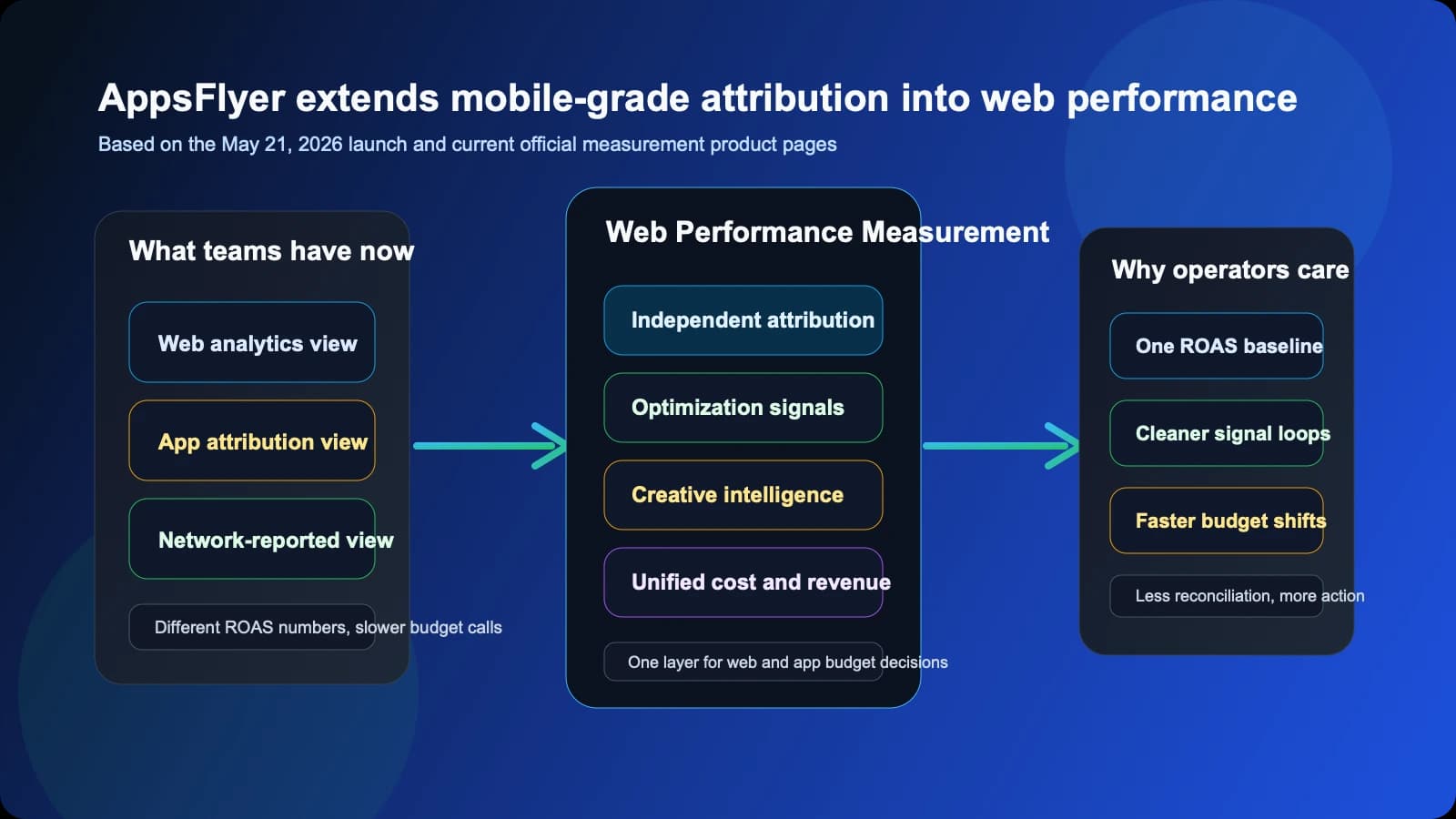
On May 21, 2026, AppsFlyer said it is launching Web Performance Measurement, a new product that extends the attribution and optimization model long used in mobile performance marketing into web campaigns. The direct operator takeaway is simple: AppsFlyer wants growth teams to stop treating web and app measurement as separate realities with separate ROAS numbers.
That launch is backed by the company's current product materials. AppsFlyer's Measurement Suite page says the platform is built to measure performance across mobile, web, CTV, and PC and console, while its Web Attribution page says marketers can now connect web activity and mobile conversions into one ROAS number across web and mobile. Read together, the message is stronger than a normal feature release: AppsFlyer is trying to turn attribution from a channel-by-channel reporting problem into a single optimization layer.
What changed
The official May 21 launch announcement lists four product claims that matter immediately for marketing and analytics teams.
| Confirmed detail | Official source | Why it matters in practice |
|---|---|---|
| Web Performance Measurement launched on May 21, 2026 | AppsFlyer launch announcement | Web attribution is being framed as a first-class measurement product, not an add-on report. |
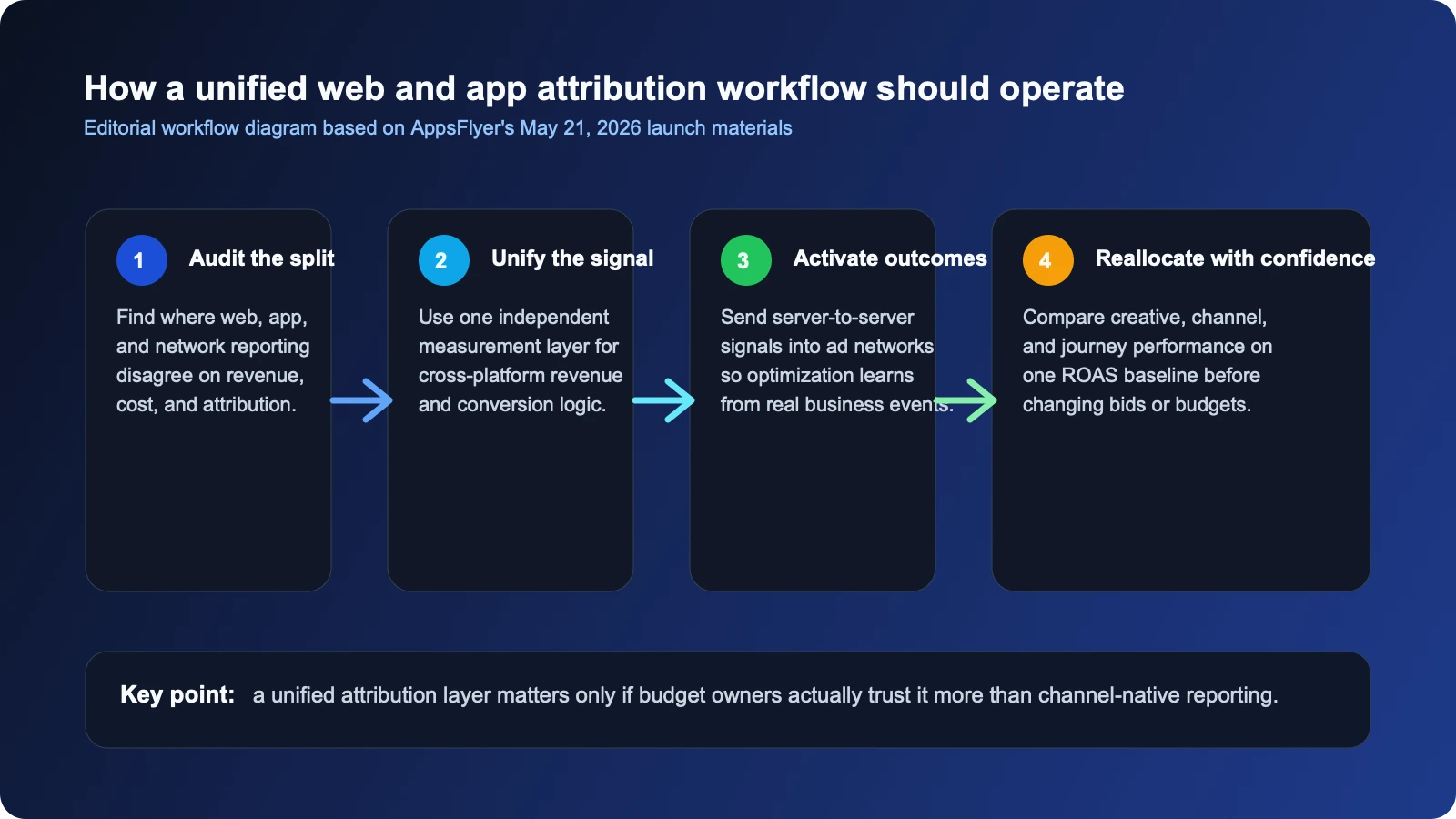
| AppsFlyer says the release provides independent web attribution and optimization signals | AppsFlyer launch announcement | Teams can route conversion signals back to ad platforms instead of optimizing only on platform-native metrics. |
| The Web Attribution product page promises one ROAS number across web and mobile | AppsFlyer Web Attribution page | Budget owners can compare channels with one reporting baseline instead of reconciling separate web and app dashboards. |
| The Measurement Suite page says AppsFlyer covers mobile, web, CTV, and PC and console | AppsFlyer Measurement Suite page | Cross-device growth paths can be measured more like one journey than a set of isolated channel reports. |
| The Web Attribution page says marketers can activate server-to-server conversion signals into major ad networks | AppsFlyer Web Attribution page | Measurement becomes more useful for bidding and optimization, not only for post-campaign reporting. |
The broader shift is not just technical. AppsFlyer is arguing that separate measurement systems create bad business decisions because teams end up maximizing channels in isolation rather than maximizing total revenue across the customer journey.
Why it matters
This matters most for companies that already spend across web acquisition, app acquisition, remarketing, and cross-device journeys. In many teams, web analytics, MMP data, and network reporting still disagree on what should count as performance. That makes budget reviews slower, creative learning weaker, and finance conversations harder than they should be.
AppsFlyer is explicitly targeting that gap. In the launch announcement, Chief Product Officer Barak Witkowski said the old split between web and mobile measurement has cost brands both budget and performance. The product pitch is that one independent attribution layer should make it easier to compare like with like, send cleaner outcome signals back into ad platforms, and see when a web touchpoint actually supports a later app conversion or the reverse.
That has immediate implications for high-value operators in the United States, Canada, the United Kingdom, Australia, and Europe. If your media mix includes paid search, paid social, app install, retention, and web commerce, then one of your biggest hidden problems is usually not lack of dashboards. It is lack of a trusted measurement spine that can support budget shifts with confidence.
The change also connects to AI-readiness. Models can only optimize effectively when the underlying conversion signals are coherent. That is the same discipline behind Slogan.website's Marketing ROI Calculator, Digital Marketing Budget Planner, and broader measurement and visibility resources in the tools hub. Better attribution does not just improve reports. It improves how automated systems learn what success actually looks like.
Who is affected
The strongest fit is for:
- Growth teams that split spend across web and app but still reconcile results manually.
- Performance marketers who need one source of truth before trusting automated bidding.
- Analytics and measurement leads responsible for explaining ROAS across multiple platforms to finance or leadership.
- Creative teams that want to know which messages or assets are working across both web and app journeys, not just in one environment.
- Agencies and in-house teams handling ecommerce, subscriptions, fintech, gaming, travel, or any business where the path from click to conversion crosses devices.
If your business only runs simple web campaigns with low channel complexity, the impact may be smaller. But for operators managing blended journeys, the product is aimed directly at a real and expensive operational problem.
What to do next
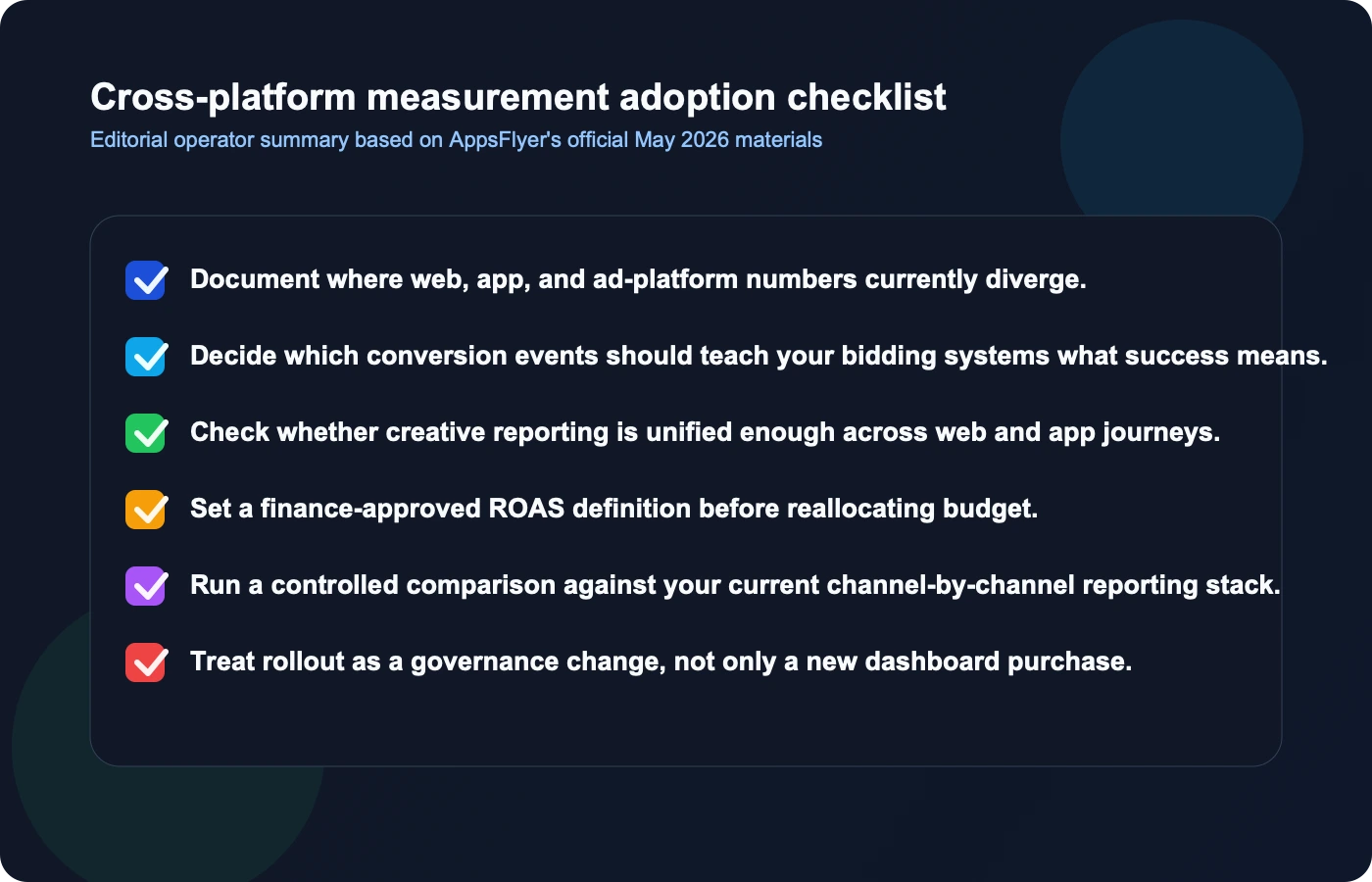
Use this launch as a trigger to audit your own measurement stack before adding another reporting layer.
- List where your current web, app, and platform reports disagree on attributed conversions and revenue.
- Check whether your optimization workflows still depend too heavily on ad-platform-native reporting.
- Decide which campaigns need cross-platform ROAS, not just channel ROAS, before your next budget cycle.
- Review whether creative reporting is unified enough to show which assets move users across devices.
- Model how cleaner attribution would change budget allocation using the Digital Marketing Budget Planner and test the business case with the Marketing ROI Calculator.
What remains uncertain
Important questions remain open. AppsFlyer's public materials clearly describe the product direction, but they do not publish standard pricing, detailed rollout constraints by region, or benchmark outcomes by industry vertical. The company also makes strong percentage claims on its broader product pages, but those are not the same as a guaranteed lift for every deployment.
There is also a governance question that software alone cannot solve: when your neutral attribution layer conflicts with the numbers shown inside large ad platforms, who wins internally? A better system only helps if finance, media, and analytics teams agree in advance on which source of truth they will actually use.
As of June 2, 2026, the practical conclusion is that AppsFlyer is pushing measurement closer to a full-funnel operating layer. For teams that already know fragmented attribution is slowing budget decisions, this is a meaningful launch worth evaluating now, before another quarter of cross-platform spend gets judged by disconnected numbers.