Canva and Anthropic turn Claude into a campaign workflow for small businesses
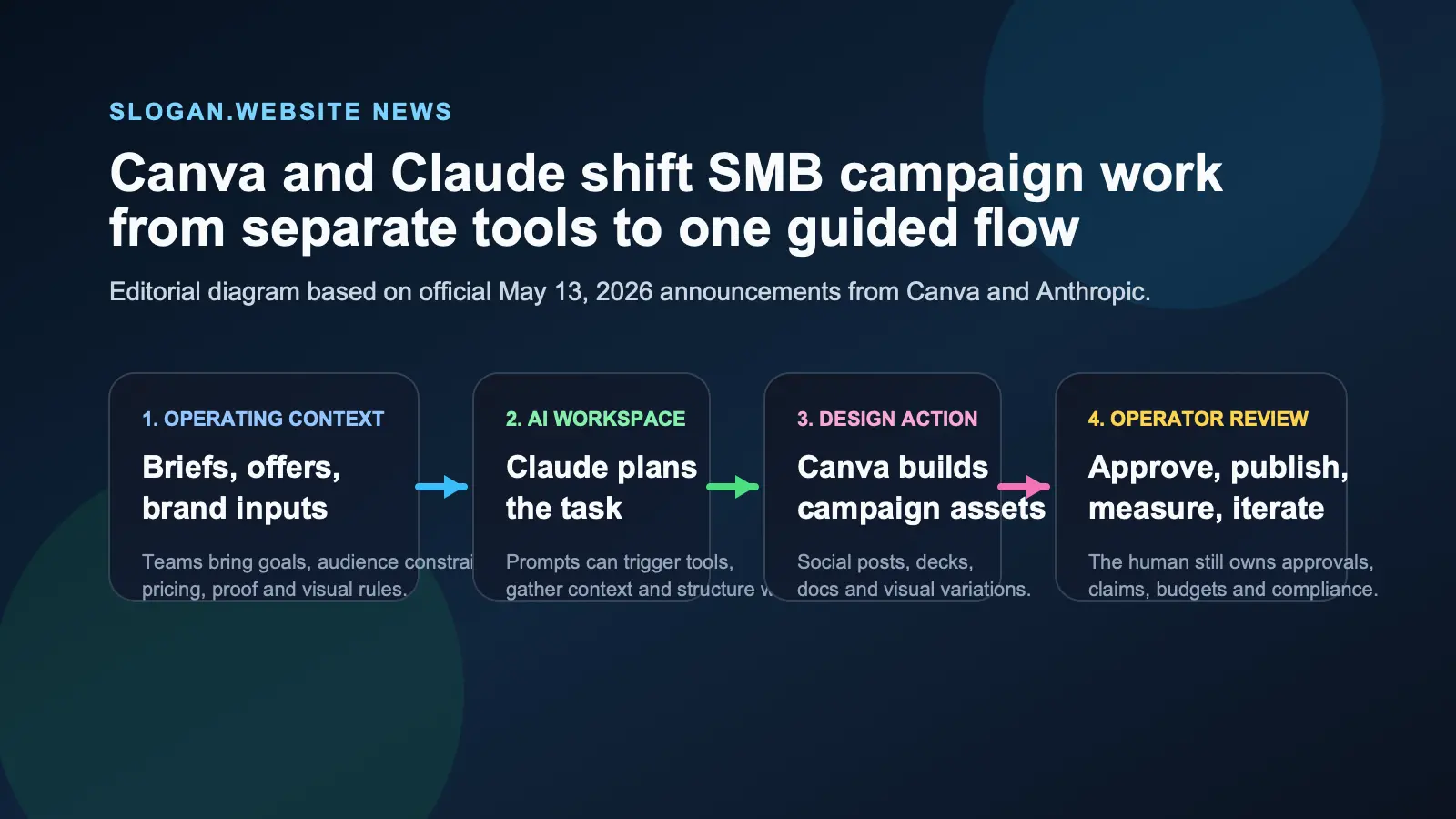
Canva and Anthropic said on May 13, 2026 and May 13, 2026 that Canva's design engine is now part of Claude for Small Business. The practical change is not just another AI integration. Small operators can move from a rough brief, a revenue signal, or a customer insight inside Claude to branded marketing assets in Canva without treating strategy, copy, and design as separate handoffs.
That matters for founders, agencies, and lean marketing teams because the bottleneck in small-business AI is usually not idea generation. It is turning insights into approved, usable campaign output fast enough to matter.
What changed
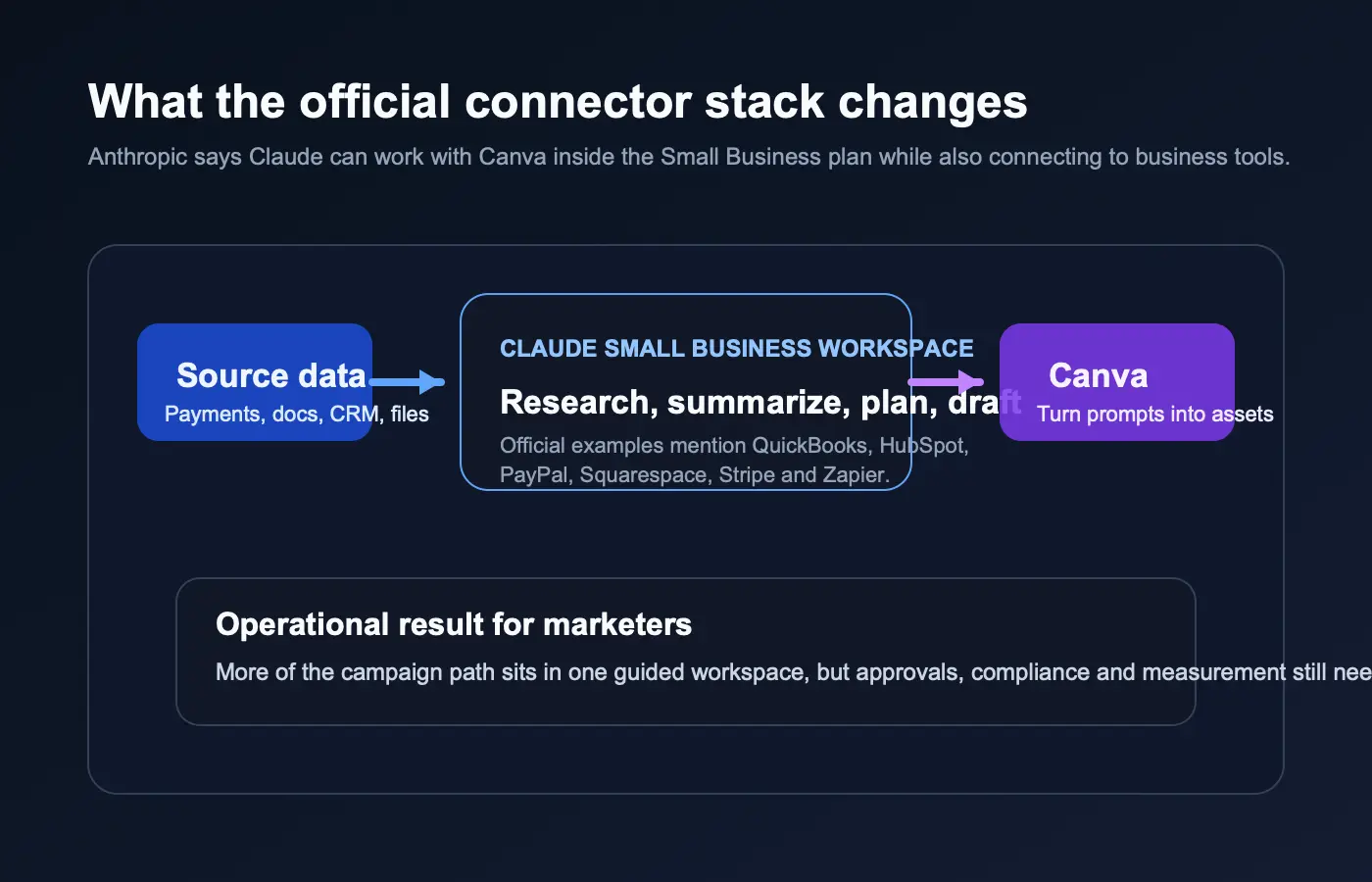
Anthropic said in its official launch post that Claude for Small Business is a package of connectors and ready-to-run workflows built around the tools small companies already use, including Intuit QuickBooks, PayPal, HubSpot, Canva, DocuSign, Google Workspace, and Microsoft 365. Anthropic also said small businesses account for 44% of U.S. GDP and employ nearly half the private-sector workforce, which explains why it is treating this as a business-product push rather than a generic consumer AI feature.
Canva's matching announcement adds the marketing-workflow angle. Canva says business owners can go from a "quick brief or messy insights" to finished and branded campaign assets such as Instagram posts, Facebook posts, and custom ads, with outputs powered by the Canva Design Model. The same post says Claude can identify a trend or sales signal, then trigger a two-week campaign in Canva with copy written and assets staged in HubSpot.
Canva also says AI usage on its platform has more than tripled in the last year in the same May 13 post, which gives more weight to the launch. This is not Canva testing whether customers want AI at all. It is Canva trying to keep more of the marketing production path inside one system.
| Confirmed detail | Official source | Operational meaning |
|---|---|---|
| Claude for Small Business launched on May 13, 2026 | Anthropic announcement | Anthropic is packaging connectors and workflows for real business operations, not only open-ended chat use. |
| Canva is one of the named product integrations inside the package | Anthropic announcement | Creative production is being pulled directly into the AI workspace. |
| Canva says the flow can turn rough inputs into branded social posts and custom ads | Canva announcement | Campaign execution gets closer to one prompt-to-asset workflow. |
| Canva describes campaign copy and staging in HubSpot as part of the connected path | Canva announcement | The launch is about orchestration across planning, creation, and activation, not only isolated design generation. |
| Canva AI 2.0 now includes connectors, scheduling, web research, and brand intelligence in research preview | Canva AI 2.0 announcement | Canva is expanding the same end-to-end workflow logic beyond this single Anthropic integration. |
Why it matters
The real shift is workflow compression. Small businesses often lose momentum between three moments: discovering what changed, deciding what to say, and producing brand-consistent assets. Anthropic is trying to solve the first two inside Claude. Canva is trying to solve the third without forcing users into a separate creative production sprint.
That has immediate value for small marketing teams in the United States, Canada, the United Kingdom, Australia, and Europe that already work across several systems with limited headcount. A founder who sees a revenue spike in one product line, or a local service business that notices a seasonal opportunity, can in theory move faster from signal to campaign.
There is also a quality-control angle. Canva's official post emphasizes editable branded output, not locked black-box creative. That matters more than the AI headline because small operators still need to verify offers, pricing, disclaimers, and visual consistency before publishing. In practice, this is where internal planning tools like the Digital Marketing Budget Planner, the Marketing ROI Calculator, and the GEO Visibility Checklist become useful. Faster content production only helps if budget allocation, visibility, and measurement are also under control.
Who is affected
The most affected group is small and mid-sized operators who already use Canva heavily but still patch strategy, approvals, and execution together manually.
- Founder-led businesses that need to turn business signals into campaign assets without hiring a full creative ops team.
- Agencies serving many small clients where briefs, copy iterations, and ad creative approvals create avoidable delay.
- CRM-driven teams using HubSpot or similar tools that want the path from customer insight to outbound campaign to be shorter.
- Ecommerce and local-service teams that need repeatable branded assets for promotions, launches, or seasonal offers.
- Marketing consultants helping clients prepare for more AI-mediated discovery and brand mention tracking.
What to do next
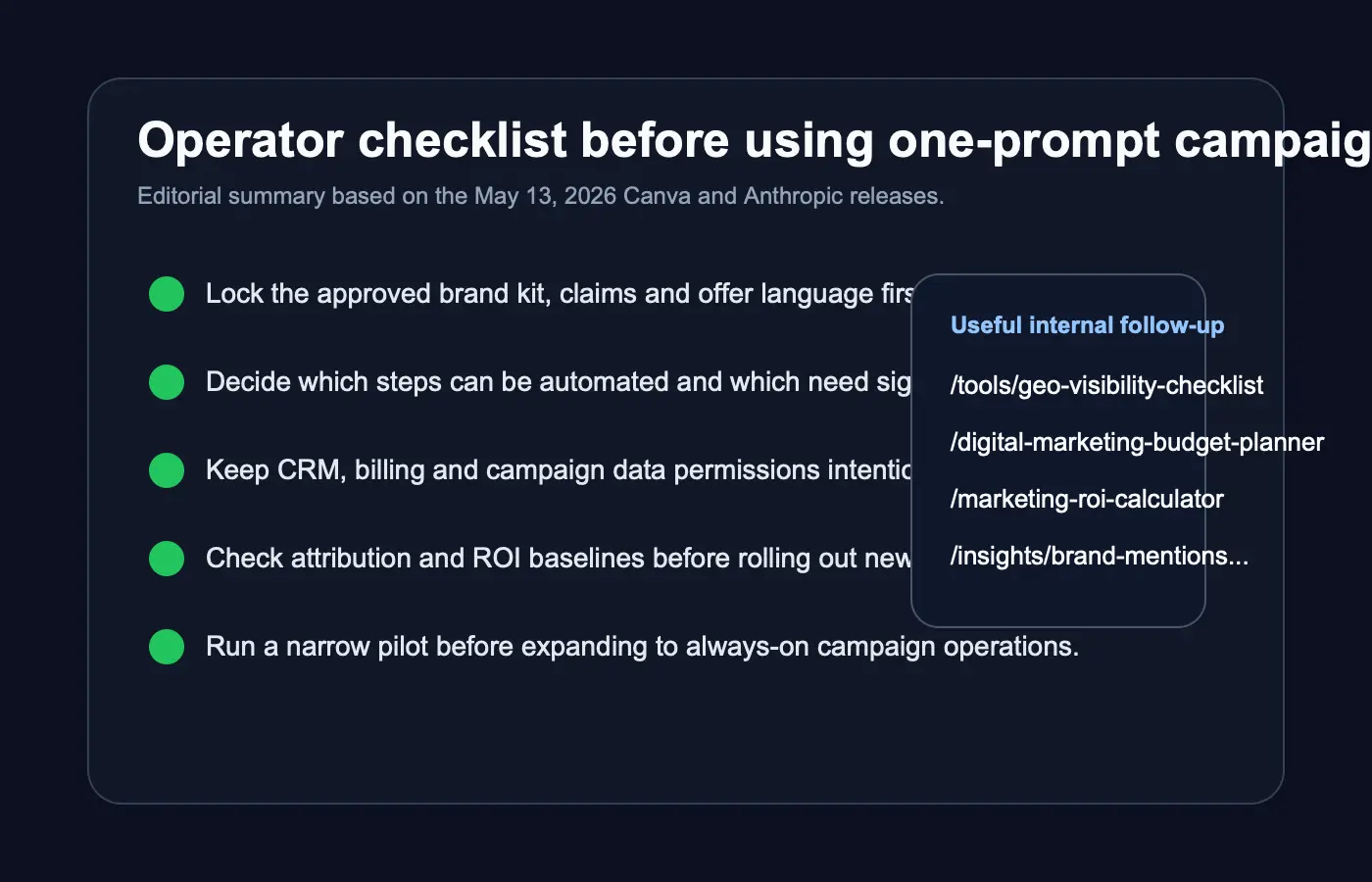
Use this five-step rollout before treating prompt-driven campaign production as normal operating infrastructure:
- Lock the approved inputs first. Define brand kit assets, offer language, legal constraints, pricing rules, and proof points before an AI workflow starts generating campaign output.
- Decide which steps are advisory and which are executable. Planning, summaries, and first drafts can move faster than publishing rights, CRM writes, or budget edits.
- Check connector scope carefully. Anthropic's launch frames the package around existing business systems, which means permission design matters as much as prompt quality.
- Build a measurement baseline. Use the Marketing ROI Calculator and Digital Marketing Budget Planner before rollout so teams can compare assisted output against real business outcomes.
- Pair speed with visibility work. If campaigns are produced faster, the supporting landing pages and brand facts also need to be easier for AI systems to interpret. That is where the GEO Visibility Checklist and the guide to tracking brand mentions and visibility fit naturally.
What remains uncertain
Several important details are still unresolved on June 1, 2026.
First, neither company's announcement proves that every small business can replace existing creative, CRM, or ad-ops workflows immediately. The official posts describe a promising operating model, but they do not publish universal benchmarks for time saved, conversion lift, or campaign performance across industries.
Second, the launch does not remove governance work. Anthropic's own framing is that Claude now sits closer to systems like payments, documents, CRM, and productivity tools. That is useful, but it also raises the cost of sloppy permissions or weak review rules.
Third, rollout depth will matter. Canva's newer AI 2.0 announcement shows the company is building a broader conversational and agentic platform, but many of those capabilities are still described as research preview. Teams should treat the May 13 integration as a signal of direction and an invitation to pilot, not as a reason to hand over campaign operations blindly.
The practical takeaway is straightforward: Canva and Anthropic are making a stronger case that small-business marketing work can move from disconnected prompts and design tools into one guided workflow. The winners will not be the teams that automate the most. They will be the teams that automate the right parts, keep approval discipline, and measure whether faster output actually improves pipeline or revenue.