Adobe turns Claude Design into a faster handoff path for enterprise web and lifecycle teams
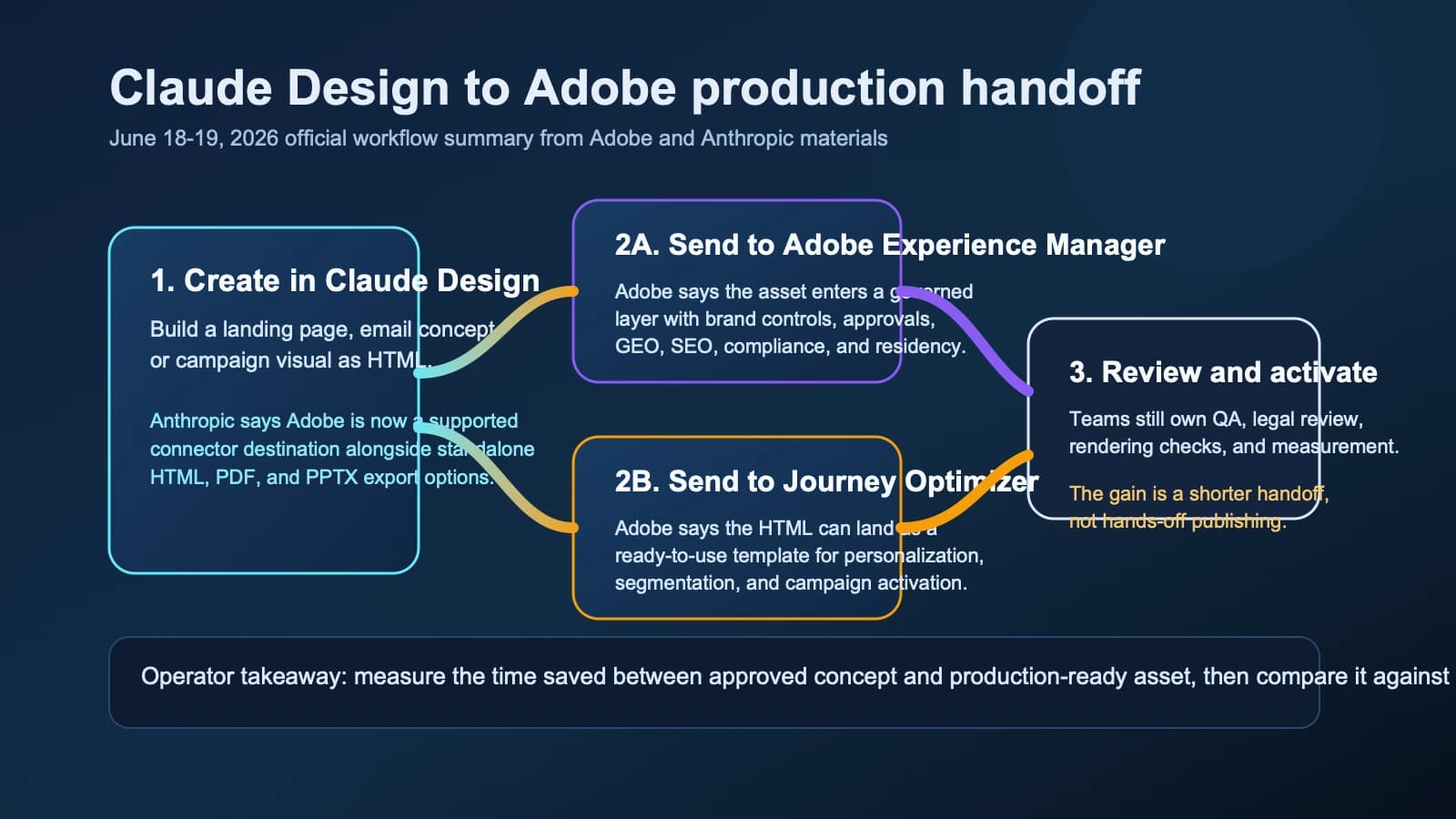
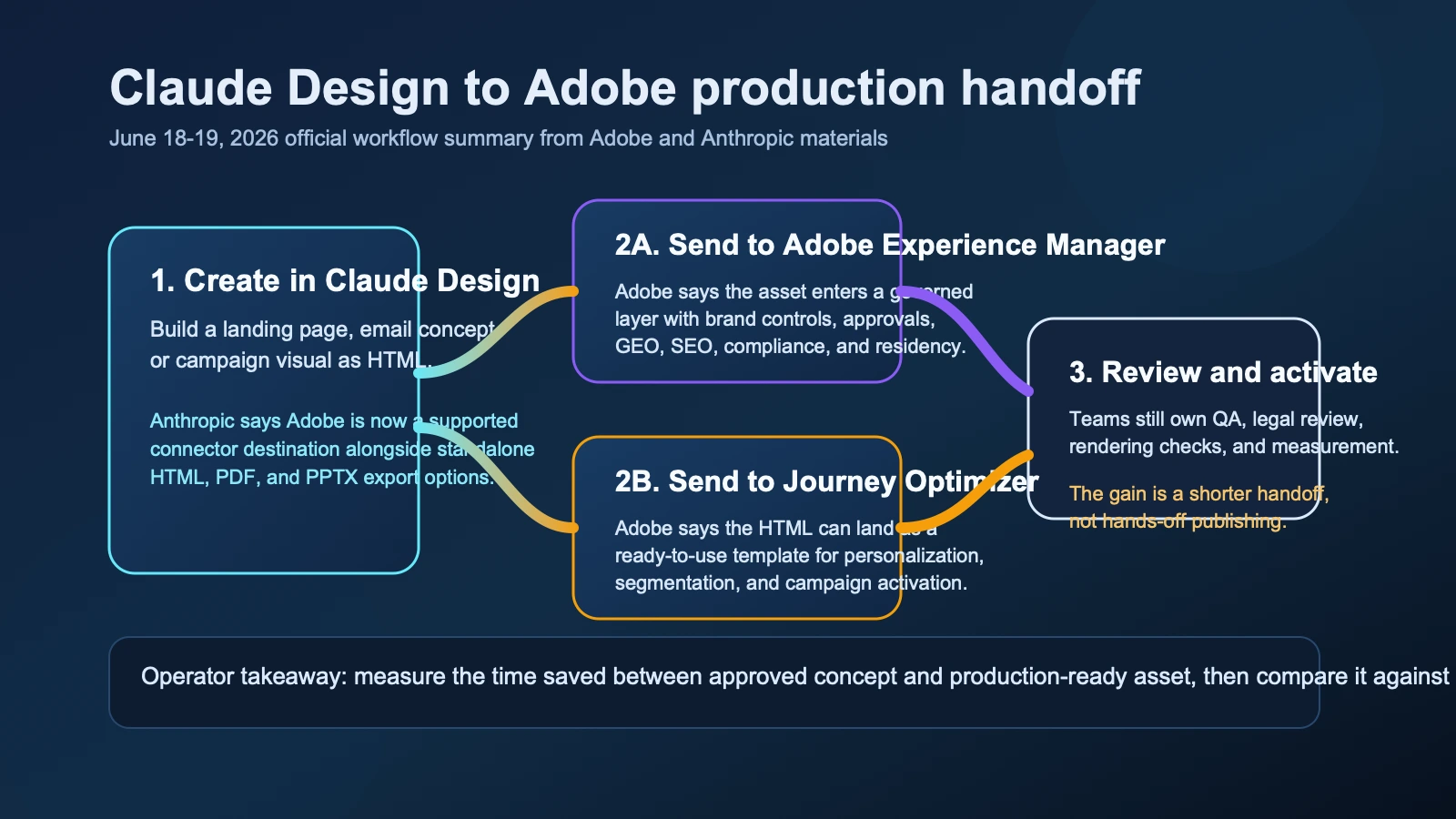
Adobe and Anthropic made a more practical workflow announcement on June 18, 2026 than the usual "AI can help with design" headline. Adobe says Claude Design can now send HTML directly into Adobe Experience Manager and Adobe Journey Optimizer through Claude Design's new Send to export flow, while Anthropic's current Claude Design product page says Adobe is now one of the supported connector destinations. For enterprise marketing and digital teams, the shift is operational: the system that creates an AI-generated concept is getting closer to the systems that govern publishing, personalization, and activation.
That matters because the slow part of AI-assisted creative work is often not the first draft. It is the handoff into the CMS, campaign, approval, and measurement stack. Adobe's June 18 post says a marketer can push a Claude-generated page into Experience Manager with one click and send an email-ready HTML template into Journey Optimizer without rebuilding it by hand. Anthropic's Claude Design support guide, updated June 17, 2026, also says users can send work to tools they already use, including Adobe. Read together, the message is clear: AI design is becoming part of the content supply chain instead of staying trapped in a prototype tab.
What changed
| Confirmed June 2026 point | Primary source | Why it matters |
|---|---|---|
| Adobe says Claude Design can send HTML directly to Adobe Experience Manager and Adobe Journey Optimizer with the new Send to feature. | Adobe for Business blog, June 18, 2026 | The core workflow moves from export-and-rebuild to direct system handoff. |
| Adobe says Adobe Express is also included in the launch. | Adobe for Business blog, June 18, 2026 | Creative, web, and lifecycle teams can keep more of the work inside one connected Adobe path. |
| Anthropic says Claude Design can send work to apps including Adobe and can also export standalone HTML. | Claude Design product page and Claude Design support guide, updated June 17, 2026 | The Adobe route is part of a broader connector model, not a one-off bespoke demo. |
| Adobe says a Claude-built email can land in Journey Optimizer as a ready-to-use template for personalization, segmentation, and activation. | Adobe for Business blog, June 18, 2026 | Email teams can move from design experimentation to campaign setup faster. |
| Adobe says mobile and conversational updates are still on the roadmap. | Adobe for Business blog, June 18, 2026 | The current release is useful now, but not yet a complete omnichannel handoff system. |
Adobe frames the Experience Manager side as more than a simple file import. Its June 18 post says the design enters a governance layer that includes brand controls, compliance, GEO, SEO, data residency, and approval workflows. The Journey Optimizer angle is similarly concrete: Adobe says Claude Design can produce an HTML file that Journey Optimizer can use immediately as a template. The message is not "publish from AI with no guardrails." It is "move faster into a governed system."
Why it matters
The practical value is handoff compression. Many enterprise teams already use AI to sketch landing pages, email concepts, or campaign visuals, but they still depend on manual translation before those ideas reach the CMS or orchestration stack. That translation adds risk along with time. Layout choices get lost, copy changes drift, and QA grows messy.
Adobe is trying to remove that dead zone. If Claude Design can create the first draft while Experience Manager governs publishing and Journey Optimizer governs activation, then the AI layer stops being an isolated brainstorming surface and starts functioning as an upstream part of content operations. For high-value teams in the United States, Canada, the United Kingdom, Australia, and Europe, that can affect launch speed, campaign throughput, and the cost of turning exploratory work into live assets.
Who is affected
The first group is enterprise web and content teams using Adobe Experience Manager as the system of record. They care because the expensive part of experimentation is not only creating a design, but getting it production-ready without forcing developers or web producers to reconstruct every variant.
The second group is lifecycle, CRM, and email teams using Adobe Journey Optimizer. Adobe's description suggests they can move an HTML concept into the campaign system faster, which may shorten iteration cycles for newsletters, nurture programs, and launch emails. Teams that already benchmark send performance with the Marketing ROI Calculator or forecast spend with the Digital Marketing Budget Planner should care because faster handoff can change production economics, not just aesthetics.
The third group is marketing operations leaders who sit between creative tools and governed execution. Anthropic's support guide says users should think about responsiveness, design systems, and usage limits early, which implies that messy upstream inputs will still create messy downstream outputs.
What to do next
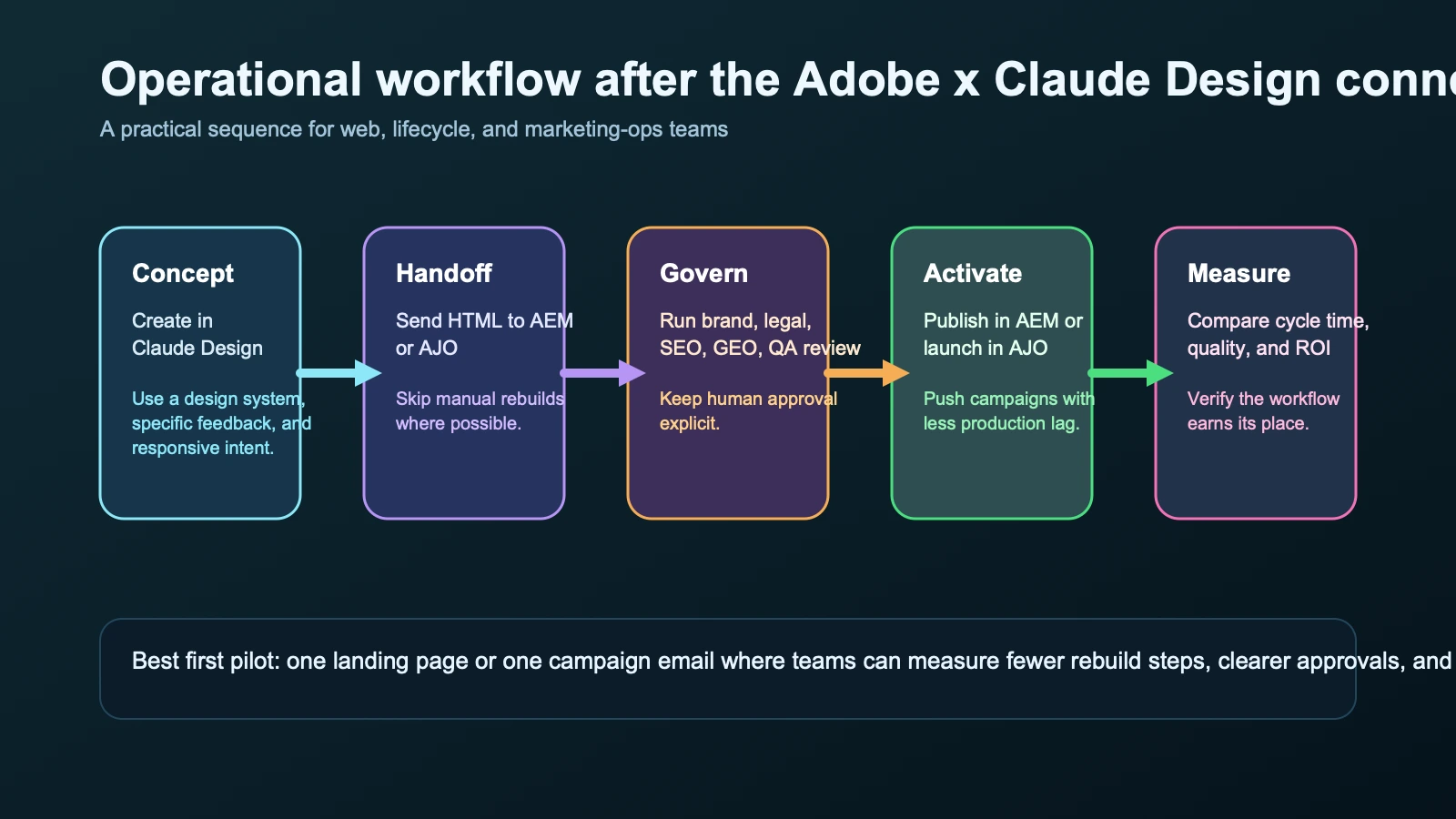
- Test the connector on one bounded use case first: a landing page refresh in Experience Manager or a campaign email template in Journey Optimizer.
- Audit your design system inputs before rollout, because Anthropic explicitly says cleaner design-system sources improve Claude Design output quality.
- Define where human review still happens: brand, legal, lifecycle QA, and rendering checks should remain explicit.
- Measure the handoff benefit, not just the novelty. Track time saved between concept approval and production readiness, then compare the gain against campaign value with the Marketing ROI Calculator.
- Use the GEO Visibility Checklist and the guide to brand visibility tracking so faster production also improves discoverability and evidence quality.
What remains uncertain
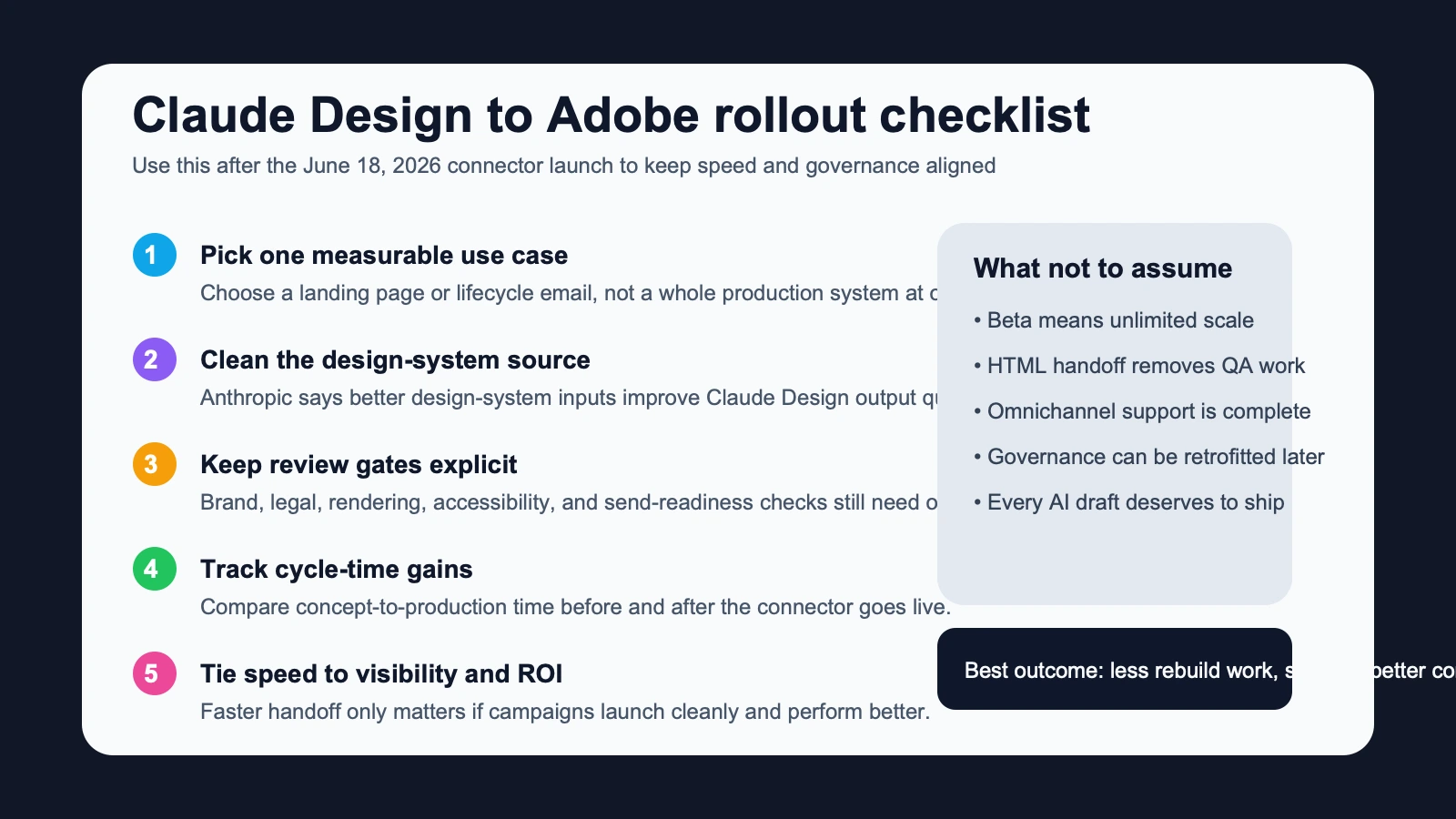
Important limits remain on June 19, 2026. Adobe describes this as a new entry point for email creation and says mobile plus conversational updates are still on the roadmap, so buyers should not treat the current release as full omnichannel coverage. Anthropic also notes that Claude Design is still in beta and that usage limits are shared with other Claude work.
There is also a governance question that the announcement only partially answers. Adobe says Experience Manager provides the brand, compliance, GEO, and approval layer, but every enterprise still has to define which assets may move straight through and which require more rigorous review. A faster handoff reduces friction; it does not remove accountability.
The defensible conclusion is narrower than the hype but still important. On June 18, 2026, Adobe and Anthropic made AI design more operational for enterprise marketing teams by connecting Claude Design directly to Experience Manager and Journey Optimizer. Teams that already have strong design systems and review discipline can benefit first. Teams with messy source content or weak production QA may simply move their chaos faster.