Cloudflare opens self-managed OAuth to all developers, giving agentic tools a cleaner path than API tokens
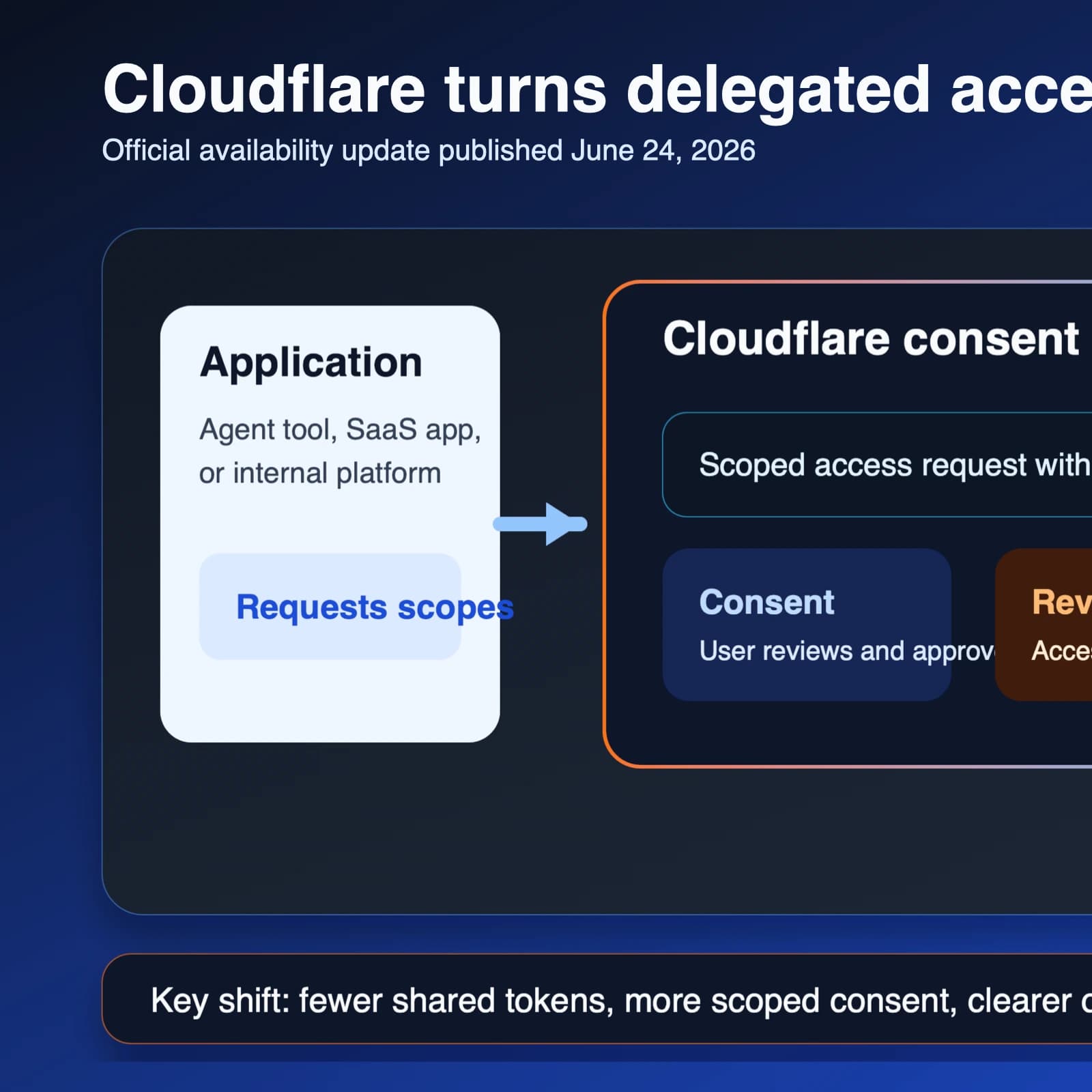
Cloudflare's most practical AI-and-automation update this week is not a new model. It is a delegated-access change. In an official blog post published on June 24, 2026, Cloudflare said self-managed OAuth is now available to all developers on its platform, expanding what had previously been limited to a small set of manually onboarded integrations. Read together with Cloudflare's June 3 changelog and its OAuth documentation, the shift is straightforward: teams building SaaS integrations, internal developer platforms, and agentic tools now have a more standard path to request scoped access than handing out long-lived API tokens.
For high-value software, operations, growth, and digital teams, that matters because AI workflows are turning more business systems into tool surfaces. If an internal assistant needs to deploy a Worker, read analytics, update a configuration, or orchestrate a workflow across vendors, the access model now becomes part of product design. Cloudflare is telling builders to move toward scoped consent, revocation, and delegated user access instead of one shared token passed around in dashboards, CI variables, or notebooks.
What changed
The official June 24 Cloudflare post says the practical bottleneck was not that Cloudflare lacked OAuth entirely. The company had OAuth support for first-party tools like Wrangler and a small number of partner integrations, but third-party OAuth was not broadly available. Builders who wanted delegated access often had to fall back to API tokens, which Cloudflare explicitly describes as harder to manage and a poor fit for many delegated application flows.
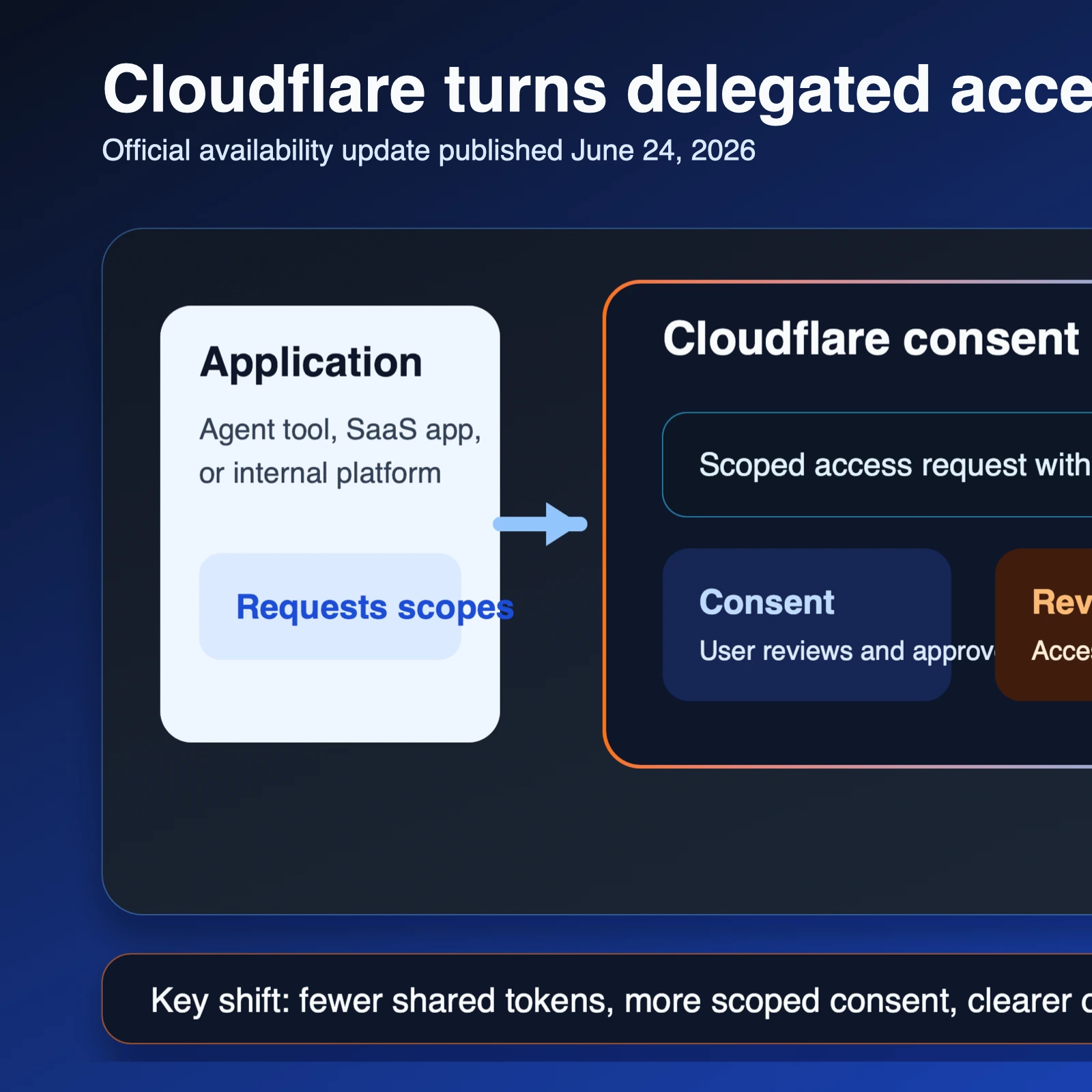
Cloudflare's June 3 release note made the launch mechanics clearer. Developers can now create and manage their own OAuth applications from Manage account > OAuth clients, choose limited scopes during setup, and ask users to approve those scopes during consent. The main client-creation guide adds more durable operating details: new clients start as private, public promotion requires a client name, logo, client URL, and scopes, and a client cannot be demoted back to private after being promoted to public.
The June 24 post also gives a useful infrastructure signal. Cloudflare says it upgraded its underlying OAuth engine and that, after the migration, OAuth API P95 latency improved from 185ms to 101ms, while average CPU, memory, and goroutine usage dropped materially. That matters less as a benchmark trophy than as a clue that Cloudflare expects more real traffic from app builders, CI systems, and agent workflows.
| Confirmed point | Official source | Why it matters in practice |
|---|---|---|
| Self-managed OAuth is now available to all Cloudflare customers and developers. | Cloudflare blog, June 24, 2026 | Delegated access is no longer limited to a few hand-managed partner integrations. |
| Cloudflare positions self-managed OAuth as a more secure and manageable alternative to API tokens. | Cloudflare changelog, June 3, 2026 | Teams can shift from shared secrets toward scoped consent and revocation. |
| OAuth clients default to private visibility, and public promotion requires domain verification and other required fields. | Create your OAuth client | Not every integration should be public by default; launch discipline now matters. |
| Users can review requested scopes before authorizing an application. | Cloudflare changelog, June 3, 2026 and Authorizing an application | Consent becomes a user-visible control surface, not only an admin back-office decision. |
| Cloudflare says its upgraded OAuth engine cut average API P95 latency from 185ms to 101ms. | Cloudflare blog, June 24, 2026 | The company is tuning the access layer for heavier integration and agent usage, not just documentation parity. |
Why it matters
This is especially relevant for organizations building AI-powered internal tools, agency delivery systems, deployment assistants, and workflow automations. When the access model depends on static tokens, every new integration expands secret sprawl, rotation overhead, and blast radius. Cloudflare's own OAuth overview frames the alternative more cleanly: applications can request limited access to specific Cloudflare resources on behalf of a user without that user sharing long-lived credentials.
That is a real operating-model improvement for teams that already run multi-tool work. A marketing engineering team might build an internal control panel that provisions campaign microsites or edge redirects. A product growth team might wire AI-assisted experiments into Workers or analytics workflows. An agency platform might need customer-granted Cloudflare access without asking each client to mint and email a token. In each of those cases, OAuth is not cosmetic plumbing. It changes onboarding friction, support burden, auditability, and revocation hygiene.
It also fits a broader direction Cloudflare has been signaling this month. On June 19, 2026, Cloudflare introduced temporary accounts for agent deployments through wrangler deploy --temporary, and its Workers docs say those temporary deployments can be created without prior credentials and claimed within 60 minutes. Taken together, the June 19 and June 24 updates suggest Cloudflare is trying to remove two different blockers in the same workflow: first deployment and ongoing delegated access.
Who is affected
The first group is SaaS and tooling teams that want customers to grant Cloudflare access through a familiar consent flow rather than exchanging credentials manually. The second is internal platform teams building workflows for developers, operators, or analysts who need action in Cloudflare but do not want shared secrets copied into every app. The third is AI-tool and agent builders who need a path from "the assistant can suggest a change" to "the assistant can act with bounded permissions."
This can also matter to marketers and digital operators more than it first appears. More campaign, SEO, analytics, and publishing work now depends on infrastructure layers such as redirects, performance controls, app deployment, and edge logic. If your team is already evaluating how to govern AI-enabled workflows, the same questions behind the GEO Visibility Checklist, Marketing ROI Calculator, Digital Marketing Budget Planner, and brand visibility tracking guide apply here too: who can act, what can they change, how do you revoke access, and how do you measure whether the workflow actually saves time or reduces risk?
What to do next
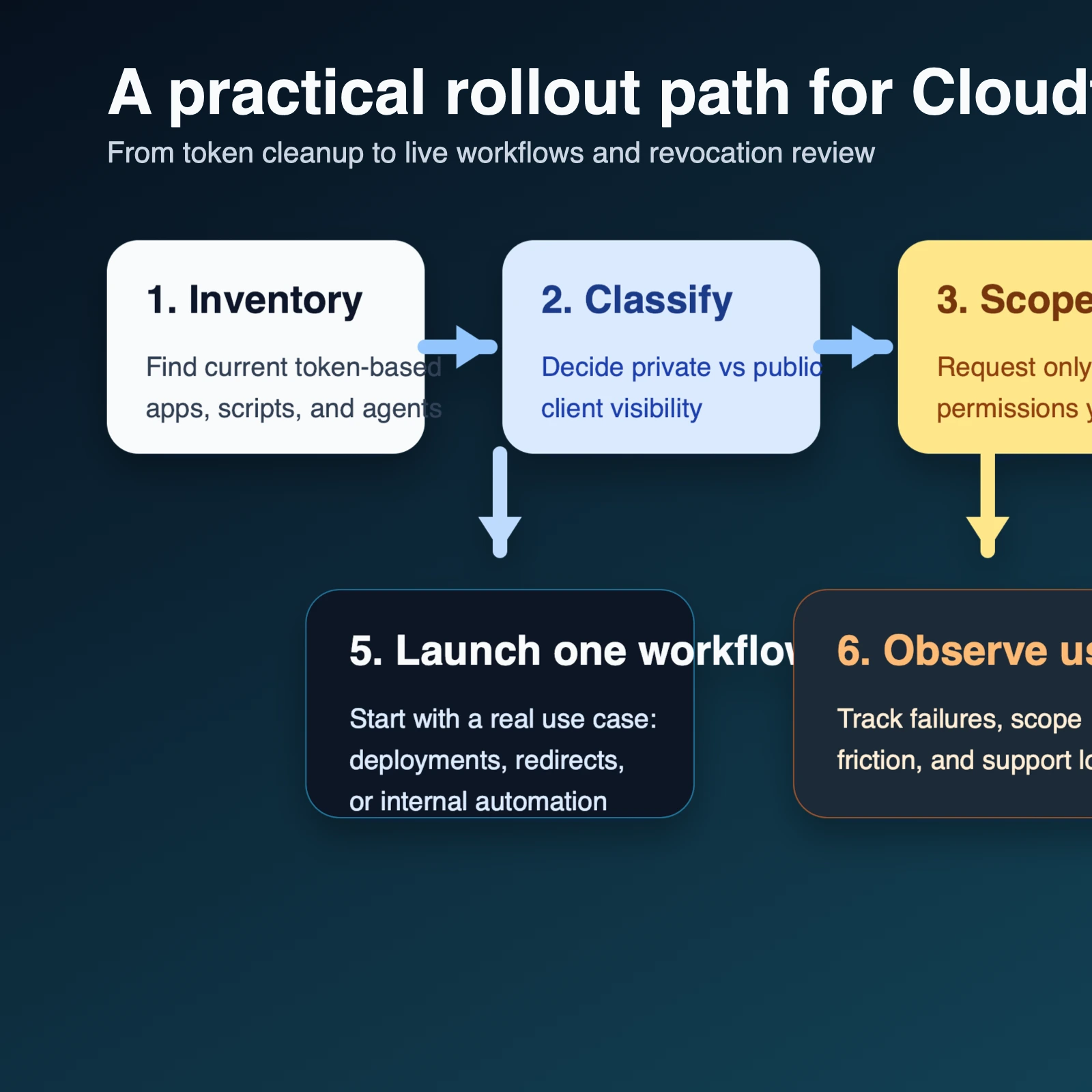
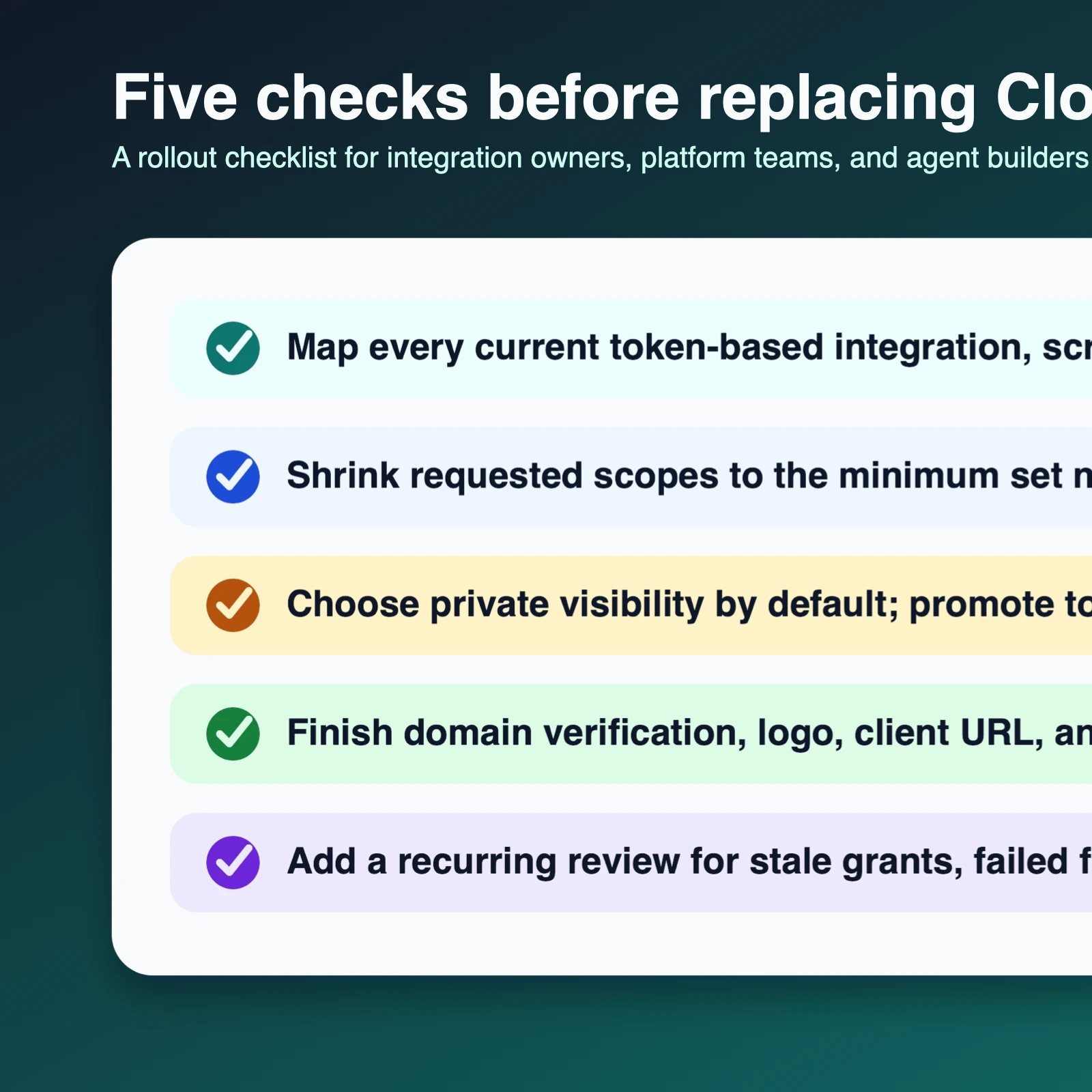
- Inventory every place your team still uses account-wide or long-lived Cloudflare API tokens for third-party apps, internal tools, or agent workflows.
- Decide which integrations should remain private to one account and which genuinely need public visibility for broader customer authorization.
- Trim scope requests aggressively so the consent screen asks only for the minimum permissions the workflow needs.
- Complete domain verification and consent-page hygiene before promoting any client to public visibility.
- Add revocation review to your regular ops routine, just as you already review budgets, prompts, connectors, or access roles.
What remains uncertain
The launch does not mean API tokens disappear. Some low-complexity or tightly controlled machine-to-machine use cases may still be better served by tokens, and Cloudflare has not claimed OAuth is the right answer for every automation. It is also still unclear how quickly third-party vendors will rebuild existing token-based integrations around delegated flows, or how much support work smaller teams will accept in exchange for better consent and revocation control.
Still, the June 24 change is strategically meaningful because it upgrades access control from an implementation detail into a product capability. For teams building agentic software, customer-facing integrations, or governed internal automation, Cloudflare has made one thing easier: replacing brittle credential sharing with a more standard, reviewable way to let software act on a user's behalf.