Facebook turns public posts into an AI search surface that brands now need to monitor
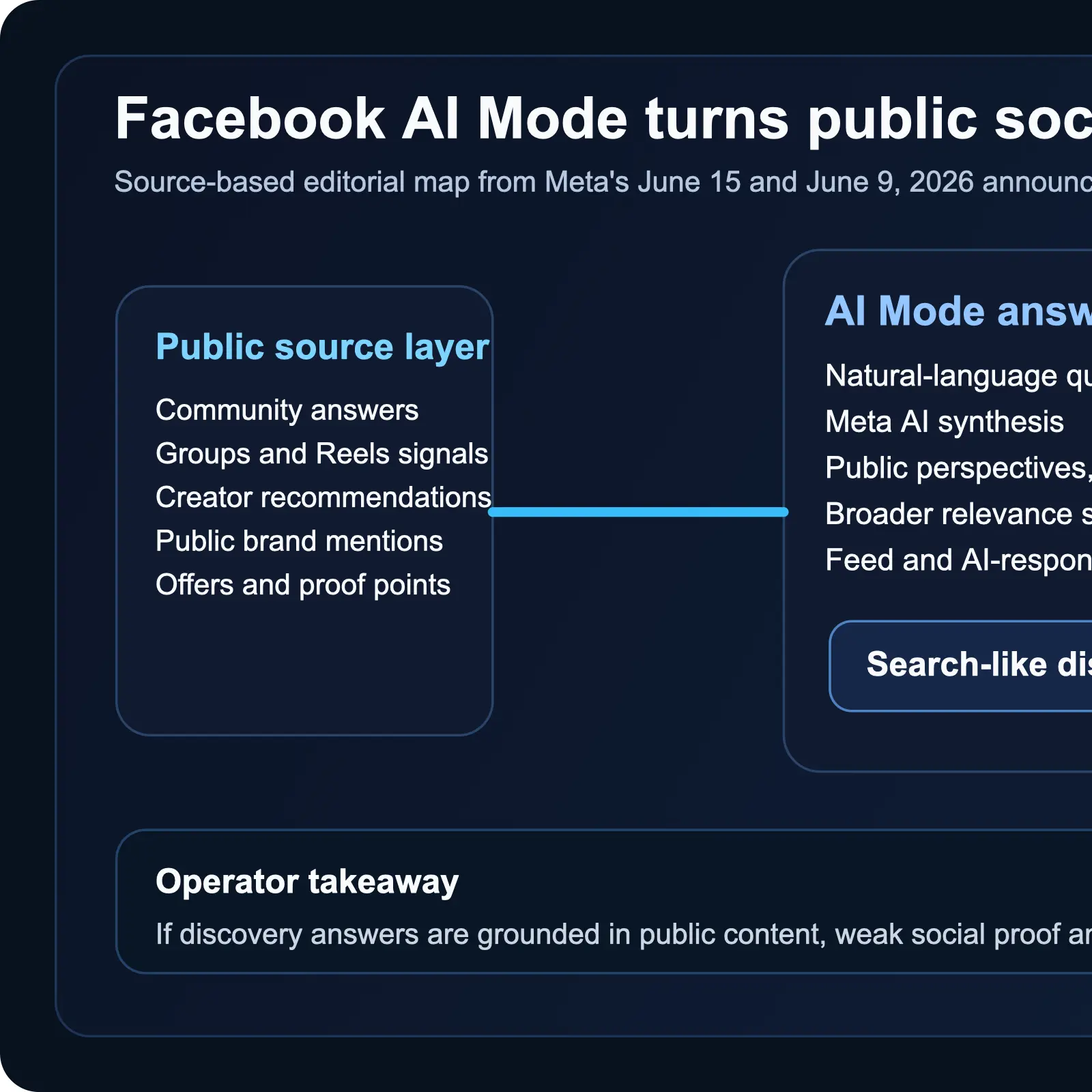
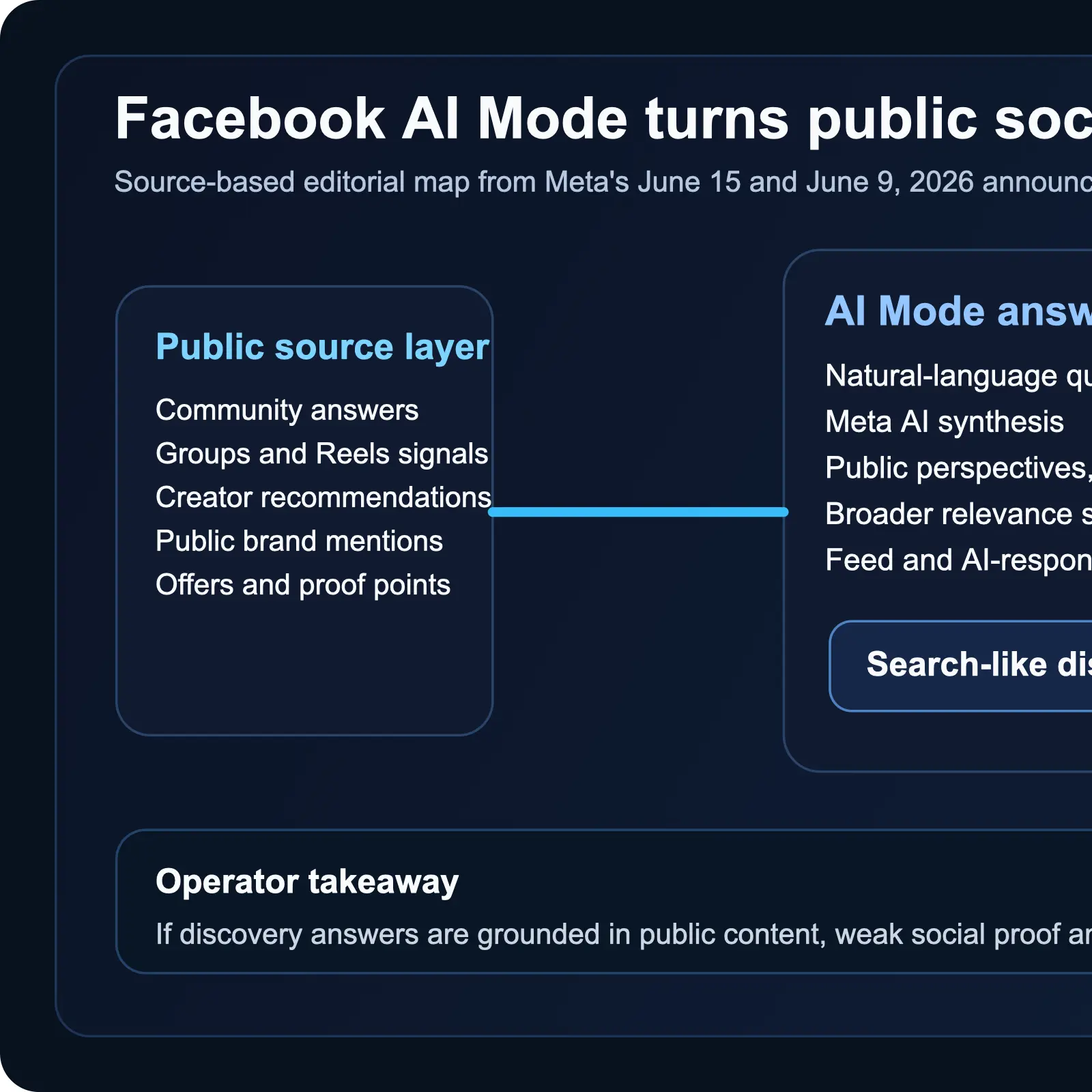
Meta said on June 15, 2026 that Facebook is rolling out AI Mode, a search tab that uses Meta AI to answer questions with material grounded in what people share publicly across Meta apps, including public recommendations and experiences from surfaces such as Groups and Reels. For marketers and brand teams, the practical shift is that Facebook is becoming more explicit about turning public social content into an answer layer, not just a feed or a list of links.
That matters because Meta is already widening how its systems use relevance signals. In a separate official update on June 9, 2026, the company said business-shared activity data will start helping personalize not only ads, but also Feed and AI responses. Read together, the June 9 and June 15 announcements point in one direction: public social proof, platform relevance signals, and AI-generated discovery are becoming more tightly connected inside Facebook.
What changed
Meta's June 15 post makes the search change concrete, while the June 9 post explains why the surrounding relevance system matters.
| Confirmed point | Official source | Why it matters operationally |
|---|---|---|
| AI Mode is a new search tab on Facebook that uses Meta AI to answer questions. | Meta Facebook product announcement, June 15, 2026 | Facebook search starts behaving more like an answer engine instead of a classic results page. |
| Meta says AI Mode answers are grounded in what people share publicly across its apps, including public perspectives from Groups and Reels. | Meta Facebook product announcement, June 15, 2026 | Public social content quality and brand mentions become more important as discovery inputs. |
| Meta says the same release also adds AI-assisted creative sharing features, while camera-roll suggestions remain opt-in. | Meta Facebook product announcement, June 15, 2026 | The launch is broader than search alone, but search is the highest-leverage business signal. |
| Meta said on June 9 that business-shared activity data will also personalize Feed and AI responses, not only ads. | Meta personalization update, June 9, 2026 | AI answers are being tied to a wider relevance system, not built as a standalone novelty feature. |
| Meta said those control and data-use changes start next month in the U.S. and a number of other countries, with more to follow. | Meta personalization update, June 9, 2026 | Regional rollout timing matters for teams serving North America, the UK, Australia, and Europe. |
Facebook now wants users to ask broader questions and get synthesized answers rooted in public social content, not only click through a stack of links.
Why it matters
For high-value growth audiences, the change matters because it reshapes where discoverability work happens. A brand used to think about Facebook mostly as a distribution channel for paid campaigns, community posts, creator collaborations, and customer-service interactions. AI Mode adds a more explicit retrieval layer on top of that activity.
That does not mean every business suddenly needs a Facebook-first strategy. It does mean the old separation between "social content," "search visibility," and "brand mentions" is getting weaker.
This also creates a stronger use case for Slogan.website's internal tools. The GEO Visibility Checklist can help teams audit whether public-facing content answers buyer questions. The guide to tracking brand mentions and visibility becomes more relevant when public references may influence AI-style discovery. The Marketing ROI Calculator and Digital Marketing Budget Planner help decide whether more investment belongs in community content, creator proof, or paid amplification.
Who is affected
The first group is multi-location, local-service, and consumer brands that rely on public recommendations, community chatter, and social proof.
The second group is B2C and creator-led teams that use Facebook and Instagram as evidence surfaces.
The third group is SEO, GEO, and content strategists. Teams that only optimize web pages and ignore public-platform evidence are taking a narrower view.
What to do next
Use this workflow before treating AI Mode as either hype or guaranteed traffic.
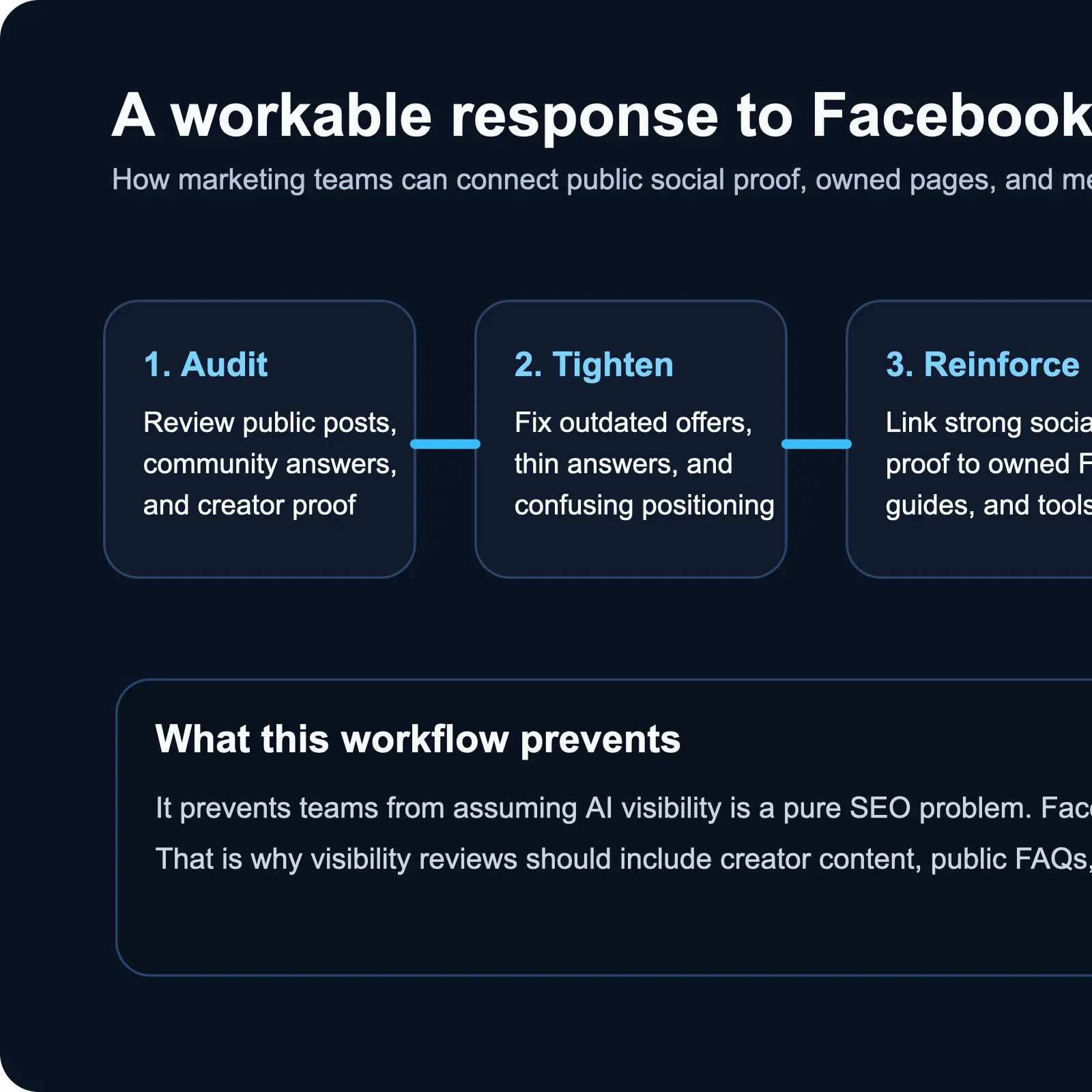
- Audit the public Facebook content, community answers, and creator posts most likely to represent your brand in search-like contexts.
- Identify weak spots where public references are outdated, thin, inconsistent, or missing the questions buyers actually ask.
- Map which topics deserve stronger official posts, creator explainers, FAQs, or landing pages so social discovery and owned content reinforce each other.
- Track branded demand, referral quality, lead quality, and assisted conversions instead of assuming any AI-driven visibility is commercially useful.
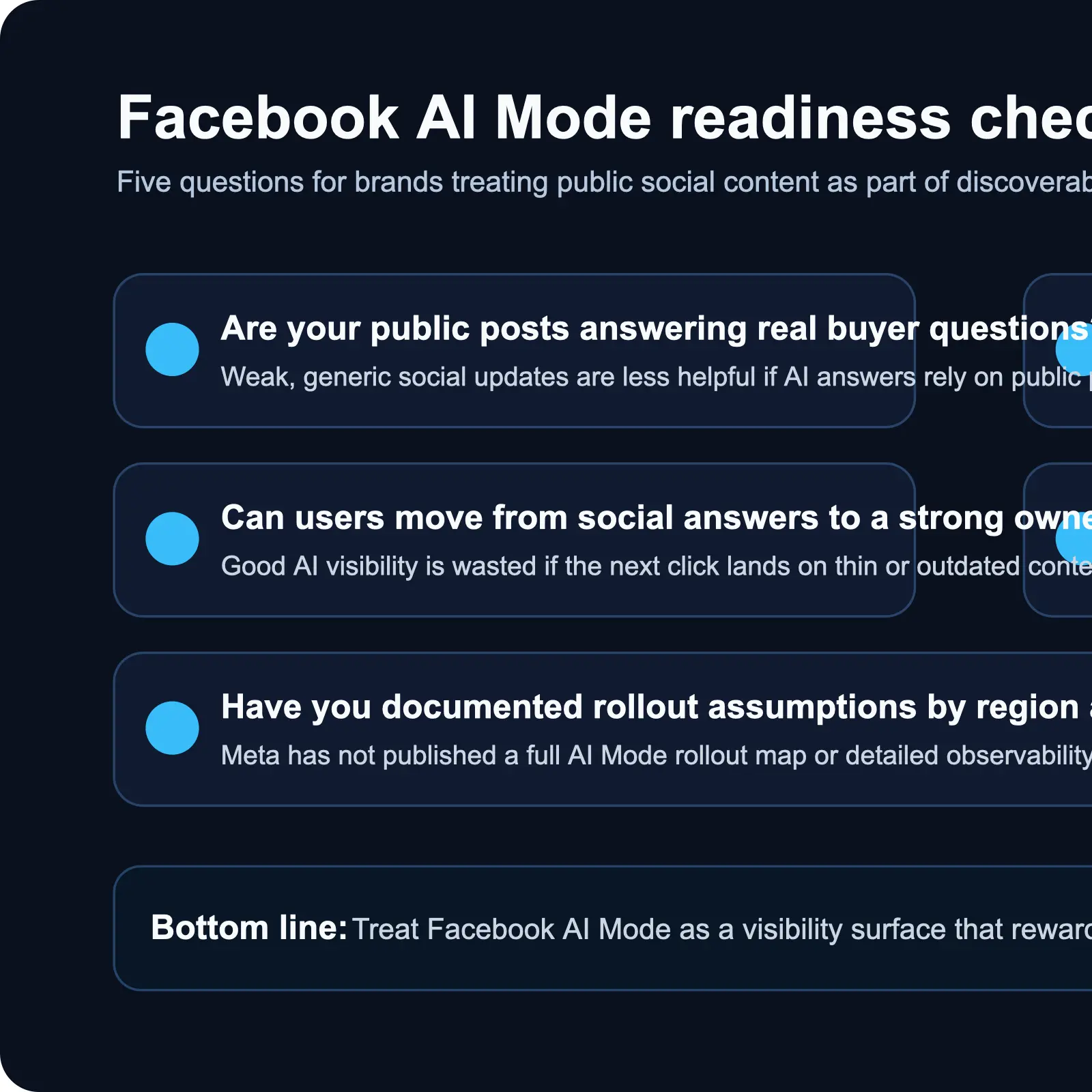
- Document regional rollout assumptions because Meta's June 9 data-use changes are not described as globally complete on day one.
What remains uncertain
Several limits remain on June 21, 2026. Meta's announcement explains the product direction, but it does not publish a rollout map for AI Mode, detailed ranking logic, or a measurement framework showing how AI Mode visibility should be distinguished from standard Facebook discovery.
There is also a control question. Meta's June 9 update says users can manage whether business-shared activity data is used for personalization, but the June 15 AI Mode post does not turn that into a marketer-facing reporting system.
The practical conclusion is still clear. Facebook is moving beyond a feed-only model and into a more explicit answer-engine role based on public social content and broader relevance signals. Brands that care about discoverability should respond by improving public proof, tightening source quality, and measuring whether social-answer visibility produces qualified business outcomes instead of only more impressions.