Gartner says CMOs are pushing more budget into awareness, conversion, and AI without the operating maturity to scale it
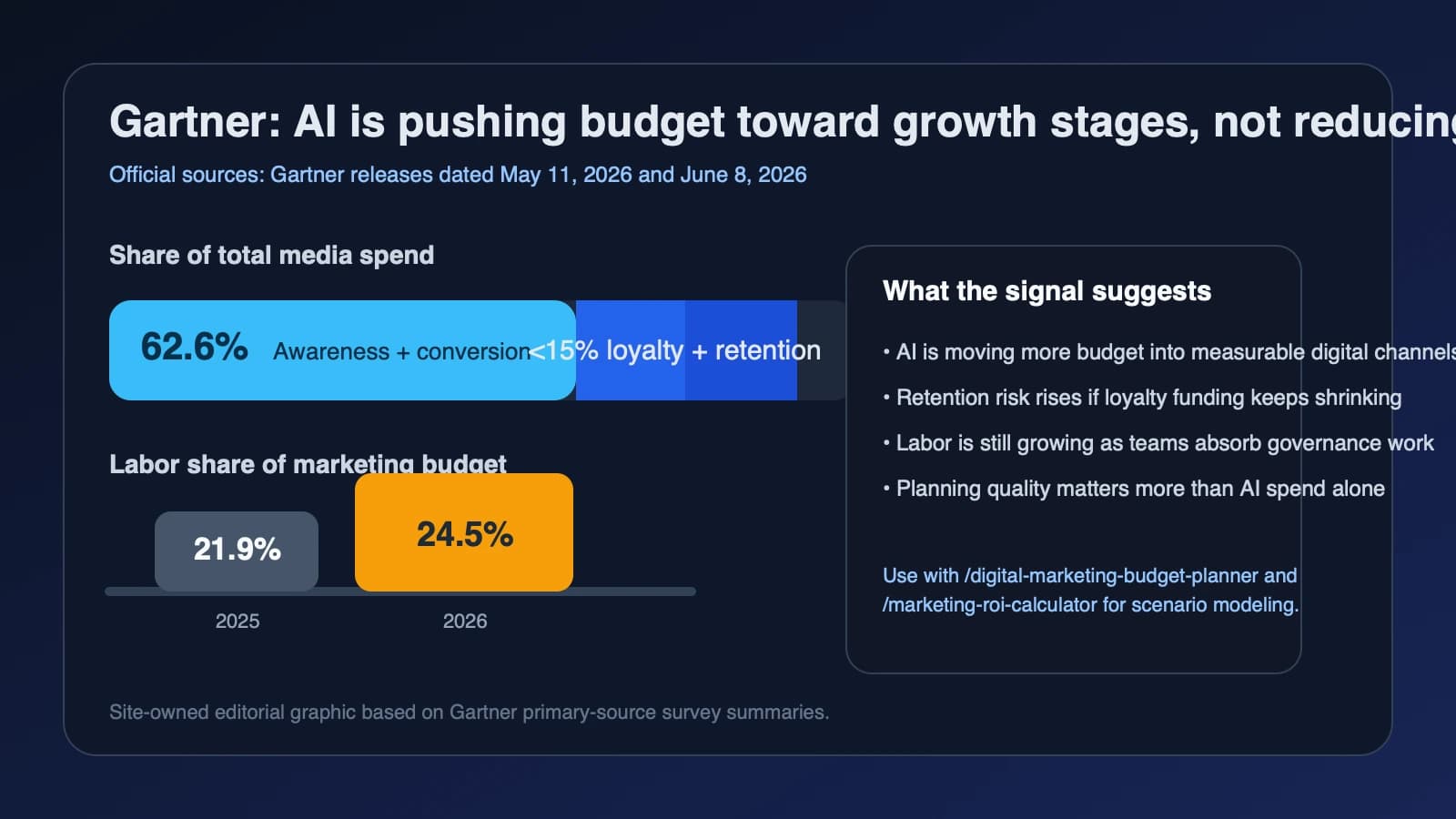
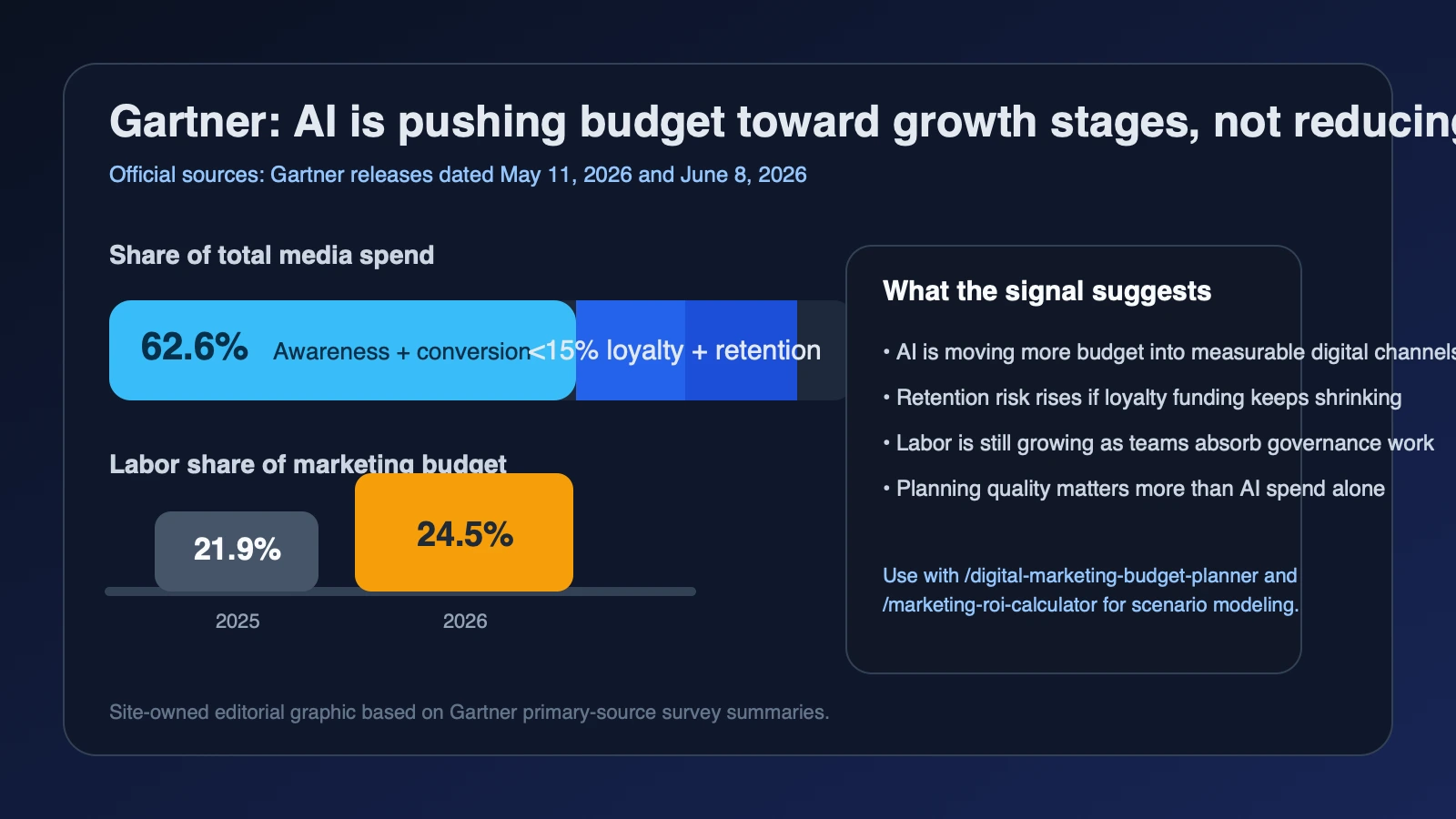
Gartner said on June 8, 2026 that awareness and conversion now account for 62.6% of total media spend, as CMOs keep shifting budget toward digital channels and customer acquisition. The same update says labor's share of the total marketing budget rose to 24.5% in 2026 from 21.9% in 2025. For operating teams, that is the real story: AI is changing where money goes, but not eliminating the need for people, process discipline, and clearer planning.
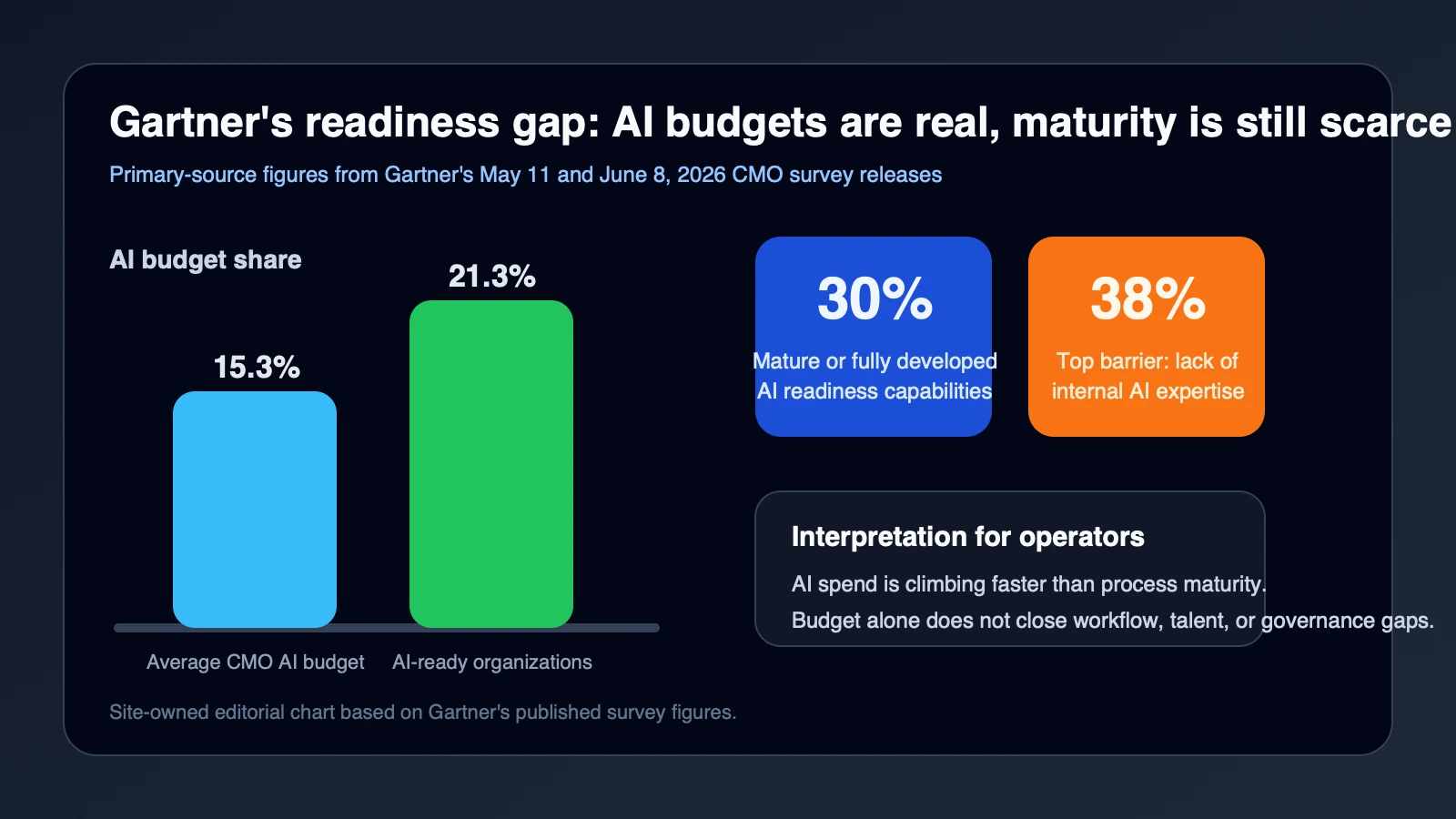
The June 8 announcement builds on Gartner's earlier May 11, 2026 CMO Spend Survey release, which said CMOs now allocate an average of 15.3% of marketing budgets to AI initiatives while only 30% report mature or fully developed AI readiness capabilities. Together, those two primary-source releases suggest the near-term effect is not magic efficiency. It is budget pressure, channel reallocation, and a rising need to prove that AI-assisted work still connects to demand, retention, and revenue.
What changed
Gartner's June 8 release turns a broad AI-budget discussion into a more operational one. According to the company, digital media now represents more than two-thirds of total media investments in 2026, up 18% since 2024. It also says spending on loyalty and retention has fallen 29% over the same period to less than 15% of total media spend, while awareness and conversion rose to 62.6%.
| Confirmed 2026 Gartner signal | Primary source | Why it matters |
|---|---|---|
| Awareness and conversion now account for 62.6% of total media spend. | Gartner, June 8, 2026 | More budget is moving toward acquisition-stage work that can show faster impact. |
| Digital media represents more than two-thirds of total media investment, up 18% since 2024. | Gartner, June 8, 2026 | AI-optimizable channels keep gaining share because they are easier to tune and measure. |
| Labor's share of marketing budgets rose from 21.9% in 2025 to 24.5% in 2026. | Gartner, June 8, 2026 | Teams still need operators, analysts, creative reviewers, and governance instead of tool-only rollouts. |
| CMOs allocate 15.3% of marketing budgets to AI, but only 30% report mature or fully developed AI readiness. | Gartner, May 11, 2026 | AI ambition is outpacing operating maturity. |
| Thirty-eight percent cite lack of internal AI expertise and talent as the top efficiency barrier. | Gartner, June 8, 2026 | The constraint is not only software access; it is organizational capability. |
Gartner's May 11 release adds one more constraint: marketing budgets only rose slightly to 7.8% of company revenue in 2026 from 7.7% in 2025, while 56% of CMOs said their organizations lack the budget required to deliver their 2026 strategy. AI is being funded inside a constrained environment, not a spending boom.
Why it matters
For senior marketing teams, the risk is not that AI gets underfunded. The risk is that AI gets funded in the easiest places to automate and measure, while harder long-term work such as loyalty, retention, brand authority, and content quality quietly loses oxygen. Gartner explicitly warned on June 8 that less mature organizations may be over-indexing on short-term optimization and the channels that are easiest to tune.
That matters because performance systems can push teams toward what is easy to measure rather than what is strategically durable. If awareness and conversion budgets climb while retention budgets keep shrinking, many brands may end up with faster acquisition loops but weaker downstream economics.
The other important implication is operational. If labor share is rising while AI investment also rises, marketing leaders need to stop framing AI plans as a headcount shortcut. The more practical model is capability redesign: fewer repetitive tasks, more review layers around prompts and data quality, better experimentation discipline, and clearer workflow ownership. That is where tools such as the Digital Marketing Budget Planner, the Marketing ROI Calculator, and the GEO Visibility Checklist become useful. They force teams to connect AI spend, media spend, and visibility work to measurable business outcomes instead of vague efficiency claims.
Who is affected
The first group is enterprise and upper-midmarket marketing leadership teams in the United States, Canada, the United Kingdom, Europe, and Australia that are being asked to deliver AI-enabled growth without materially larger budgets. Gartner's survey covered 401 CMOs and other marketing leaders across North America, the United Kingdom, and Europe, so the signal is strongest for larger operators.
The second group is channel owners responsible for paid media, lifecycle, CRM, and owned-content programs. If the budget mix is tilting toward acquisition and digital optimization, those teams need stronger arguments for retention and brand-strength investments that may not look as immediately efficient in a dashboard.
The third group is agencies, consultants, and in-house ops teams selling AI transformation programs. They need to show not just tooling access but operating readiness: governance, QA, attribution, data flow, and staffing models. Otherwise the pitch will sound good in procurement and fail in execution.
What to do next
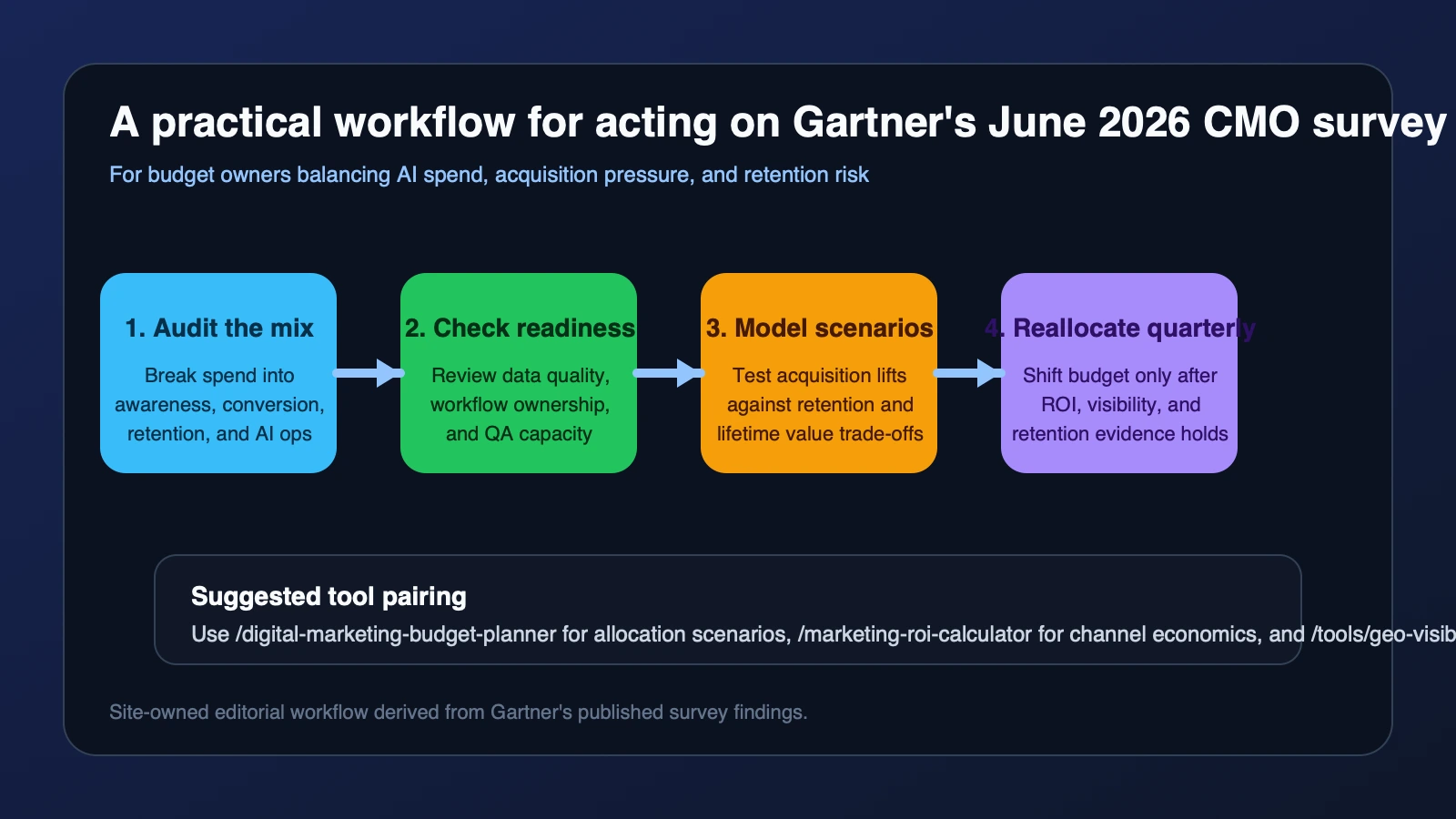
- Map your current budget by funnel stage and compare awareness plus conversion against retention and loyalty to see whether your mix is drifting too far toward short-term acquisition.
- Separate AI tool spend from AI operating spend so training, QA, analytics, and review capacity are visible instead of hidden inside labor lines.
- Run at least one scenario in the Digital Marketing Budget Planner showing what happens if retention investment falls while acquisition spend rises.
- Pressure-test channel ROI in the Marketing ROI Calculator before treating AI-optimized media as automatically more profitable.
- Add brand-visibility and answer-engine checks using the GEO Visibility Checklist and the guide to tracking brand mentions and visibility so AI spend does not ignore emerging discovery channels.
The practical goal is to stop funding AI in a way that weakens the rest of the operating system.
What remains uncertain
There are still limits on how far these figures should be generalized. Gartner's June 8 and May 11 releases summarize survey findings rather than publishing a full industry-by-industry breakdown, so they show directional patterns, not a universal prescription for every business model.
Another open question is how fast AI readiness can actually improve. Gartner says 70% of CMOs believe their internal marketing processes are not mature enough to implement and scale AI effectively, but it does not yet specify which fixes close the gap fastest across analytics, governance, or team design.
The immediate takeaway is still clear. As of June 8, 2026, the official Gartner signal is not that AI has simplified marketing. It is that AI is concentrating spend into more measurable parts of the funnel while making operating discipline more important, not less.