Google turns AI ad disclosures into a creative-ops workflow across Search, YouTube, and Discover
Google changed the practical rules for AI-made ad creative on July 9, 2026. The update is not a vague trust statement. Google says it is adding a global "How this ad was made" panel inside My Ad Center for ads on Search, YouTube, and Discover, and it is also rolling out new advertiser controls so teams can mark whether assets were created or edited with AI. For marketers, agencies, and creative-ops teams in the United States, Canada, the United Kingdom, Australia, and Europe, that turns AI disclosure from a side policy question into a workflow that now touches asset libraries, campaign review, regional compliance, and brand governance.
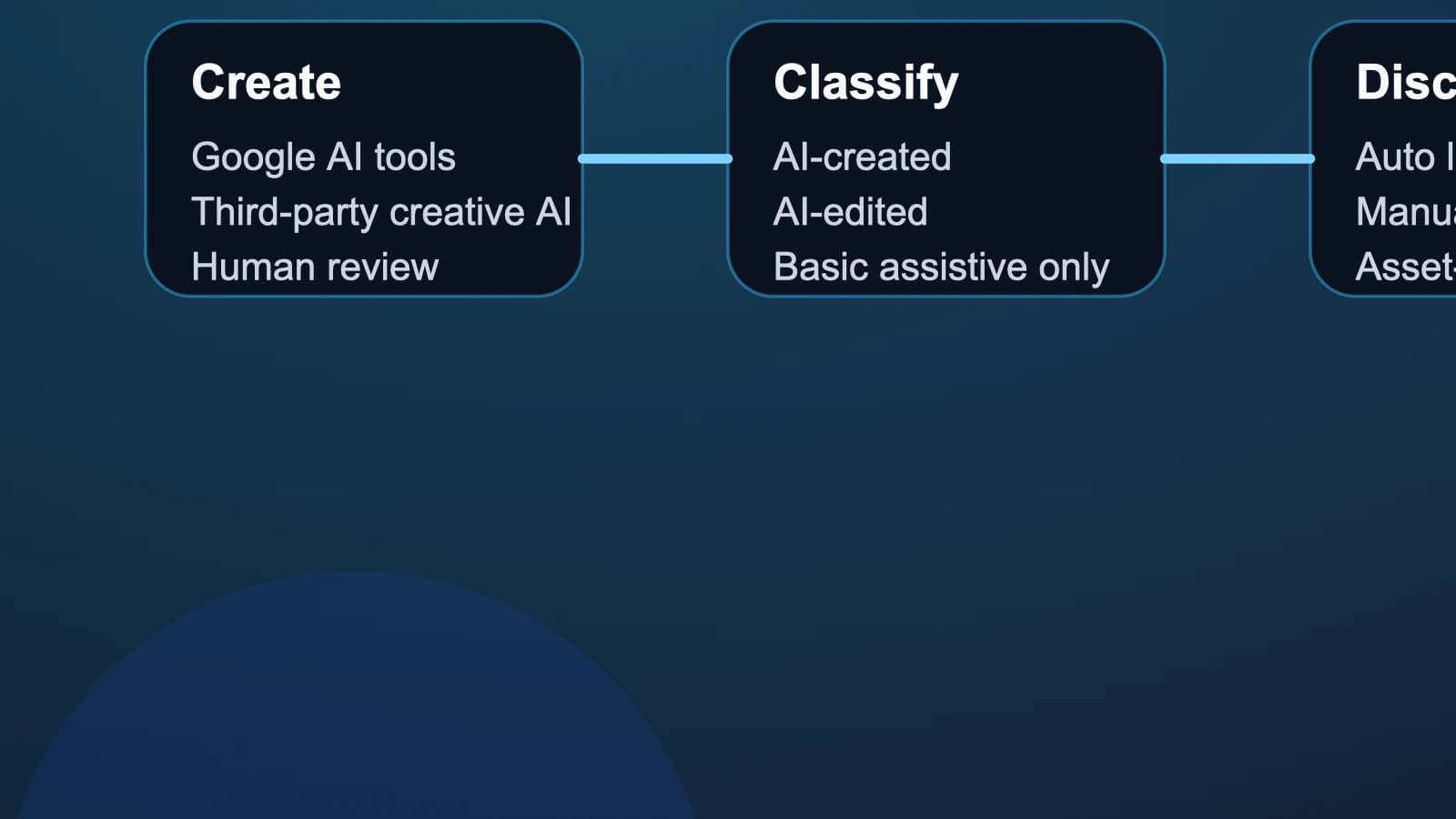
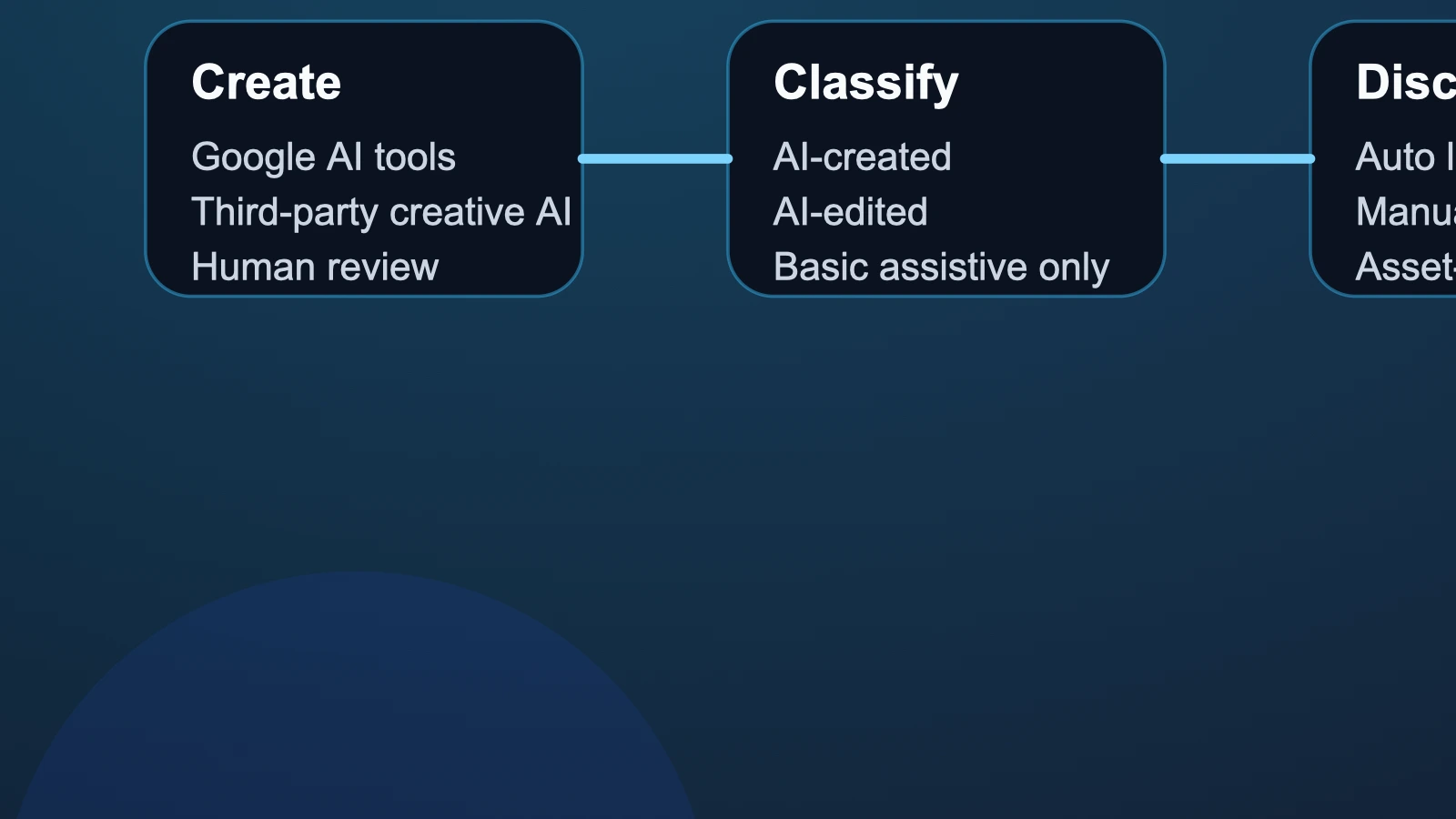
The operational consequence is straightforward. If your team uses generative AI to build images, video, or ad variants, Google now expects that usage to be legible both to your internal operators and, in some cases, to the people seeing the ad. That does not mean every AI-assisted crop or cleanup will carry the same visible signal. It does mean creative teams need a more explicit process for deciding when an asset qualifies as AI-created or AI-edited, who applies the label, and how those choices align with market-specific rules.
What changed
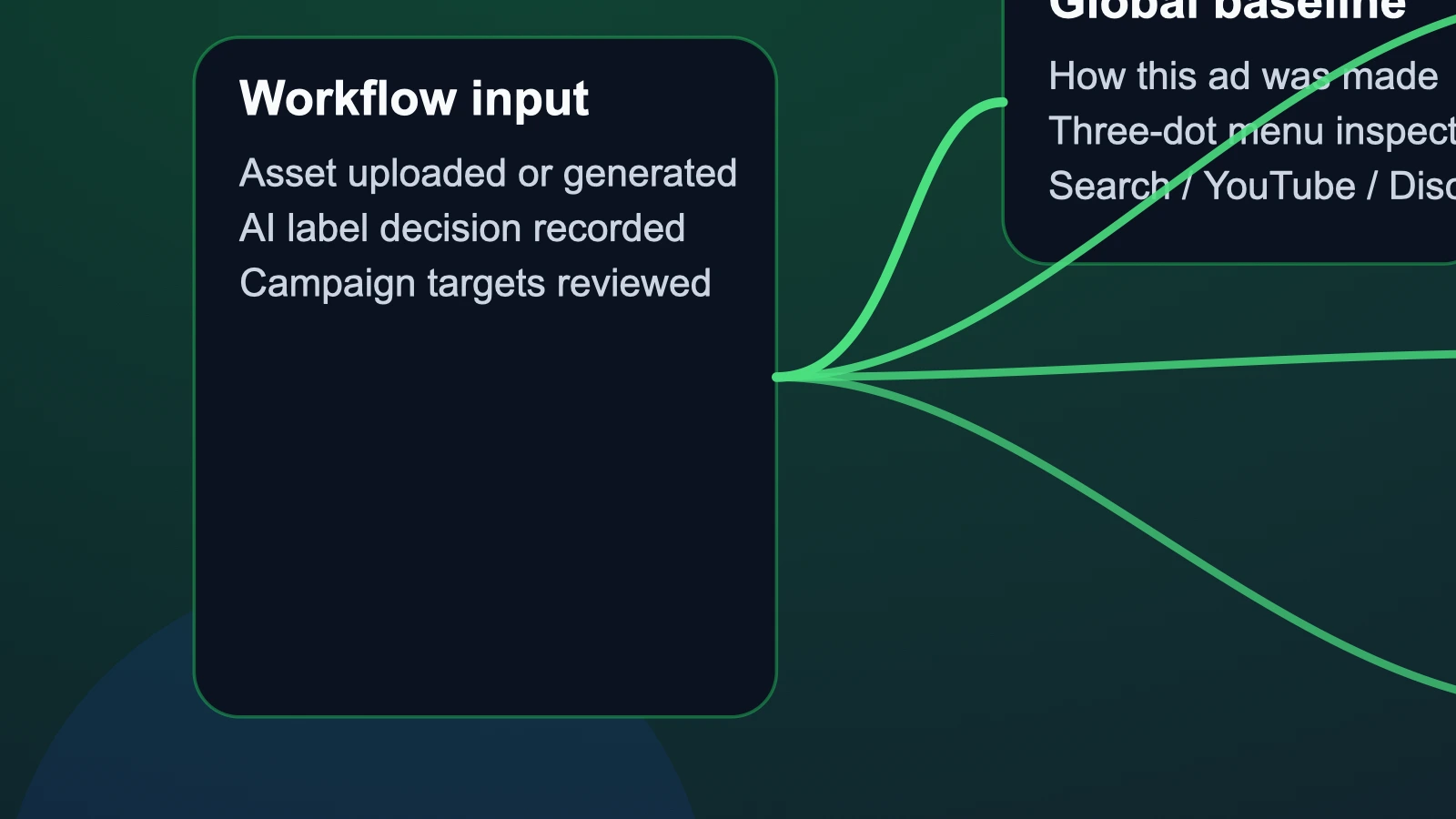
In Google's official July 9 announcement, the company says the new "How this ad was made" section is being added to the My Ad Center panel and will be accessible globally from the three-dot menu or info icon on ads across Search, YouTube, and Discover. Google says the panel will indicate whether an ad was created or edited with AI. The same announcement says Google will automatically add disclosures when advertisers use Google's own generative AI advertising tools, and it is introducing a separate advertiser control for assets created elsewhere so teams can indicate if generative AI was used.
Google's Google Ads Help documentation adds the implementation detail that matters most for operators. The help page says the AI label setting will launch gradually throughout July 2026 for Google Ads, Display & Video 360, Campaign Manager 360, Merchant Center, and Ads Editor. It also says disclosures may appear only in the My Ad Center panel in some cases, but for campaigns targeting the European Union, India, and New York, ads with designated AI-created or AI-edited assets will also include visible overlays on the ad itself.
The user-facing side appears in Google's My Ad Center Help page. That page says users can open the ad menu and check not only "About this advertiser" and "Why this ad," but also "How this ad was made" when an ad uses AI-created or AI-edited assets. Google also says it continues to apply existing ad policies and advertiser verification safeguards, which means the new disclosures sit on top of policy enforcement rather than replacing it.
| Confirmed July 2026 change | Official source | Why operators should care |
|---|---|---|
| Google is adding a global "How this ad was made" panel for ads on Search, YouTube, and Discover. | Google Ads & Commerce, July 9, 2026 | Consumer-facing AI disclosure is becoming a standard part of ad inspection, not an edge case. |
| Google will automatically add disclosures when its own generative ad tools create assets. | Google announcement | Teams cannot assume AI use inside Google's native tools stays invisible. |
| An AI label setting is rolling out gradually through July 2026 across Google Ads, DV360, Campaign Manager 360, Merchant Center, and Ads Editor. | Google Ads Help | Disclosure handling now affects both self-serve ad teams and broader media-operations stacks. |
| For campaigns targeting the EU, India, and New York, designated AI assets can trigger visible overlays on the ad itself. | Google Ads Help | Regional compliance rules can directly change the creative shown to end users. |
| Users can inspect "How this ad was made" through My Ad Center when an ad uses AI-created or AI-edited assets. | My Ad Center Help | Brands should assume motivated buyers, reporters, regulators, and partners can inspect AI provenance. |
Why it matters
This matters because generative creative is no longer just a production shortcut. It is becoming a disclosed input in media delivery. For many teams, the hard part will not be turning on one new setting. The hard part will be defining a reliable threshold for AI-edited versus AI-created, especially when the workflow spans multiple vendors, agencies, and asset handoffs.
The July 2026 update also changes brand-risk math. A creative team may be comfortable using AI-assisted image generation or expansion, but the media team now has to consider when that choice changes how the ad is presented in regulated geographies. That makes creative review more similar to localization, privacy, or financial-compliance review: a decision upstream can affect what appears at delivery time.
For Slogan.website readers, this is where operational planning matters more than AI hype. The right follow-on tools are the GEO Visibility Checklist for source and message consistency, the brand-mentions visibility guide for monitoring downstream perception, and the Digital Marketing Budget Planner or Marketing ROI Calculator for modeling whether AI-assisted creative production actually saves time once compliance and review overhead are included.
Who is affected
The first group is in-house paid-media and creative-ops teams using AI to scale asset testing. They now need a disclosure decision point in the same workflow as naming, approvals, and version control.
The second group is agencies and holding-company teams managing campaigns across multiple geographies. The Google Ads Help page makes clear that regional requirements are not uniform, so a single creative process may no longer produce one identical output everywhere.
The third group is compliance, brand-safety, and communications leaders. They may not build the assets, but they now need to understand when an AI label or overlay can appear and whether that affects brand trust, regulated offers, or creative acceptance.
What to do next
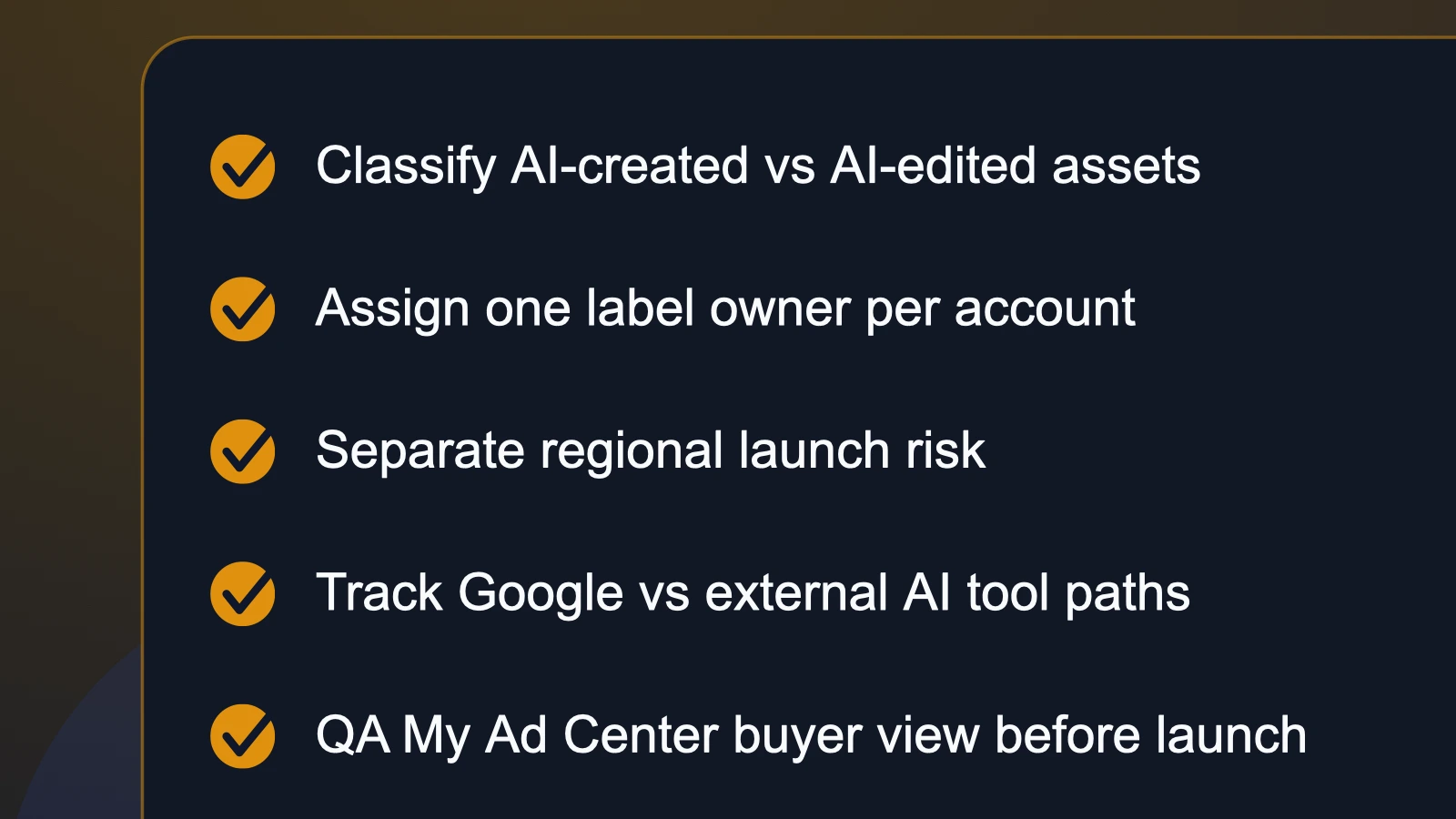
- Audit which ad assets in your current workflow use generative AI creation, meaningful AI editing, or only basic assistive adjustments.
- Assign one owner for AI-label decisions in Google Ads and connected platforms instead of leaving disclosure choices buried in ad-hoc creative chats.
- Split campaigns by geography when disclosure treatment could materially affect regulated, sensitive, or premium brand creative.
- Document when your team uses Google's native AI ad tools versus third-party creative tools, because Google's disclosure handling differs between those paths.
- Add a final prelaunch check inside your campaign QA process for asset-label status, visible overlays, and the buyer-facing experience inside My Ad Center.
What remains uncertain
Google has published the core mechanics, but several operating details are still fluid on July 10, 2026. The rollout is described as gradual throughout July, so not every account or platform surface will expose the same controls at the same time. The documentation also does not provide a universal bright line for every borderline editing case, which leaves room for interpretation when teams use mixed workflows or external tools. And while Google notes that disclosure handling does not guarantee compliance with local law, it does not provide one single cross-market checklist that brands can rely on without legal review.
That means the strongest conclusion is narrower than "Google is labeling all AI ads now." The defensible conclusion is that Google has made AI-ad disclosure inspectable, operational, and increasingly region-sensitive. Teams that treat this as a creative-governance workflow should adapt quickly. Teams that keep AI usage informal may discover the new transparency surface only after a launch, a policy review, or a stakeholder question.