Google Ads' July 1 terms make AI-generated campaign inputs an explicit advertiser review workflow
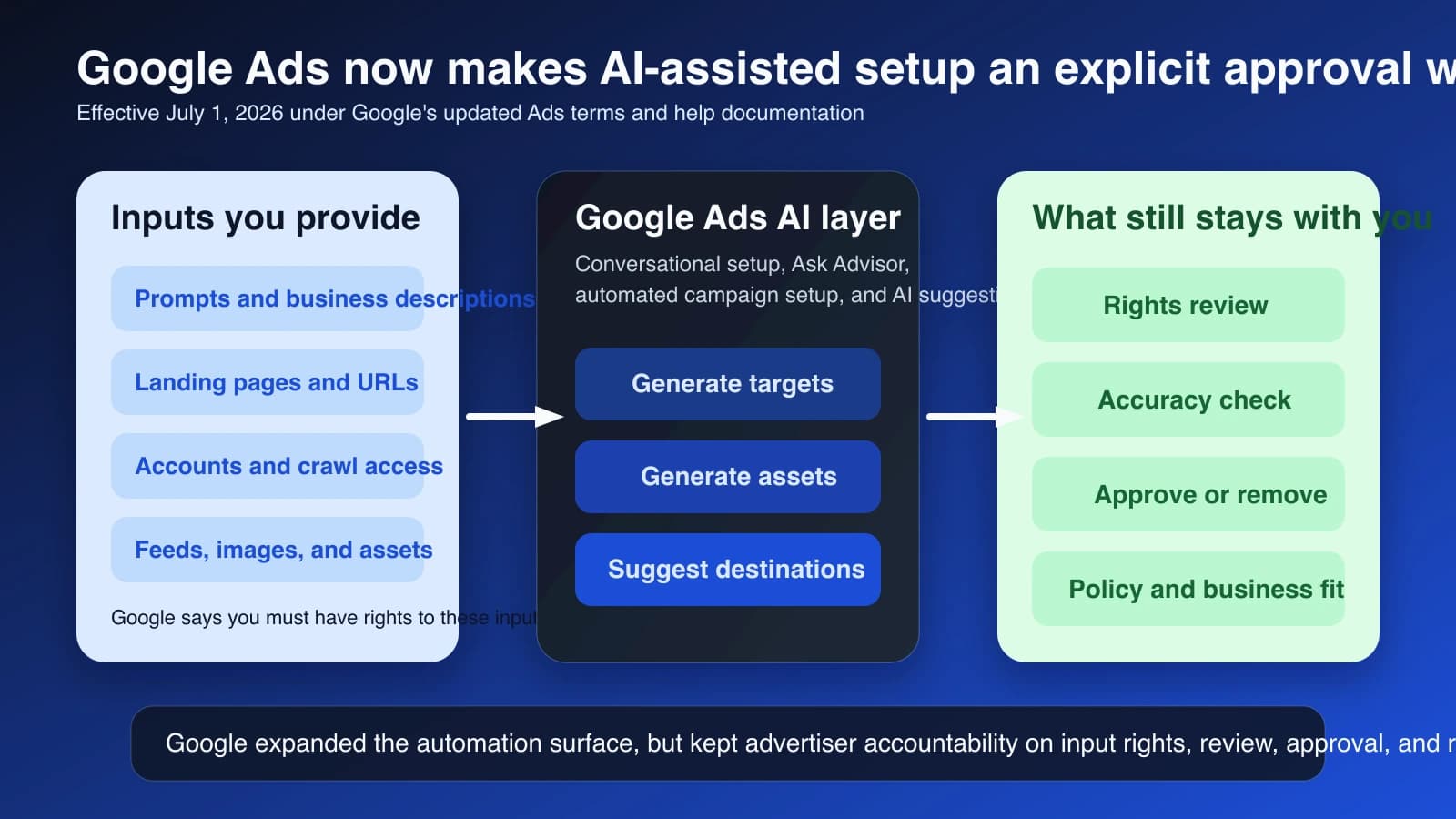
Google's updated Ads terms took effect on July 1, 2026, and Google now spells out that information and URLs entered into conversational Google Ads features, plus URLs or accounts you authorize Google to crawl for automated campaign setup, fall inside the input-and-approval model for modern Ads workflows.
For growth teams in the United States, Canada, the United Kingdom, Australia, and Europe, that turns AI-assisted campaign setup into an operating-control issue. Google is making two points explicit: you must have the rights to what you feed in, and you still own review, approval, and removal of what comes out.
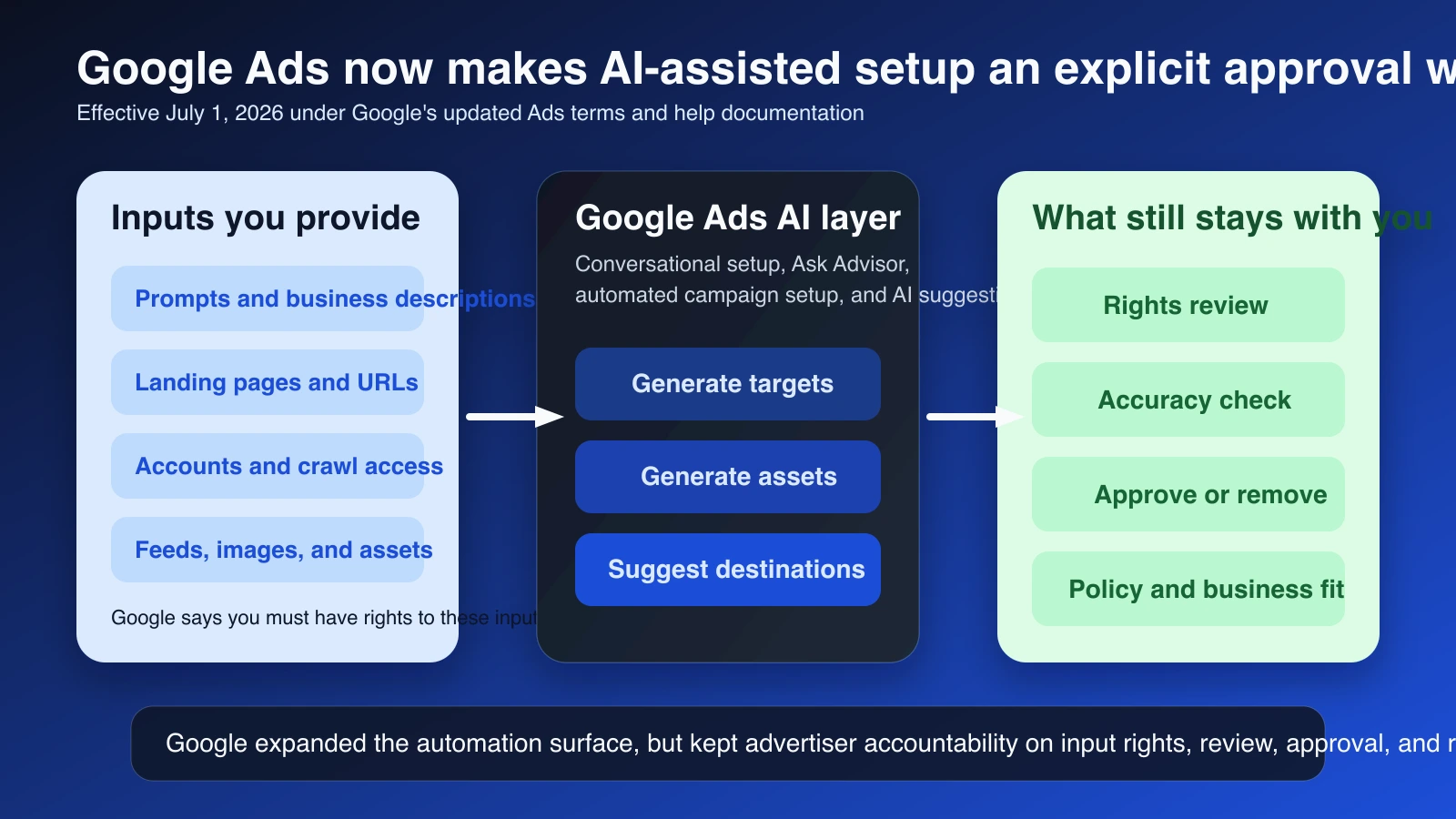
What changed
Google's April 17, 2026 terms update notice says the new terms became effective on July 1, 2026. In that notice, Google highlights updates covering how inputs can be used across Google Ads features, including information or URLs entered into conversational experiences and URLs or accounts that advertisers authorize Google to crawl during automated campaign setup. The same notice also says advertisers are responsible for ensuring they have rights to those inputs and for continuing to review, approve, or remove campaigns and ad assets generated automatically by Google Ads features.
The actual Google LLC Advertising Program Terms go further. Section 1 says the platform may use automated Program features to format, select, or generate targets, ads, or destinations on the customer's behalf. The same section then says the customer remains solely responsible for those resulting targets, ads, or destinations and for reviewing and, where applicable, approving or removing campaigns and assets.
That language aligns with how Google's product docs describe current AI-assisted workflows. The conversational experience in Google Ads says users can enter a landing-page URL, receive an AI-generated business summary, and get suggested keywords, headlines, descriptions, images, and sitelinks. It also says image suggestions may come either from the landing page or from Google AI, and that advertisers are responsible for checking accuracy and relevance before launch. Google's Ask Advisor help page similarly says the beta tool can suggest new text and image creatives and implement suggested changes with the advertiser's approval.
| Confirmed point | Official source | Operational meaning |
|---|---|---|
| The updated Ads terms became effective on July 1, 2026. | Google Ads Help notice | Teams should treat this as a live workflow rule, not a future policy hint. |
| Google can use information or URLs entered into conversational features and URLs or accounts authorized for automated campaign setup. | Google Ads Help notice | Prompt text, landing pages, connected accounts, and crawlable source material now matter more as governed inputs. |
| Automated features may format, select, or generate targets, ads, or destinations on the advertiser's behalf. | Google Ads terms | Automation scope is broad enough to affect campaign structure, asset selection, and final routing. |
| The advertiser remains solely responsible for reviewing, approving, or removing those outputs. | Google Ads terms and terms notice | AI assistance does not transfer accountability for policy, accuracy, rights, or business fit. |
| Conversational setup and Ask Advisor can suggest keywords, creatives, images, and fixes based on URLs and account context. | Conversational experience and Ask Advisor | Review needs to cover both the source inputs and the generated outputs, not only final ad copy. |
Why it matters
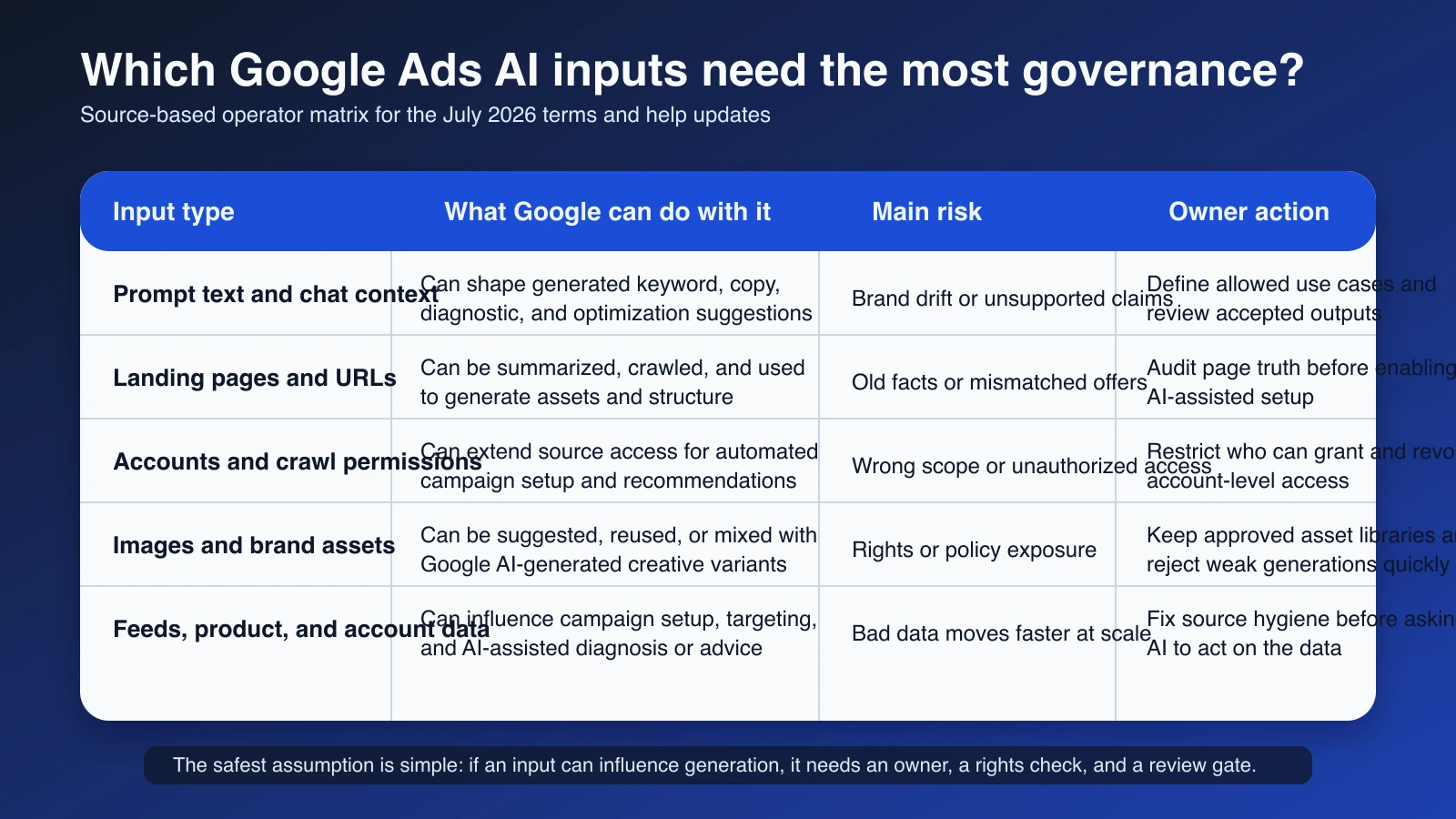
Google's legal language is now catching up with its product design. URLs, landing pages, account context, and business prompts can feed directly into campaign generation and optimization. That can save time, but it also raises the cost of bad inputs.
This is especially important for agencies, multi-brand groups, and lean in-house paid media teams. In those environments, the person prompting an AI tool is often not the same person who owns compliance, brand approvals, product truth, or legal rights. If one teammate grants crawl access and another accepts generated assets, the accountability still sits with the advertiser account.
There is also a measurement angle. Faster asset generation can create the illusion of faster go-to-market, but only if the review layer catches weak claims, mismatched destinations, or low-quality imagery before budget starts moving. That is why this story connects naturally to the GEO Visibility Checklist and the Digital Marketing Budget Planner.
Who is affected
The first group is paid-search and growth teams already using conversational setup, Ask Advisor, or AI-assisted creative tools inside Google Ads. The second group is agencies and consultants operating on behalf of several advertisers, because input rights and approval ownership can blur across client accounts. The third group is ecommerce and software teams that rely on fast campaign iteration from landing pages, product feeds, or shared brand assets.
What to do next
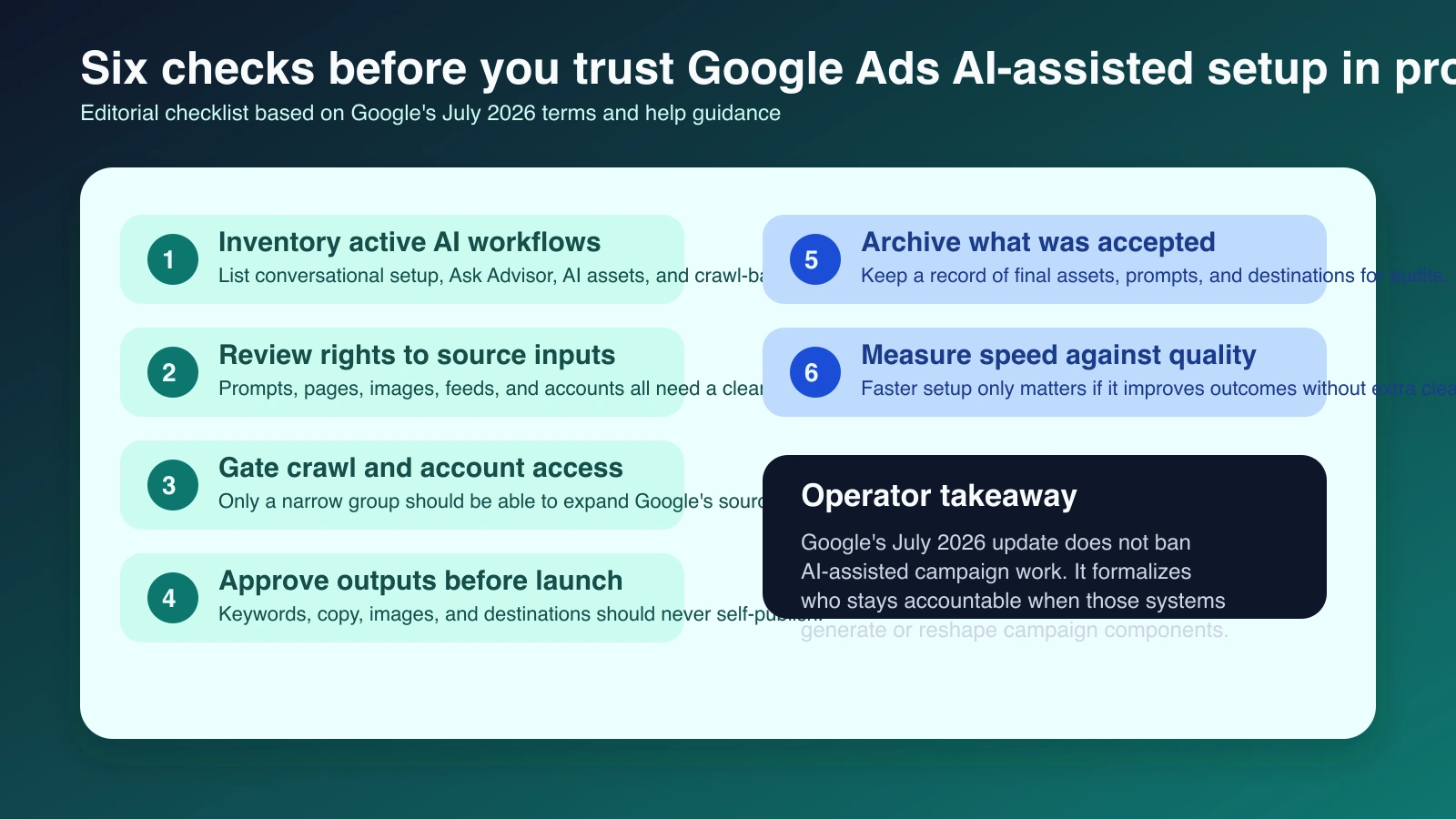
- Inventory which Google Ads workflows in your organization already use conversational setup, Ask Advisor, automated campaign setup, AI-generated images, or crawl-based inputs.
- List the source URLs, accounts, feeds, and asset libraries those workflows can touch, then confirm who actually owns rights and update authority for each one.
- Add a clear approval checkpoint before generated keywords, destinations, text, or images are published, especially in shared client or multi-brand environments.
- Document who can grant crawl or account access to Google and who is responsible for revoking or correcting that access when source material changes.
- Archive the final approved assets and destination choices so performance reviews can be tied back to the exact inputs that produced them.
- Use the Marketing ROI Calculator and Digital Marketing Budget Planner to test whether faster AI-assisted production is improving outcomes or only increasing review load.
What remains uncertain
Google has clarified the responsibility model, but some implementation details are still unclear from the public docs. The product pages do not fully spell out how every AI-assisted feature handles persistence, reuse boundaries, or governance differences across account types and markets. Ask Advisor is still in beta, and conversational experience eligibility still depends on account access and supported languages.
So the defensible conclusion on July 5, 2026 is not that Google Ads automation suddenly became unsafe. It is that Google made the tradeoff more explicit. The platform is getting better at generating campaign components from URLs, prompts, and account context, while making it clearer that advertisers still own the rights, the review burden, and the business consequences.