Google Analytics adds Business Profile reporting and AI assistant traffic tracking
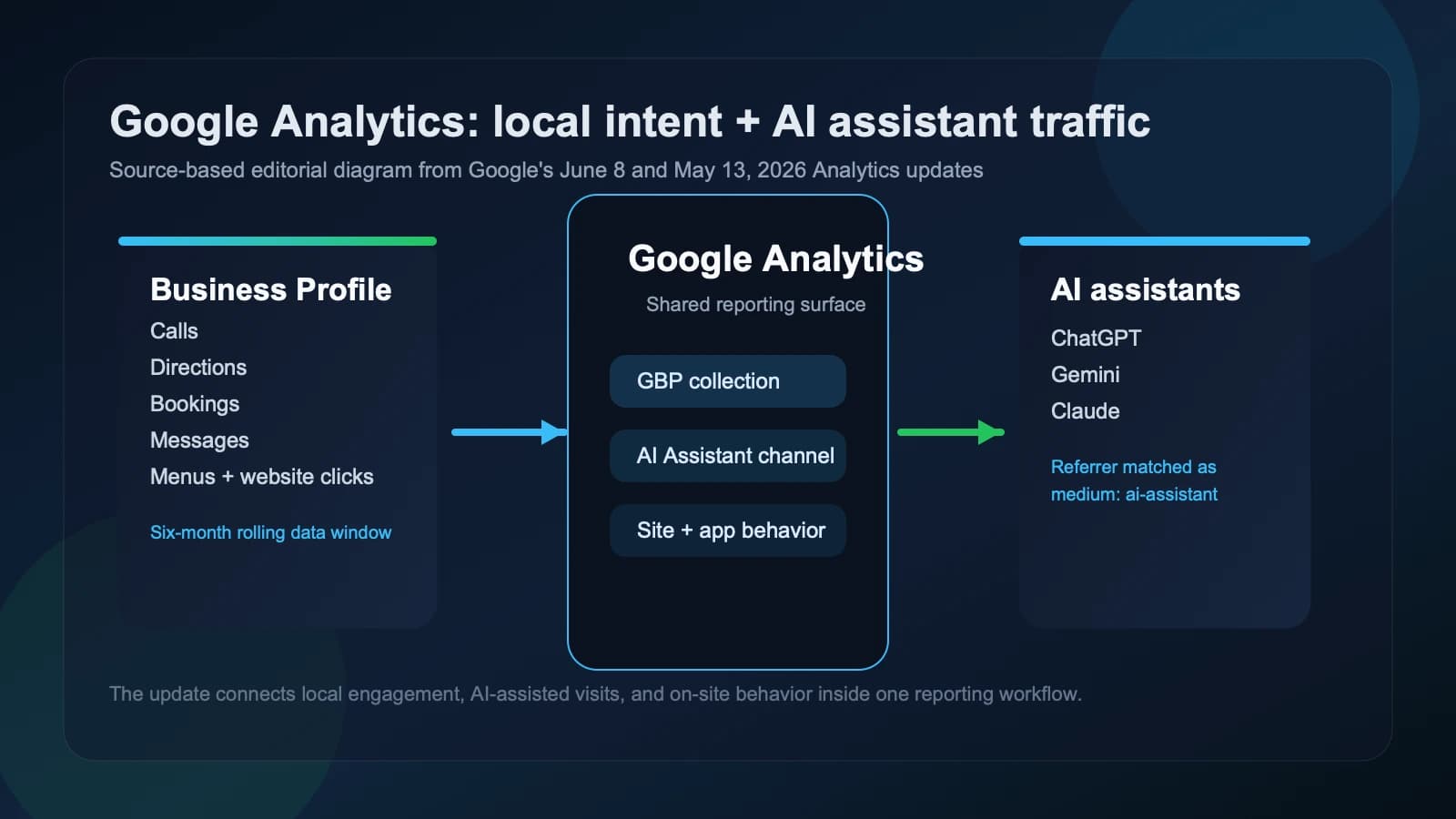
Google quietly made two Google Analytics changes that matter more together than apart. In its official release notes updated on June 8, 2026, Google said marketers can now link Google Business Profile directly to Google Analytics and pull Business Profile engagement metrics into a dedicated reporting collection. In the same release log, Google also documented a May 13, 2026 update that creates a new AI Assistant channel for traffic coming from recognized assistants such as ChatGPT, Gemini, and Claude.
For growth teams, local operators, agencies, and multi-location brands, the practical shift is straightforward: Google Analytics is becoming a better place to measure two discovery layers that often sit outside a normal landing-page conversion report. One is local intent from Search and Maps. The other is answer-engine traffic from AI assistants. If you care about how people discover a business before they become a clean website session, that is a meaningful change.
What changed
The June 8 release is the clearer of the two changes. Google’s new help documentation for connecting Google Business Profile to Google Analytics says Analytics users can now link one or more Business Profiles from the Admin area, then access a dedicated reporting collection with aggregated Business Profile metrics. Google lists seven metrics: interactions, website clicks, calls, directions, messages, bookings, and menus.
The same documentation adds some important operating detail. Google says the reports cover a rolling six-month window, multiple profiles are aggregated together, and the resulting data cannot be segmented by individual profile inside this integration. It also says the feature is not supported for subproperties. That means the release is useful, but not infinitely flexible.
The second update is smaller on paper and arguably broader in strategic impact. In the same official release log, Google says Analytics now assigns an ai-assistant medium when the referrer matches a recognized AI assistant, groups those visits under an AI Assistant default channel, and tags them with the campaign value (ai-assistant). That gives marketers a cleaner way to separate AI-answer traffic from generic referral or organic buckets.
| Confirmed update | Primary source | Why it matters |
|---|---|---|
| Google added direct Google Business Profile linking to Google Analytics on June 8, 2026. | Google Analytics release notes | Local business engagement can now live beside website and app reporting. |
| The linked reports include interactions, website clicks, calls, directions, messages, bookings, and menus. | Google Analytics GBP linking help | Operators get a broader picture of local intent than website sessions alone can provide. |
| Business Profile data is available only for the last six months. | Google Analytics GBP linking help | Teams need to start collecting now if they want a useful baseline later. |
| Multiple linked profiles are aggregated and cannot be broken out by profile in this integration. | Google Analytics GBP linking help | Enterprise and franchise teams still need location-level reporting elsewhere. |
| Google created a dedicated AI Assistant channel for traffic from recognized assistants such as ChatGPT, Gemini, and Claude. | Google Analytics release notes | AI-originated visits become easier to isolate and trend against organic search or referral traffic. |
Why it matters
Most measurement setups still over-reward what happens after a user lands on the site and under-measure how discovery really began. That is especially true for businesses with physical locations, appointment workflows, or service-area demand. A website session is only one part of the journey. Calls, direction requests, bookings, and Business Profile interactions often show intent earlier or more directly than a pageview does.
At the same time, AI discovery is creating a second measurement blind spot. Many marketers are already tracking brand mentions, citation presence, and visibility checks in tools like the GEO Visibility Checklist or guides such as how to track and measure brand mentions and visibility. But once AI assistants begin sending real traffic, teams still need that traffic separated cleanly in Analytics. Google’s AI Assistant channel is not a full answer-engine measurement system, but it is a better starting point than blending those visits into a catch-all referral bucket.
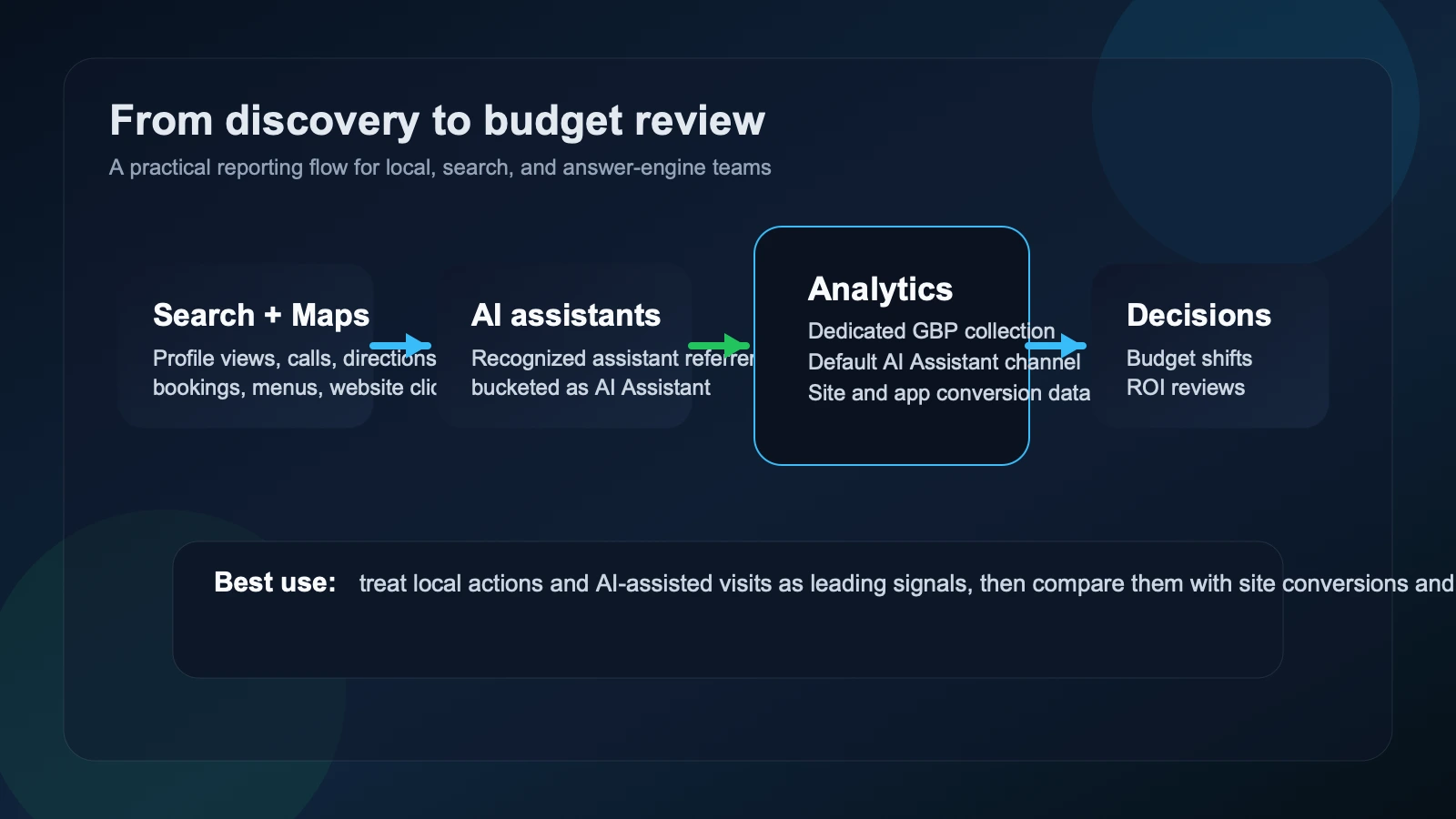
Put together, these two releases help operators connect three layers of performance that usually live apart:
- discovery on Search, Maps, and Business Profile,
- discovery inside AI assistants,
- on-site conversion and revenue behavior after the visit.
That makes budget conversations more practical. A team using the Marketing ROI Calculator or Digital Marketing Budget Planner can now pressure-test whether branded search, local visibility work, and AI visibility efforts are creating signals before the final conversion report catches up.
Who is affected
The clearest winners are multi-location businesses, local service brands, hospitality and retail operators, agencies managing local demand, and B2B companies that rely on branded discovery plus high-intent contact actions. Any team that has struggled to explain why calls or direction requests matter before a form fill should pay attention.
This also matters for publishers, software companies, and ecommerce operators with growing AI-originated traffic. Even if your business does not depend on Business Profile actions, the AI Assistant channel adds a cleaner baseline for measuring whether answer engines are starting to deliver qualified visits.
What to do next
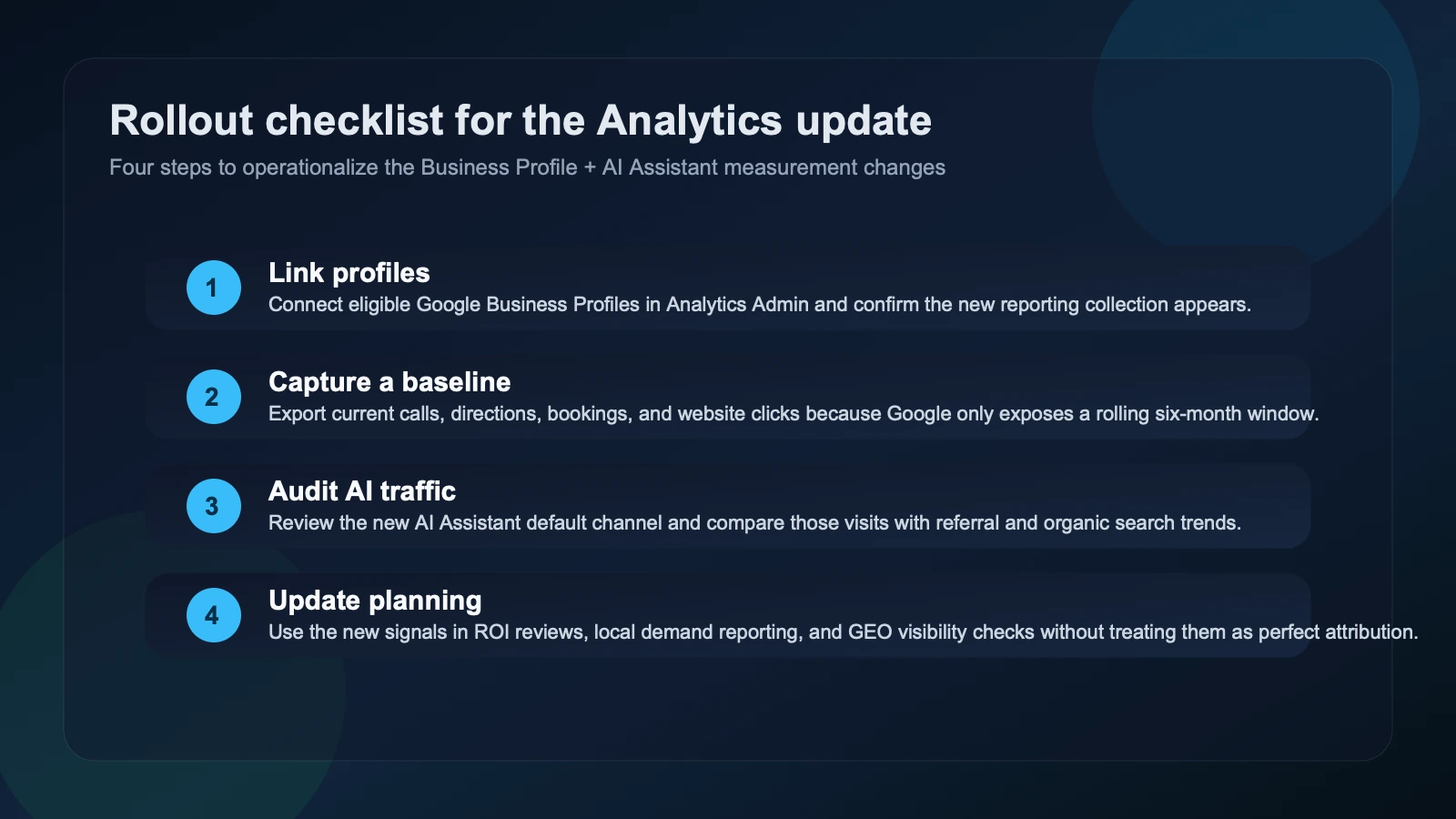
Use this workflow before treating the release as a solved measurement stack:
- Link your eligible Business Profiles in Google Analytics Admin and confirm the new reporting collection appears.
- Snapshot your current local-intent metrics, because Google says the integration shows only six months of Business Profile data.
- Compare Business Profile actions with site conversions, not as substitutes but as leading signals.
- Review default channel reports for the new AI Assistant bucket and document how much traffic it already contributes.
- Pair those visits with your existing visibility work in /tools/geo-visibility-checklist and /insights/generative-engine-optimization-benefits so AI traffic does not get analyzed without AI visibility context.
What remains uncertain
Google’s own documentation leaves some meaningful limits in place. The Business Profile data is aggregated, not profile-level inside this integration, and Google says those metrics cannot be used in custom explorations, comparisons, or filtered deeply in the same way many analysts expect. That makes the release helpful for monitoring and trend review, but not a full local BI replacement.
There is also an attribution caution. Google says the AI Assistant channel depends on recognized assistant referrers, which means the coverage is only as complete as the referrer logic and platform behavior allow. Marketers should treat it as a better directional signal, not proof that every AI-originated visit is now perfectly labeled.
The right conclusion is measured, not hype-driven. Google Analytics did not suddenly solve local attribution or answer-engine reporting. But between the June 8 Business Profile integration and the May 13 AI Assistant channel update, it did move both problems closer to the same operational dashboard. For teams trying to understand how visibility turns into intent before a classic conversion path appears, that is real progress.