Google's Ask Advisor turns Ads, Analytics and Merchant Center into one AI operating layer
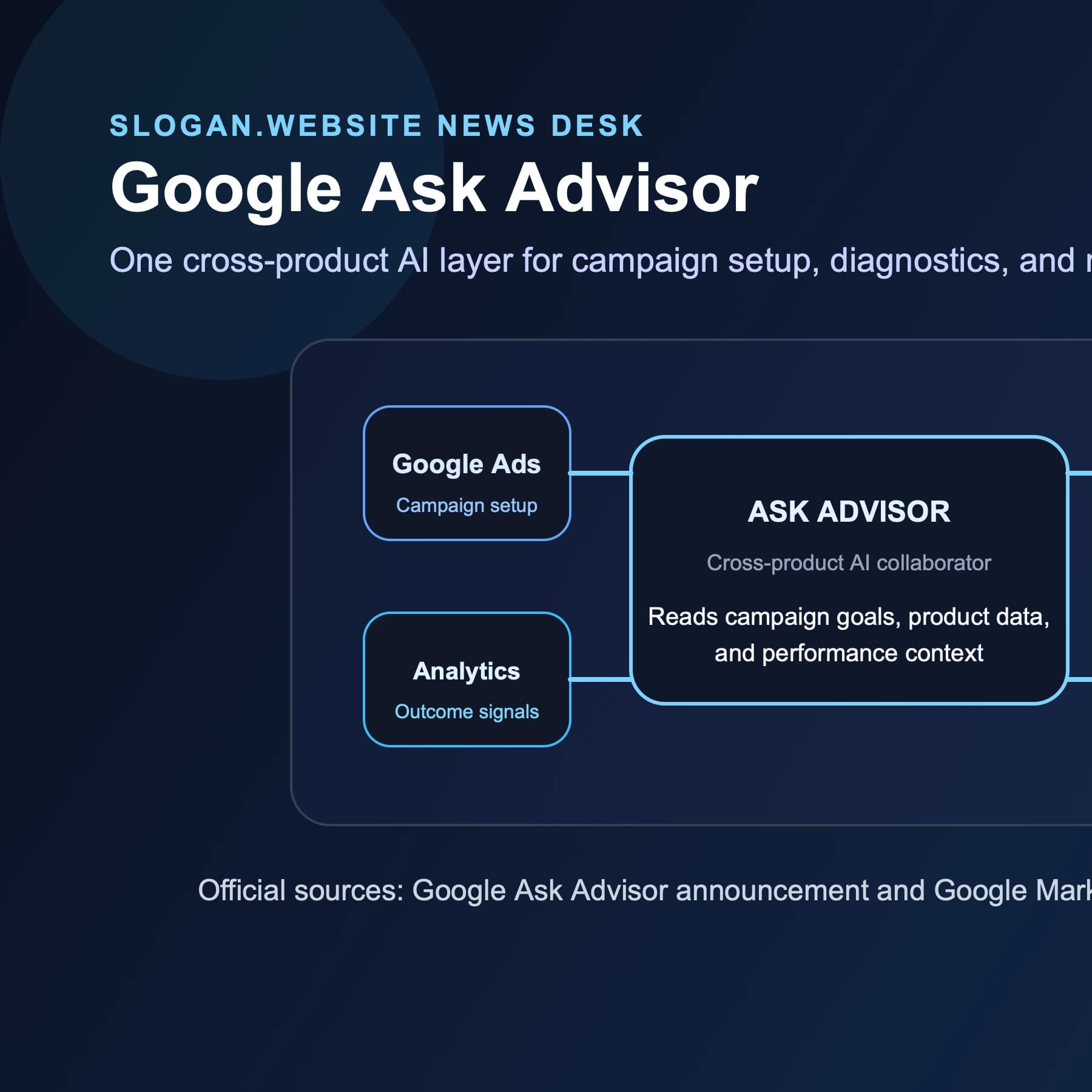
Google said on May 20, 2026 that Ask Advisor is a new cross-product AI agent that connects Google Ads, Google Analytics, Merchant Center, and Google Marketing Platform into one guided workflow. Google is trying to reduce the handoff cost between planning, launching, diagnosing, and adjusting campaigns with one AI layer that can move across products with shared context.
That matters because a lot of paid-media work still breaks at the seams. Teams brainstorm in one place, set up campaigns in another, then compare spend and outcomes in separate reporting tools. In its Google Marketing Live 2026 collection page, Google framed Ask Advisor as part of a broader push toward "deeply integrated agentic technology" for marketers, not just more suggestions inside existing product silos.
What changed
Google's official Ask Advisor post from May 20, 2026 spells out four concrete points.
| Confirmed point | Official source | Why it matters operationally |
|---|---|---|
| Ask Advisor is a new unified AI experience across Google marketing products | Ask Advisor announcement | Campaign work can move through one assistant instead of repeated product-switching. |
| Google says it spans Google Ads, Google Analytics, Merchant Center, and Google Marketing Platform | Google Marketing Live 2026 collection | Planning, setup, measurement, and commerce inputs are being linked more tightly. |
| Google says Ask Advisor can pull product details from Merchant Center to set up a campaign in Google Ads | Ask Advisor announcement | Merchant feed quality starts affecting campaign assembly more directly. |
| Google says Ask Advisor can use Google Ads and Google Analytics data to explain what worked and recommend next steps | Ask Advisor announcement | Performance analysis is shifting closer to an always-on diagnostic workflow. |
| Ask Advisor is in beta for English-language accounts, with more features rolling out later in 2026 | Ask Advisor announcement | Teams should treat this as an early workflow signal, not universal availability. |
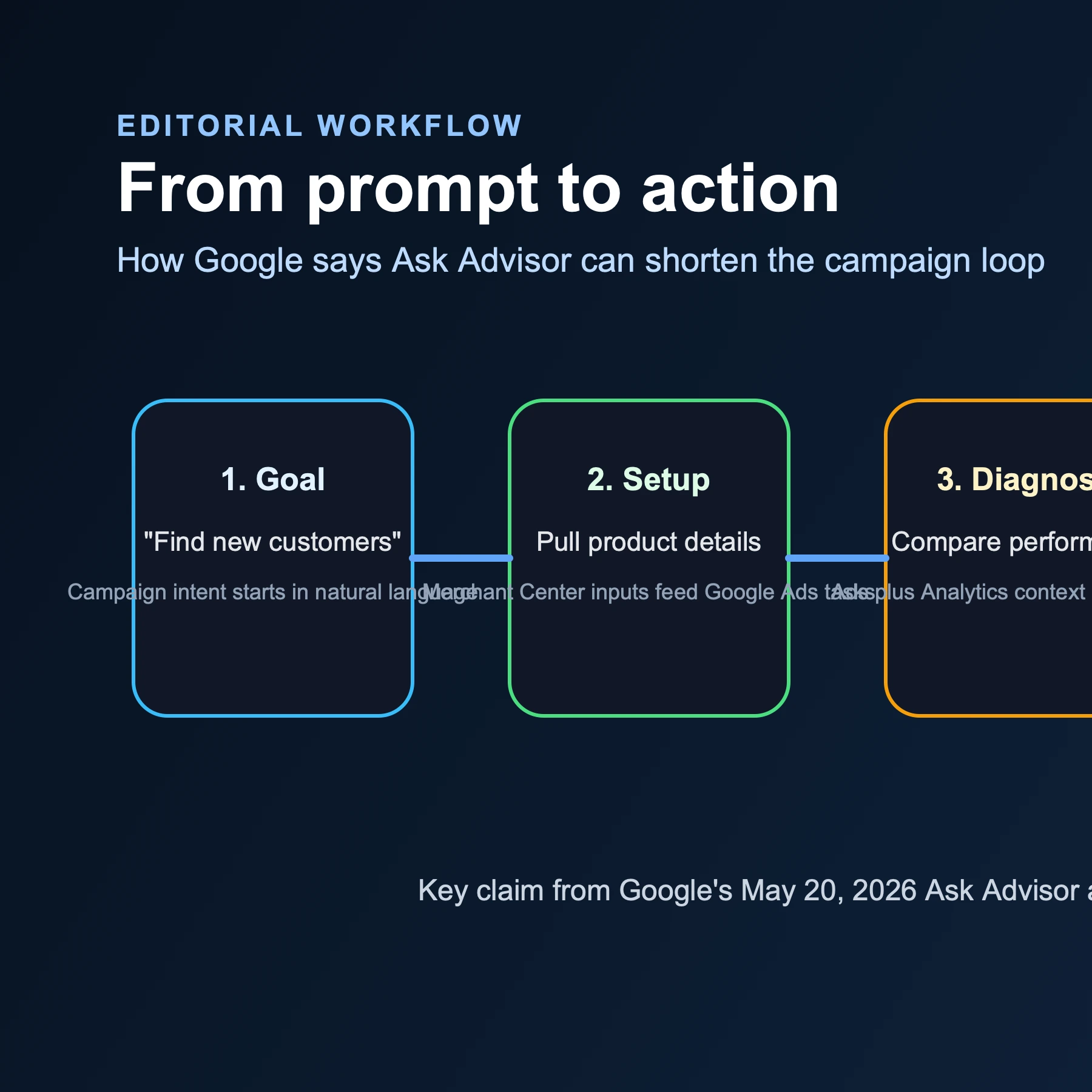
The most useful example in Google's own post is simple and revealing. Google says a marketer can ask Ask Advisor to "find new customers for my hair care products," and the system can use Merchant Center product data to begin campaign setup inside Google Ads. In the same announcement, Google says Ask Advisor can then surface insights from both Google Ads and Google Analytics, explain what happened, and recommend what to do next. That is a tighter loop than the older pattern of bouncing between interfaces and manually translating one report into another action.
Why it matters
In Google's Google Marketing Live collection page, the company positioned Ask Advisor next to AI Search ad formats, Asset Studio upgrades, and a reimagined Analytics 360 measurement layer. Read together, the message is clear: Google wants marketers to rely less on manual navigation between tools and more on one agent that can connect intent, assets, catalog data, and performance context.
For operators in the United States, Canada, the United Kingdom, Australia, and Europe, that raises the bar for data quality. If Ask Advisor is drawing campaign setup context from Merchant Center and performance context from Google Ads plus Google Analytics, then weak product titles, vague landing pages, poor measurement hygiene, and inconsistent conversions become workflow problems sooner. The AI layer cannot rescue bad inputs. It only makes the dependency more obvious.
There is also a search-and-visibility angle. Campaign setup is becoming more dependent on machine-readable business context, while campaign analysis is being pulled closer to AI-assisted interpretation. That overlaps with the same discipline behind the GEO Visibility Checklist, the guide to tracking brand mentions and visibility, and our earlier coverage of Google's AI Search ad changes. If AI systems are increasingly part of planning and discovery, the source pages and product facts they read matter more.
Who is affected
The immediate impact is strongest for teams already operating across several Google surfaces:
- ecommerce teams that maintain Merchant Center feeds and regularly launch Shopping or Performance Max campaigns;
- paid-search managers who still spend too much time translating between setup tasks and reporting tasks;
- agencies handling many small or mid-market accounts where repeated platform navigation creates avoidable execution drag;
- analytics and marketing-ops teams responsible for keeping Google Ads and Google Analytics aligned;
- founders and growth leads who need practical recommendations without becoming experts in every Google interface.
Smaller advertisers should not ignore this just because it starts in beta. If Google keeps moving toward shared AI context across setup, reporting, and optimization, the advertisers who benefit most will be the ones that already cleaned up product data, conversion tracking, and landing-page clarity.
What to do next
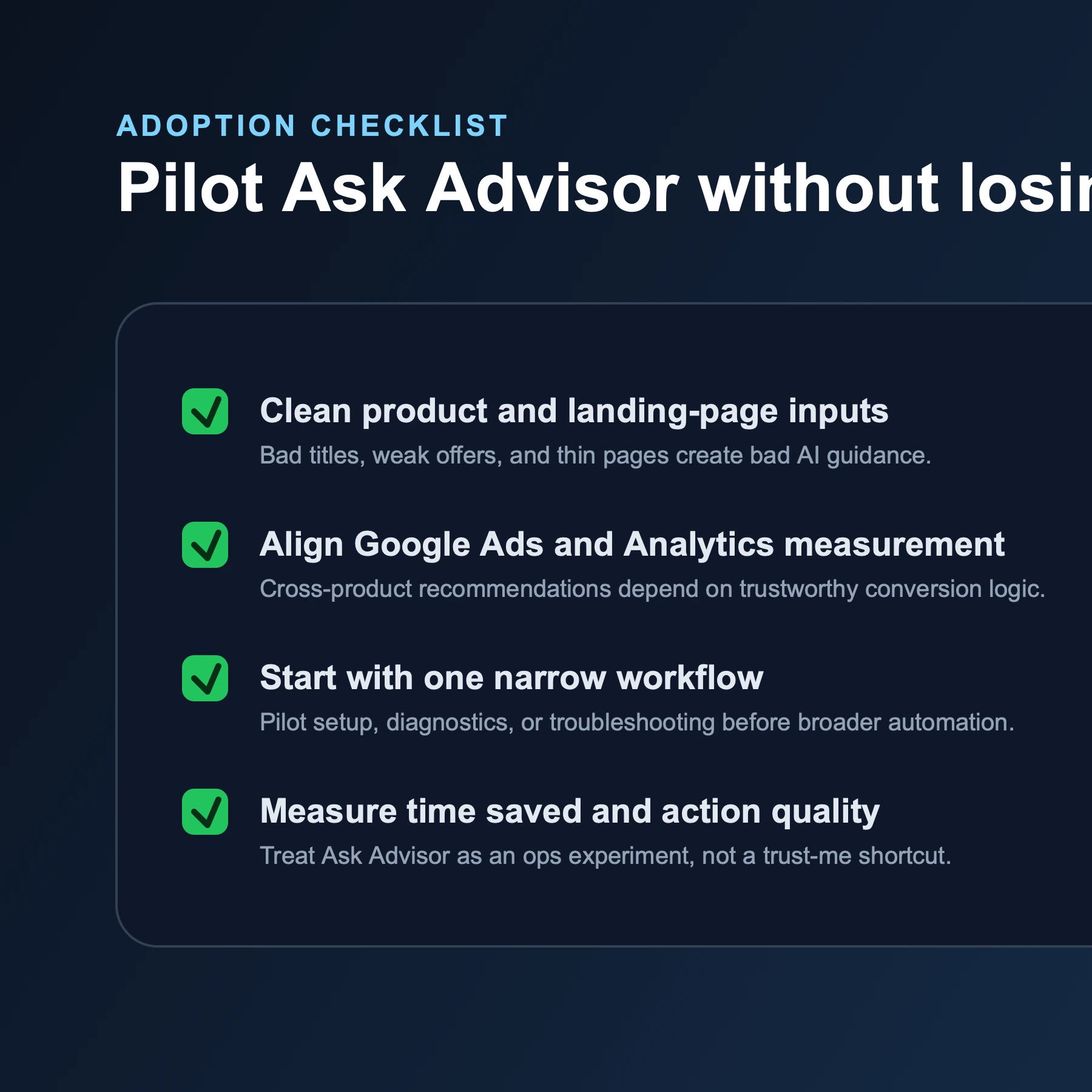
Use this rollout checklist before treating Ask Advisor as a production shortcut:
- Audit Merchant Center inputs first. Confirm product titles, descriptions, availability, pricing, images, and taxonomy are current.
- Check whether your most important landing pages explain the offer clearly enough for both buyers and AI systems to interpret.
- Reconcile Google Ads and Google Analytics conversion logic before asking an AI layer to summarize performance or recommend next steps.
- Pick one narrow pilot workflow first, such as campaign setup from product data, weekly diagnostics, or account troubleshooting.
- Compare the resulting workflow against your current manual process for time saved, error rate, and action quality.
- Use the Marketing ROI Calculator and Digital Marketing Budget Planner to pressure-test whether faster execution is actually improving business outcomes.
What remains uncertain
The biggest limitation is rollout depth. Google's Ask Advisor announcement says the product is currently in beta for English-language accounts and that new features will roll out in the coming months, while the same post says the broader unified experience is rolling out later in 2026. That leaves open questions around market availability, account eligibility, feature parity, and how much workflow control will be exposed in practice.
There is also a governance question. Google describes Ask Advisor as an always-on collaborator and problem solver, but the public announcement does not publish a detailed admin model for what different teams can allow, review, or block across every connected product. Enterprise teams will still need their own approval boundaries.
Finally, Ask Advisor does not remove the usual causality and attribution limits. It may make cross-product workflows easier, but it still depends on the quality of the source signals it receives. If the tracking setup is weak, the recommendations can only be so strong.
The practical takeaway on June 1, 2026 is straightforward: Ask Advisor is a meaningful operating-model signal from Google. Campaign execution, product data, and performance diagnostics are being pulled into one AI workflow. The teams that should move first are not the ones chasing novelty, but the ones ready to pilot with clean inputs, narrow scope, and measurement they can defend.