Google delays the DSA sunset, but AI Max migration pressure on Search teams is still here
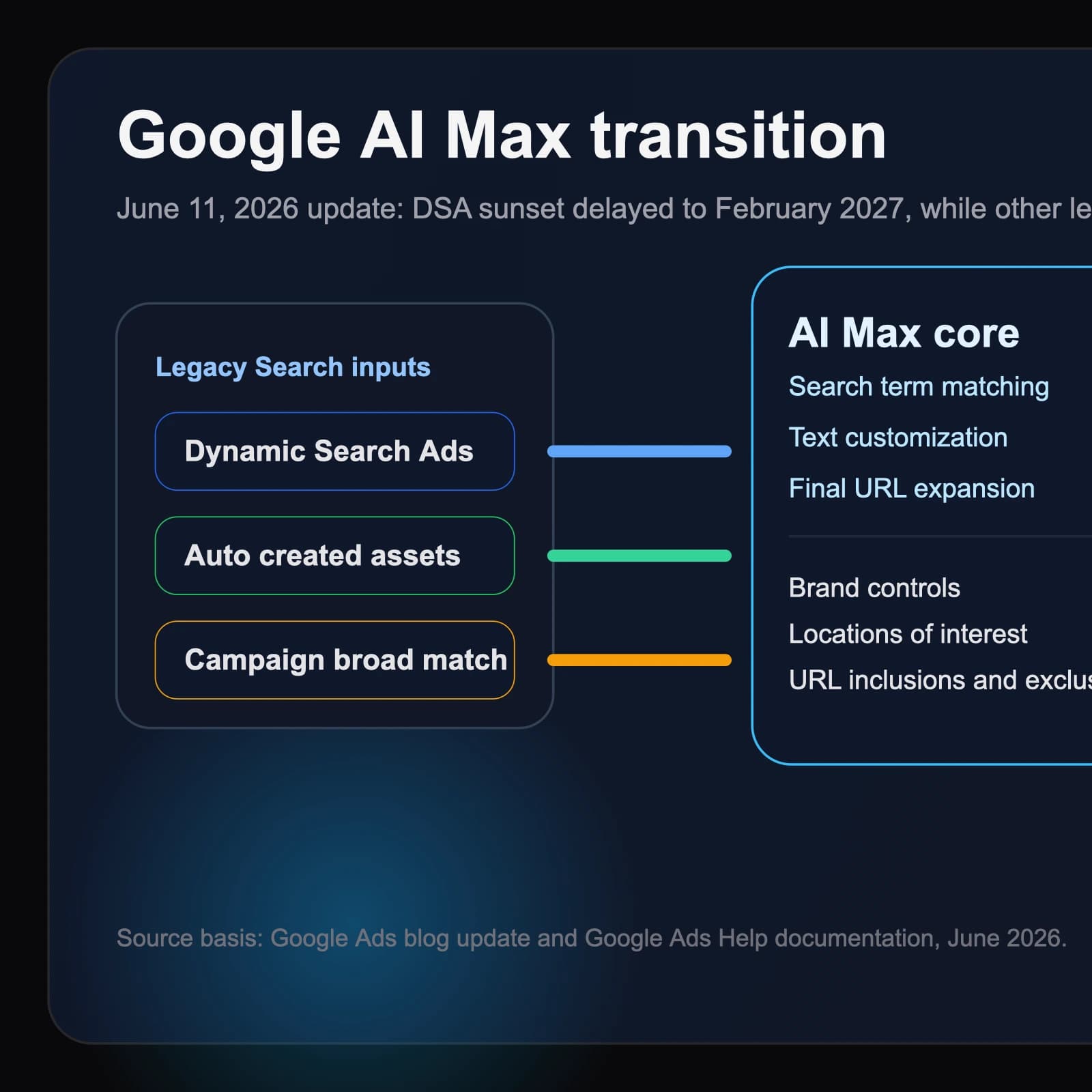
Google updated its official AI Max migration guidance on June 11, 2026, and the practical message for Search marketers is narrower than "everything got delayed." Google says the Dynamic Search Ads sunset and auto-upgrade now begin in February 2027, not September 2026, after advertiser feedback. But the same update also says campaigns using automatically created assets and campaign-level broad match settings will still begin auto-upgrading to AI Max in September 2026. For paid-search operators, agencies, and in-house growth teams, that means the migration workload is still real this quarter even if the DSA deadline moved.
What changed
The official Google Ads blog post updated on June 11, 2026 makes three points that matter together.
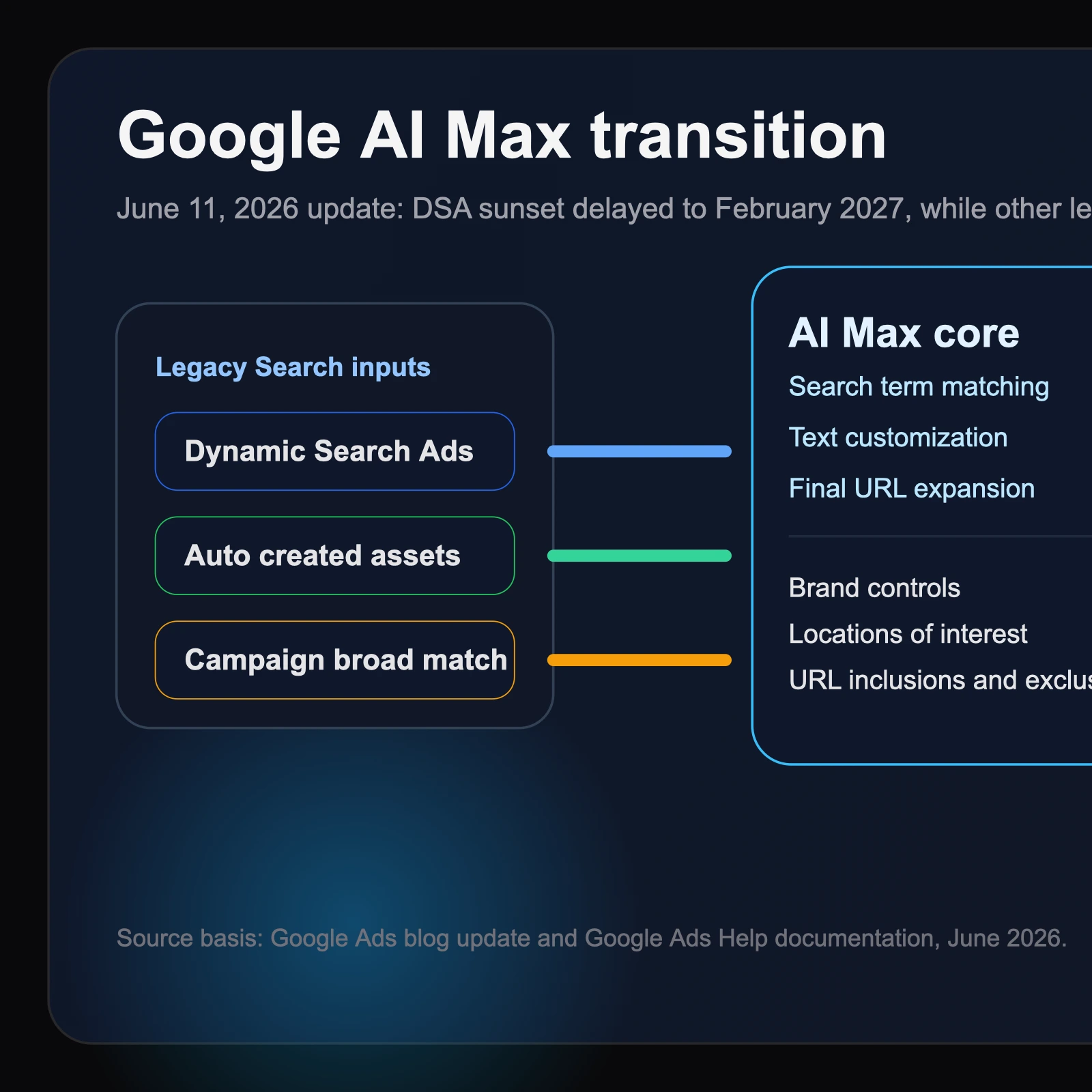
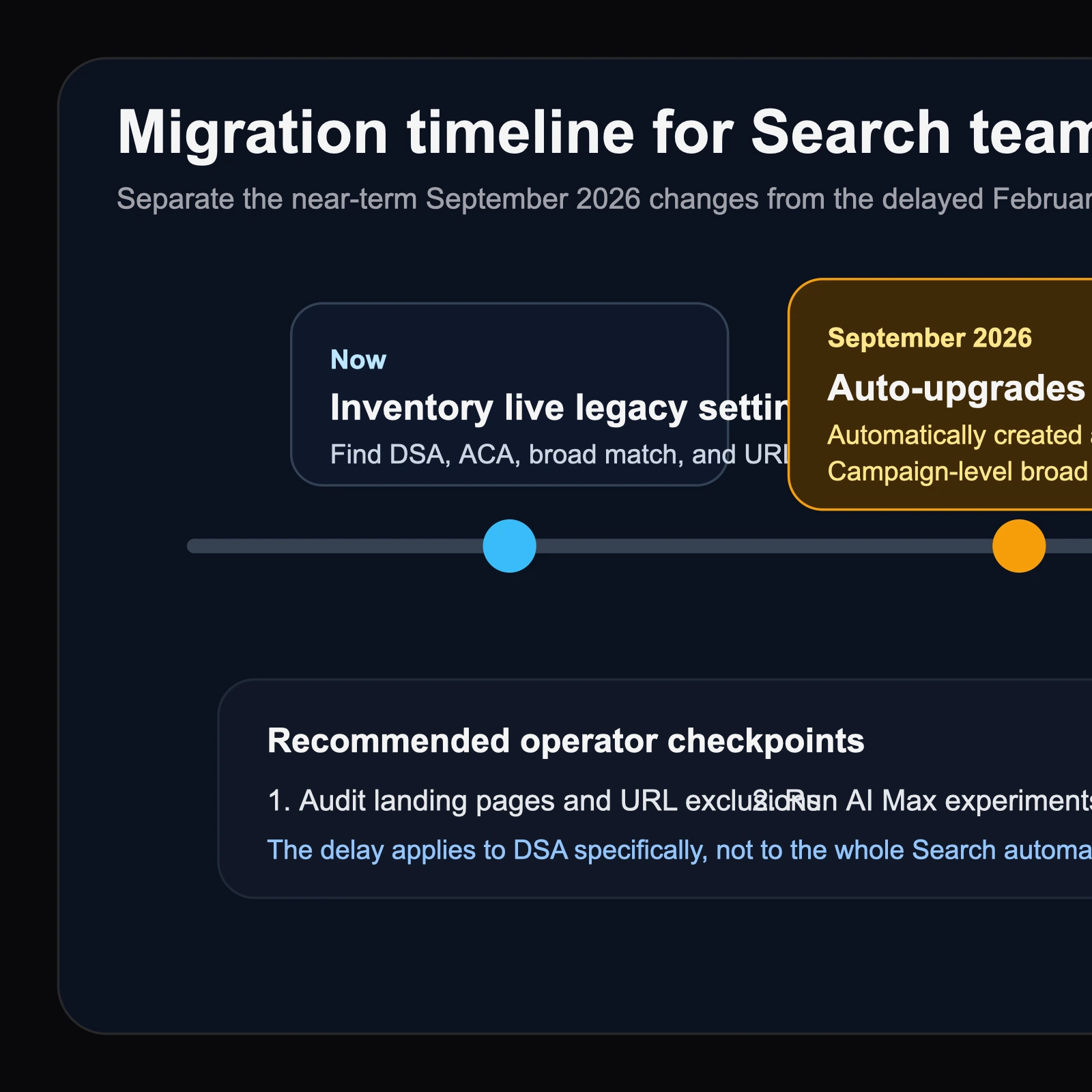
First, Google says the DSA sunset and auto-upgrade will begin in February 2027 after feedback from advertisers who needed more time. Second, Google says automatically created assets and the campaign-level broad match setting will still start auto-upgrading in September 2026. Third, Google continues to frame AI Max as the destination for all three legacy behaviors, with Google recommending voluntary upgrades now rather than waiting for the account-level prompts.
The supporting Google Ads Help documentation reinforces that this is not a minor wording tweak. The Dynamic Search Ads help page now warns that DSA, automatically created assets, and campaign-level broad match settings are all on the path toward AI Max. The AI Max product help page says AI Max combines search term matching, text customization, and final URL expansion, then layers in controls such as brand settings, locations of interest, and URL exclusions. Google's AI Max experiments help page also confirms that teams can test the feature through split experiments before fully applying it.
| Confirmed point | Official source | Why it matters operationally |
|---|---|---|
| Google updated the migration guidance on June 11, 2026. | Google Ads blog update | The timeline changed recently enough that older internal notes may already be wrong. |
| DSA sunset and auto-upgrade now begin in February 2027. | Google Ads blog update | Teams running DSA get more runway for cleanup, exclusions, and landing-page review. |
| Automatically created assets and campaign-level broad match settings still begin auto-upgrading in September 2026. | Google Ads blog update | Search teams cannot treat the delay as a full migration pause. |
| AI Max adds controls like brand settings, locations of interest, URL inclusions, and URL exclusions. | AI Max help documentation | The new model is not only broader matching; it also changes where governance lives. |
| Google provides AI Max experiments for Search campaigns. | AI Max experiments help page | Teams can test migration effects before locking the setting into live campaign operations. |
Why it matters
Many paid-search teams still use DSA as a coverage layer for large sites, product catalogs, or fast-changing landing-page inventories. Google's own DSA documentation says the format helps advertisers catch queries that keyword-based campaigns may miss, while generating landing pages and headlines from website content. That made DSA useful, but it also trained teams to separate "keyword search," "dynamic expansion," and "asset automation" into different mental buckets.
AI Max compresses those buckets into one operating model. Google's AI Max help article says search term matching can expand beyond current keywords, while asset optimization can activate text customization and final URL expansion at the campaign level. In practice, that means account structure, exclusions, brand controls, landing-page eligibility, and creative governance all become more connected.
For operators managing spend across the United States, Canada, the United Kingdom, Australia, and Europe, the biggest risk is not missing the headline. It is misreading the timeline and discovering too late that one part of the account is already being auto-shifted while another part still looks untouched. If your team uses tools such as the Digital Marketing Budget Planner, the Marketing ROI Calculator, or visibility workflows like the GEO Visibility Checklist, this is the moment to treat AI Max as a workflow and control change, not just a feature toggle.
Who is affected
The most exposed teams are agencies with many mature Search accounts, in-house ecommerce or lead-generation teams that still rely on DSA for long-tail coverage, and enterprise advertisers with layered approval processes around brand safety, landing-page policy, and geo targeting.
Smaller businesses are affected too, especially those that enabled automatically created assets or broad-match-style automation without a documented governance process. Those teams may think they are "not really using AI Max yet" when Google already treats parts of their setup as migration candidates. The issue is less about company size than about account complexity and whether campaign logic is written down clearly enough to survive automated transitions.
What to do next
Treat Google's June 11 update as an account-audit trigger.
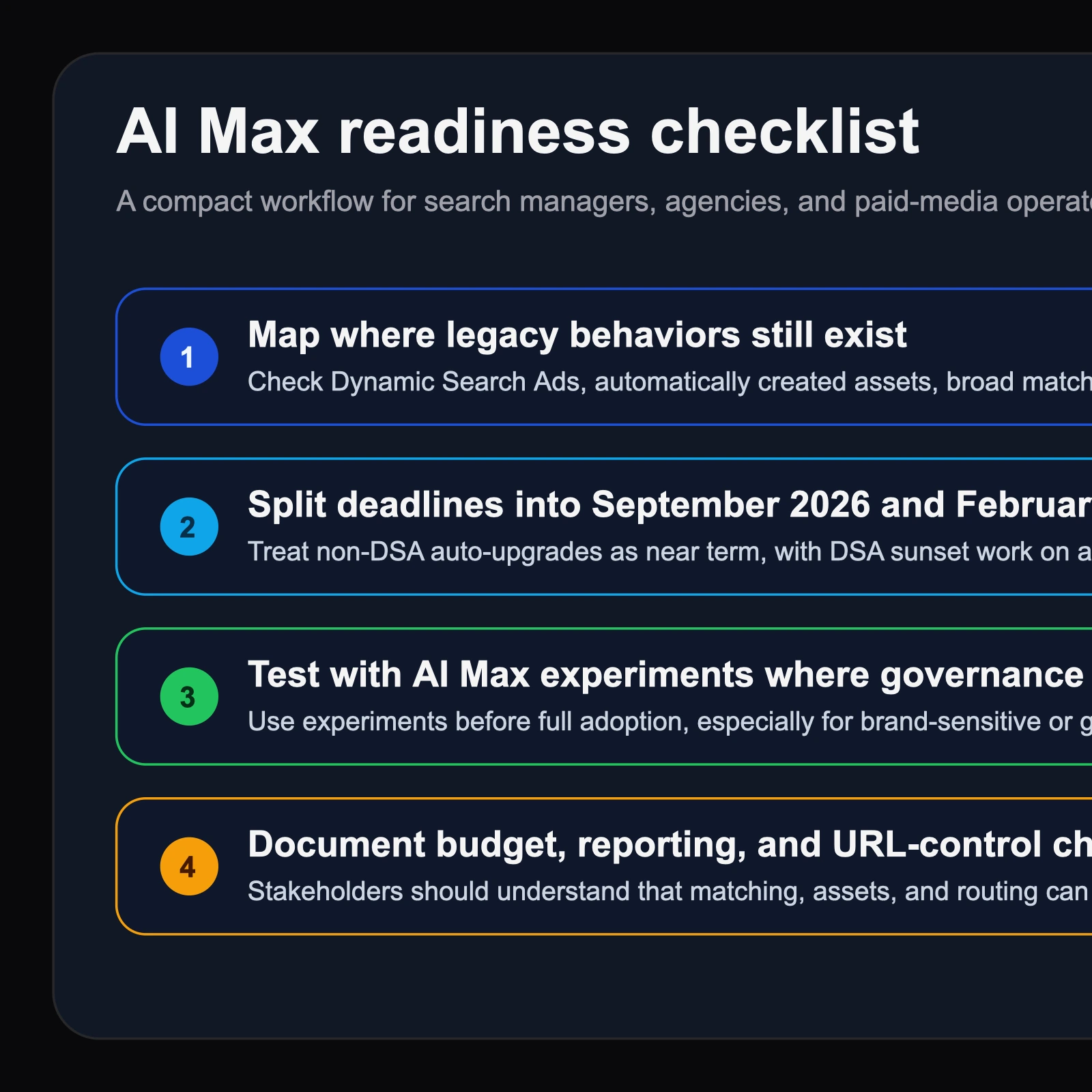
- Inventory where DSA, automatically created assets, and campaign-level broad match settings still exist in live accounts.
- Separate the work into two deadlines: September 2026 for non-DSA legacy upgrades, and February 2027 for DSA sunset planning.
- Review landing-page hygiene, exclusions, and site coverage now, because Google's own DSA documentation ties performance to crawlable pages, clear titles, and working URLs.
- Run an AI Max experiment on representative campaigns before broader rollout, especially if the account has brand constraints or fragile routing logic.
- Update budget and reporting expectations so stakeholders know that match logic, text customization, and URL behavior may change together rather than in isolated tests.
- Pair the migration with a broader search visibility review using internal reporting plus resources like how to track brand mentions and measure visibility and generative engine optimization benefits.
What remains uncertain
Google's updated post does not say exactly how many advertisers still rely heavily on DSA, how aggressively account prompts will surface by vertical, or whether performance deltas will vary materially between former DSA-heavy accounts and accounts mostly using keyword-based Search campaigns. The company cites internal data showing that AI Max campaigns using the full feature suite can see better results than search-term matching alone, but that does not answer every migration-risk question for brand-sensitive accounts.
There is also a practical uncertainty around execution quality. Google's experimentation help shows that some campaign setups have limitations, including legacy features that can block clean AI Max testing. That implies some teams may need account cleanup before they can even run the recommended experiment path.
The clearest reading is this: Google gave Search teams more time on DSA specifically, but not a reason to delay account preparation. The highest-value move now is to map which legacy behaviors still exist, test AI Max where it is safe, and document the control changes before the September 2026 migration wave hits the rest of the stack.