Google's EU and EEA financial ads verification rollout becomes a July compliance workflow
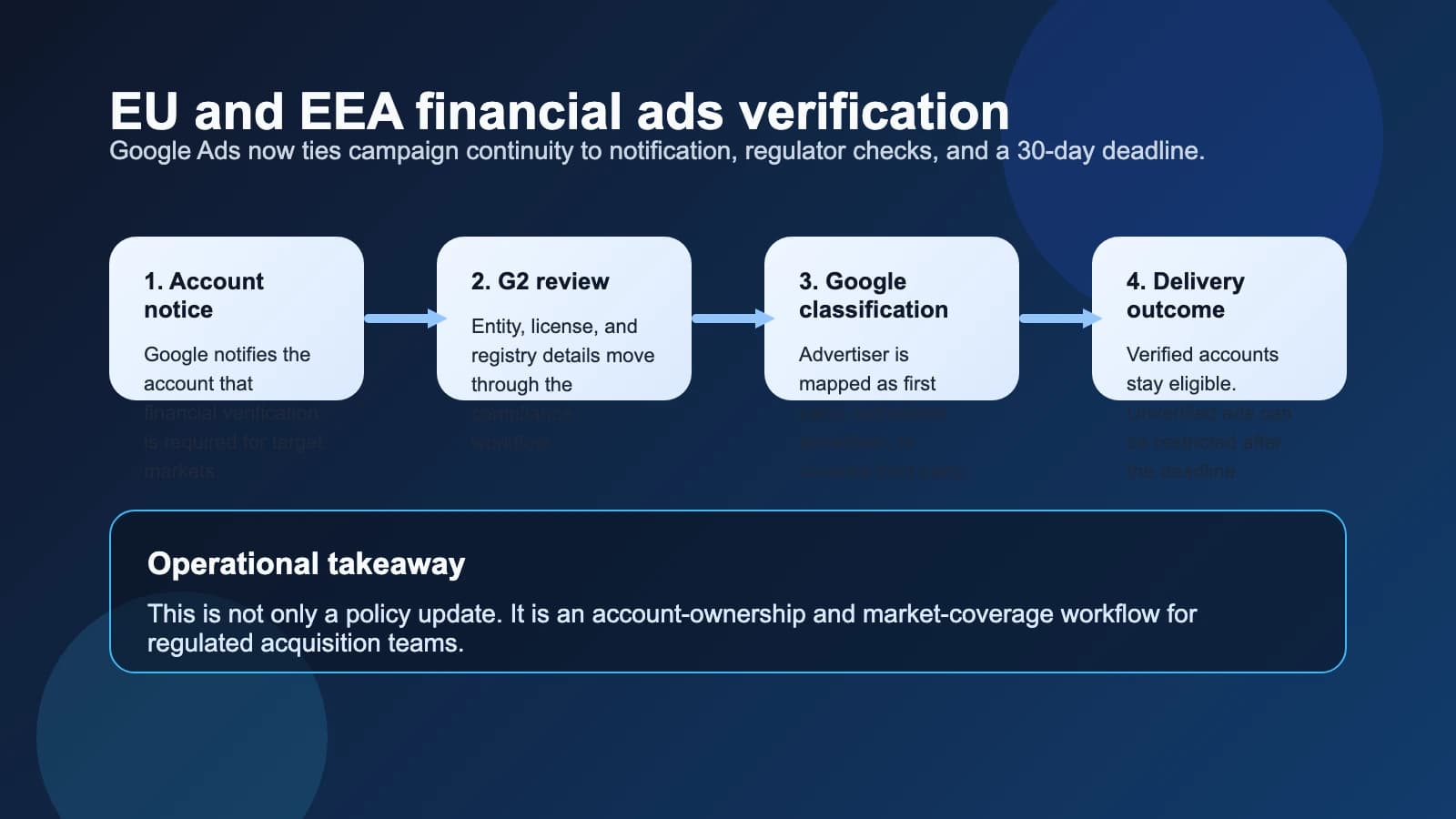
Google's June 23, 2026 expansion of financial services advertiser verification across the European Union and European Economic Area is no longer just a policy note. It is now a live operating deadline for any team running Google Ads for banking, lending, investment, insurance, broker, or related financial offers in those markets. For marketers and operators serving Europe from the United States, Canada, the United Kingdom, Australia, or inside the region itself, the practical issue is simple: Google says affected advertisers get 30 days after notification to complete verification, and unverified financial ads in the relevant targeted locations will be restricted.
The announcement matters because Google is not framing this as a future trust principle. It is tying enforcement to account notifications, regulator checks, and a region-by-region rollout that now reaches every EU and EEA member state. Teams that still treat compliance as a legal side task risk finding out too late that campaign continuity depends on ops, billing, agency disclosure, and documentation quality as much as on creative or bidding.
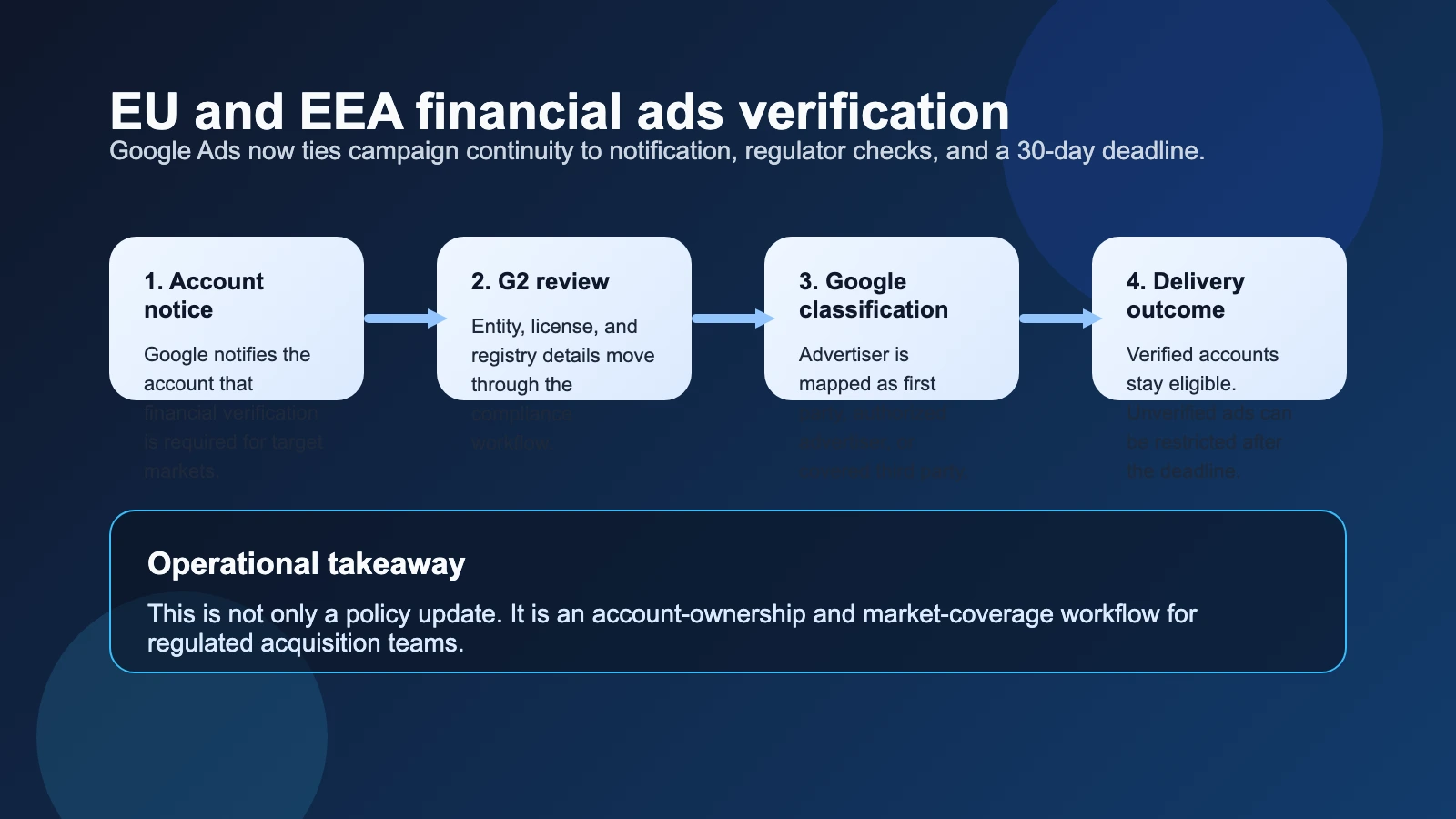
What changed
In its June 23 blog post, Google said the financial services advertiser verification program is expanding to every EU and EEA member state. The company described the move as a rollout to 24 additional countries, building on a program already active in 18 countries worldwide, including six EU member states and the United Kingdom. Google also said the requirements are introduced in phases and that businesses will have 30 days to complete the process after notification.
The more detailed policy mechanics appear in Google's June 2026 verification requirements update. That page says in-scope advertisers will be notified directly inside Google Ads, that agencies managing affected accounts also need verification, and that the process starts with Google's external compliance partner G2 before the advertiser applies to Google as either a first party or an authorized advertiser. Google says approved third-party advertisers cannot apply on their own; a verified first party or authorized advertiser must apply on their behalf.
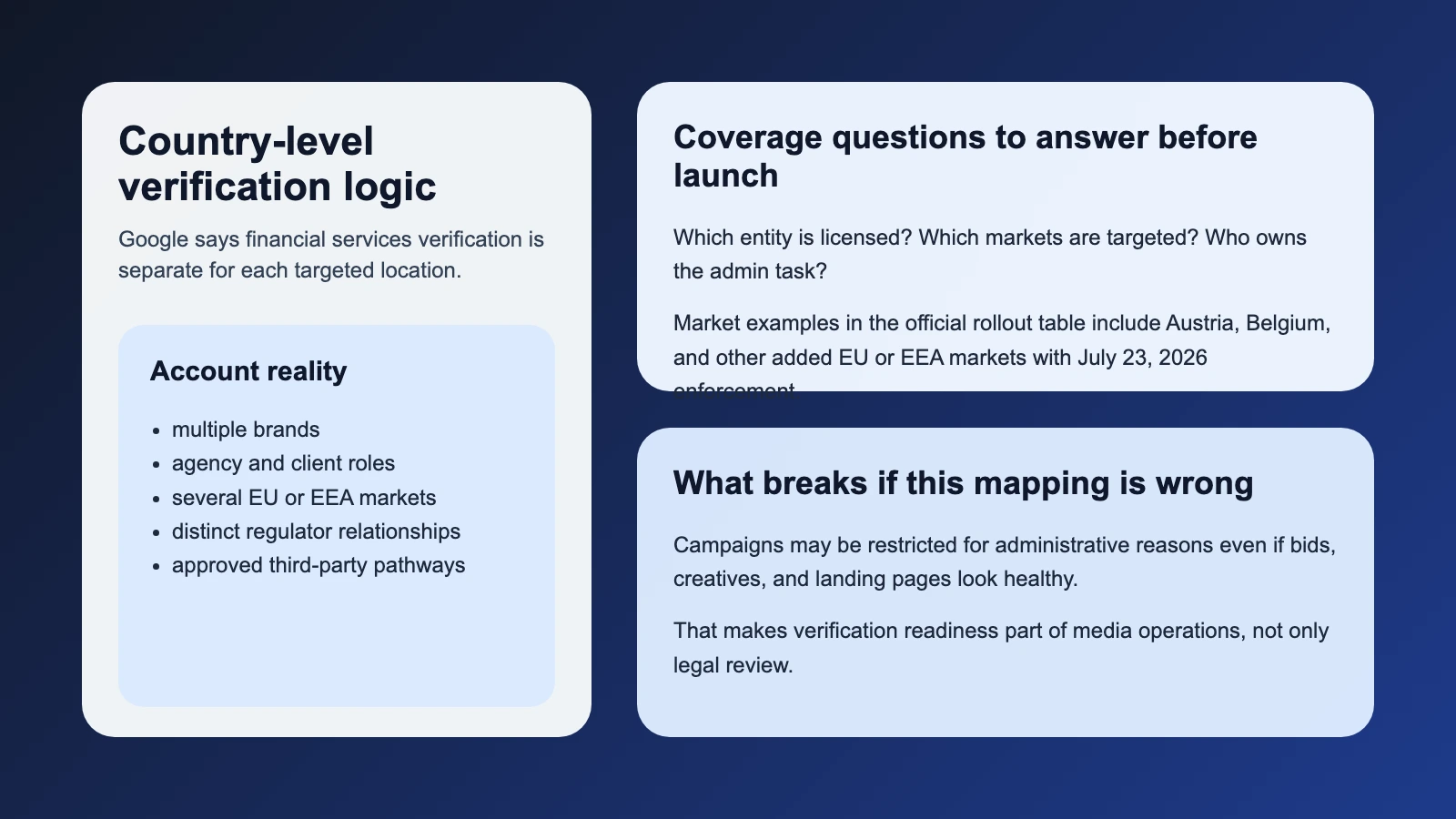
Google's regulators and enforcement dates page adds the operational detail many teams will miss if they only read the blog headline. Verification is location-specific, requires a separate verification for each targeted location, and lists July 23, 2026 as the enforcement start date for newly added markets such as Austria and Belgium, with other EU and EEA locations following the same rollout table. Google's broader advertiser verification overview and task guide also make clear that account admins need to complete the required steps and that paused or restricted accounts may stay blocked until verification is finished.
| Confirmed requirement | Official source | Operator impact |
|---|---|---|
| Google is expanding financial advertiser verification to every EU and EEA member state. | Google Ads & Commerce, June 23, 2026 | European financial campaign eligibility now depends on verification, not only standard ad approval. |
| Advertisers have 30 days after notification to complete the process. | Google Ads & Commerce, June 23, 2026 | Teams need a deadline owner and escalation path before the notice lands. |
| Verification begins with G2, then continues with Google as first party or authorized advertiser. | Google policy update, June 23, 2026 | Documentation gathering and entity mapping need to happen before campaign risk becomes visible. |
| Verification is separate for each targeted location. | Google regulators and enforcement dates | Multi-country accounts cannot assume one approval covers every EU or EEA market. |
| Only account admins can complete the required account tasks. | Google task guide | Agencies and distributed teams need to confirm ownership now, not on the deadline day. |
Why it matters
This matters because regulated acquisition is usually managed across multiple hands. Paid-search managers control campaigns, compliance teams hold licenses, finance teams control billing, and agencies often sit between the brand and the ad account. Google's latest documentation turns that organizational sprawl into a delivery risk. If the wrong entity is named, if the account is marked incorrectly, if an agency does not disclose its role correctly, or if market coverage assumptions are wrong, performance can drop for administrative reasons rather than market reasons.
It also changes how budget planning should work. Verification work is not media spend, but it now directly affects spend continuity. Teams using Slogan.website's Digital Marketing Budget Planner or Marketing ROI Calculator should treat verification readiness as a prerequisite input for any EU or EEA financial acquisition forecast. There is no realistic ROI model for a campaign that may be restricted mid-quarter because the admin path was never assigned.
Who is affected
The first group is regulated brands advertising loans, insurance, cards, broker services, investing products, or other in-scope financial offers into Europe. The second group is agencies and consultants that run Google Ads on behalf of those brands, because Google's policy page explicitly says agencies managing affected accounts also need verification. The third group is partner, affiliate, and approved-third-party models that rely on another authorized entity, because Google's documentation says those advertisers cannot independently apply for this status and must be covered by a verified first party or authorized advertiser.
What to do next
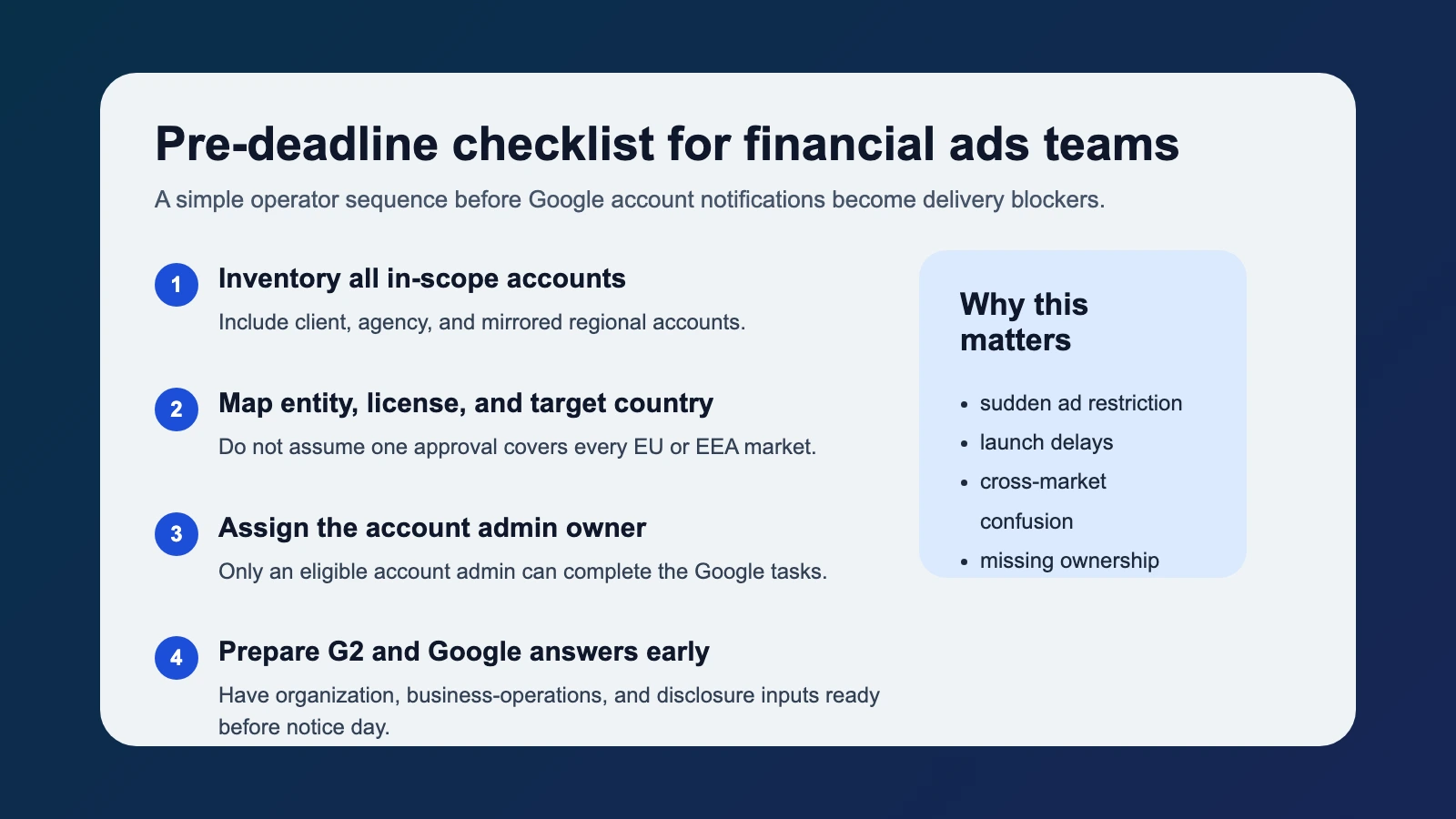
Start with workflow hygiene instead of waiting for an account notice.
- List every Google Ads account that promotes financial offers into the EU or EEA, including agency-managed accounts and cloned regional setups.
- Map each account to the legal entity, licensing basis, and target countries it actually represents.
- Confirm which admin user can complete advertiser verification tasks inside Google Ads and whether that person has the documents and approvals needed.
- Separate first-party accounts from authorized or approved-third-party relationships before G2 or Google asks the question for you.
- Update your launch checklist so campaign expansion into a new European market requires verification review, not only keyword, creative, and budget approval.
- If search visibility is part of the wider growth plan, pair compliance work with the GEO Visibility Checklist so market expansion does not outrun source quality and message clarity.
What remains uncertain
Google has been clear about the structure of the program, but not every operational edge case is public yet. The company has not published one simple market-by-market examples guide showing how multinational groups, franchise structures, aggregators, comparison sites, or mixed-brand agency setups should prepare beyond the general first-party and authorized-advertiser model. The public pages also do not promise identical review timing for every case, even though Google's advertiser verification guide says review can take up to five business days in common cases and up to 30 days in rare ones.
So the defensible conclusion on July 3, 2026 is narrower than "Google is cracking down on finance ads." The stronger conclusion is that Google has turned EU and EEA financial advertising into a verification-led operations problem. Teams that inventory accounts, assign ownership, and reconcile market-by-market eligibility now should stay live. Teams that wait for a restriction notice may learn that compliance debt behaves like media downtime.