Google expands Home Listings Ads nationwide, turning Local Services Ads into a richer buyer-agent funnel
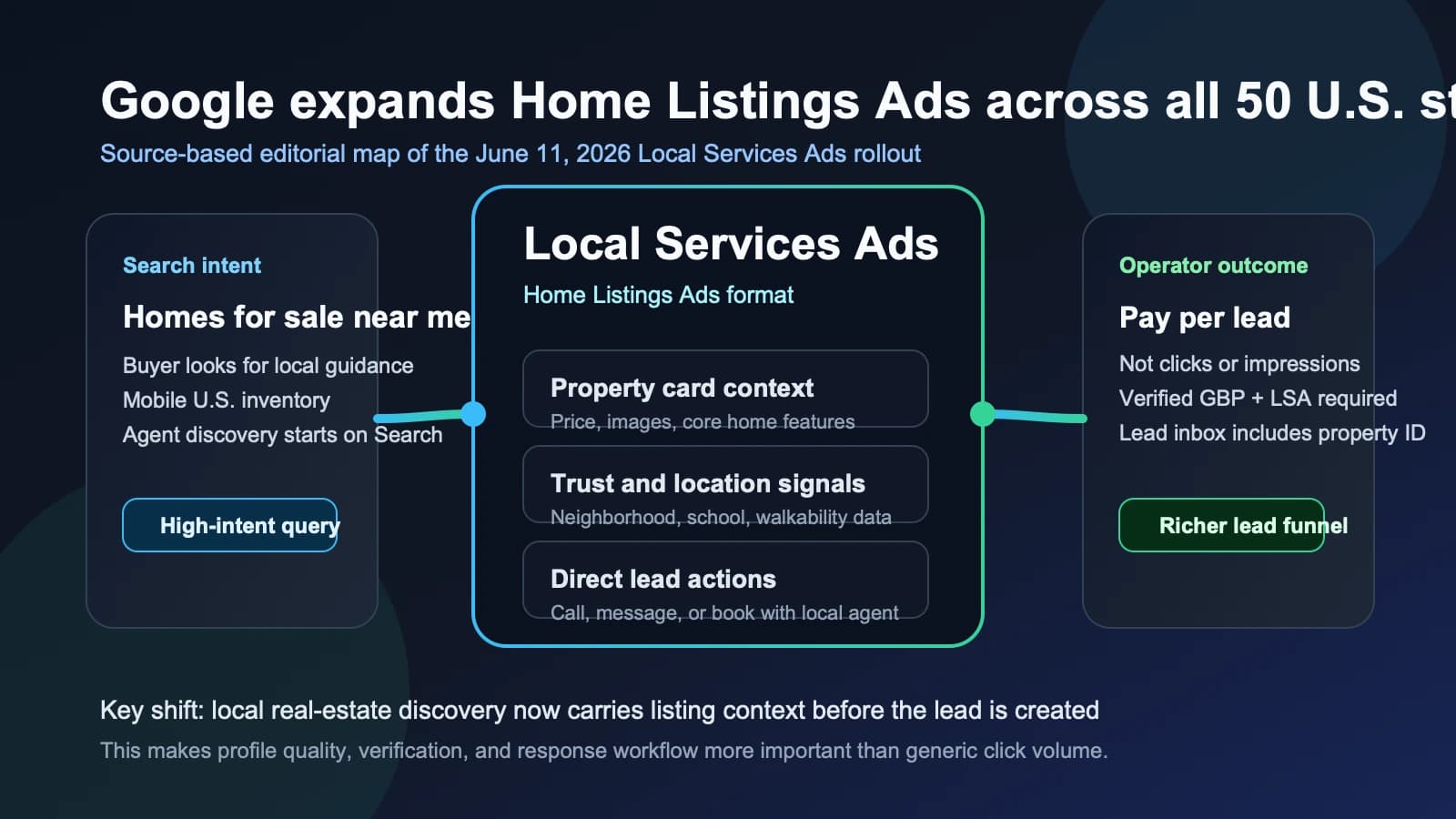
Google said on June 11, 2026 that it is rolling out richer Local Services Ads for Home Listings across all 50 U.S. states after a limited pilot. The practical shift is not just "more real estate inventory on Google." It is that buyer's agents and seller's agents can now appear next to property details, images, and core home facts inside a pay-per-lead Local Services Ads workflow, instead of relying only on standard local lead-gen formats.
The official help documentation makes the commercial model clearer. In Google's Home Listings Ads help page, the company says potential buyers can see listing agent information, prices, images, neighborhood data, school info, and walkability scores, then call or message a local buyer's agent from the ad. Google also says advertisers pay for leads, not clicks or impressions. For operators, especially brokerages and performance-minded local teams, that changes how search demand can move into a qualified contact workflow.
What changed
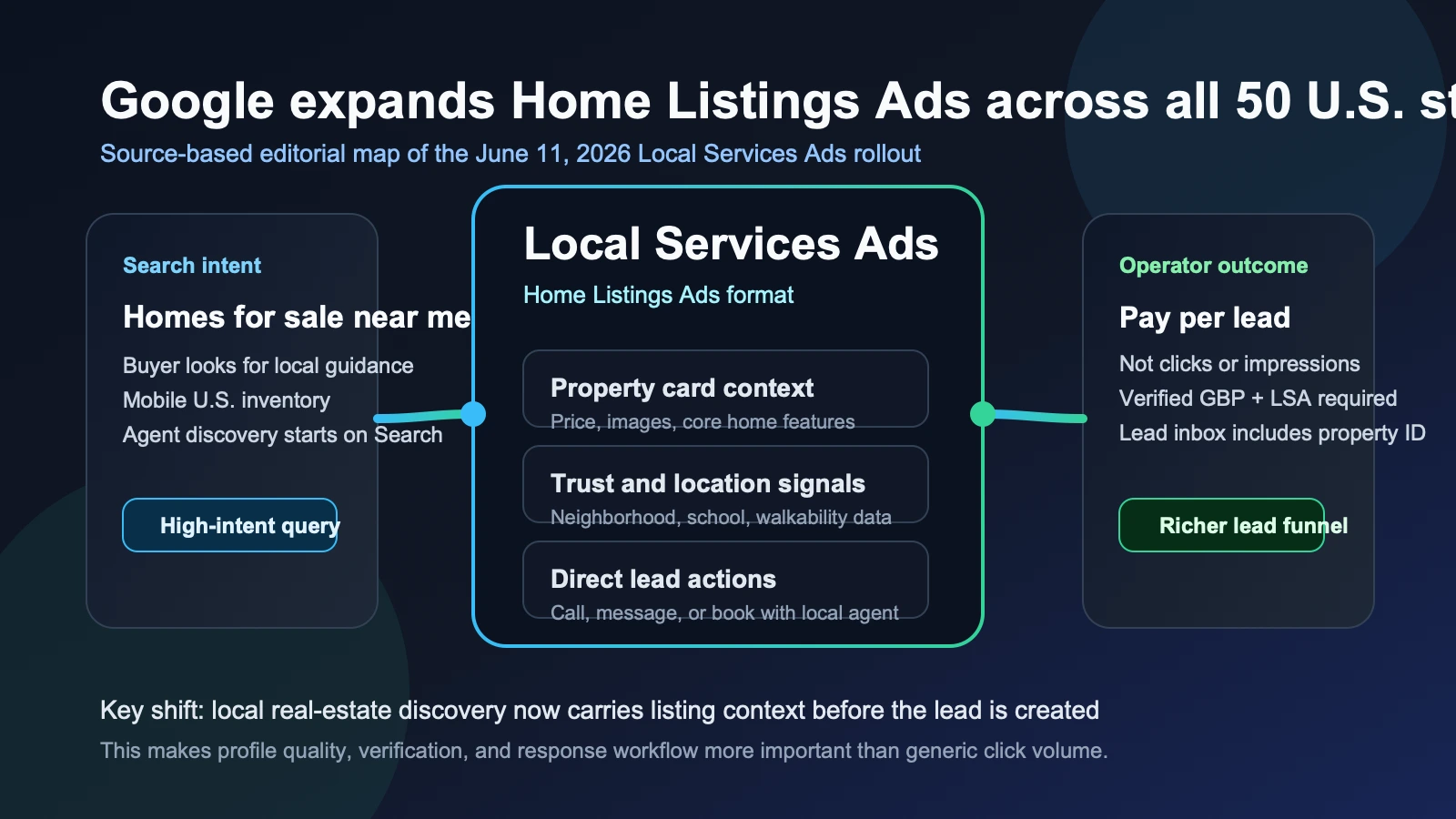
Google's June 11 announcement says the expanded format surfaces pricing, images, and core home features and is powered by a partnership with HouseCanary. Google's matching Local Services Help page adds several operational details that matter more than the launch headline.
First, this is currently a United States mobile-market feature. Second, agents need an active Local Services Ads account, must pass the standard verification process, and need a verified Google Business Profile linked to their campaign. Third, the format is not fully self-diagnosing: Google's help page says reporting includes impressions, leads, impression share, top impression share, and spend, but there is no reporting breakdown by ad format. The dashboard also does not specify the exact ad format that drove a lead, although leads coming from a specific property listing include a property ID in the leads inbox.
| Confirmed point | Official source | Why it matters in practice |
|---|---|---|
| Home Listings Ads are rolling out across all 50 U.S. states after a limited pilot. | Google Ads & Commerce post | This is a real availability expansion, not just an experimental test mention. |
| The ad can show pricing, images, core home features, and direct contact actions. | Google Ads & Commerce post and Local Services Help | Searchers can evaluate more listing context before deciding whether to contact an agent. |
| Advertisers pay for leads, not clicks or impressions. | Local Services Help | This makes the format easier to compare with other local lead-generation channels. |
| The feature is currently available in U.S. markets on mobile. | Local Services Help | Desktop and non-U.S. operators should not assume equivalent rollout timing. |
| Google says the dashboard does not break out performance by ad format. | Local Services Help | Teams need a measurement plan before attributing lead-quality shifts to this new format. |
Why it matters
This is really a workflow story. Google is packaging local real-estate discovery, listing context, and agent contact into one search step. That compresses the path between "I am browsing homes" and "I am ready to talk to an agent," which is exactly where many paid-local campaigns either get expensive or lose context.
For agencies, brokerages, mortgage-adjacent partners, and local growth teams, the update creates a more concrete performance surface to test. A lead-gen team can now compare traditional search ads, listing portals, SEO, Local Services Ads, and this richer home-listings format inside the same business conversation about lead quality, response time, and economics. That is where tools like the Marketing ROI Calculator and Digital Marketing Budget Planner become useful. The question is no longer only "Can we get more inquiries?" It is "Do these richer leads convert well enough to justify the budget and operational follow-up?"
Who is affected
The immediate impact is strongest for U.S. residential brokerages, independent agents, managed-service lead vendors, and marketing teams that already use Google Business Profile and Local Services Ads. Portal partners also matter here because Google's announcement says managed partners can enroll their agents through the LSA managed partner program.
Teams outside the United States should still pay attention for two reasons. First, many Canadian, U.K., Australian, and European operators watch U.S. rollout patterns to understand where Google may push local lead formats next. Second, the underlying lesson travels: richer search surfaces reward teams that keep listings, business profiles, and response workflows accurate. That connects directly to Slogan.website's guidance on the GEO Visibility Checklist and tracking brand mentions and visibility, because structured source data and fast response systems increasingly decide who wins the click or the lead before a website visit even becomes central.
What to do next
Treat the rollout as a channel test with operational guardrails.
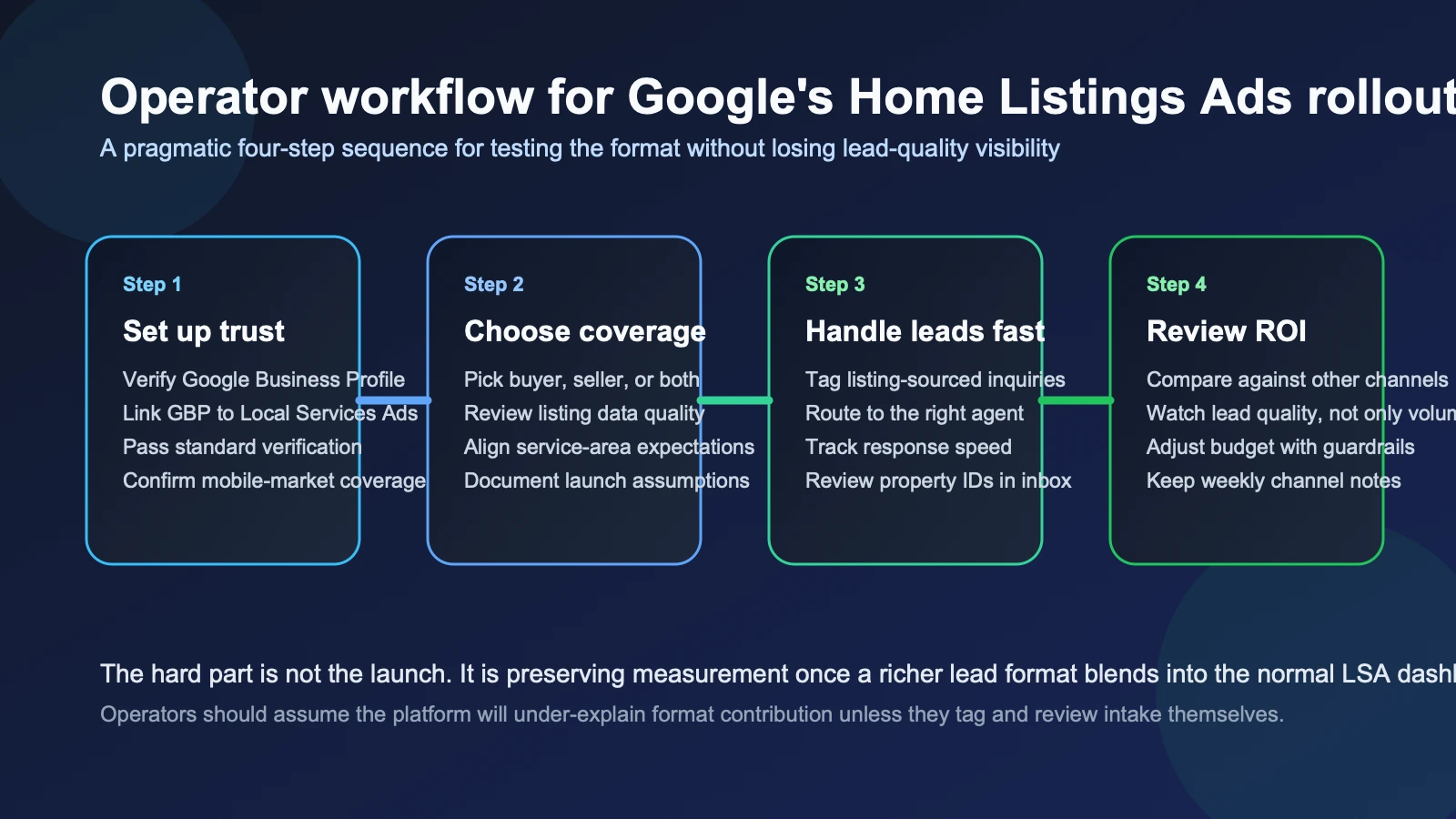
- Confirm that your Google Business Profile is verified and correctly linked to your Local Services Ads account.
- Audit whether you are opted into the Buyer's agent, Seller's agent, or both job types, because Google's help page says that choice affects which query classes you can surface on.
- Build a lead-routing rule so listing-sourced inquiries are tagged and reviewed separately from standard local-service leads.
- Model acceptable lead cost and response-time targets before raising budget, using the Marketing ROI Calculator or Digital Marketing Budget Planner.
- Review your business profile, listing details, and trust signals with the same discipline you would apply to answer-engine visibility, because the user often decides whether to contact you before visiting your site.
What remains uncertain
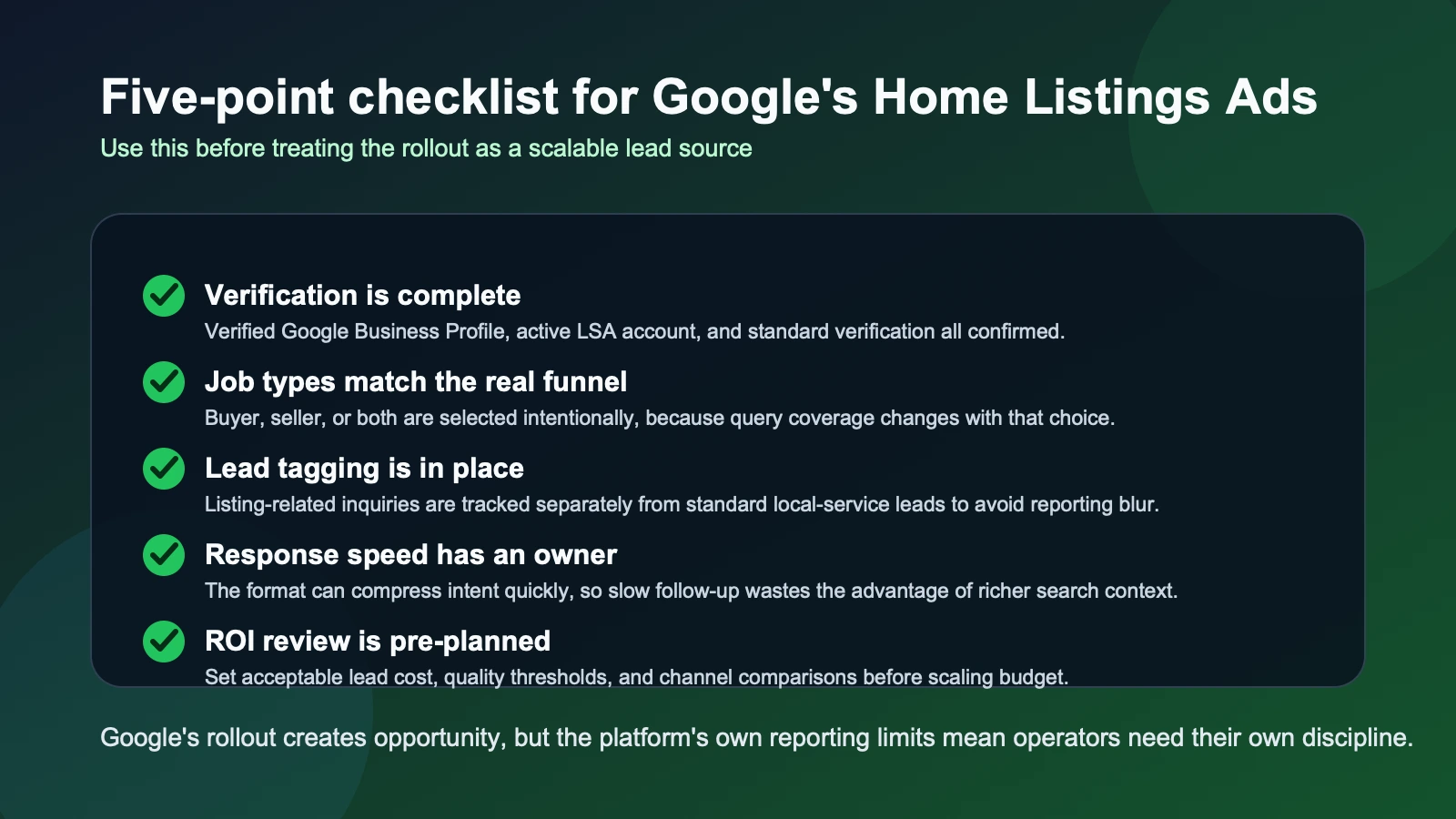
Google has not published lead-quality benchmarks, conversion-rate expectations, or pricing ranges for this format by market. The company also says the reporting dashboard does not identify the exact ad format behind each lead, which means teams can misread performance if they do not build their own lead tagging and intake discipline.
There are other clear boundaries. Google's help page says the format does not serve on Google Maps, and that availability is currently limited to U.S. markets on mobile. That means this is not yet a blanket replacement for every local real-estate search workflow. It is a new acquisition surface with real promise, but also with visibility gaps that require careful testing.
The useful conclusion on June 12, 2026 is narrower than hype and stronger than dismissal: Google just made Local Services Ads more commerce-like for residential real estate. Teams that win from this rollout will be the ones that pair fast lead handling with clean profile data, disciplined measurement, and a clear answer to one basic question: are these richer search contacts actually better business?