Google turns YouTube creator planning and Demand Gen into a more measurable workflow
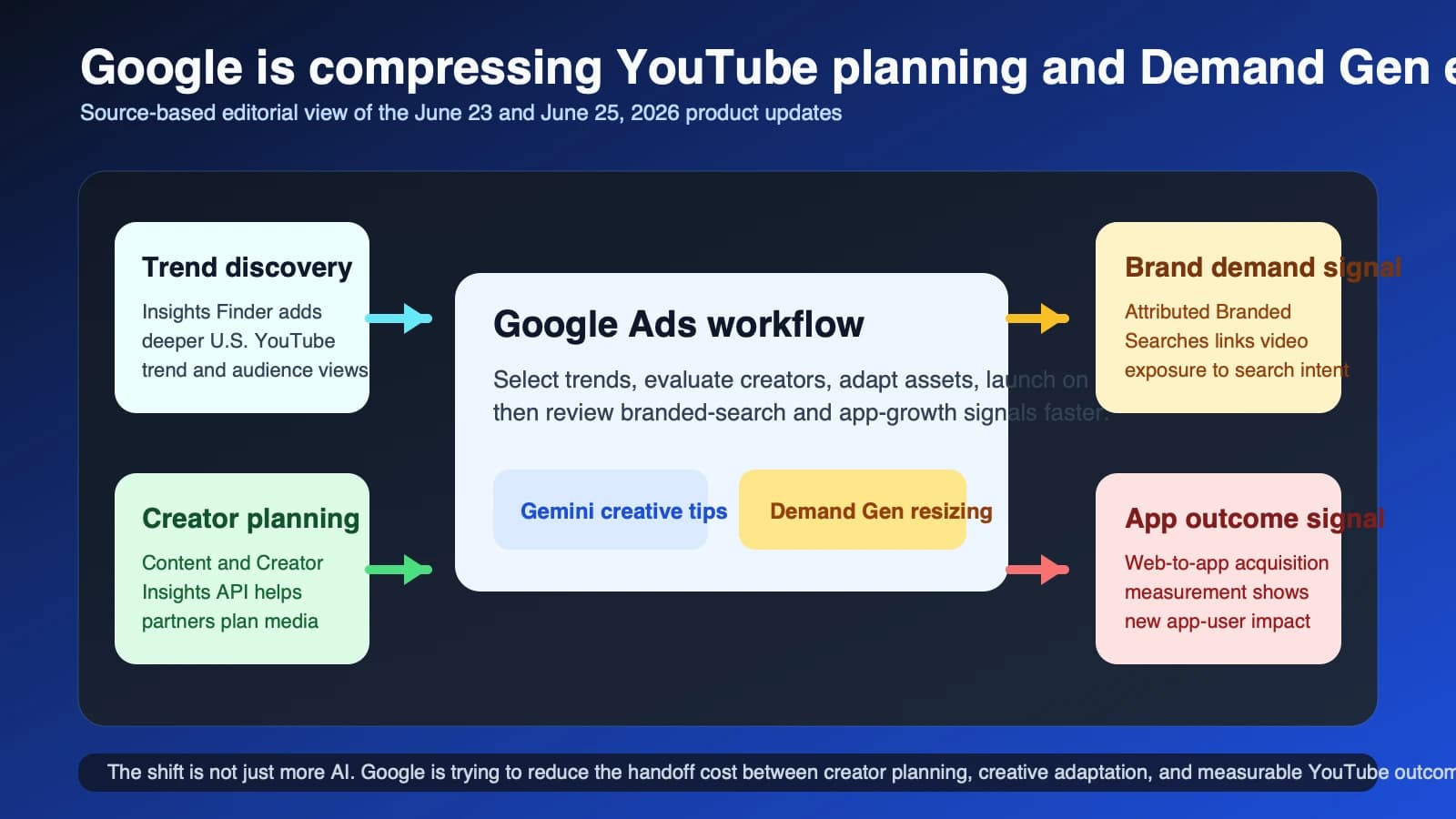
Google used two official updates in the same week to make a practical point for advertisers, agencies, and growth teams. On June 23, 2026, it said YouTube is getting deeper trend data in Insights Finder, select brand pulse metrics inside the same tool, a new Content & Creator Insights API for partners, and Gemini-powered creative tips for YouTube campaigns. Two days later, on June 25, 2026, Google said Demand Gen is also gaining broader video resizing, new web-to-app acquisition measurement, and more automated creative guidance for YouTube.
That sounds like a collection of product notes. The more useful read is operational: Google is trying to pull creator planning, audience trend discovery, brand-lift proxy signals, creative iteration, and app-growth measurement into one tighter workflow inside Google Ads. For teams buying across the United States, Canada, the United Kingdom, Australia, and Europe, that matters because YouTube is becoming less of a standalone video channel and more of a planning-and-measurement system for brand and demand work together.
What changed
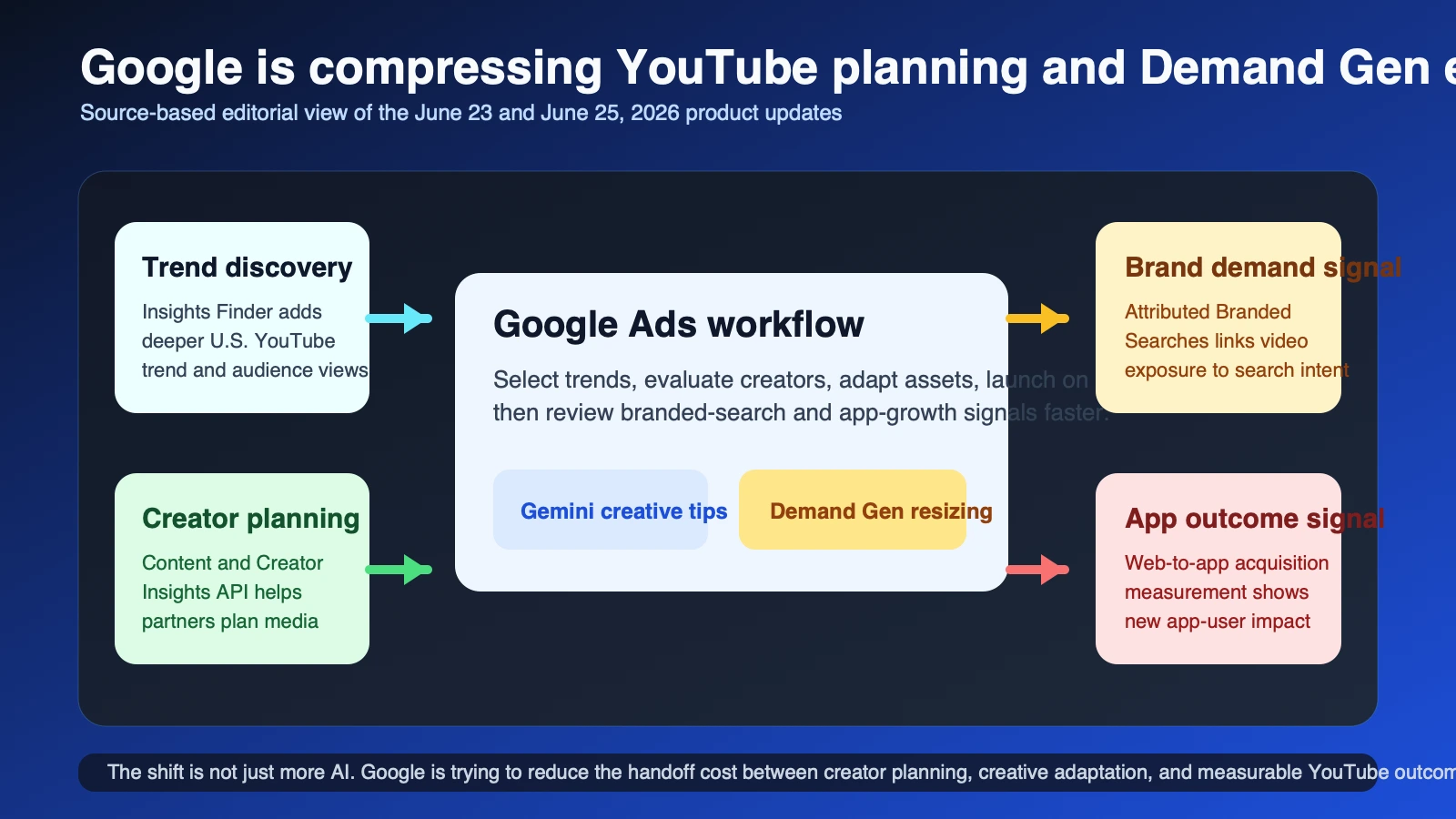
The June 23 Google Ads & Commerce post focused on creator and brand-campaign planning. Google said advertisers now get more granular trending insights in the U.S. inside Insights Finder, select Attributed Branded Searches reporting is available globally in Google Ads, and a new Content & Creator Insights API gives agencies and partners richer creator and audience information for planning. The same announcement also said Gemini will soon provide creative advice for Demand Gen campaigns on YouTube, including guidance about which visuals may perform better.
The June 25 Demand Gen Drop added three more pieces that make the workflow more actionable. Google said Demand Gen will soon support more video aspect-ratio transformations, including vertical-to-square and vertical-to-landscape, so teams can reuse creative more flexibly across screens. It also said web-to-app acquisition measurement is now available so advertisers can see how Demand Gen helps drive new app users. Read together, those two updates move the conversation from "creator marketing is important" to "here is how Google wants you to plan, adapt, and measure it."
| Confirmed June 2026 signal | Official source | Why it matters in practice |
|---|---|---|
| New U.S. trending insights and select brand pulse metrics are now surfacing in Insights Finder. | Google Ads & Commerce, June 23 and Insights Finder | Video planning can start from fresher YouTube trend and audience context instead of generic audience assumptions. |
| The new Content & Creator Insights API provides richer creator and audience data for partners. | Google Ads & Commerce, June 23 | Agencies and software partners can bring creator-planning data into their own planning workflows. |
| Attributed Branded Searches is now available globally in Google Ads. | Google Ads & Commerce, June 29 and Google Business | Brand teams get a faster way to see whether YouTube exposure is driving branded search demand. |
| Gemini will soon provide creative recommendations for Demand Gen campaigns on YouTube. | Google Ads & Commerce, June 23 and Demand Gen Drop, June 25 | Creative review is moving closer to campaign setup instead of living entirely in separate studio handoffs. |
| Demand Gen is adding broader video resizing and web-to-app acquisition measurement. | Demand Gen Drop, June 25 | Teams can repurpose more creative formats and measure app outcomes more directly from the same campaign type. |
Why it matters
This matters because creator marketing often breaks when the workflow stays fragmented. One team watches trends, another team finds creators, a media team buys distribution, a designer resizes assets late, and measurement arrives weeks later in a separate report. Google's own Insights Finder page says the tool helps teams uncover audience segments, explore search trends, discover what YouTube content people watch, and export ideas into action. The new June announcements extend that logic further into creator planning and Demand Gen execution.
For marketers, this is also a bridge between brand and performance. Google's Attributed Branded Searches page describes ABS as an always-on metric that ties video exposure to branded search behavior. That will not replace incrementality testing or long-term MMM. But it does give operators a faster signal when they are trying to understand whether YouTube creator or video work is generating intent before a full conversion path becomes visible. That is especially useful for teams already using tools like Slogan's Marketing ROI Calculator, Digital Marketing Budget Planner, and GEO Visibility Checklist to connect awareness activity to downstream outcomes.
Who is affected
The first group is agencies and in-house teams managing YouTube creator partnerships, video demand generation, and app growth together. They now need to think less about isolated campaign setup and more about whether trend data, creator selection, creative packaging, and measurement all line up.
The second group is martech and reporting teams. If Google's Content & Creator Insights API becomes part of agency tooling, then creator discovery and audience planning can start moving into proprietary dashboards, QA layers, and recommendation systems. That raises the bar for data definitions and internal governance.
The third group is app marketers and consumer brands that depend on short-form video. Google's YouTube Shorts help documentation says Shorts inventory is available across Demand Gen, Video View, Video Reach, reservation, Performance Max, and app campaigns. If creative resizing and app-acquisition reporting improve in practice, more teams will treat YouTube video strategy as one cross-format system instead of separate vertical and horizontal workflows.
What to do next
Treat this as a workflow cleanup moment rather than a reason to launch more campaigns immediately.
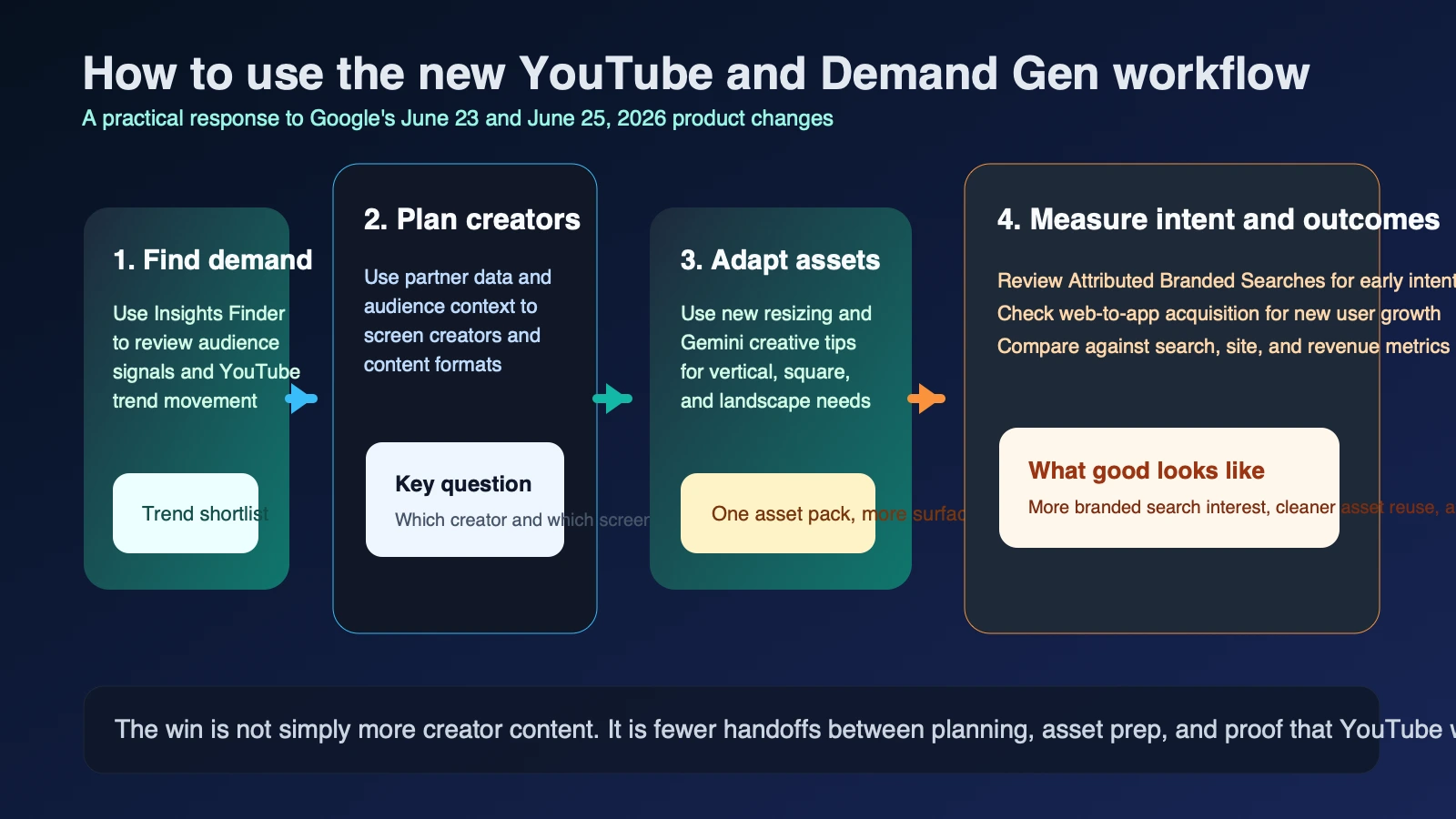
- Check whether your team is already using Insights Finder for YouTube trend and audience work, or whether planning still starts from stale personas and generic creator lists.
- Decide how you will evaluate Attributed Branded Searches alongside conversion, lift, and revenue data so it becomes a useful early signal instead of another vanity metric.
- Review whether your creative pipeline can actually supply vertical, square, and landscape assets fast enough to benefit from the new resizing and Demand Gen guidance.
- Map creator-led YouTube activity to the same measurement framework you use for search, app installs, and assisted revenue, including the workflow in Slogan's visibility tracking guide.
- For app campaigns, confirm that web-to-app acquisition measurement is configured cleanly before presenting YouTube creator or video spend as a growth engine.
What remains uncertain
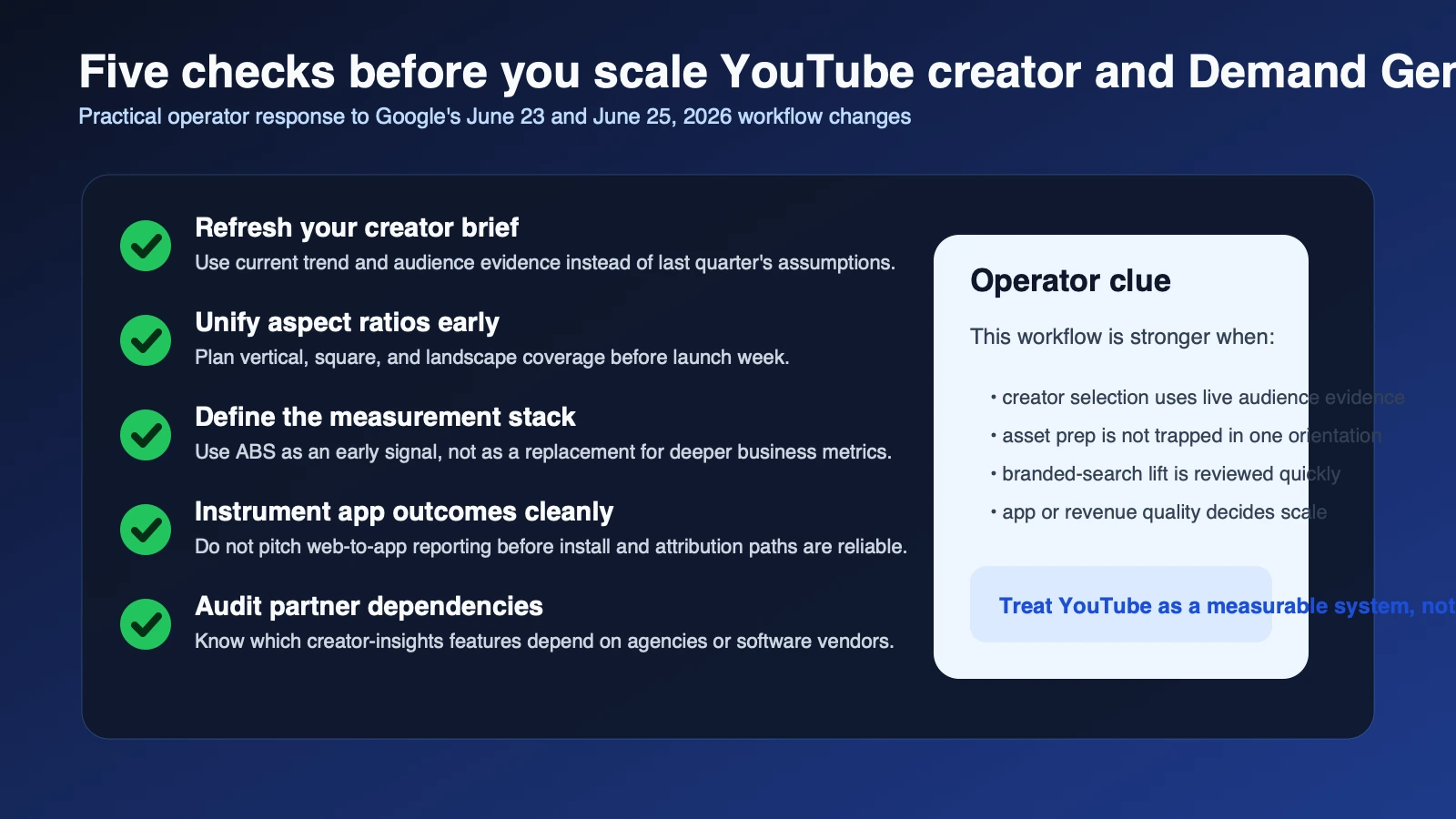
Google has been clearer about the direction than about every rollout boundary. The company did not publish a full market-by-market release matrix for each creator-planning feature, and the June 23 post described several capabilities at a high level without public technical documentation for every integration detail. The Content & Creator Insights API is also described primarily for partners, which means many brands will rely on agencies or vendors before they interact with it directly.
There is also a measurement caution. Attributed Branded Searches can help teams detect intent sooner, but Google still positions it as one signal inside a broader measurement stack, not as a complete substitute for deeper experimentation or longer-horizon business results. The practical conclusion on July 2, 2026 is that Google is tightening the loop between YouTube planning and Google Ads execution. The teams that benefit most will be the ones with clean creator criteria, adaptable assets, and a measurement model that connects attention to revenue instead of treating video as a black box.