Instacart turns its Ads Manager into a retailer media console
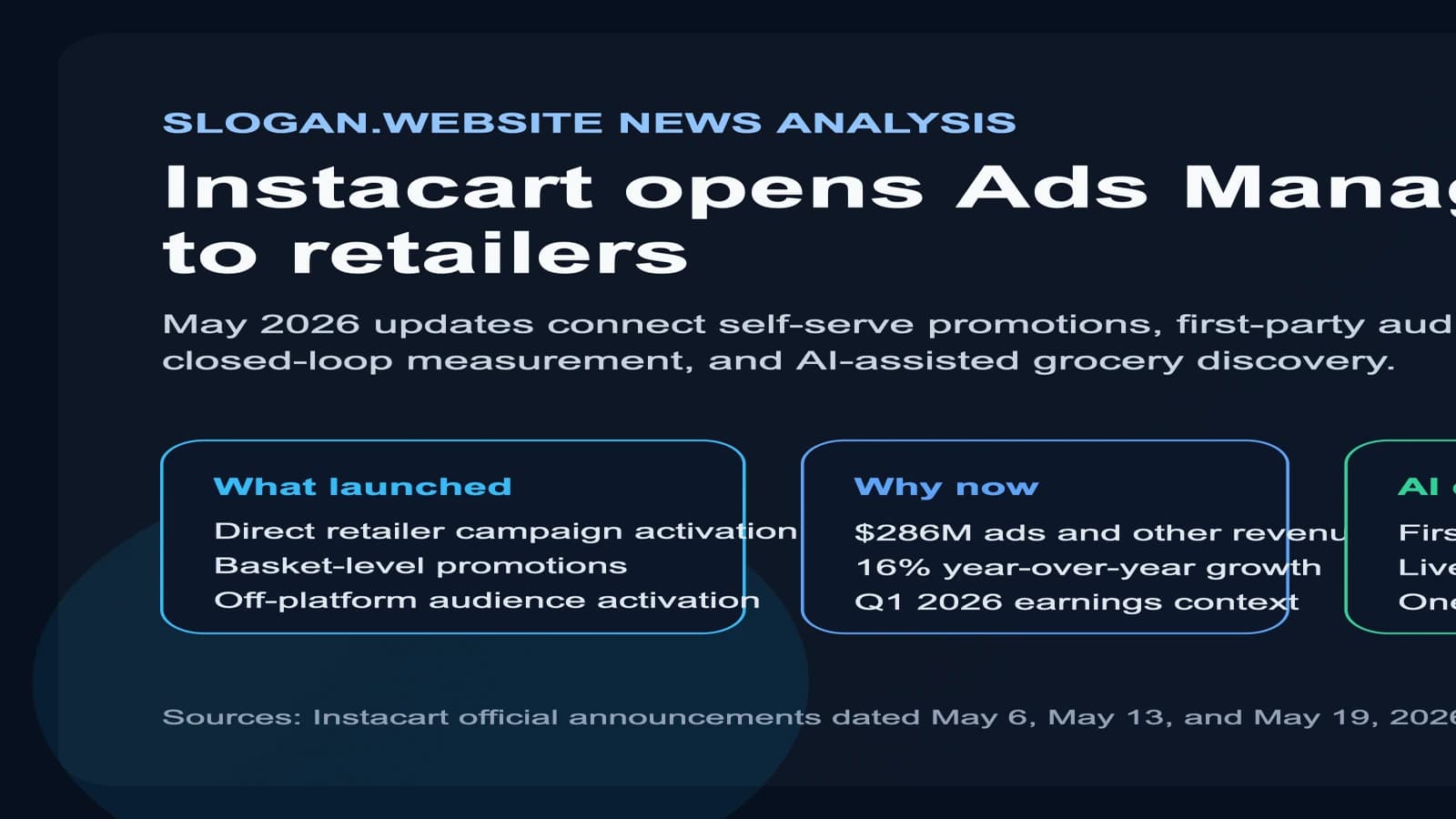
Instacart said on May 13, 2026 that retailers can now activate campaigns directly inside Instacart Ads Manager, adding self-serve promotions and off-platform audience activation to a stack that had been used mainly by CPG brands. Read with Instacart's May 6, 2026 first-quarter results and its May 19, 2026 Gemini integration post, the move looks bigger than a dashboard update. Instacart is trying to turn its grocery data, ad measurement, and AI shopping infrastructure into one operating layer for retailers that want more control over demand generation.
For operators in the United States and Canada first, with clear implications for retail media teams in the United Kingdom, Australia, and Europe, the practical shift is simple: retailers no longer have to treat Instacart only as a marketplace distribution channel. They can use it more like a retail media system that supports campaign launch, audience targeting, closed-loop measurement, and increasingly AI-assisted discovery.
What changed
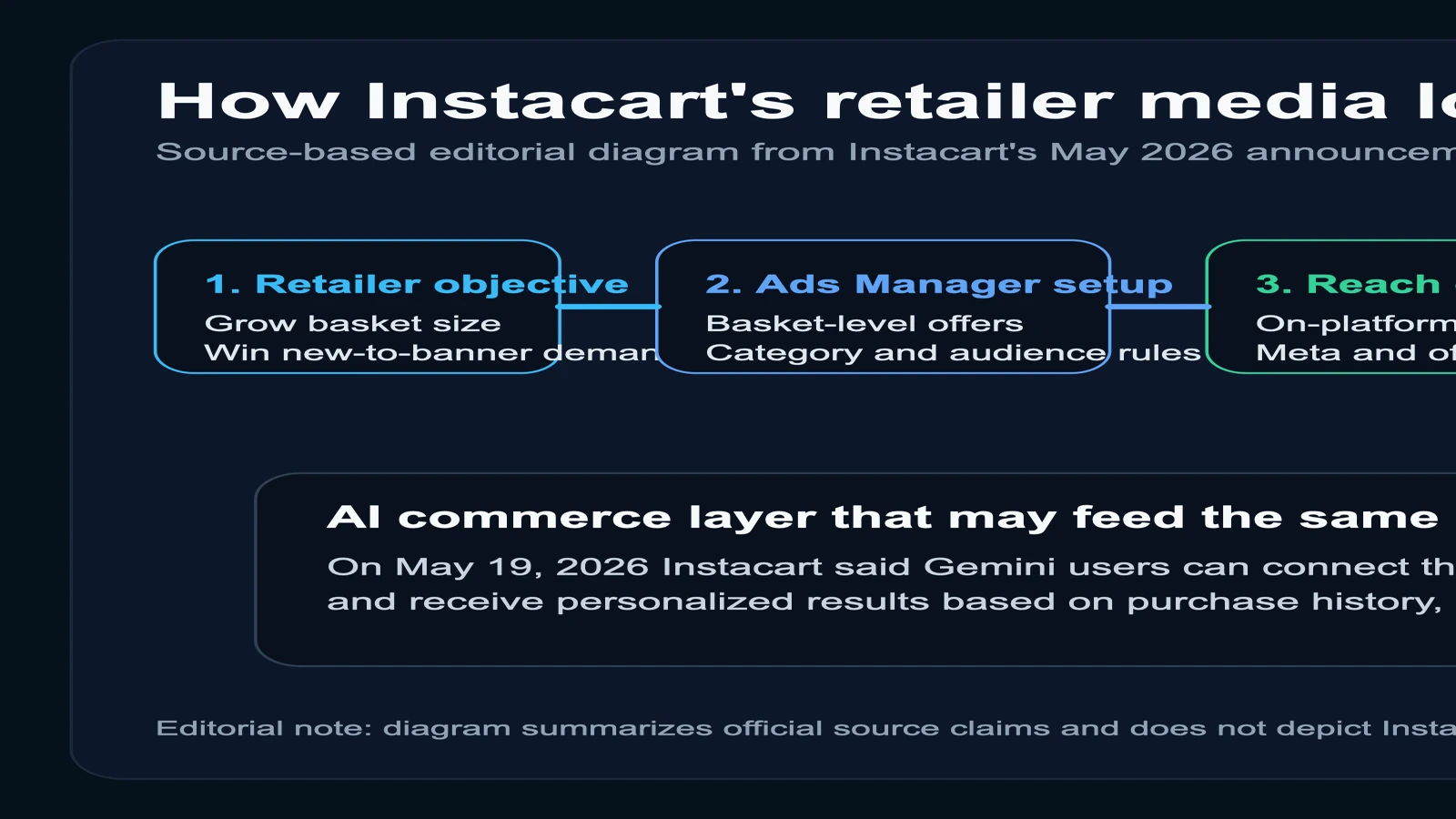
The core product change came on May 13, 2026. Instacart said retailers can now create basket-level offers, target high-intent consumer segments, and measure redemptions, sales impact, and new-to-banner growth in real time inside Ads Manager. The same announcement says retailers can test off-platform advertising through partners including Meta, using Instacart's first-party audiences to win back lapsed customers and find new ones.
Instacart's Q1 2026 earnings release on May 6, 2026 provides the business context behind that launch. The company said advertising and other revenue reached $286 million, up 16% year over year, while total revenue crossed $1.019 billion and gross transaction value passed $10.288 billion. In the same release, Instacart said its Ads ecosystem includes more than 310 Carrot Ads partners and over 9,000 brand partners as of Q4 2025, which helps explain why it now has enough infrastructure to sell retailer-facing ad controls as a scaled product rather than a custom service.
The May 19, 2026 Gemini announcement adds the AI direction. Instacart said it became the first grocery partner integrated into Gemini, letting users connect their account, build a shoppable cart through natural-language prompts, and move into checkout with real-time inventory and personalized recommendations. That is not an ad product by itself, but it shows the same first-party commerce graph starting to power both discovery and media activation.
| Confirmed point | Official source | Operator takeaway |
|---|---|---|
| Retailers can now activate campaigns directly inside Instacart Ads Manager | Instacart press release, May 13, 2026 | Retail media teams get more direct execution control instead of waiting on managed-service support. |
| Self-serve promotions include basket-level offers, audience targeting, and real-time measurement | Instacart press release, May 13, 2026 | Retailers can treat promotions more like measurable acquisition and retention campaigns. |
| Off-platform retailer campaigns are being tested through partners including Meta | Instacart press release, May 13, 2026 | Instacart wants its audience data to matter beyond its own marketplace. |
| Advertising and other revenue grew 16% year over year to $286 million in Q1 2026 | Instacart Q1 2026 earnings release, May 6, 2026 | The ad business is already material enough to justify deeper productization. |
| Instacart became Gemini's first grocery partner on May 19, 2026 | Instacart company update, May 19, 2026 | The same commerce intelligence layer is expanding into AI-assisted demand capture. |
Why it matters
This matters because retailers have spent years watching retail media networks act more like supplier monetization layers than operator-grade growth systems. Instacart is now saying grocers can use its stack to move faster on campaign launch, target shoppers based on category and banner behavior, and see performance with closed-loop data in the same workflow. That is useful for chains that need to defend margin, increase basket size, and keep digital traffic from drifting entirely toward big-box rivals.
There is also a GEO and AI-discovery angle. If Instacart can turn conversational demand in Gemini into real carts using live inventory, purchase history, and local availability, then retail media strategy is moving closer to search and answer-engine strategy. Retailers may need the same discipline they use for brand visibility measurement and the GEO Visibility Checklist: stronger product data, cleaner promotion rules, and clearer proof that the offer shown by an AI surface is actually purchasable.
For finance-minded operators, this is also a budgeting story. Self-serve retailer promotions and off-platform retargeting only help if teams can distinguish incremental sales from subsidized demand. That is where Slogan.website tools such as the Marketing ROI Calculator and Digital Marketing Budget Planner become relevant. Retail media is getting easier to launch, but not automatically easier to justify.
Who is affected
The most exposed teams are grocers, marketplaces, and retail media operators that already have meaningful first-party demand but still run fragmented promotion and measurement workflows.
- Regional grocery chains that need faster promotion launch without building a full in-house ad stack.
- Retail media teams that want to use audience intelligence across on-platform and off-platform buying.
- Ecommerce and merchandising leaders responsible for basket growth, repeat purchase, and new-to-banner acquisition.
- Agencies and consultants managing grocery, CPG, or omnichannel performance budgets.
- Data and analytics teams that need to separate real incremental lift from platform-assisted reporting.
What to do next
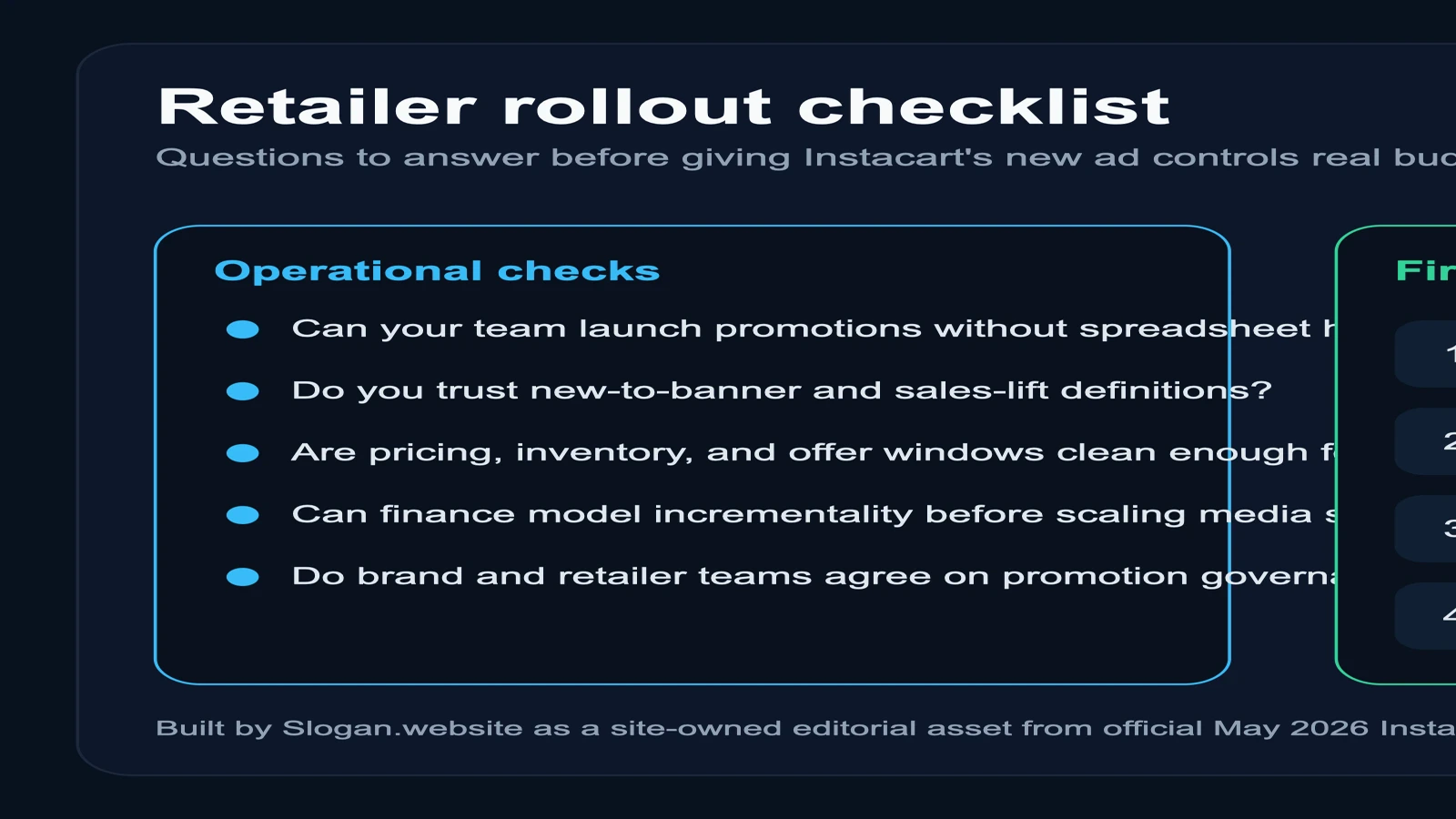
Use Instacart's May 2026 updates as a retail media readiness prompt.
- Map which promotions still require manual briefs, channel handoffs, or spreadsheet reconciliation.
- Identify where basket-level offers or category-based audience targeting could drive measurable new-to-banner growth.
- Review whether your feed, inventory, and pricing data are reliable enough for AI-assisted shopping surfaces, especially after Instacart's Gemini launch on May 19, 2026.
- Model retailer-promo upside and guardrails in the Digital Marketing Budget Planner, then test break-even assumptions in the Marketing ROI Calculator.
- Pair retail media reporting with a broader visibility workflow using AI search analytics tools if your category is also seeing answer-engine traffic shifts.
What remains uncertain
Important gaps remain. Instacart's May 13 release does not publish broad adoption data, detailed pricing, regional rollout boundaries outside its current footprint, or exactly how retailer reporting will compare with existing brand-side views. The company also says more ad capabilities will arrive through 2026, which means today's launch is still an opening phase rather than the final operating model.
The AI side is also early. The May 19 Gemini post proves that Instacart's commerce graph can travel into conversational interfaces, but it does not yet answer how much demand will shift there, how sponsored placements may evolve, or how retailers will govern offer visibility across AI assistants.
The practical takeaway on June 2, 2026 is that Instacart is becoming easier to treat as both a retail media network and an AI-era commerce infrastructure layer. Grocers that tighten their promotion logic, measurement discipline, and product data now will be in a better position if that convergence accelerates through the second half of 2026.