Koddi and Search Ads 360 bring commerce media closer to the main search workflow
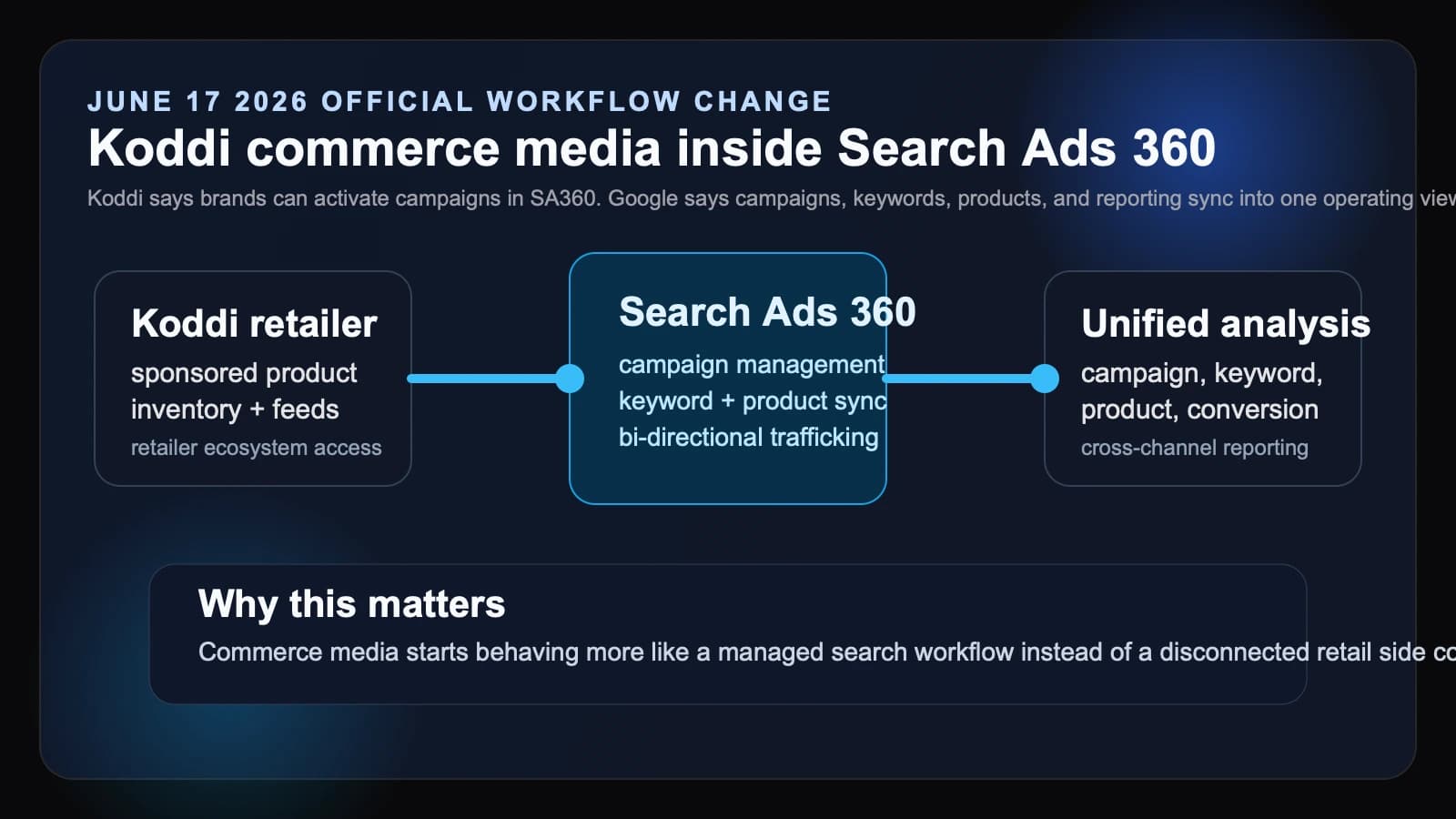
Koddi announced on June 17, 2026 that its retailer ecosystem is now integrating with Search Ads 360, and Google’s own Search Ads 360 Help documentation confirms that brand advertisers can manage Koddi sponsored product campaigns directly inside the SA360 interface. The practical change is clear: commerce media no longer has to sit as a side workflow completely separate from the main search team’s execution layer.
For operators who already manage large paid search and shopping programs in Search Ads 360, this matters less as a flashy launch and more as an operating-model simplification. Koddi says advertisers can activate campaigns across Koddi-powered retailer inventory with the same workflow they already use for Google accounts and search campaigns, while Google says the integration continuously syncs campaigns, ad groups, keywords, and product entities into SA360.
What changed
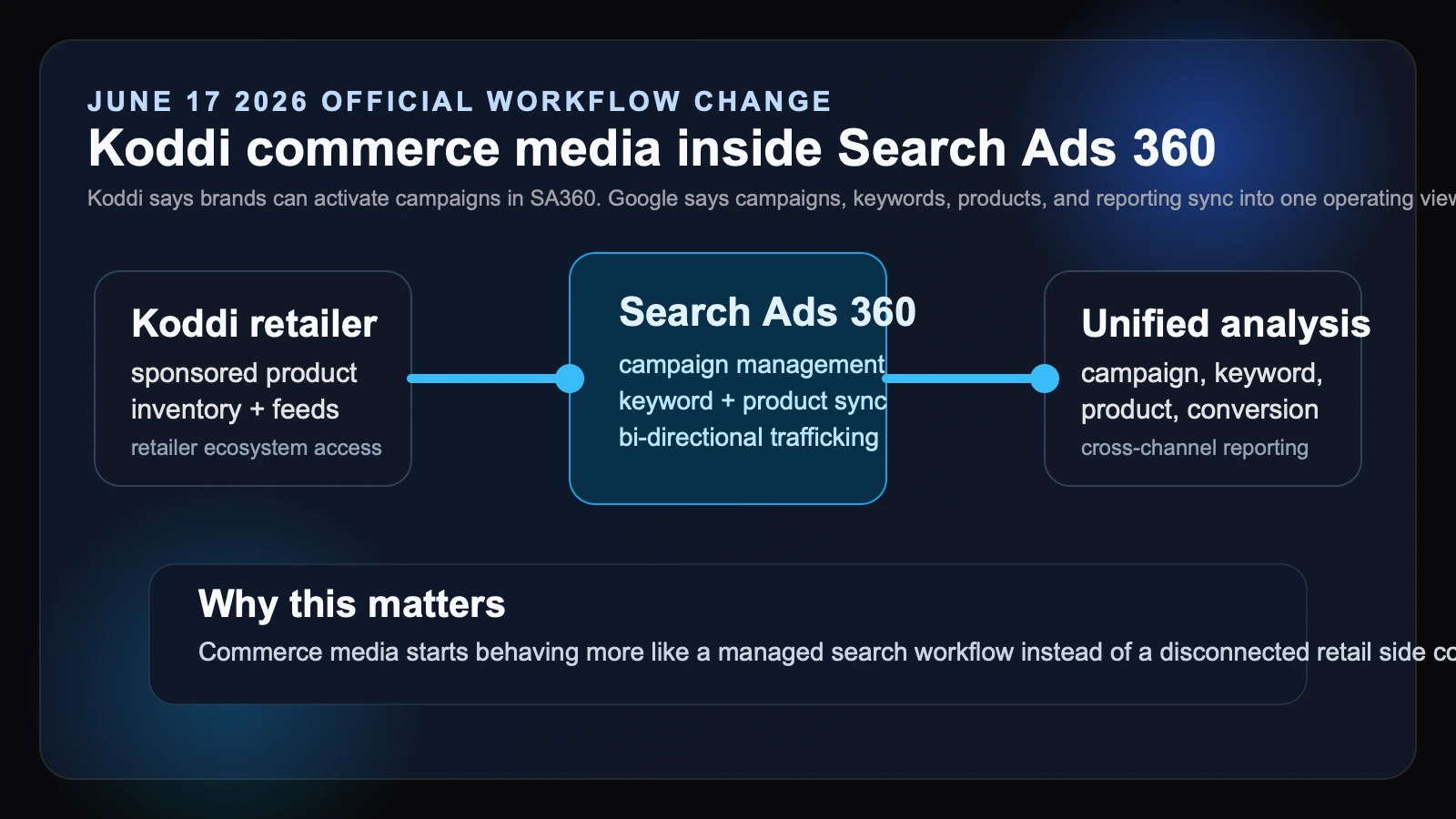
Koddi’s official release says advertisers can now access and activate commerce media campaigns across Koddi’s retailer ecosystem directly within Search Ads 360, instead of treating those programs as a separate activation surface with a separate reporting trail. Koddi also says SA360 can pull onsite commerce media reporting into one centralized view.
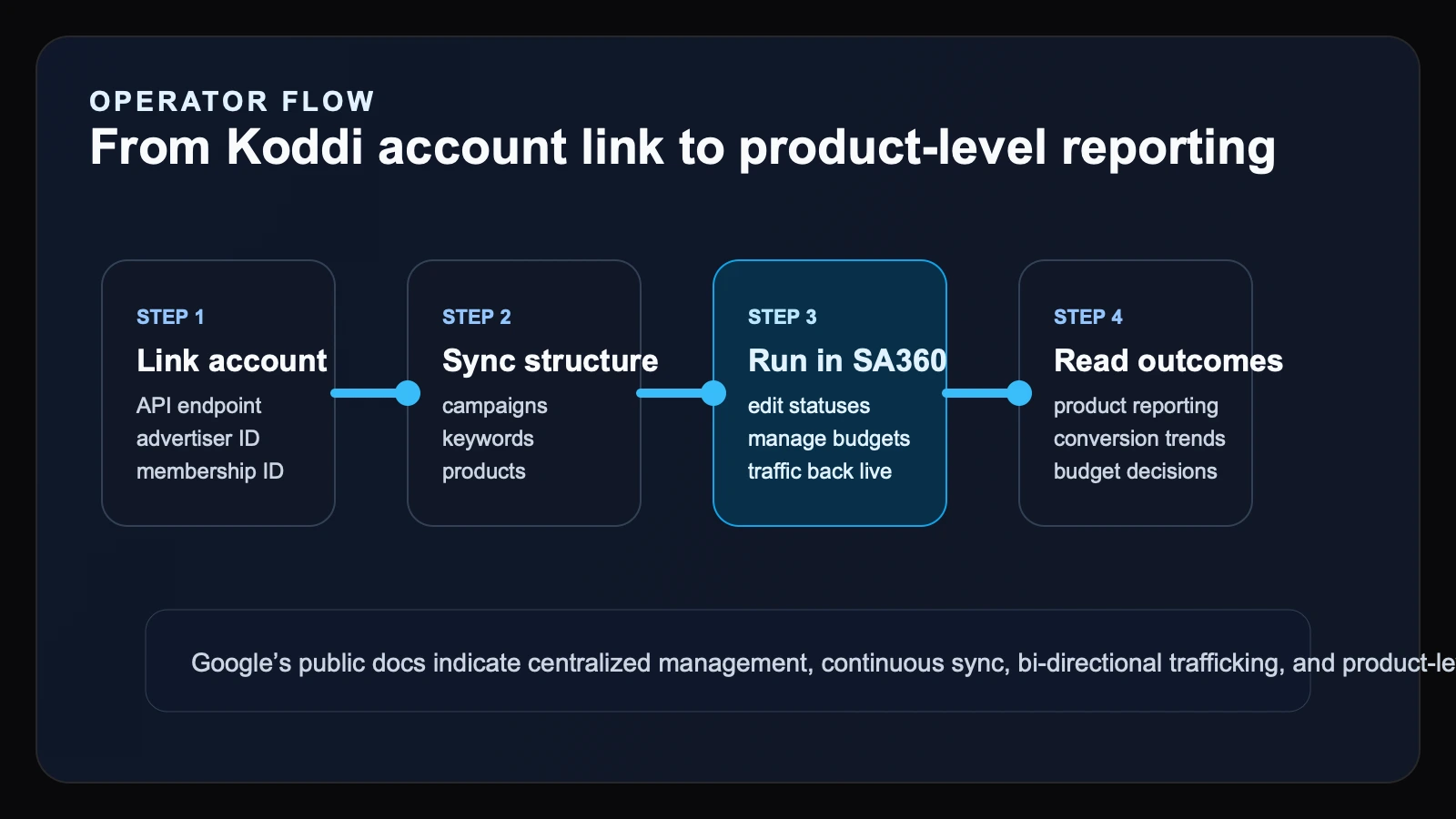
Google’s documentation adds the implementation detail that makes the announcement more concrete. In the Koddi for Commerce Media Network help page, Google says SA360 supports centralized campaign management, continuous inbound sync for campaigns, ad groups, keywords, and product entities, bidirectional trafficking back to live Koddi campaigns, unified reporting for campaigns through product level, and even a synthetic Google Merchant Center account so product feeds can be managed and reported on in the UI. Google also states that the feature is for Koddi sponsored product campaigns inside its Commerce Media Network framework, not a vague future promise.
The broader SA360 commerce media docs matter too. Google says in its Commerce media overview that brands can use retailer data to set up, optimize, and report on campaigns with accurate reporting at brand, campaign, and SKU level. Read together with the Koddi-specific page, the signal is that Google wants commerce media to behave more like a first-class planning and reporting lane inside enterprise search operations.
| Confirmed point | Official source | Why it matters operationally |
|---|---|---|
| Koddi announced the SA360 integration on June 17, 2026. | Koddi release | Commerce media access is now framed as an active workflow change, not only a roadmap statement. |
| Brand advertisers can manage Koddi sponsored product campaigns directly in SA360. | Google SA360 Help | Search teams can keep one control plane instead of juggling separate day-to-day UIs. |
| SA360 syncs campaigns, ad groups, keywords, and product entities from Koddi. | Google SA360 Help | Operators get usable structure for optimization, not just headline-level visibility. |
| Google says reporting can be built for campaigns, ad groups, keywords, and products. | Google SA360 Help | Performance analysis can move closer to SKU and retail outcome decisions. |
| Koddi says brands gain more control and transparency through unified measurement of conversions and commerce outcomes. | Koddi release | The integration is as much about measurement discipline as it is about activation convenience. |
Why it matters
Commerce media budgets have grown faster than the operating systems around them. In many organizations, search teams, retail media teams, and analytics teams still work across different platforms, naming conventions, product feeds, and reporting exports. The cost is slower optimization and weaker accountability when someone asks which channel moved product demand.
This integration addresses a specific part of that problem. Google’s Koddi help page says brands can gather performance stats and detailed reporting for Koddi campaigns, ad groups, keywords, and products in the same system they already use for search and commerce media management. Koddi adds that brands can align media spend more directly with consumer purchase behavior through unified measurement of conversions and commerce outcomes.
For U.S.-led brands, that is immediately relevant. For teams in Canada, the United Kingdom, Australia, and Europe, it is also a useful directional signal because enterprise workflow patterns often spread outward from U.S. retail and agency stacks. If commerce media increasingly plugs into the same control layer as search, then channel planning, SKU prioritization, and attribution hygiene need to get tighter. That is where internal resources like the Digital Marketing Budget Planner, Marketing ROI Calculator, GEO Visibility Checklist, and brand visibility measurement guidance become more useful, not less.
Who is affected
The most affected groups are brand advertisers already using retailer media, agencies managing large commerce portfolios, and internal analytics teams that need search and retail performance compared on one clock. Search Ads 360 power users gain another commerce media surface inside an existing governance system, while finance and growth leaders get a cleaner way to compare product, keyword, and conversion outcomes across channels.
What to do next
Use the June 17, 2026 announcement as a readiness checkpoint rather than assuming every organization should move immediately.
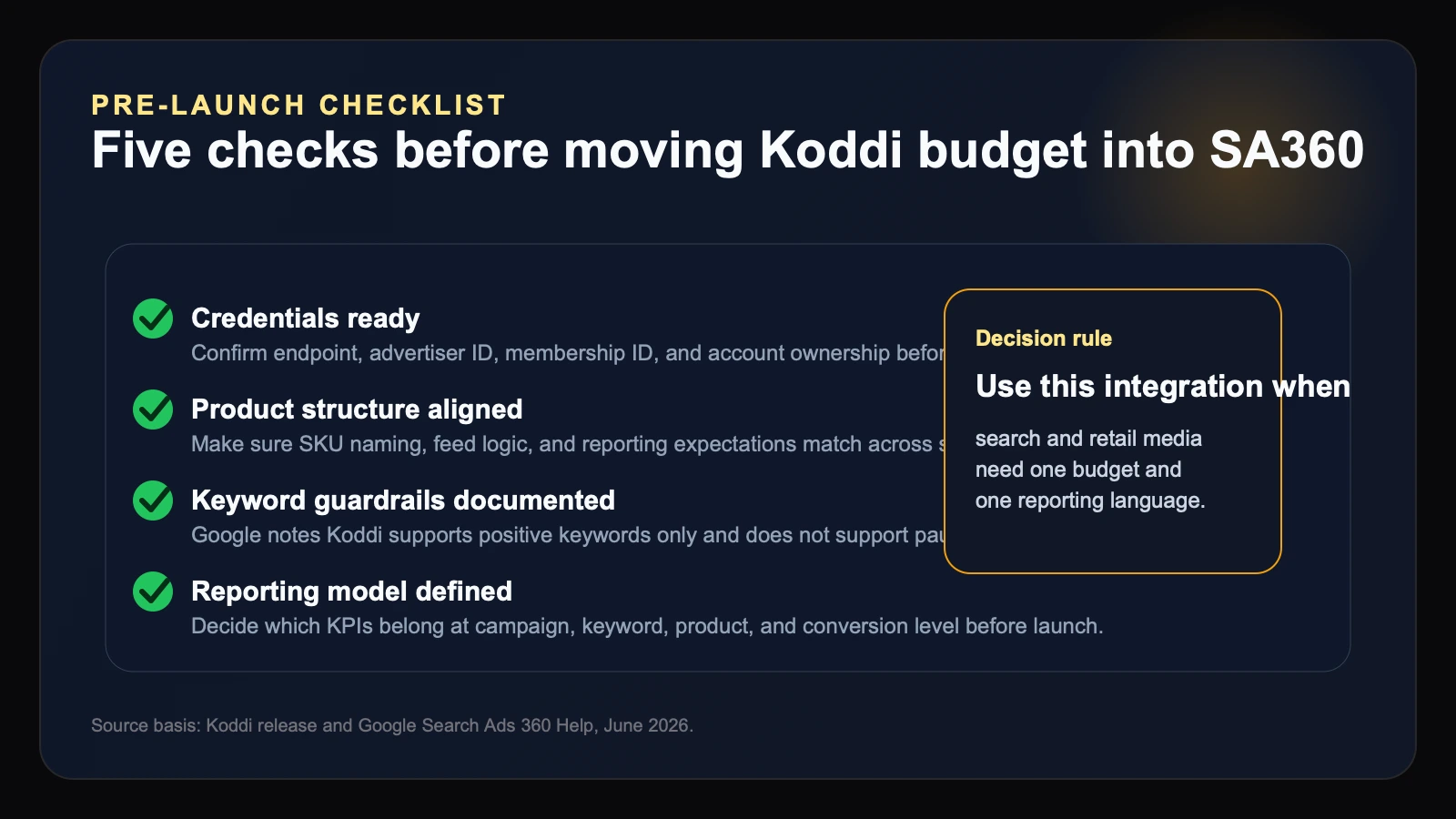
- Confirm whether your team has the Koddi API endpoint, advertiser ID, and membership ID Google lists as onboarding requirements in SA360 Help.
- Audit whether your search and retail media teams use consistent SKU logic and conversion definitions before you centralize reporting.
- Identify which retailer campaigns should stay measured as isolated retail tests and which belong in a unified budget conversation with search and shopping.
- Document Google’s current guardrails, including the note that Koddi only supports positive keywords and does not support pausing individual product entities.
- Build a reporting template that compares keyword, product, and conversion trends across channels instead of waiting until after launch to define success.
What remains uncertain
The integration is concrete, but some rollout details are still thin in public materials. Koddi’s release does not publish a market-by-market availability map, and Google’s help page explains how the feature works without giving broad public adoption numbers or a public pricing layer. Teams should also note Google’s guardrails: Koddi supports only positive keywords, daily budgets sit at the ad group level, and individual product entities cannot be paused.
The useful conclusion for June 18, 2026 is narrower than the hype. Koddi and Search Ads 360 have made commerce media more interoperable with mainstream enterprise search workflows, which is meaningful for brands that need cleaner reporting, tighter budget logic, and less fragmentation between search intent and retail outcomes.