LinkedIn and Adobe turn AI training into a marketer workflow issue, not just a skills slogan
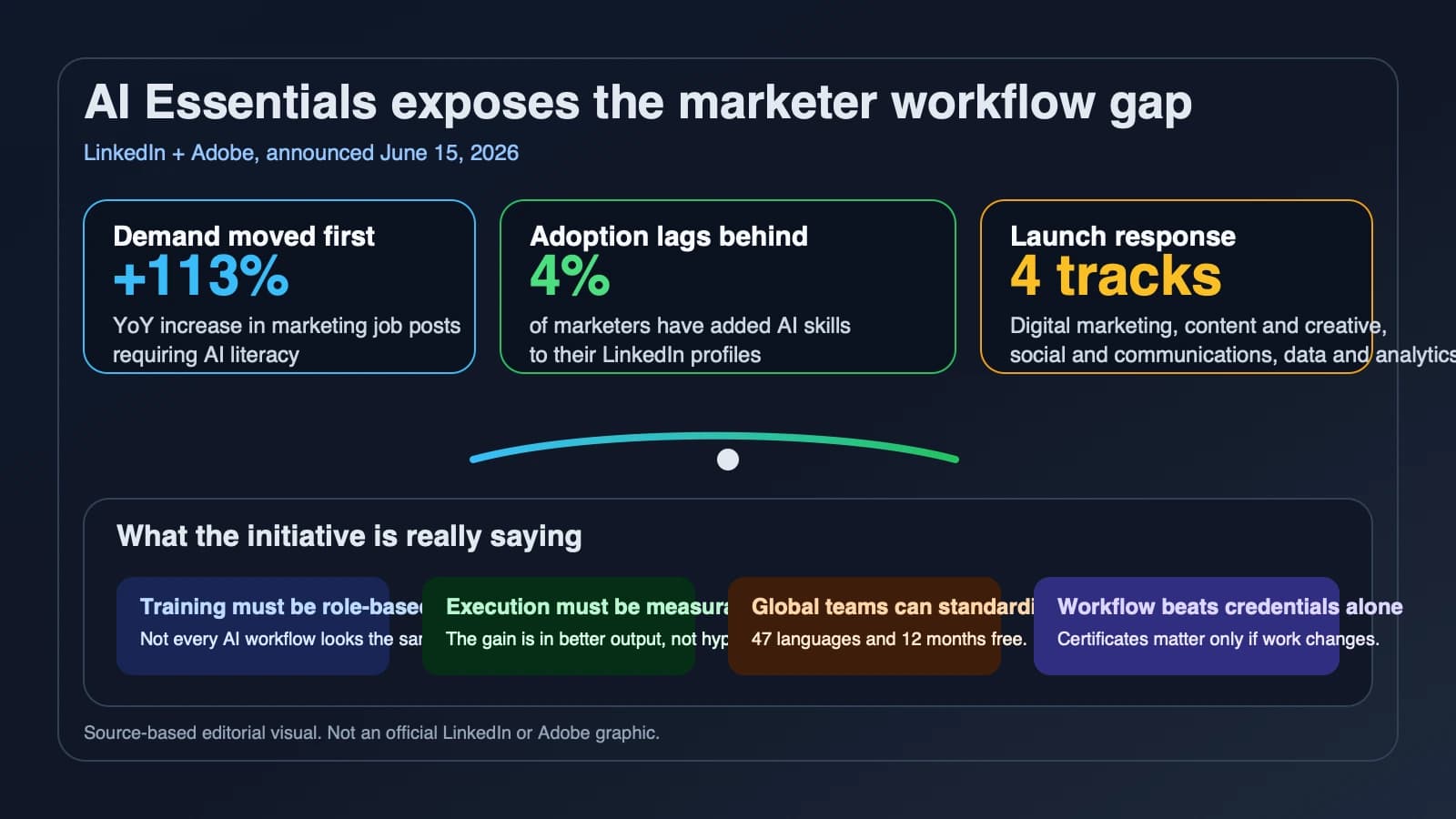
LinkedIn and Adobe said on June 15, 2026 that they are launching AI Essentials for Marketers, a new training initiative built around short LinkedIn Learning courses for digital marketing, content and creative, social and communications, and data and analytics roles. The more useful interpretation is practical: two large platforms that already sit inside campaign planning, content production, and hiring are signaling that AI readiness is now a workflow problem for marketing teams, not only an HR issue.
The official launch post says marketing job postings requiring AI literacy are up 113% year over year, the initial courses will be available in 47 languages, and access will be free for the first 12 months through LinkedIn Learning. The supporting initiative page adds a more uncomfortable data point: only 4% of marketers globally have added AI skills to their LinkedIn profiles. For operators managing demand generation, SEO and GEO programs, paid media, or content systems across the United States, Canada, the United Kingdom, Australia, and Europe, that gap matters because the tooling layer is moving faster than the average operating model.
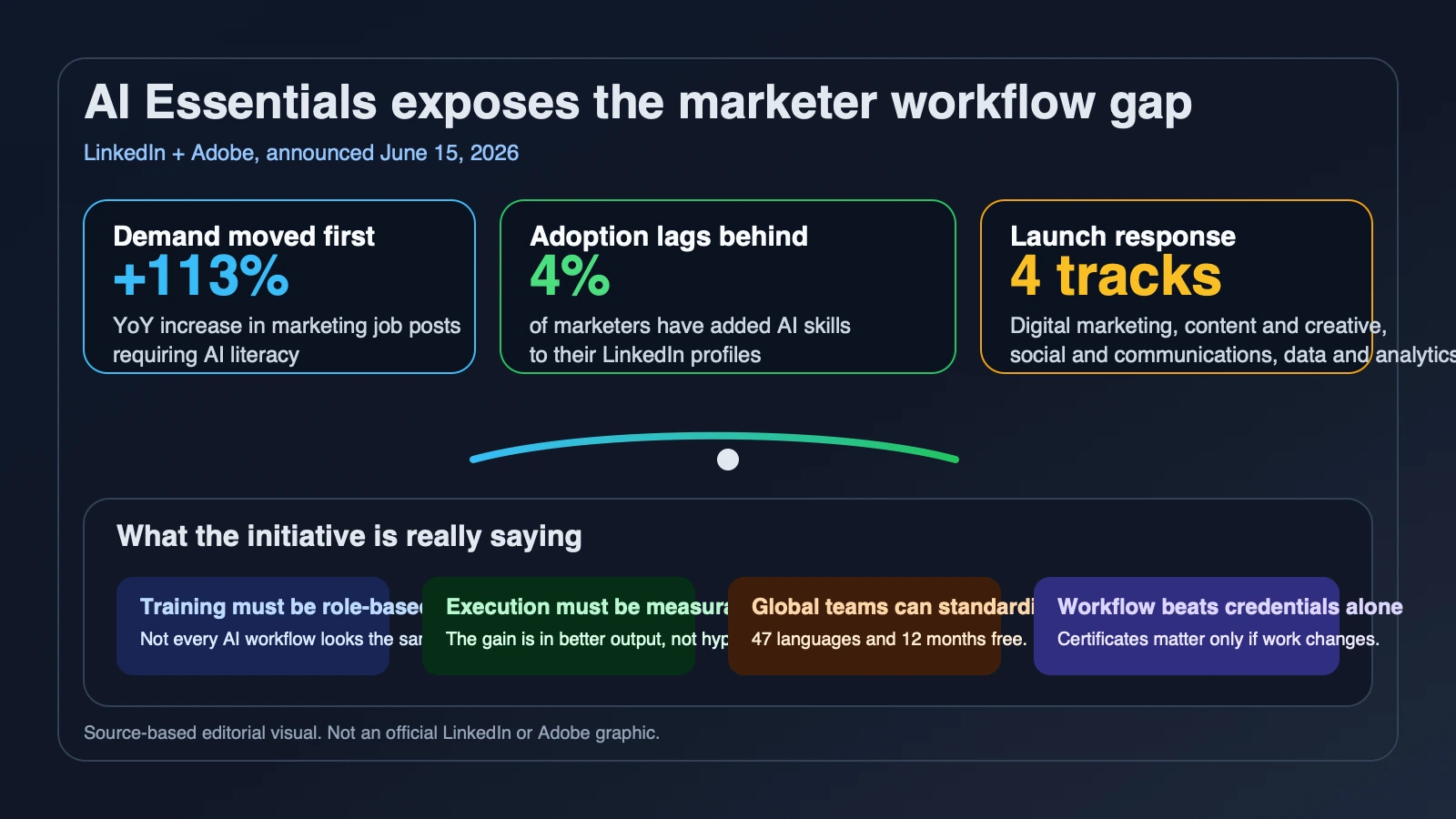
What changed
| Confirmed June 2026 detail | Primary source | Why it matters in practice |
|---|---|---|
| LinkedIn and Adobe launched AI Essentials for Marketers on June 15, 2026. | LinkedIn pressroom announcement | The story is a live go-to-market move, not a vague roadmap statement. |
| The launch starts with four role-based LinkedIn Learning courses covering digital marketing, content and creative, social and communications, and data and analytics. | LinkedIn pressroom announcement | LinkedIn is treating AI fluency as function-specific operational training, not generic inspiration. |
| The courses are available in 47 languages and free of charge for the first 12 months. | LinkedIn pressroom announcement | Global marketing teams can standardize faster without waiting for local custom programs. |
| LinkedIn said marketing job postings requiring AI literacy are up 113% year over year. | LinkedIn pressroom announcement | The market is already rewarding AI-ready marketers before many teams have a mature training stack. |
| LinkedIn's Economic Graph team said only about 1 in 25 marketers have added AI skills to their profiles, while AI skill growth has risen by 30%+ across practitioners and leaders over the last six months. | LinkedIn Economic Graph post | The adoption gap is not just between companies; it also exists inside the marketing talent pool itself. |
LinkedIn says the courses are designed by BrandWorks, its internal strategy and creative support team, and that learners who finish them can display LinkedIn Learning certificates of completion on their profiles. The launch page also frames the initiative around quick, social-first learning instead of long classroom-style modules, another sign that the companies see this as embedded workflow enablement.
Why it matters
This matters because marketing teams are increasingly being asked to use AI in environments where speed, brand control, measurement, and compliance have to coexist. If AI capability rises unevenly across roles, some parts of the workflow become AI-accelerated while others still run on old review habits, undocumented prompts, or inconsistent quality standards.
LinkedIn's own June 8, 2026 EU and UK labour-market analysis reinforces that the talent question is broader than one campaign team. LinkedIn said the EU added more than 256,000 AI-related jobs since 2023 and the UK added more than 95,000. That suggests AI capability is becoming a competitive labor-market variable across the exact regions Slogan.website targets.
For operators, the practical takeaway is that the story is not really about certificates. It is about whether your team can turn AI into repeatable output in content operations, analytics interpretation, campaign planning, creative production, and discoverability work. That overlaps directly with Slogan.website's GEO Visibility Checklist, the Generative Engine Optimization guide, and planning tools such as the Marketing ROI Calculator.
Who is affected
The first affected group is in-house marketing leadership that now has to decide whether AI training belongs inside enablement, workflow design, or both. The second is agencies that need more consistent AI literacy across account strategy, reporting, content, and paid media teams. The third is small and midsize businesses that cannot fund a custom AI academy but still need staff to work faster without damaging brand quality.
Teams working across content, SEO, brand visibility, and analytics should pay particular attention. If only one person can safely extract insights, adapt assets, or prepare AI-ready messaging, AI becomes a fragile dependency.
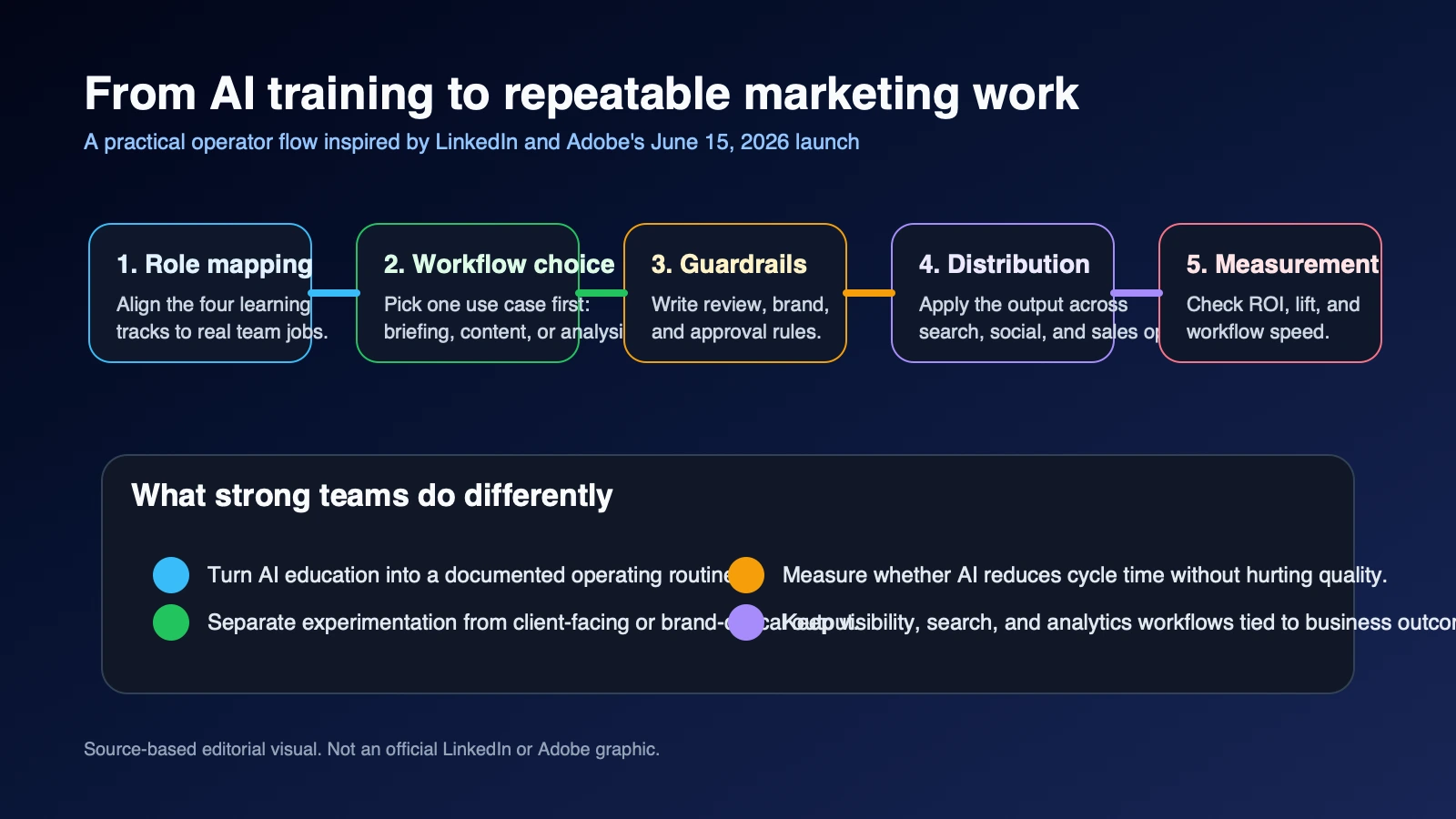
What to do next
Treat the LinkedIn and Adobe launch as a prompt to audit your operating model, not as proof that your team is suddenly AI-ready.
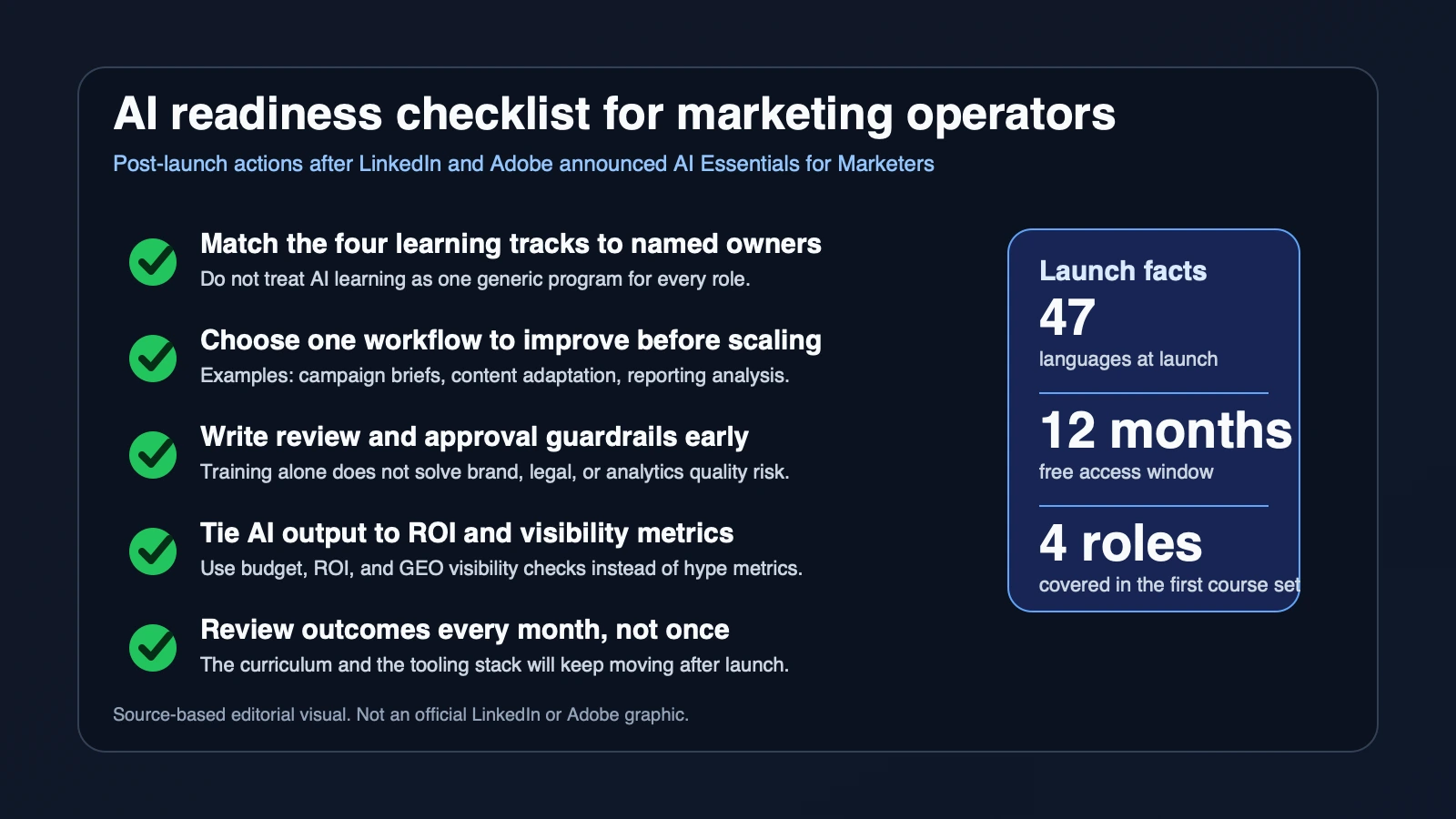
- Map the four launch lanes against real jobs in your team: digital marketing, content and creative, social and communications, and data and analytics.
- Identify where AI work is already happening informally through prompts, copilots, or ad-platform automation without a documented review process.
- Pick one measurable workflow to standardize first, such as campaign briefing, creative adaptation, or post-launch analysis.
- Define the success metric before training starts, using tools such as the Marketing ROI Calculator or Digital Marketing Budget Planner.
- Review whether AI-assisted output improves your search and answer-engine visibility using the GEO checklist and the guide to tracking brand mentions and visibility.
What remains uncertain
Important limits remain visible on June 17, 2026. LinkedIn and Adobe have described the launch structure, but they have not publicly shown completion benchmarks, downstream job-performance outcomes, or a standard implementation pattern that proves these courses will change operating behavior inside every team.
There is also a difference between skill signaling and workflow adoption. A certificate on a profile may help with hiring and internal credibility, but it does not guarantee that a team has solved approval design, brand governance, analytics interpretation, or cross-functional handoffs. The strongest reading of the launch is therefore practical but limited: LinkedIn and Adobe are telling marketers that AI fluency is now core job infrastructure.