LinkedIn and Bain say B2B deals stall when buyers cannot defend the decision
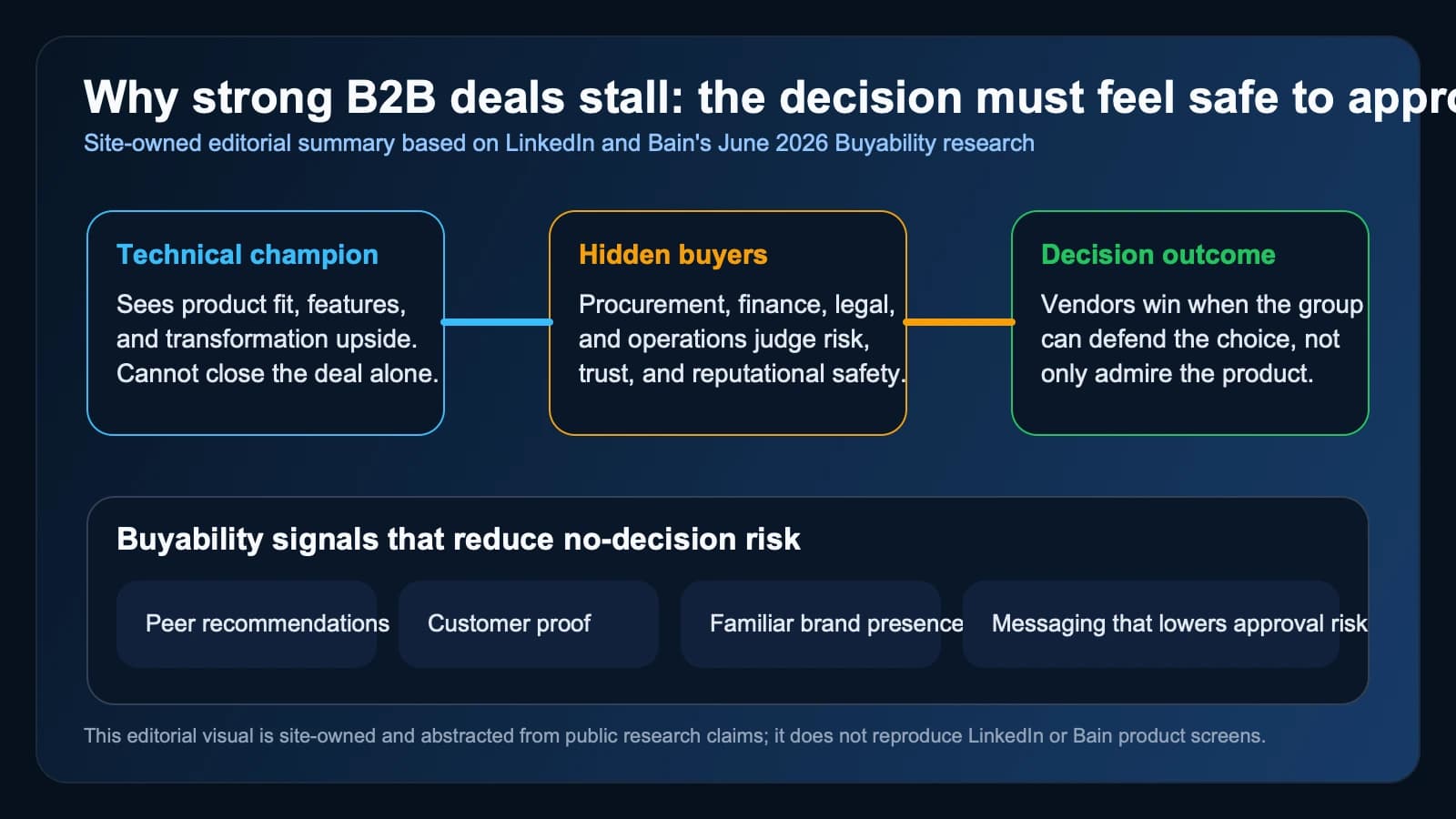
LinkedIn and Bain are making a sharper claim about why B2B pipeline stalls. In LinkedIn's official June 11, 2026 “Principles of Buyability” post, the companies argue that buying groups are not only comparing features, price, or product fit. They are judging whether a decision will feel defensible inside the room where finance, legal, procurement, operations, and the technical champion all have to align. LinkedIn's follow-up published on June 15, 2026 makes the emotional logic explicit: B2B buyers optimize for defensibility when shared accountability is high.
That matters for growth teams in the United States, Canada, the United Kingdom, Australia, and Europe because many current demand programs are still built as if winning one champion is enough. LinkedIn's own B2B Institute says it is not. In The Hidden Buyer Gap, a LinkedIn Business resource drawing on the same Bain-linked research, the company says “Hidden Buyers” from procurement, finance, legal, and operations can veto around half of shortlisted vendors. That turns this into an operating-model story, not just a messaging story.
What changed
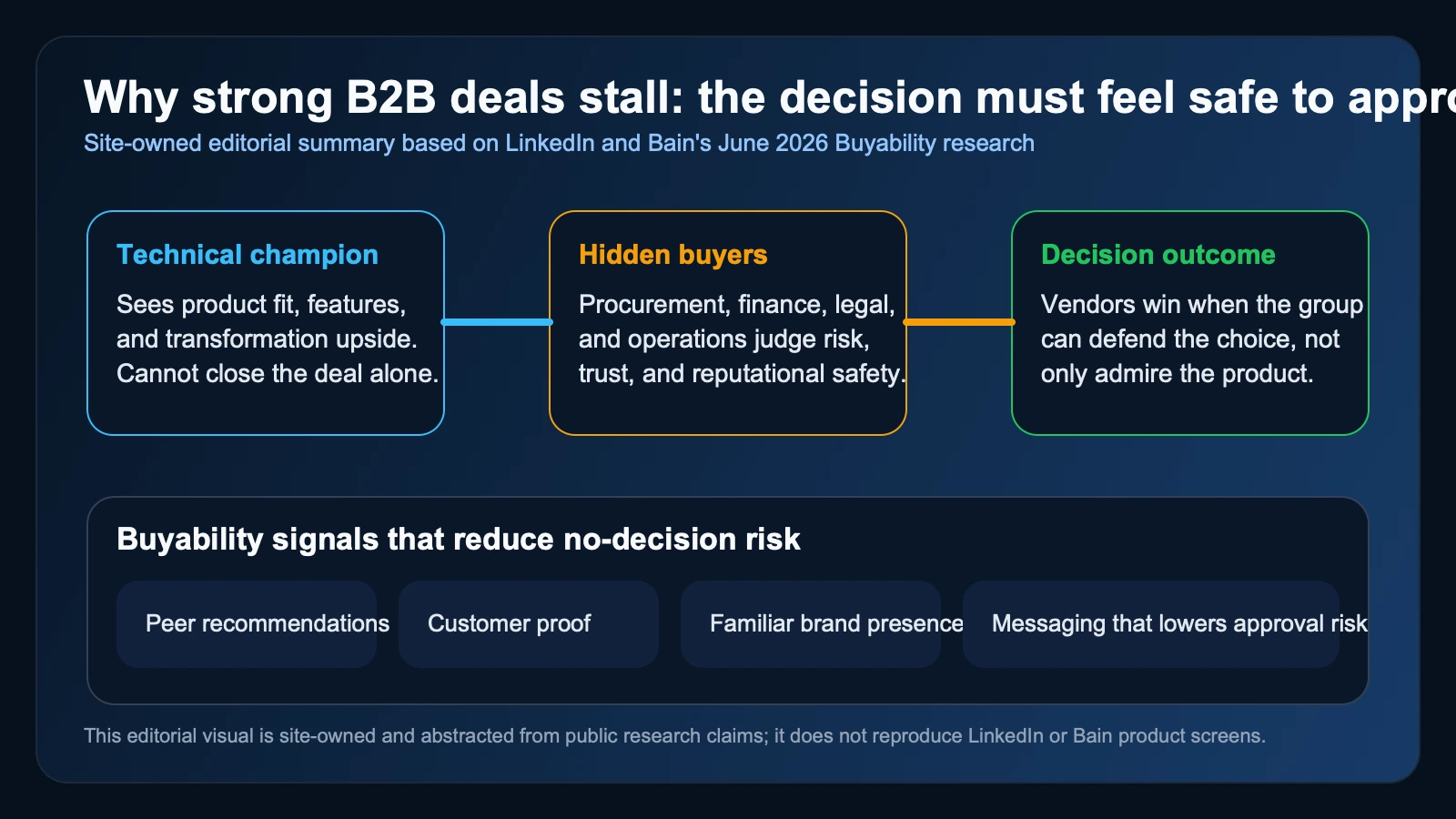
The June 11 research reframes the decision problem. LinkedIn says Buyability is about whether a brand builds enough confidence across the full buying group to become the choice people can justify internally, not just the choice that looks best on a feature matrix. The June 15 follow-up goes further and says buyers often act from “Fear of Messing Up,” or FOMU, when decisions are complex and shared.
| Confirmed June 2026 point | Official source | Why operators should care |
|---|---|---|
| LinkedIn and Bain say buyers are buying a decision they can defend, not only a solution they admire. | LinkedIn Marketing Blog, June 11, 2026 | Product superiority alone is a weaker closing argument than many teams assume. |
| LinkedIn says 40% of deals stall because the buyer group cannot agree. | LinkedIn Marketing Blog, June 11, 2026 | No-decision risk should be treated as a core funnel problem, not an edge case. |
| LinkedIn says 81% of purchases went to vendors that almost everyone in the buying group already knew. | LinkedIn Marketing Blog, June 11, 2026 | Awareness across non-champion stakeholders is commercially meaningful, not vanity. |
| The June 15 follow-up says buyers optimize for defensibility under shared accountability and cites 40-60% no-decision rates. | LinkedIn Marketing Blog, June 15, 2026 | Teams need proof, reassurance, and consensus support earlier in the journey. |
| LinkedIn's B2B Institute says hidden buyers from procurement, finance, legal, and operations can veto around half of shortlisted vendors. | LinkedIn Business, The Hidden Buyer Gap | Demand programs aimed only at visible product evaluators can leak value late in the deal. |
The useful shift is not theoretical. LinkedIn's June 11 article says vendors are 20 times more likely to be chosen when the entire buyer group already knows and trusts the brand at the start of the process, compared with cases where only the recommending function knows it. That turns brand familiarity, customer proof, and peer validation into revenue-protection assets.
Why it matters
This research changes how marketers should read late-stage deal behavior. If the buying group is trying to avoid a decision that becomes politically hard to defend, then the usual “more product detail” response is incomplete. Technical depth still matters, but it is not enough when the blocker is consensus.
That has implications for brand visibility work, not only for sales enablement. Teams that want to reduce no-decision outcomes need recognizable proof across more surfaces: customer stories that feel close to the buyer's situation, references from peers, category presence that reaches non-expert stakeholders, and messaging that lowers perceived career risk. That is why this story connects naturally to Slogan.website's GEO Visibility Checklist, the brand mentions measurement guide, the Marketing ROI Calculator, and the Digital Marketing Budget Planner. If buying groups choose what feels easier to approve, then share of voice, trust signals, and measurable proof are part of pipeline creation.
The regional angle also matters. U.S.-led enterprise buying patterns often set the commercial rhythm for multinational teams across Canada, the U.K., Europe, and Australia. Even when procurement structures vary, committee buying, compliance review, and budget sign-off remain common. LinkedIn's research is not saying every B2B deal works the same way. It is saying the final approval dynamic often has more to do with trust and group safety than marketers admit.
Who is affected
The first group is enterprise and upper-midmarket B2B teams selling software, services, data, or infrastructure into committee-led accounts.
The second group is agencies and consultants running ABM, paid social, category education, or executive-thought-leadership programs for clients with long sales cycles.
The third group is RevOps and sales-enablement teams that currently measure engagement and meetings but do not yet have clear visibility into where hidden buyers appear, stall, or veto.
What to do next
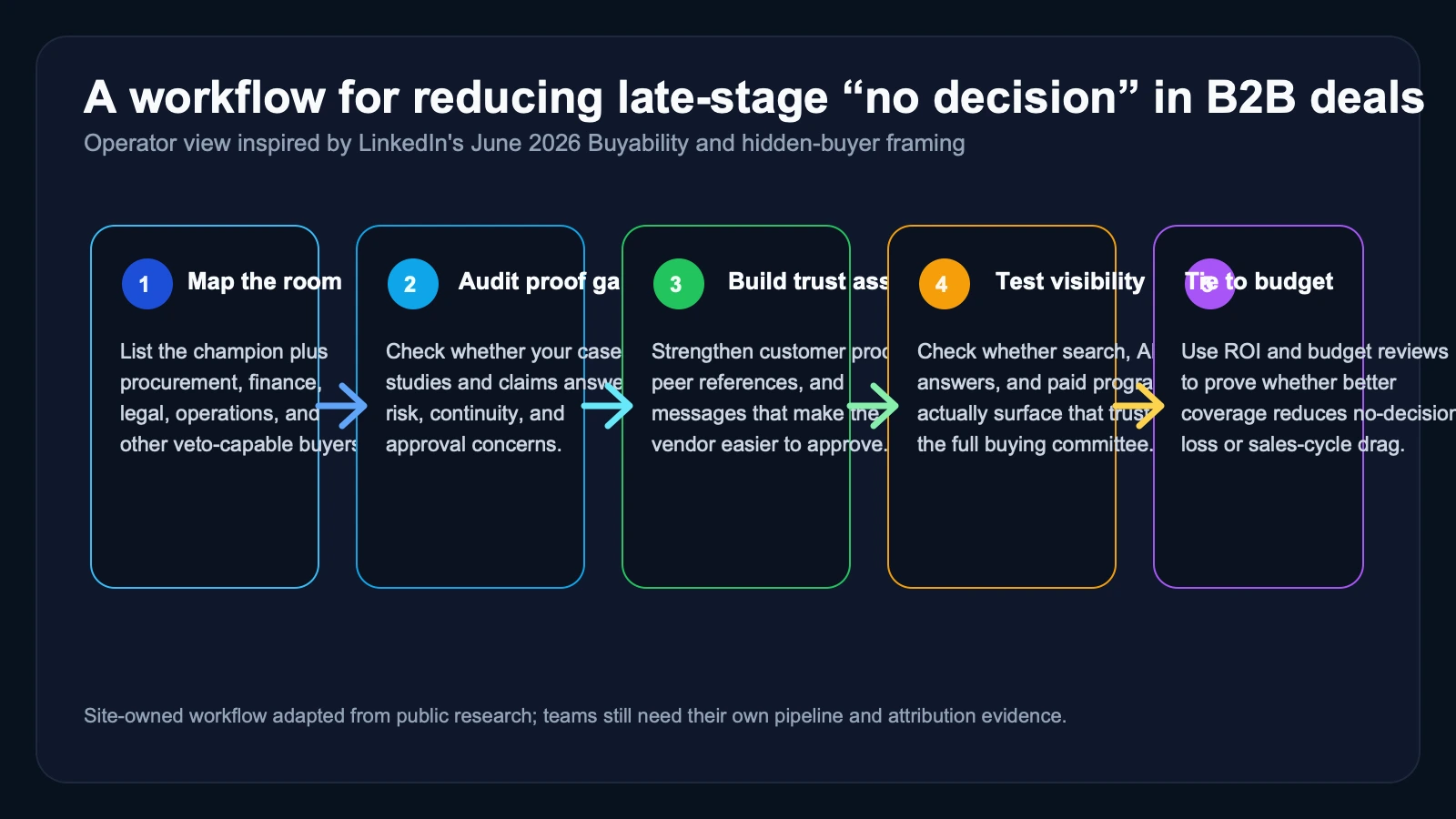
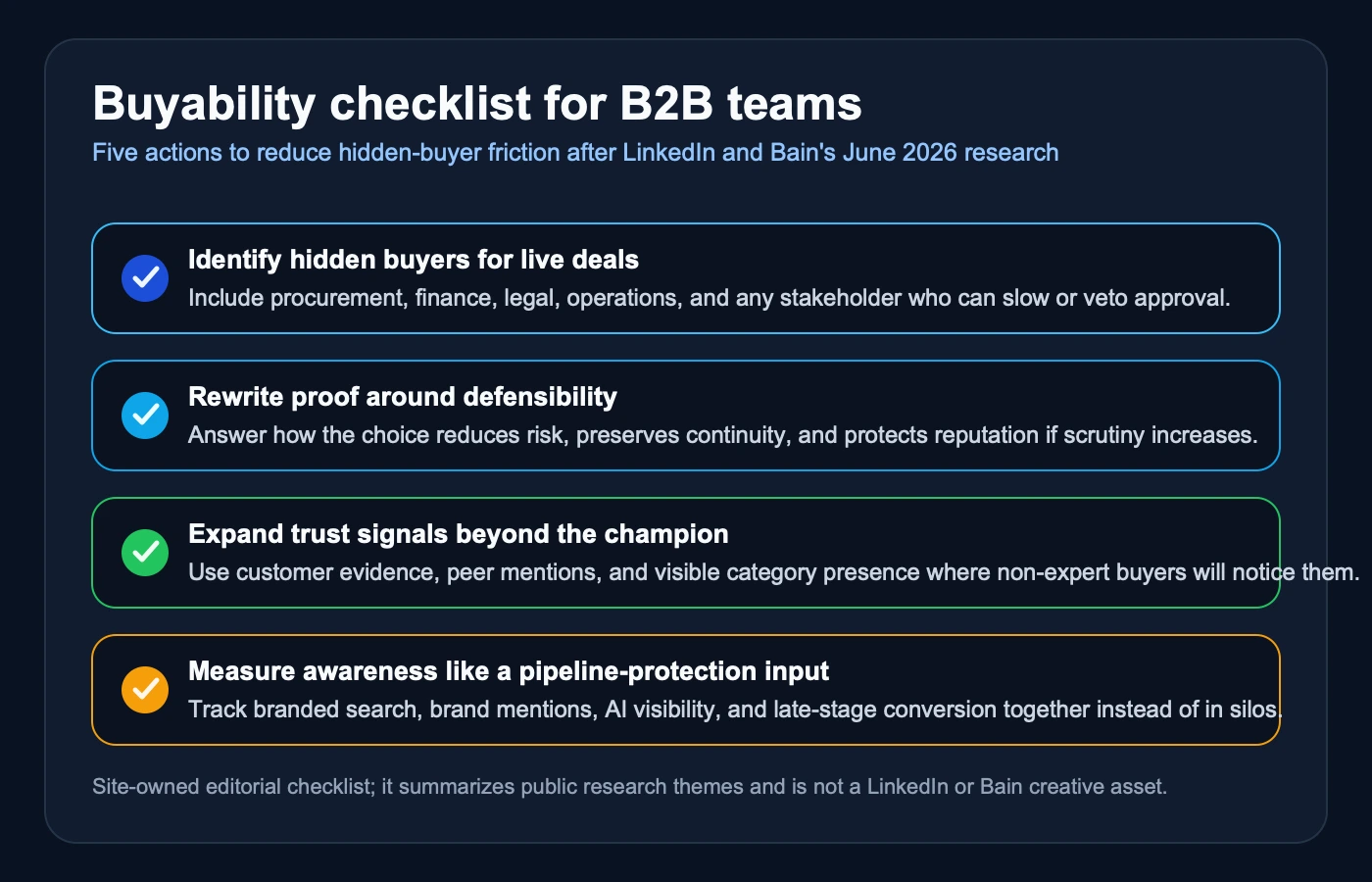
- Map the visible and hidden buyers in your top deals, especially procurement, finance, legal, security, and operations stakeholders who appear late.
- Audit your proof assets. If most customer evidence only speaks to technical champions, create versions that answer risk, continuity, compliance, and reputation concerns.
- Track mention quality and trust coverage across search, AI answers, analyst-style summaries, and peer-facing channels using the brand mentions guide.
- Pressure-test paid and content budgets with the Marketing ROI Calculator and Digital Marketing Budget Planner so awareness work is tied to deal protection, not just top-of-funnel volume.
- Rework campaign messaging to answer a practical question: “Will this feel safe and defensible to approve if the room gets harder?”
What remains uncertain
There are still limits on June 15, 2026. LinkedIn's public posts do not disclose the full research methodology on the June 11 page itself, and the follow-up article leans partly on a book citation when discussing 40-60% no-decision rates. The public materials also do not quantify how much investment should shift from champion-focused demand generation toward broader trust-building across hidden buyers.
So the disciplined read is narrower than the headline hype: LinkedIn and Bain have surfaced a real late-stage decision pattern, and LinkedIn's own B2B Institute materials reinforce it. But every team still has to validate the effect in its own funnel by tracking committee coverage, peer proof, budget logic, and whether improved visibility actually reduces no-decision loss.