LinkedIn says AI is reshaping the C-suite as leaders confront a workforce blind spot
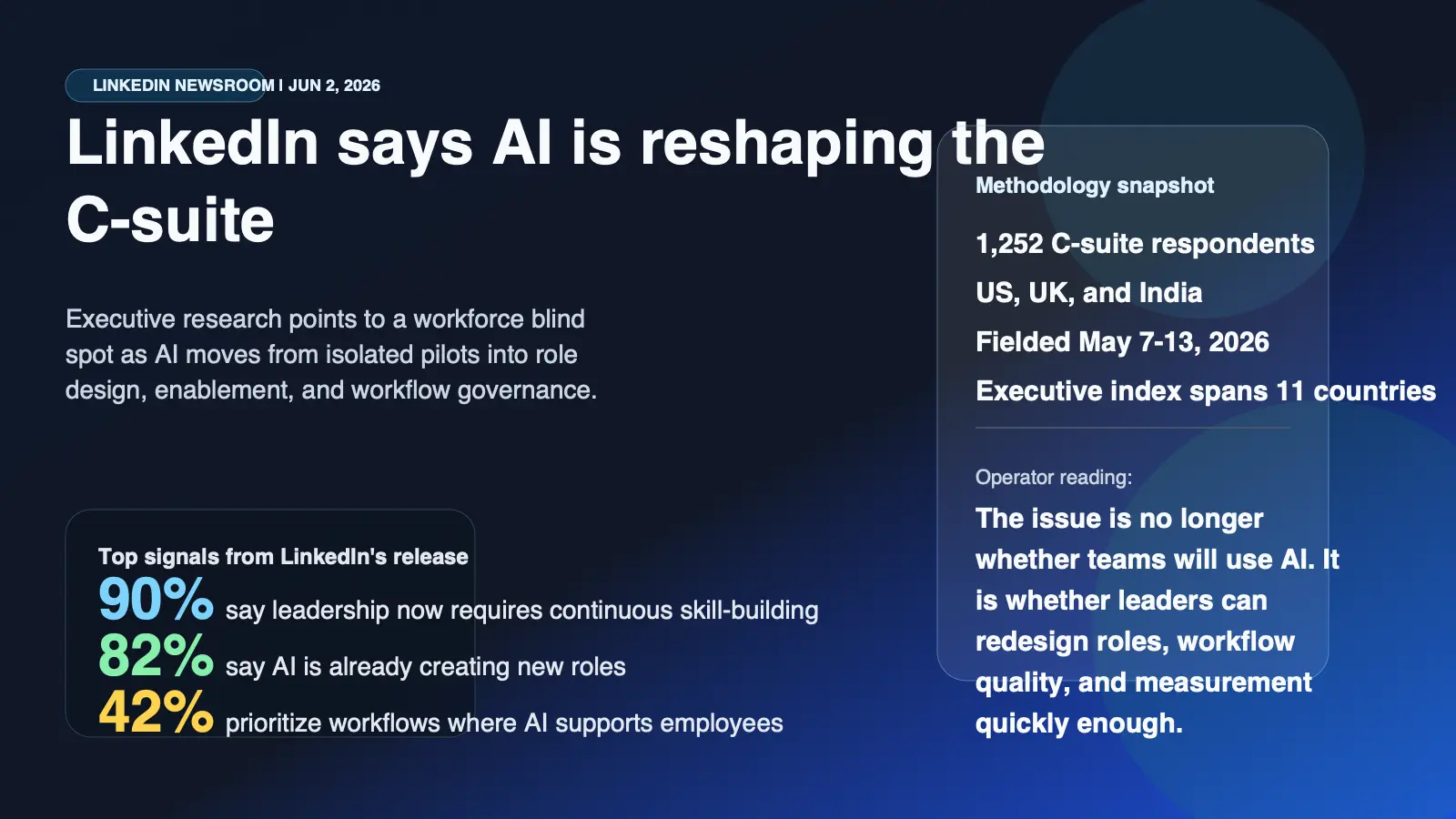
LinkedIn said on June 2, 2026 that AI is changing leadership operating models, not just software stacks. In a new C-suite research release, the company said 90% of leaders now see continuous skill-building as necessary, 82% say AI is already creating new roles, and 42% are prioritizing workflows where AI supports employees. For CMOs, heads of digital, RevOps leaders, agency principals, and growth operators, the practical shift is clear: AI strategy is moving out of the experimentation lane and into org design, hiring, enablement, and workflow governance.
This is not a generic "AI is important" headline. LinkedIn's methodology says the June 2 release draws on a survey of 1,252 C-suite leaders across the United States, United Kingdom, and India, fielded between May 7 and May 13, 2026, while its Executive Confidence Index draws on 5,000+ VP-level and above respondents across 11 countries including the U.S., Canada, UK, Australia, Germany, France, Italy, Spain, the Netherlands, India, and Brazil. That makes the update especially relevant for the high-value English-speaking markets Slogan.website targets, because the signal is already tied to the labor, skills, and measurement questions those teams are dealing with now.
What changed
The June 2 LinkedIn release adds five practical signals that matter more than the headline:
| Confirmed signal | Official source | Why operators should care |
|---|---|---|
| 90% of C-suite leaders say their roles now require continuous skill-building. | LinkedIn newsroom, June 2, 2026 | AI readiness is becoming a leadership operating requirement, not a side training program. |
| 82% say AI is creating roles that did not exist a few years ago. | LinkedIn newsroom, June 2, 2026 | Hiring plans need new role definitions, not just upgraded job descriptions. |
| Half of leaders say they lack visibility into the roles and skills they will need. | LinkedIn newsroom, June 2, 2026 | This "workforce blind spot" can slow execution even when AI budgets are approved. |
| 42% say optimizing workflows where AI supports employees is critical. | LinkedIn newsroom, June 2, 2026 | The priority is shifting from buying tools to redesigning how work actually moves. |
| LinkedIn said on April 29, 2025 that 3x more C-suite executives were adding AI literacy skills to profiles than two years earlier. | LinkedIn newsroom, April 29, 2025 | The new research looks like a continuation of an already visible leadership upskilling trend, not a one-off survey blip. |
The most important change is the framing. LinkedIn is no longer treating AI leadership as a matter of personal enthusiasm or isolated automation wins. In the June 2 post, the company says leaders are balancing a weaker global hiring market, macro pressure, and faster AI adoption at the same time. That means the real constraint is not only tooling. It is decision quality around roles, workflow design, and cross-functional alignment between technology and people teams.
Why it matters
For marketing and digital leaders, the June 2 release is useful because it reframes AI strategy around operational leverage instead of slide-deck ambition. Many teams already have access to writing assistants, media tools, analytics copilots, and AI-enabled SaaS features. The bottleneck is that the underlying workflow often stays unchanged. Content approval chains remain slow. Brand-mention monitoring is fragmented. Search and GEO learnings do not consistently flow into editorial plans. Paid-media teams test AI features without a shared measurement model.
LinkedIn's data suggests leaders are starting to recognize that gap. If 85% say innovation is the main outcome they want from AI investments and 78% say they are moving faster on AI than they can effectively measure, the operating risk is not under-adoption alone. It is adopting faster than the organization can redesign roles, governance, and attribution. That is exactly where practical planning matters more than vendor hype.
This is also why the update matters across the U.S., Canada, UK, Australia, and Europe even though the top-line C-suite survey was fielded in the U.S., UK, and India. LinkedIn's broader executive index spans those other markets, and the same org questions apply everywhere: who owns AI workflow quality, how skills are audited, what must stay human-reviewed, and how gains are measured beyond output volume.
Who is affected
The first group is executive marketing leadership. CMOs and heads of growth are now being pulled into workforce design questions that used to sit mostly with HR or IT. If campaign planning, SEO, brand monitoring, and sales enablement all gain AI layers, marketing leadership has to define where human judgment still creates the moat.
The second group is digital operations and RevOps teams. They often end up stitching together the actual workflow changes: prompt libraries, approval logic, analytics handoffs, source-of-truth documents, and reporting definitions. LinkedIn's "workforce blind spot" language is a warning that ad hoc tooling will not scale cleanly without that backbone.
The third group is agencies and service firms selling AI transformation, content production, or demand-gen execution. Buyers are moving past "do you use AI?" and toward "can you help redesign the workflow, the team, and the measurement system?" That is a harder but more durable service proposition.
What to do next
Treat LinkedIn's June 2 research as an execution prompt:
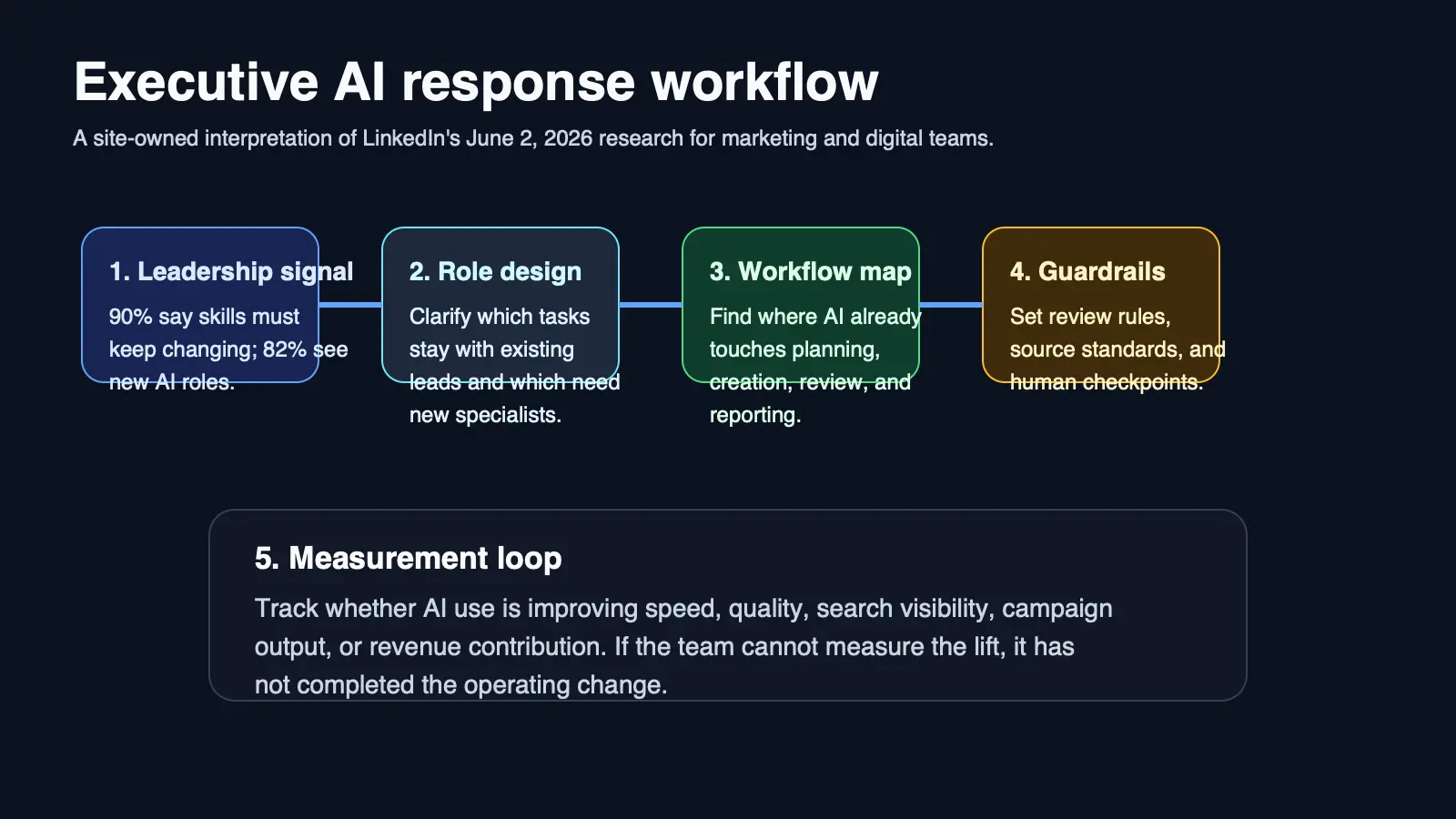
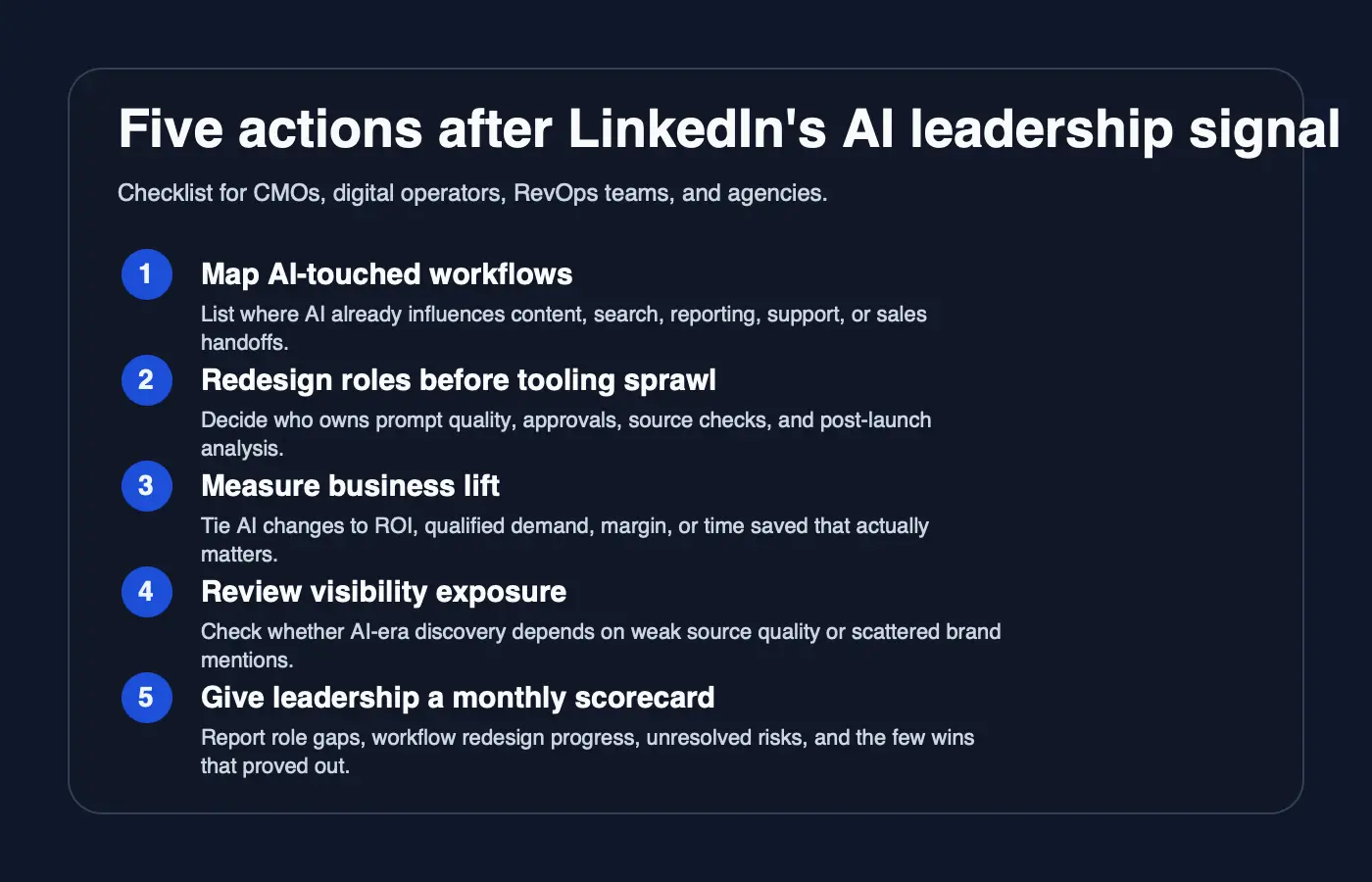
- Map the workflows where AI is already touching marketing, search, content, reporting, or customer communication, then mark which steps still require human review.
- Audit role design before buying more software. If AI is creating new responsibilities, decide whether they belong to existing leads or to newly defined specialist roles.
- Build one measurement model for AI-assisted work. Use the Marketing ROI Calculator and Digital Marketing Budget Planner to separate productivity claims from revenue, pipeline, or margin impact.
- Review whether your source-quality and brand-visibility process is strong enough for AI-era discovery. The GEO Visibility Checklist, generative engine optimization guide, and brand mentions measurement guide are useful starting points.
- Give leadership a short monthly scorecard: role changes needed, workflows redesigned, risks still unmeasured, and the few AI use cases that actually produced business lift.
What remains uncertain
Several limits still matter as of June 5, 2026. LinkedIn's top-line C-suite survey is not a census of every market or industry, and the company has not published a detailed breakdown by company size, revenue band, or marketing maturity. The public release also does not show which kinds of workflow redesigns are actually producing the best returns, only that leaders increasingly see the need.
There is also a sequencing problem. LinkedIn's data shows leaders feel urgency, but urgency can lead to shallow deployment if the team has not agreed on role boundaries, quality controls, or measurement standards. That makes the "workforce blind spot" more than a phrase. It is a practical warning that AI transformation can stall when responsibilities become fuzzy.
The useful takeaway is not that every company needs a new AI org chart tomorrow. It is that leadership teams should stop treating AI as a software line item alone. LinkedIn's newest research points to a more demanding reality: the winners will likely be the teams that pair tooling with explicit skill-building, workflow redesign, and evidence-based measurement.