LinkedIn turns B2B creator partnerships into a campaign workflow with Creator Marketplace and BrandWorks
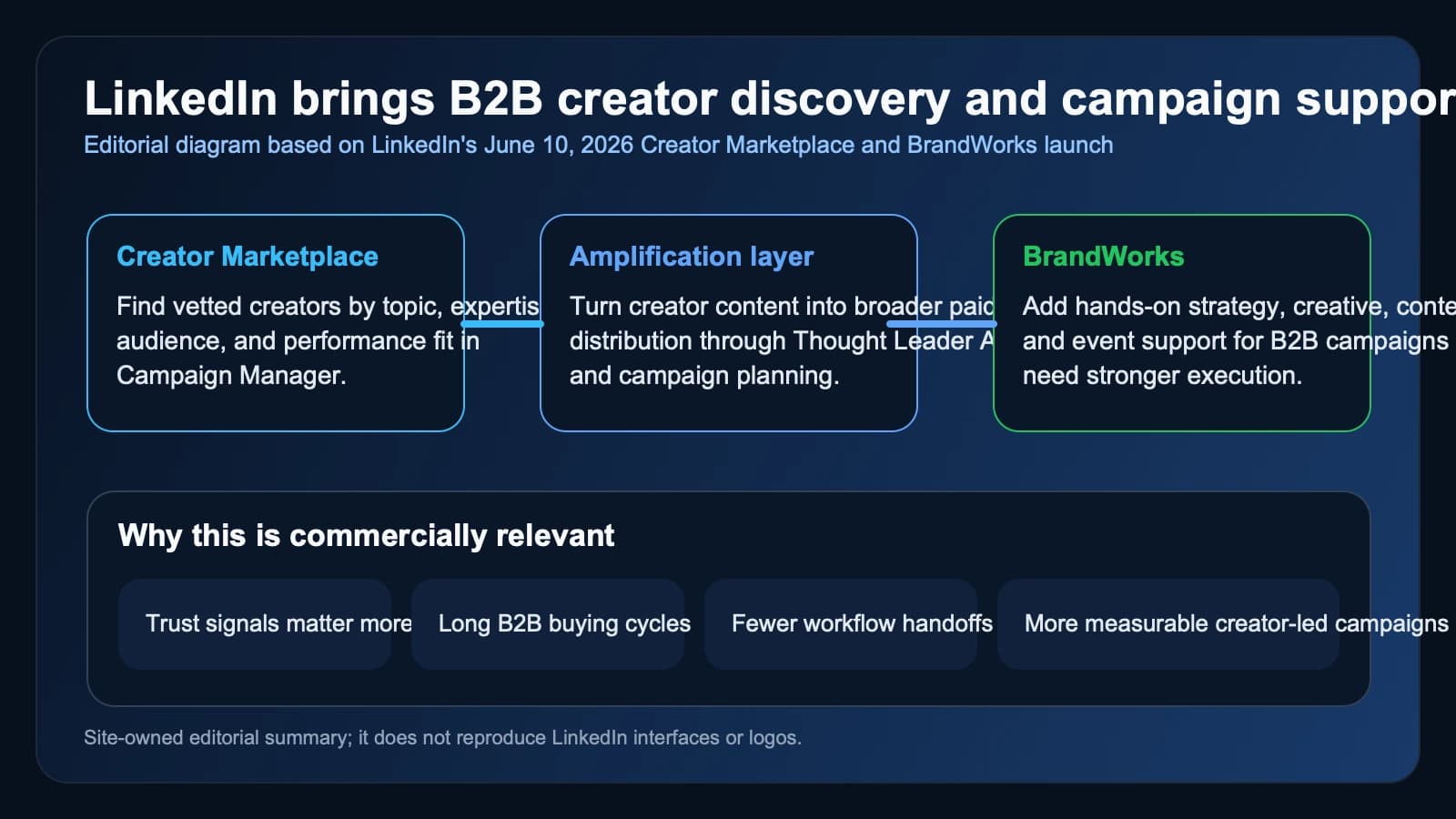
LinkedIn said on June 10, 2026 that it is launching Creator Marketplace and BrandWorks for B2B marketers. That sounds like a brand-marketing story, but the more practical read is operational: LinkedIn is trying to turn creator discovery, expert-led distribution, and campaign creative support into one workflow inside its own ad stack. For growth teams targeting the United States, Canada, the United Kingdom, Australia, and Europe, the news matters because trusted voices and buyer education increasingly sit between the first impression and the sales conversation.
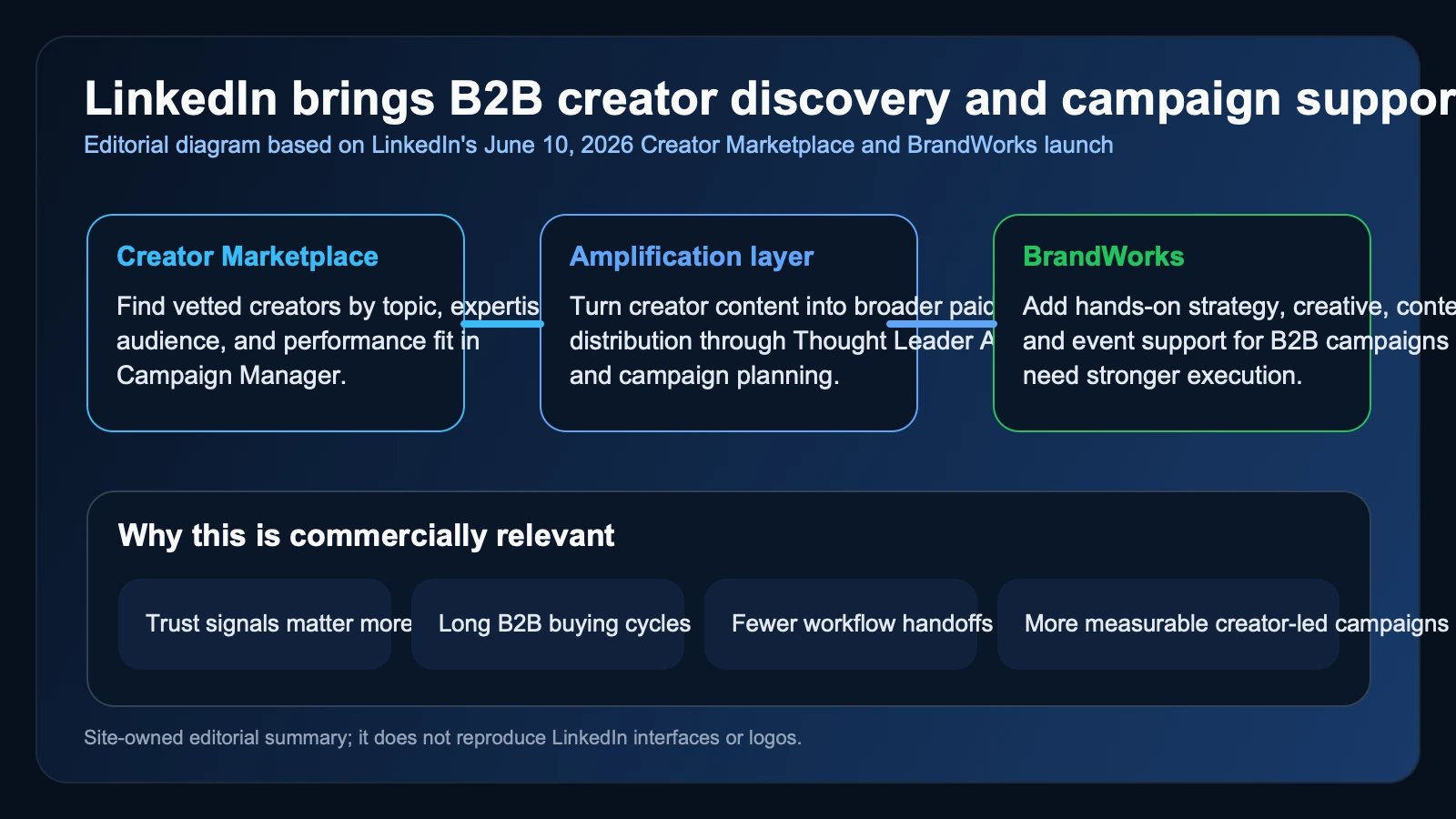
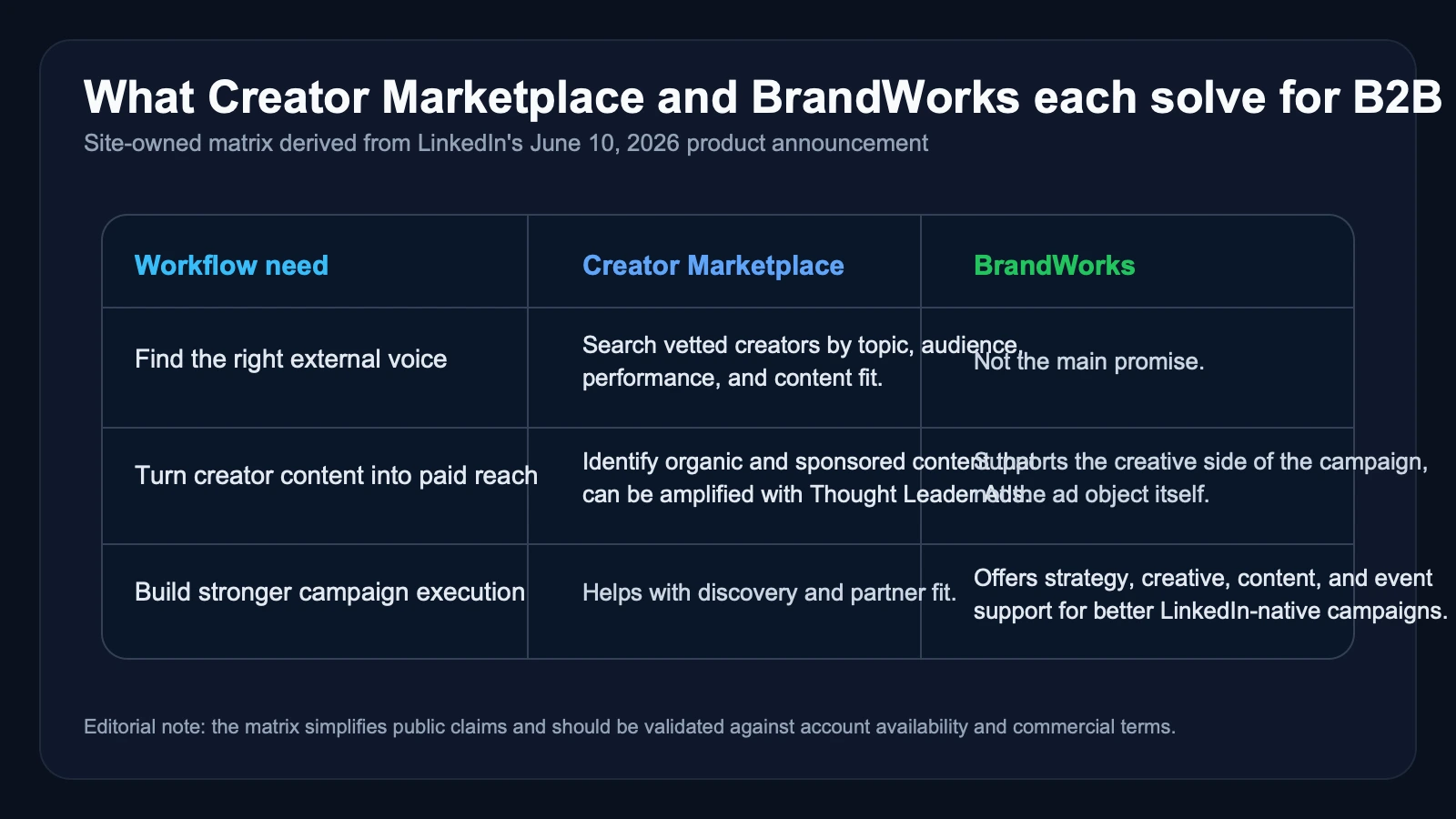
The official announcement is unusually clear about the job to be done. LinkedIn says Creator Marketplace is available within Campaign Manager, where brands can search for vetted creators by topic and expertise, assess audience and performance fit, and identify creator posts that can be amplified through Thought Leader Ads. The same June 10 post says BrandWorks is a new hands-on team spanning strategy, creative, content, and events, built to help marketers create higher-performing LinkedIn campaigns. That is less "creator economy" hype and more an attempt to reduce the handoff problem between brand planning, content production, and paid distribution.
What changed
LinkedIn's June 10 announcement lays out two new products and the logic behind them. The first is Creator Marketplace, which centralizes creator discovery, insights, and partnership tools inside Campaign Manager. The second is BrandWorks, which LinkedIn describes as a service layer to help brands and agencies turn audience insight into stronger campaign creative and custom activations.
The announcement also gives useful evidence about why LinkedIn thinks this timing works. In the same post, the company says 82% of B2B marketers believe creators increase credibility with decision-makers, 83% say credibility matters more than traditional brand messaging, and 56% of B2B buyers rely on creator input late in the buying process to validate recommendations. LinkedIn attributes those figures to its 2026 Global B2B Marketing Outlook, fielded by YouGov across the USA, UK, France, Germany, and India between January 14 and February 5, 2026.
| Confirmed June 10 detail | Official source | Why it matters |
|---|---|---|
| Creator Marketplace is available within Campaign Manager. | LinkedIn newsroom, June 10, 2026 | Creator partnerships move closer to existing paid-media planning instead of living in separate spreadsheets and inboxes. |
| Brands can search for vetted creators by topic, audience, performance, and fit. | LinkedIn newsroom, June 10, 2026 | B2B teams get a more inspectable discovery path than generic influencer marketplaces. |
| Organic and sponsored creator content can be amplified with Thought Leader Ads. | LinkedIn newsroom, June 10, 2026 | Trusted creator voice can be extended through paid distribution instead of remaining one-off organic reach. |
| BrandWorks is a new team covering brand, creative, content, and events support. | LinkedIn newsroom, June 10, 2026 | LinkedIn is packaging media plus creative services together for B2B campaigns that need more than ad placement. |
| The 2026 Global B2B Marketing Outlook surveyed 1,299 marketers across five countries. | LinkedIn newsroom methodology | The buyer-trust framing comes from LinkedIn-backed research, not only a loose product narrative. |
LinkedIn also ties the launch back to earlier creator moves, explicitly naming BrandLink, Top Voices 360, and Advice Sessions. That sequence matters because it shows the company is no longer testing isolated creator features. It is assembling a more complete B2B creator-commercial layer.
Why it matters
For most B2B teams, the hard part of creator marketing is not believing that experts influence buyers. The hard part is finding credible voices, getting legal and brand approval, building usable creative, and connecting those partnerships to measurable pipeline. LinkedIn is trying to compress that process by keeping more of it inside surfaces marketers already use.
That makes this relevant beyond classic influencer campaigns. Software companies, agencies, fintechs, enterprise SaaS brands, and consulting firms often sell to committees, not impulse buyers. In that environment, expert credibility and distribution quality matter as much as raw reach. If Creator Marketplace helps a team identify a trusted niche operator and BrandWorks helps shape better LinkedIn-native creative around that voice, the value is operational: fewer disconnected tools, fewer handoffs, and more controlled paid amplification.
This also fits the broader visibility problem that Slogan.website has been covering. Teams working on brand demand and answer-engine discovery need more third-party mentions, clearer expert signals, and content that travels across human and machine-mediated channels. That is why the brand mentions measurement guide, the GEO Visibility Checklist, and the Marketing ROI Calculator are relevant here. Creator programs should not be judged only on engagement; they need to be tied to branded search lift, qualified demand, and revenue logic.
Who is affected
The first group is in-house B2B marketing teams that already run LinkedIn media and need more credible top-of-funnel or mid-funnel content.
The second group is agencies managing executive thought leadership, creator partnerships, or demand generation for enterprise clients. A workflow that unifies creator selection and campaign amplification is more relevant to them than a consumer-style influencer directory.
The third group is creators and niche experts serving professional audiences. LinkedIn says creators can opt in, control how brands contact them, choose which work to feature, and approve how sponsored content is used. That makes this a monetization and governance update for experts, not just for advertisers.
What to do next
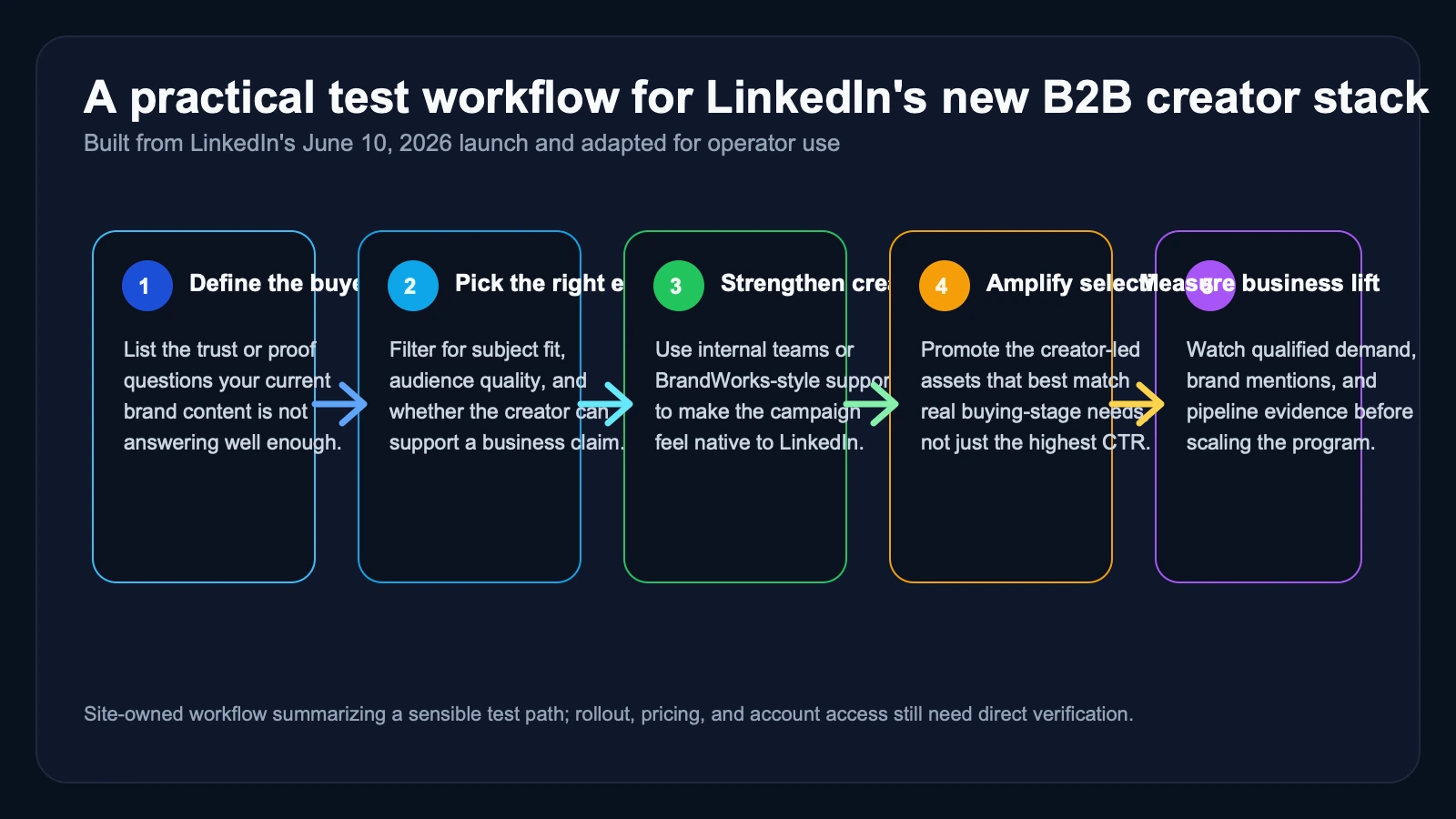
- List the buying-stage questions where your current brand content lacks credible third-party voices, especially in categories with long evaluation cycles.
- Define what makes a creator or expert usable for your brand: audience fit, subject authority, regional relevance, compliance comfort, and whether their content can stand up as a paid asset.
- Separate creator discovery from performance proof. Use the Marketing ROI Calculator and Digital Marketing Budget Planner before expanding spend.
- Build a measurement view that tracks branded search, assisted conversions, qualified meetings, and mention quality alongside post-level engagement.
- Review whether your current campaign creative is strong enough to benefit from expert amplification, because LinkedIn's BrandWorks launch implies creative quality is still a bottleneck.
What remains uncertain
Important gaps remain on June 10, 2026. LinkedIn's public post does not spell out full geographic rollout details for Creator Marketplace or BrandWorks, does not publish pricing, and does not show exactly how creator vetting is standardized across industries. It also does not quantify whether creator-led Thought Leader Ads outperform equivalent brand-produced creative on cost per opportunity or influenced pipeline.
There is also a governance question. LinkedIn says creators stay in control of contact preferences and sponsored-content use, but the public materials do not yet show how complex approval chains, multi-market compliance, or enterprise procurement will work at scale. So the defensible conclusion is narrower than the hype: LinkedIn has created a more structured B2B creator workflow, but serious teams still need their own standards for fit, disclosure, measurement, and business impact.