LinkedIn brings Amazon DSP into its CTV buying path for B2B marketers
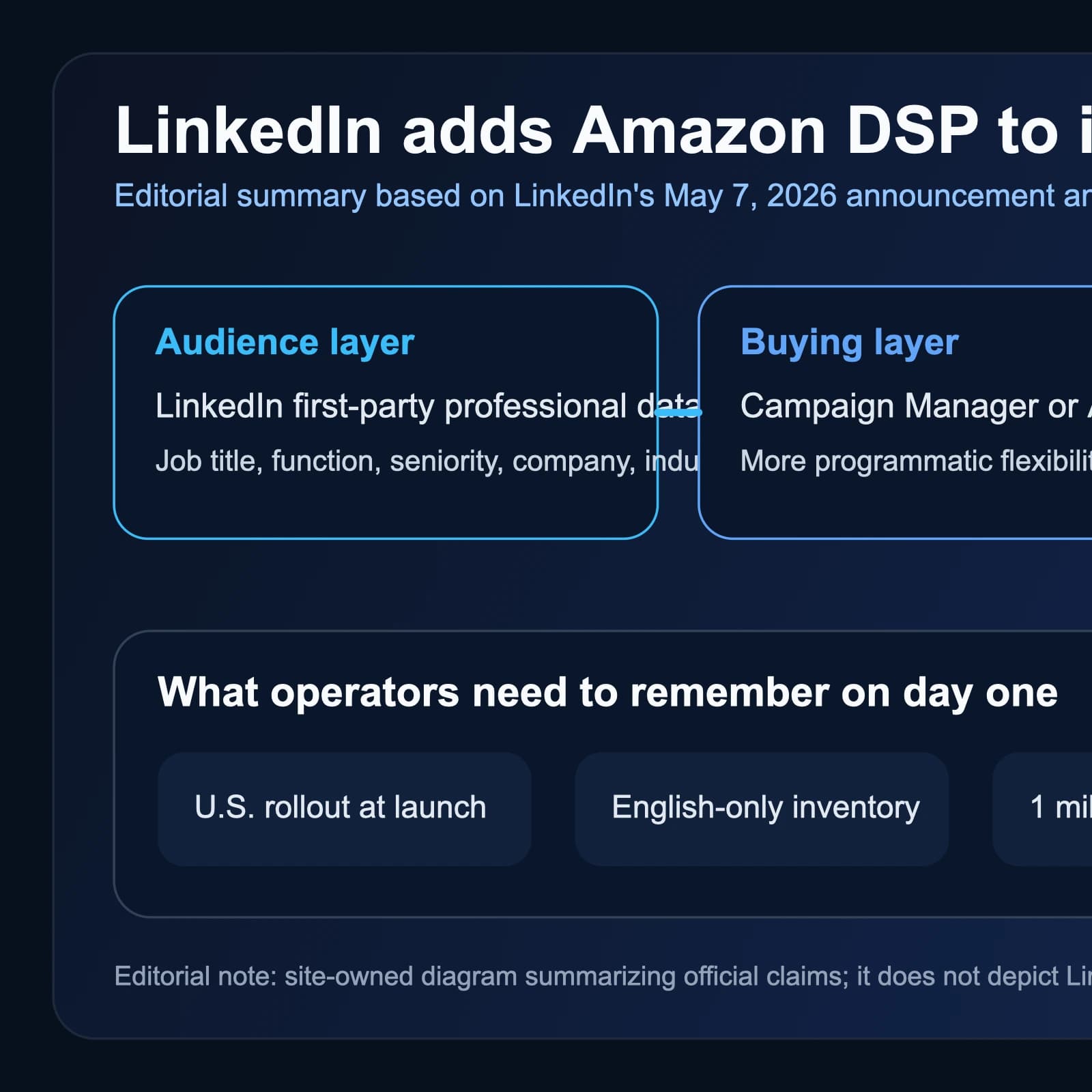
LinkedIn said on May 7, 2026 that advertisers can now buy LinkedIn Connected TV Ads through Amazon DSP, expanding a format that had previously relied on direct buying and, more recently, The Trade Desk access announced on March 18, 2026. For B2B marketing teams, agencies, and demand-generation operators, the practical change is straightforward: LinkedIn's professional audience data can now be activated inside another major programmatic buying stack instead of living only inside a narrower insertion-order path.
This matters because Connected TV has become more important for high-value B2B awareness and account-based reach, but the workflow has often been messy. Teams have had to balance audience quality, buying flexibility, streaming inventory access, and measurement rigor across separate systems. LinkedIn is now trying to reduce that friction by letting marketers use Amazon DSP while still leaning on LinkedIn's professional targeting signals.
What changed
LinkedIn's May 7 announcement says the company is expanding Connected TV Ads to Amazon DSP in the United States. The same post says advertisers can reach audiences built from LinkedIn's first-party professional data and deliver campaigns across premium streaming inventory, while Microsoft Monetize remains the supply-side path behind the scenes.
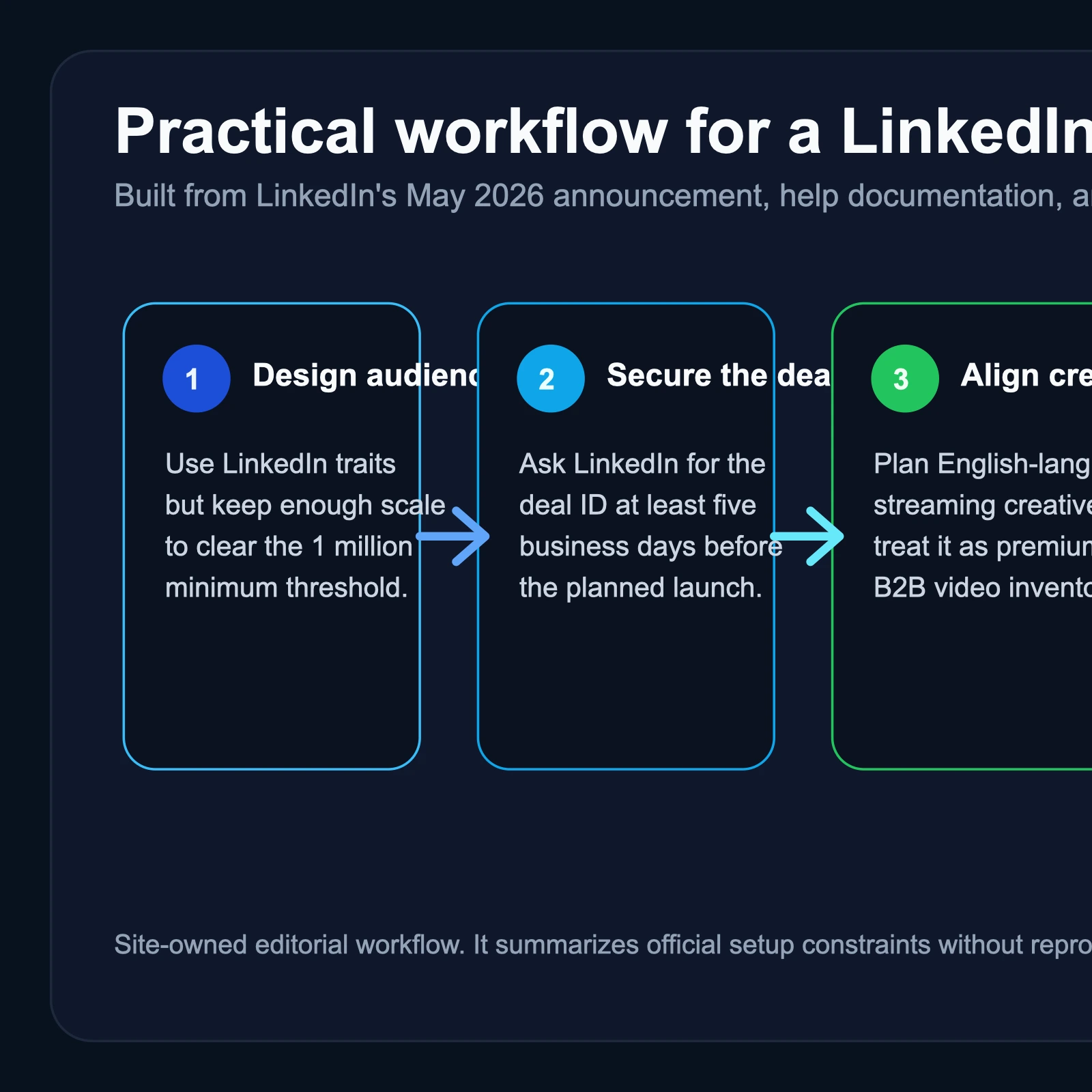
LinkedIn's help documentation adds several operating details. In its Connected TV Ads overview, LinkedIn says Campaign Manager buying is still available, but Amazon DSP access is part of the programmatic expansion. The help page also says CTV Ads are currently available in English only, require a minimum audience size of 1 million, and for DSP activations require advertisers to work through a deal ID created by the LinkedIn team at least five business days before launch.
The announcement also sits inside a broader spring video push. On March 18, 2026, LinkedIn said it had launched its first video advertising product for streaming platforms, with access through Campaign Manager and The Trade Desk. That earlier release also said brands such as Adobe, Comcast, HSBC, Intuit, and Samsung Ads were early testers, and that LinkedIn was positioning CTV as a professional-audience layer rather than a generic video add-on.
| Confirmed detail | Official source | Why it matters in practice |
|---|---|---|
| Amazon DSP access for LinkedIn CTV Ads was announced on May 7, 2026 | LinkedIn announcement | B2B media teams can now activate LinkedIn CTV through another major DSP instead of relying on one buying path. |
| The rollout is currently for the United States | LinkedIn announcement | Global teams in Canada, the UK, Australia, and Europe can plan, but should not assume immediate local availability. |
| CTV Ads remain available through Campaign Manager and also through programmatic access | LinkedIn help documentation | Operators can choose between direct workflow control and DSP-based execution depending on buying model. |
| LinkedIn requires a minimum audience of 1 million and at least five business days for deal-ID setup | LinkedIn help documentation | Account-based teams need to widen planning windows and audience design before launch. |
| The earlier March 18, 2026 launch added The Trade Desk access and positioned CTV as a B2B streaming format | LinkedIn launch post | The Amazon DSP move is an expansion of the buying model, not a brand-new product category. |
Why it matters
The core shift is workflow flexibility. Many B2B marketers already use LinkedIn for audience intelligence but buy connected TV somewhere else. Amazon DSP access means they can test whether professional audience filters improve business-outcome quality without rebuilding their entire media operation around one native ad console.
That is especially relevant for enterprise software, financial services, telecom, consulting, and higher-consideration B2B brands in the United States that care about job-function reach, company-size filters, and buying-group awareness more than raw impression volume. It also matters to agencies serving clients in the United Kingdom, Canada, Australia, and Europe because even if the current rollout is U.S.-only, the operational pattern is now visible: professional-data targeting is moving deeper into the programmatic TV stack.
The measurement angle is just as important. LinkedIn says in its help documentation that third-party verification through iSpot is currently tied to The Trade Desk workflow, not Amazon DSP. That means teams should avoid assuming identical verification paths across every buying option. Before shifting budget, they need to map which reporting source will be trusted for reach, completion rate, lift, or downstream conversion analysis.
This is where internal planning discipline matters more than platform excitement. If your brand is exploring broader discovery visibility, CTV should connect to a measurement model, not float as a brand line item with vague goals. Slogan.website's Marketing ROI Calculator, Digital Marketing Budget Planner, and guide to tracking brand mentions and visibility are useful for pressure-testing whether a premium B2B video test supports pipeline goals or just adds media cost.
Who is affected
The first group is B2B demand-generation and brand teams that already buy programmatic video and want better professional audience quality. The second is media agencies that manage enterprise accounts and need one more path to execute streaming tests without creating a separate operating model per platform.
Marketing operations and analytics teams are affected too. LinkedIn's audience threshold, deal-ID timing, English-language limitation, and U.S.-market scope all shape whether a test can launch cleanly. Teams running tight campaign calendars or narrower account lists may find that the targeting promise is real, but the setup constraints are just as real.
What to do next
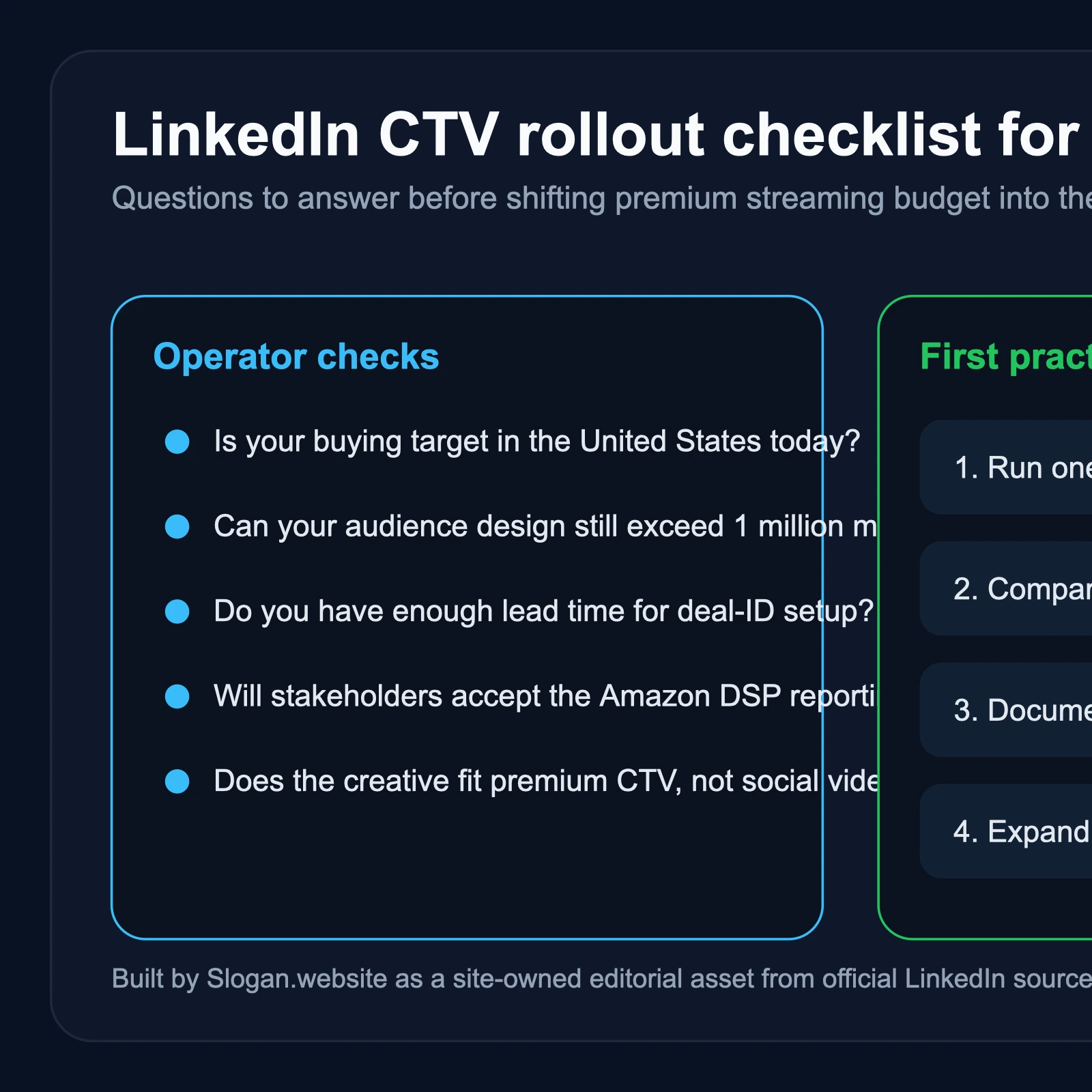
Use this launch checklist before moving real budget:
- Confirm whether your target market is U.S.-based and whether your creative plan fits English-only inventory for the current release.
- Validate that your audience can clear LinkedIn's 1 million minimum without turning the buy into a generic awareness blast.
- Ask early about deal-ID timing so campaign launch is not blocked by the five-business-day setup window.
- Decide whether Amazon DSP, Campaign Manager, or The Trade Desk gives you the reporting and verification path your stakeholders will trust.
- Forecast spend and expected pipeline contribution in the Digital Marketing Budget Planner, then model best-case and conservative returns in the Marketing ROI Calculator.
What remains uncertain
Several practical questions are still open in public materials as of June 2, 2026. LinkedIn has not announced a Canada, UK, Australia, or Europe rollout date for Amazon DSP access. It also has not published broad benchmark data showing how Amazon DSP execution compares with Campaign Manager or The Trade Desk for cost efficiency, verified reach, or downstream business outcomes.
There is also a targeting tradeoff that operators should keep in view. A 1 million minimum audience makes sense for streaming scale, but it may limit how narrowly some account-based programs can go. That does not make the launch less important. It just means LinkedIn's May 7, 2026 expansion should be read as a meaningful B2B media-planning change, not as proof that professional-data CTV is now infinitely flexible.
For marketers, the right next move is measured experimentation. Treat Amazon DSP access as a new route to test premium B2B streaming with clearer audience logic, then judge it on setup friction, measurement quality, and whether it moves real pipeline indicators rather than vanity reach.