Mailchimp adds Analytics AI to turn campaign reporting into conversational decision support
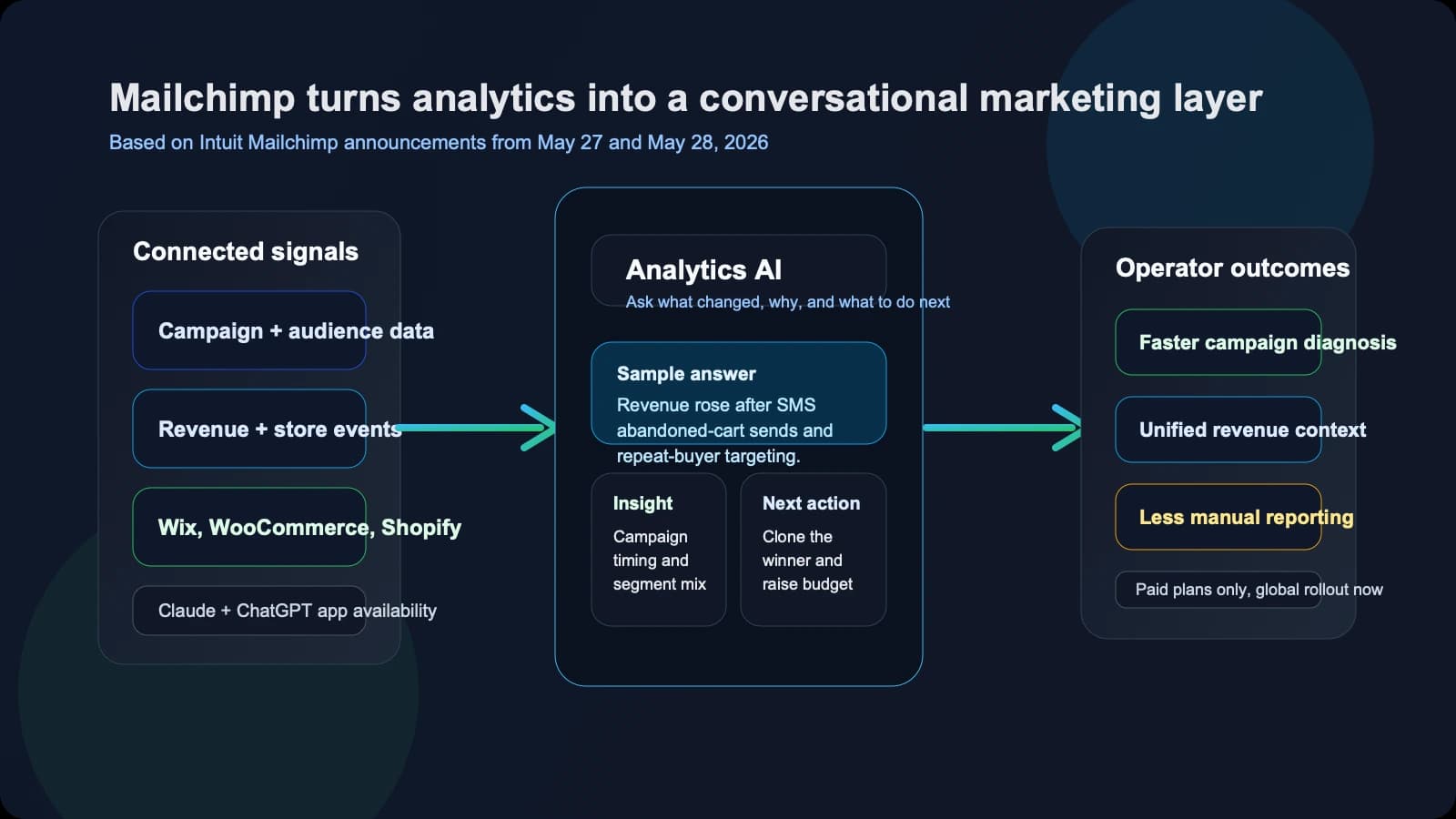
Intuit Mailchimp said on May 28, 2026 that it is launching Analytics AI, a native conversational analytics agent that connects campaign performance, audience behavior, and revenue outcomes inside Mailchimp. The practical shift is not just another AI assistant. Mailchimp is trying to compress the path from "what happened?" to "what should we do next?" for ecommerce brands and small or mid-sized marketing teams that are buried in dashboards, exports, and one-off reporting.
That timing matters because Mailchimp had already been moving toward a more connected ecommerce stack. In its February 10, 2026 product release, the company said it was adding more ecommerce triggers, a revamped omnichannel dashboard, expanded SMS coverage, and new store-data connections to improve ROI tracking. Analytics AI looks like the next layer on top of that foundation: less manual interpretation, more guided action.
What changed
Mailchimp's May 28 announcement and its official help documentation confirm several concrete points that operators should not miss.
| Confirmed point | Official source | Why it matters in practice |
|---|---|---|
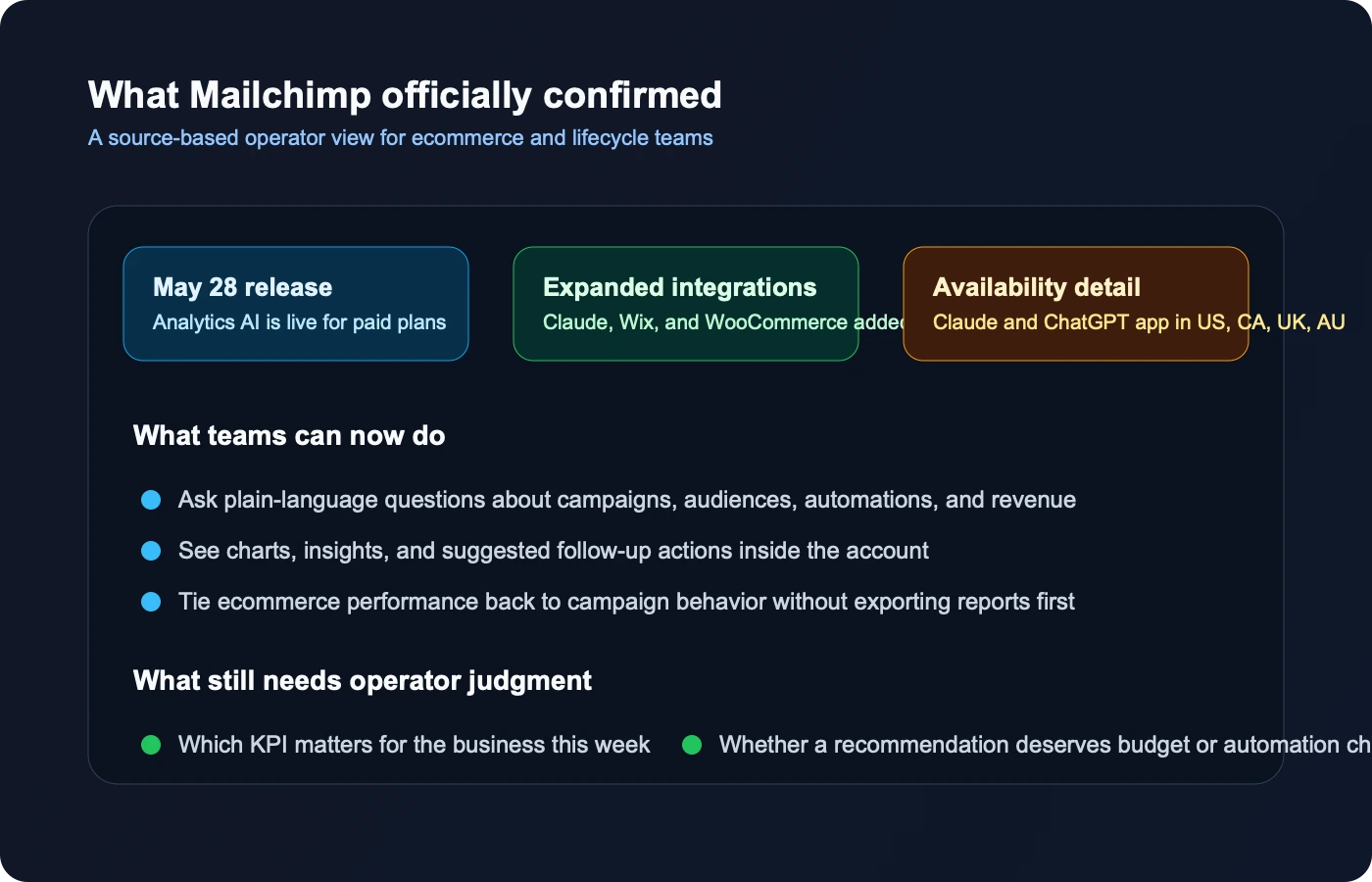
| Analytics AI is available now to Mailchimp customers on paid plans | Mailchimp May 28 release and Analytics AI help doc | This is a current workflow change, not a vague future roadmap item. |
| The agent answers plain-language questions across campaigns, automations, audiences, and revenue | Analytics AI help doc | Teams can diagnose performance without building custom reports first. |
| Mailchimp also expanded integrations with Claude, Wix, and WooCommerce | Mailchimp May 28 release | More of the business context can flow into the same marketing workspace. |
| The Mailchimp app is now available in Claude and ChatGPT for users in the United States, Canada, the United Kingdom, and Australia | Mailchimp May 28 release | English-speaking teams in major markets can connect AI assistants more directly to Mailchimp workflows. |
| Mailchimp says February's ecommerce release added 26% more ecommerce triggers and tools built around ROI visibility | Mailchimp February 10 release | Analytics AI sits on top of a broader push toward unified campaign and store intelligence. |
Mailchimp also published supporting research on May 27, 2026 that helps explain the launch. The company said 70% of business owners surveyed report "metric anxiety" when starting a marketing campaign, and that ecommerce businesses track even more performance metrics on average. That does not prove the new product will solve the problem by itself, but it does make Mailchimp's strategy clear: reduce analysis friction so marketers can move faster from signal to decision.
Why it matters
Many smaller ecommerce and lifecycle teams do not suffer from a lack of data. They suffer from too much disconnected data and not enough time to interpret it well. Mailchimp's own help article says the agent can surface trends, recommend next steps, and show charts from campaign and revenue data inside the account. If the feature works as described, the gain is operational clarity more than novelty.
That matters especially for teams running email, SMS, automations, and store promotions at the same time. A marketer does not only need open rates or click rates. They need to know whether a revenue jump came from segmentation, timing, abandoned-cart automation, product demand, or something else. Conversational analytics can shorten that loop, but only if the connected data is clean and the team still checks the reasoning before acting.
There is also a broader AI workflow signal here. Mailchimp says in the same May 28 release that Analytics AI is a step toward a more agentic experience where marketers describe a goal and the system helps plan, build, and learn from campaigns. That overlaps with the same operating discipline behind Slogan.website's tools hub, the GEO Visibility Checklist, the guide to tracking brand mentions and visibility, and the review of AI search analytics tools for marketing teams. If AI systems are moving closer to planning and interpretation, your underlying business facts and campaign structure matter more.
Who is affected
The teams most likely to benefit first are:
- ecommerce operators running recurring promotions, product launches, and retention automations;
- lifecycle marketers responsible for email, SMS, and audience segmentation in one stack;
- agencies or consultants who manage several SMB accounts and need faster, defensible diagnostics;
- founders and heads of growth who want answers tied to revenue instead of channel vanity metrics;
- operators in the United States, Canada, the United Kingdom, and Australia who can also use the new Mailchimp app availability in Claude and ChatGPT.
The feature matters less for accounts with weak data hygiene. Mailchimp's own documentation says the agent works best after a first campaign has been sent and that store connections improve ecommerce revenue insight. In other words, conversational output is only as useful as the account setup behind it.
What to do next
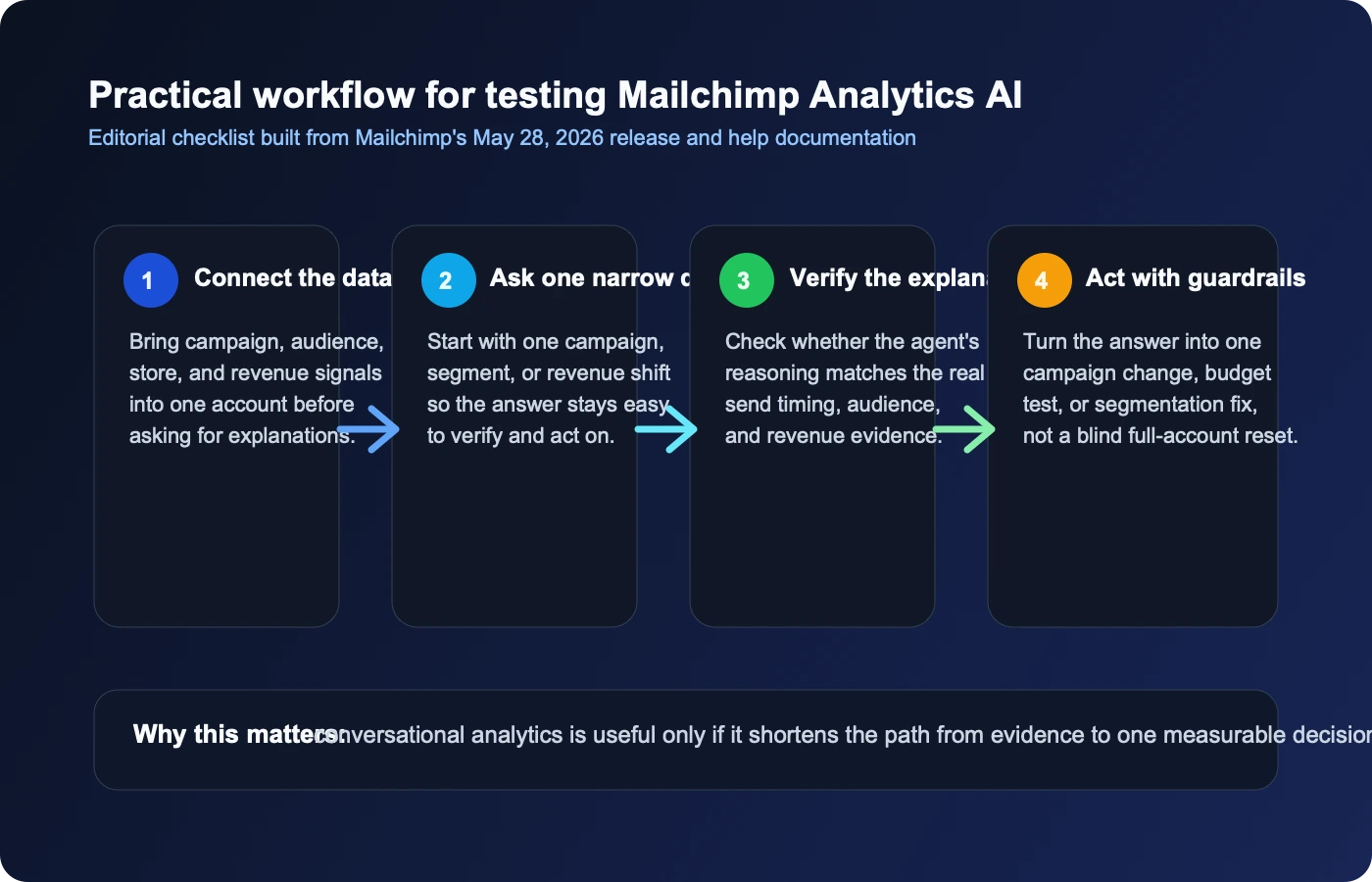
Use a narrow rollout instead of handing your whole reporting process to the new agent on day one:
- Connect or verify the store and campaign data sources that actually drive revenue decisions.
- Start with one plain-language question tied to a real business issue, such as why repeat-buyer revenue fell or which abandoned-cart flow is driving the highest return.
- Compare the AI answer against the raw campaign timeline, audience definition, and store events before changing spend or automations.
- Turn one verified insight into one action, such as cloning a winning segment, revising send cadence, or shifting budget.
- Pressure-test the expected upside in the Marketing ROI Calculator and compare scenarios in the Digital Marketing Budget Planner.
- Keep a parallel visibility workflow through the GEO Visibility Checklist, because better campaign diagnosis still depends on better source pages, product facts, and offer clarity.
What remains uncertain
Several practical questions remain open. Mailchimp's May 28 release positions Analytics AI as the start of a more agentic marketing experience, but it does not publish detailed boundaries for how far autonomous execution will go, how recommendations are prioritized, or how deeper governance controls will evolve for larger teams. The help documentation also makes clear that permissions, connected data quality, and account activity affect what the agent can explain well.
There is also a measurement question. Mailchimp is clearly trying to become more of a decision layer, not only an execution layer. But marketers still need to define which outcomes matter most: gross revenue, repeat purchase rate, contribution margin, lead quality, or customer lifetime value. An AI assistant can summarize patterns, but it cannot choose business priorities for you.
The practical takeaway on June 1, 2026 is straightforward. Mailchimp is moving beyond campaign reporting into conversational decision support. For teams with solid store connections and recurring campaign volume, that could save time immediately. The teams that benefit most will be the ones that use Analytics AI as a faster analysis surface, not as a substitute for measurement discipline.