Meta expands business-shared activity signals beyond ads into Feed and AI responses
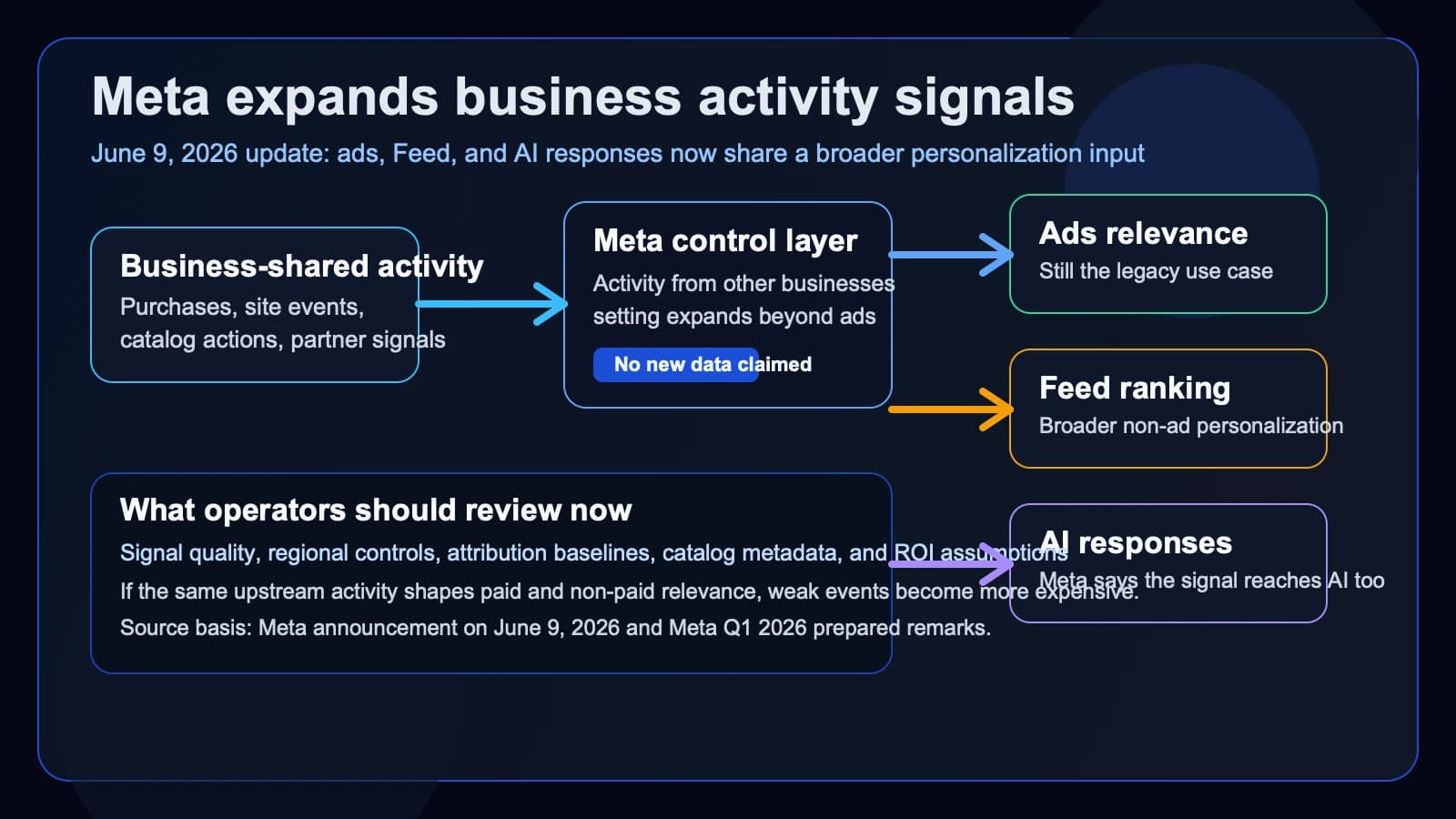
Meta said on June 9, 2026 that it will start using information businesses already share with Meta to personalize not only ads, but also non-ad surfaces including Feed and AI responses. That is the real operational change. Marketers have spent years treating "activity information from ad partners" as an ads setting. Meta is now moving that same signal closer to a cross-surface relevance system.
The company also said the update will take effect in the United States and "a number of other countries" next month, with more countries to follow, according to the same June 9 announcement. In parallel, Meta's Q1 2026 prepared remarks said that more than 3.5 billion people use at least one of Meta's apps every day and that Meta is working on improving recommendation systems and ads with newer AI models. Put together, those two official signals matter for operators: audience response, content discovery, and paid relevance are being tied more tightly to the same underlying understanding of what a person is likely trying to do.
What changed
Meta's official post describes a narrower technical move and a broader product consequence.
| Confirmed point | Primary source | Why operators should care |
|---|---|---|
| Business-shared activity data will now be used for non-ad personalization, including Feed and AI responses | Meta announcement, June 9, 2026 | Signals previously treated as ad-targeting inputs now influence a wider discovery layer. |
| Meta says it is not collecting new data as part of this change | Meta announcement, June 9, 2026 | The shift is about expanded use of existing inputs, not a newly announced data source. |
| The old "Your activity off Meta technologies" setting is going away and the "Activity from other businesses" control is being expanded | Meta announcement, June 9, 2026 and Meta Help guidance for activity information from ad partners | Teams should expect more stakeholder questions about how one control now affects more surfaces. |
| Meta says the changes begin next month in the U.S. and several other countries, with more to follow | Meta announcement, June 9, 2026 | Rollout timing matters for multinational teams that need region-aware consent and reporting checks. |
| Meta says more than 3.5 billion people use at least one of its apps every day and that newer AI models will improve recommendations and ads | Meta Q1 2026 prepared remarks, April 29, 2026 | The scale of the recommendation system makes even "settings" changes strategically relevant to marketers. |
The most important reading is not that ads are becoming slightly better targeted. It is that Meta is treating off-platform business activity as a more general relevance input. If the same signal can shape ad selection, organic content ranking, and AI-generated assistance, then creative, CRM, consent, and measurement teams no longer have clean separation between "paid personalization" and "platform personalization."
Why it matters
For advertisers and operators in the United States, Canada, the United Kingdom, Australia, and Europe, this raises three practical issues.
First, content relevance gets closer to performance relevance. If Meta is using business-shared activity to shape Feed and AI responses in addition to ads, then the creative and offer strategies that once sat only inside paid campaigns may start affecting how users encounter a brand elsewhere in Meta's ecosystem. That does not mean brands can control AI responses or Feed placement directly. It does mean that the quality of product signals, event signals, and business context being shared upstream matters more.
Second, measurement boundaries get fuzzier. A team may see better click-through or conversion rates in paid campaigns while also seeing changes in engagement, discovery, or branded search behavior that are not caused by ads alone. When one platform uses the same activity signal across more surfaces, attribution conversations get more complex. That is exactly why this should connect to the Marketing ROI Calculator, the Digital Marketing Budget Planner, and the guide to tracking brand mentions and visibility. Teams need a model that can separate spend decisions from broader relevance effects.
Third, governance gets more important, not less. Meta says users remain in control of whether this data is used, and it says no new data is being collected in the update. Even so, operators should assume legal, privacy, analytics, and paid media leads will want clearer internal documentation. A setting that used to be discussed as ad preference infrastructure is now being described as infrastructure for ads and non-ad personalization together.
Who is affected
The first group affected is performance marketing teams already relying on Meta pixel, Conversions API, catalog events, or partner-shared activity to improve campaign relevance. Their signal strategy now has broader platform implications.
The second group is lifecycle and CRM teams. If business-shared activity helps shape AI responses and content recommendations, then event quality, taxonomy consistency, and offer clarity start looking less like ad-ops details and more like audience-experience infrastructure.
The third group is privacy and regional operations teams. Meta explicitly says the rollout begins next month in the U.S. and some other countries. That means international brands should map where local consent language, internal documentation, and cross-border workflows may need review before the changes are fully live across more markets.
The fourth group is agencies and consultants advising clients on GEO, discovery, and paid-social effectiveness. The GEO Visibility Checklist becomes more relevant here because brands increasingly need machine-readable, well-governed business signals across multiple AI-assisted surfaces, not only search.
What to do next
Treat the update as a signal-governance review, not a policy footnote.
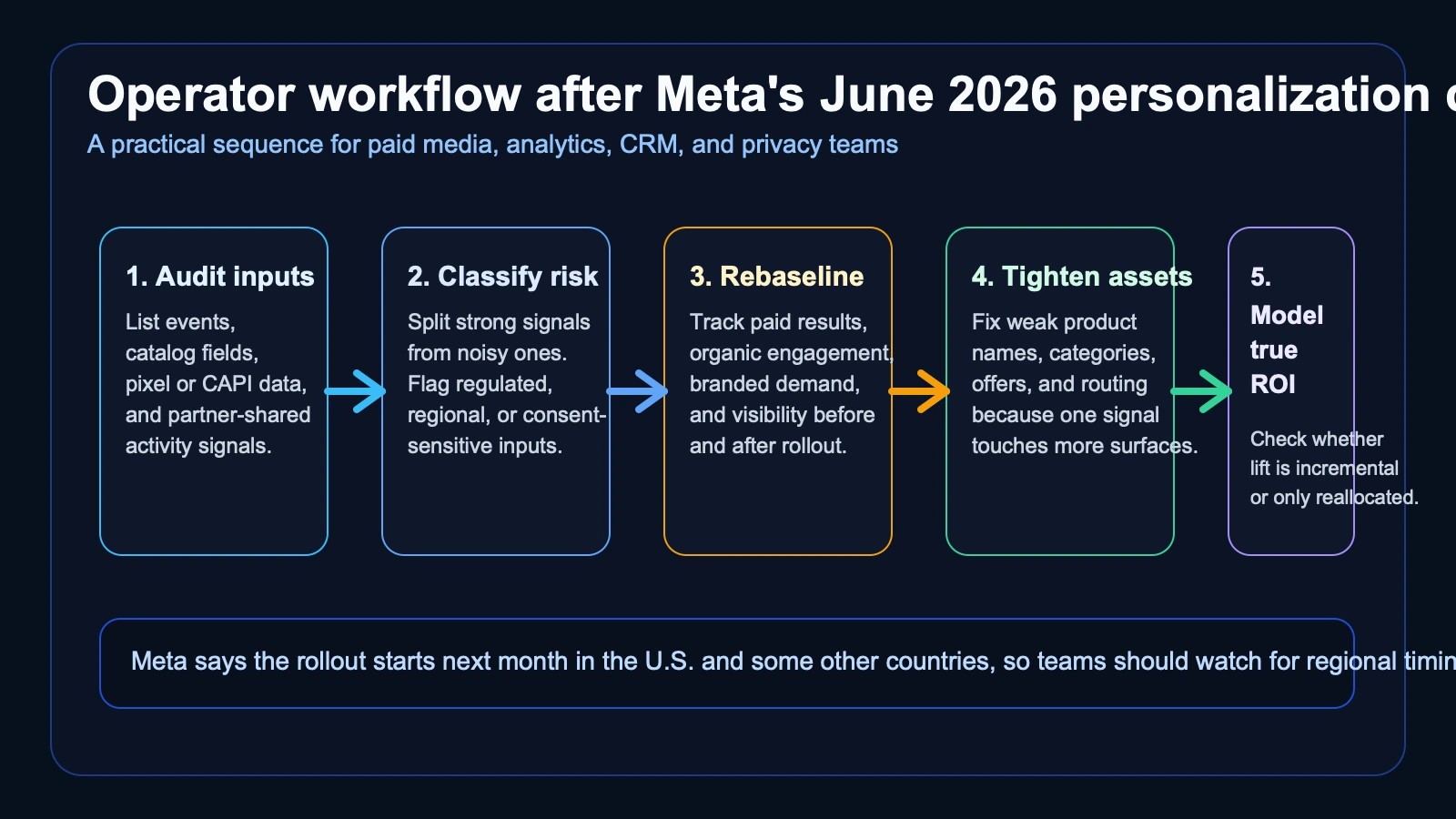
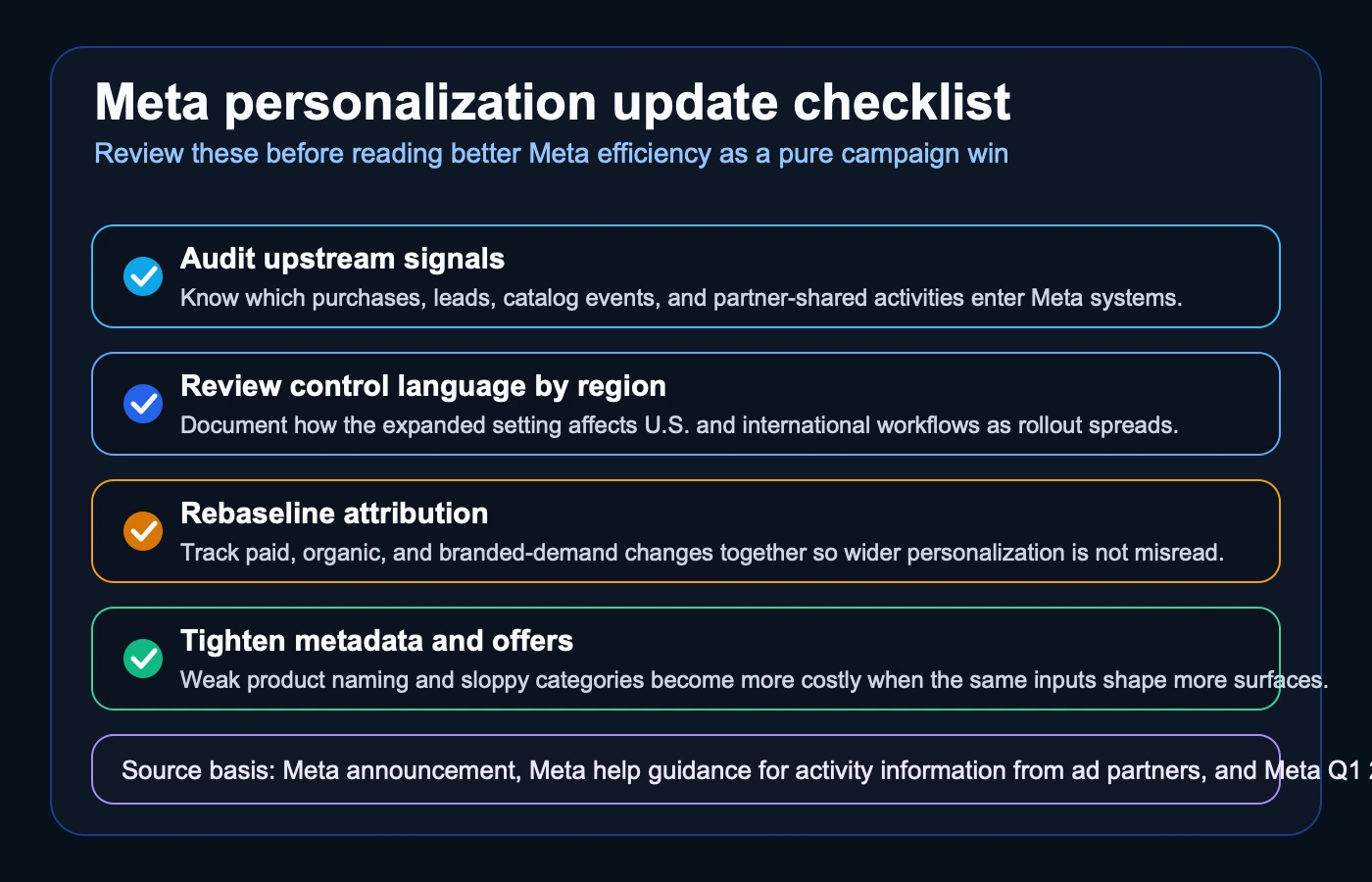
- Inventory which business events, catalog actions, or partner signals you currently send into Meta systems.
- Separate high-confidence, well-governed signals from noisy or weakly mapped events that could distort optimization.
- Review whether regional teams understand that "activity from other businesses" is becoming broader than an ad-only setting.
- Recheck reporting baselines before and after rollout in affected markets so you do not misread platform-wide relevance changes as campaign-only wins.
- Tighten creative and product metadata where possible, because weak naming, inconsistent categories, and thin product context become more expensive when the same signals shape multiple surfaces.
- Use the Digital Marketing Budget Planner and Marketing ROI Calculator to stress-test whether better Meta efficiency is actually incremental profit or partly a channel-mix illusion.
What remains uncertain
Meta leaves several implementation questions open in the public materials. It does not publish a market-by-market launch schedule in the announcement, only that the first wave starts next month in the U.S. and some other countries. It also does not quantify how much this expanded signal use may affect Feed ranking, AI response selection, or campaign performance relative to existing recommendation systems.
The help documentation around activity information from ad partners still largely reflects the older ads framing, so teams should expect some temporary documentation lag while Meta updates user-facing guidance across products and regions. That is not a blocker, but it is a reason to keep change logs and internal explanations precise.
There is also an interpretation risk. Meta says no new data is being collected, which is important, but that does not make the operational impact trivial. A broader use of existing data can still change discovery patterns, campaign efficiency, and stakeholder expectations. Teams that ignore that distinction may underreact until reporting shifts show up.
The practical conclusion on June 11, 2026 is simple: Meta has widened the role of business-shared activity data from ad relevance infrastructure into broader personalization infrastructure. Smart teams should respond by tightening signal quality, documenting control changes, and measuring Meta performance with more skepticism than a standard campaign optimization update would require.