Meta turns Creator Assistant and AI translations into a tighter Facebook growth workflow
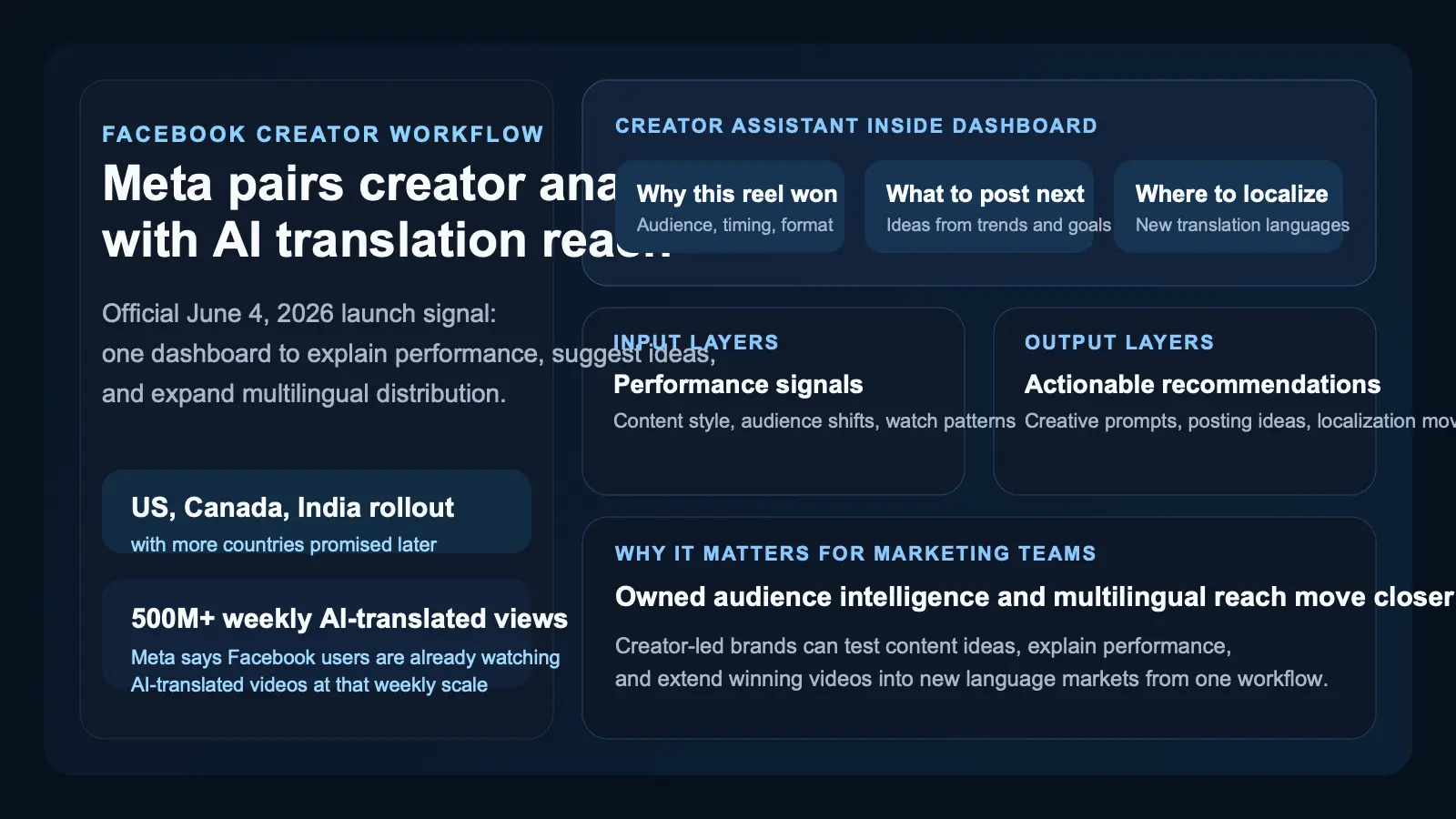
Meta said on June 4, 2026 that it is launching Creator Assistant inside Facebook's creator dashboard and expanding AI translations to more languages. The practical shift is not just "Meta added another AI helper." The company is trying to combine performance diagnosis, idea generation, and multilingual reach into one workflow for creators and creator-led brands. For operators who treat Facebook as a serious distribution and monetization channel, that is a more actionable product change than a generic inspiration tool.
The timing matters. Meta says Creator Assistant is rolling out to creators in the United States, Canada, and India, while the same June 4 announcement says over half a billion users on Facebook are now watching AI-translated videos weekly. Read together, those claims suggest Meta is tightening the loop between understanding why content worked and extending that content into new audiences faster. That is relevant for marketers, agencies, and social teams serving the United States, Canada, the United Kingdom, Australia, and Europe because creator-led distribution increasingly overlaps with brand education, product discovery, and demand generation.
What changed
Meta's June 4, 2026 announcement makes four product points that matter in practice, and older official creator updates help explain why they matter now.
| Confirmed point | Official source | Why operators should care |
|---|---|---|
| Creator Assistant is built directly into the Facebook creator dashboard. | Meta announcement, June 4, 2026 | Performance explanation and next-step ideation move closer to the place where creators already check results. |
| Meta says the assistant can explain why a reel outperformed others, track audience shifts, and suggest new ideas based on trends and goals. | Meta announcement, June 4, 2026 | Content teams may spend less time translating charts into hypotheses and more time testing the next iteration. |
| Creator Assistant is rolling out first in the US, Canada, and India. | Meta announcement, June 4, 2026 | Global teams should treat this as an early-market rollout, not universal access. |
| Meta says over half a billion Facebook users watch AI-translated videos weekly, and more languages are coming next. | Meta announcement, June 4, 2026 and Meta AI performance update, January 28, 2026 | Localization is becoming a measurable distribution lever, not only an accessibility add-on. |
| Meta said on March 18, 2026 that Facebook paid creators nearly $3 billion in 2025 and added new performance metrics for monetization. | Creator Fast Track announcement | Creator analytics and monetization are already a serious operating surface, which makes an AI advisor more consequential. |
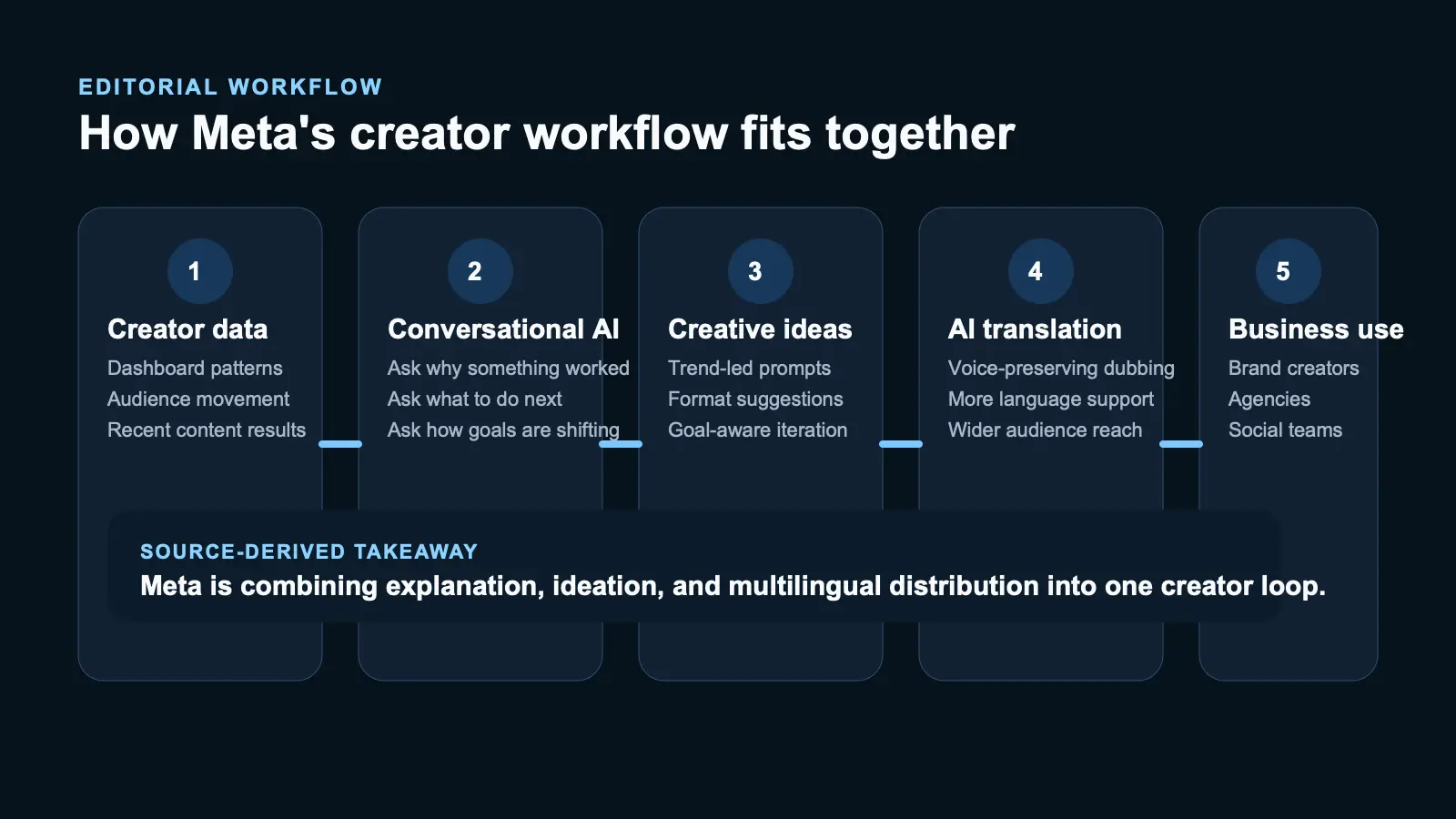
The key product decision is that Meta is not limiting the assistant to simple post ideas. In the official launch note, Meta says creators can ask why a specific reel performed better, how their audience has shifted over time, and what to do differently next. That turns the assistant into a layer for interpretation, not just generation.
Why it matters
For high-value marketing teams, the real significance is workflow compression. A lot of creator-led programs still break into separate jobs: one person reviews dashboard data, another brainstorms new hooks, another localizes scripts or captions, and someone else decides whether the winner should become an ad, email asset, or landing-page proof point. Meta is trying to collapse more of that loop into one place.
That helps three groups. First, creator-led brands can use the assistant to diagnose what is resonating without relying on raw metric screenshots alone. Second, agencies and social teams can move faster from performance review to a testable content brief. Third, multilingual growth teams can use Meta's translation expansion as a signal to rethink which English-language winners are strong enough to localize for broader reach.
This is also where Slogan.website's internal tools become useful. If a team wants to turn creator-led reach into a defendable growth channel, it should connect the content loop to budgeting and attribution. Use the Digital Marketing Budget Planner to decide how much resource belongs in creator testing versus paid amplification, the Marketing ROI Calculator to pressure-test whether localization and creator ops are improving return, and the guide to brand mentions and visibility measurement to track whether creator content is expanding branded demand beyond one platform.
Who is affected
The most obvious group is independent creators and creator-led small businesses in the initial rollout markets. They get a lower-friction way to ask what is working and what to try next inside a dashboard they already use.
The second group is brand social teams that operate through creators, spokespeople, founders, or community-led pages. Even if the tool is framed for creators, the underlying job is the same: explain performance, generate the next content angle, and extend winners to new audiences.
The third group is agencies managing multilingual social programs. Meta's language expansion to Arabic, Bahasa Indonesian, French, Thai, and Vietnamese changes the operational conversation from "Should we localize at all?" to "Which winning assets are worth localizing first, and how will we support those audiences once reach expands?"
What to do next
Use this update as an operating-model prompt, not a novelty test.
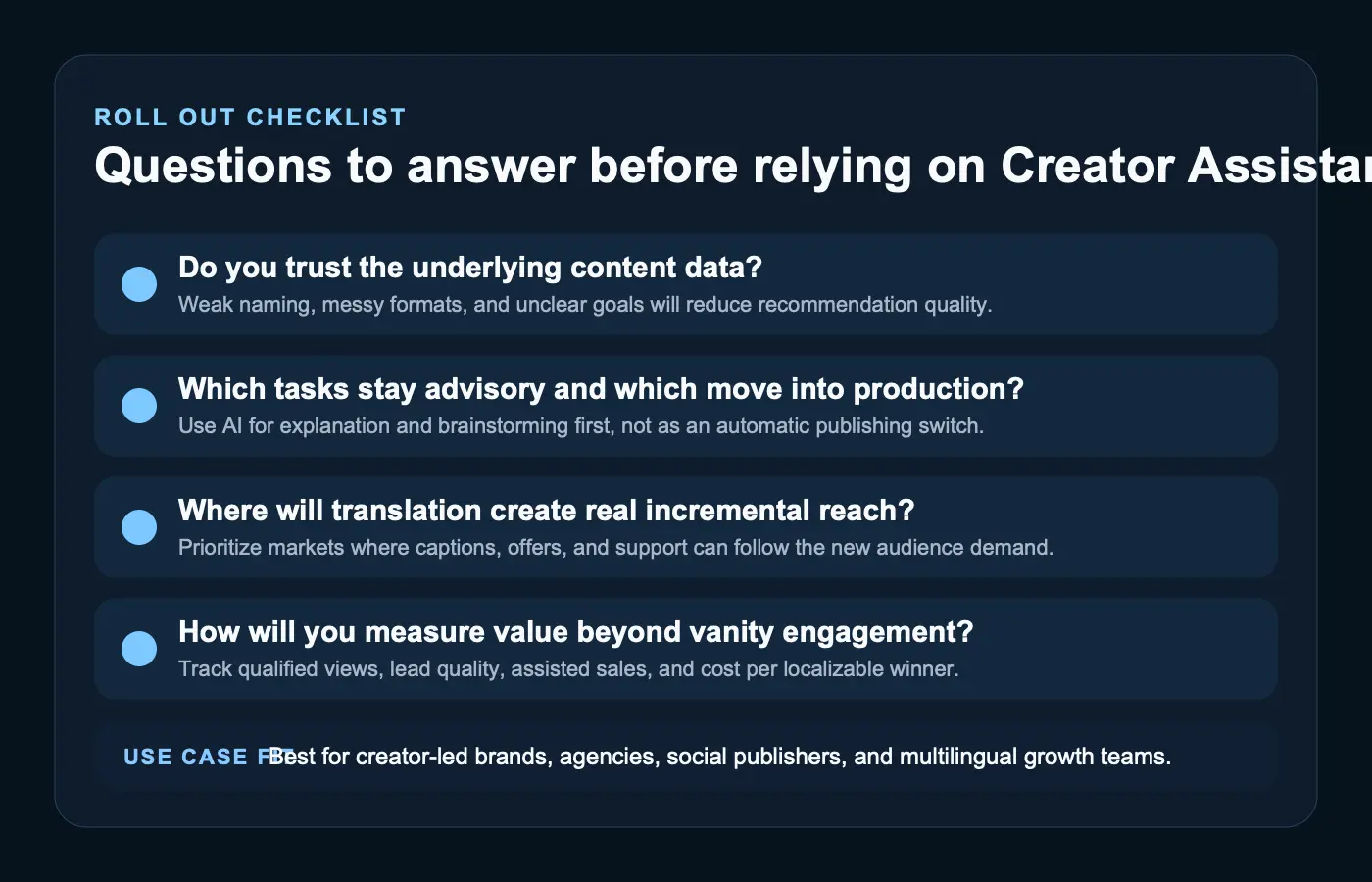
- List the content questions your team answers repeatedly after every creator or social campaign: why did this win, what audience changed, what hook should we test next, and which asset deserves paid support.
- Decide which of those questions Creator Assistant can support safely and which still need human editorial, legal, or brand review.
- Build a shortlist of content winners that could justify translation or dubbing into another language without breaking the offer, support flow, or landing-page experience.
- Connect creator reporting to budget and ROI planning instead of evaluating the tool on engagement alone.
- Define one pilot market and one pilot content format before you scale the workflow.
What remains uncertain
Several important gaps remain in Meta's public materials. The company says Creator Assistant is rolling out in the United States, Canada, and India, with more countries coming later, but it does not publish a full rollout timeline for the United Kingdom, Australia, or Europe. It also does not spell out detailed admin controls for teams that manage multiple creators or branded pages.
There is also a measurement ambiguity. Meta explains that the assistant provides tailored recommendations based on a creator's content style, performance, and community, but it does not publish the exact recommendation logic or how often those insights refresh. Teams should treat the assistant as a guided interpretation layer, not a neutral source of truth.
Finally, translation reach is not the same as commercial value. Meta's weekly viewing scale is notable, but the public announcement does not break out downstream metrics such as lead quality, subscription lift, site traffic quality, or conversion impact by language. The practical takeaway on June 5, 2026 is still strong: Meta is making creator analytics and multilingual distribution feel more like one growth workflow. But disciplined teams should validate whether that workflow improves qualified demand, not just surface-level reach.