Microsoft makes Copilot a default SMB licensing path with new July 1 Microsoft 365 Business bundles
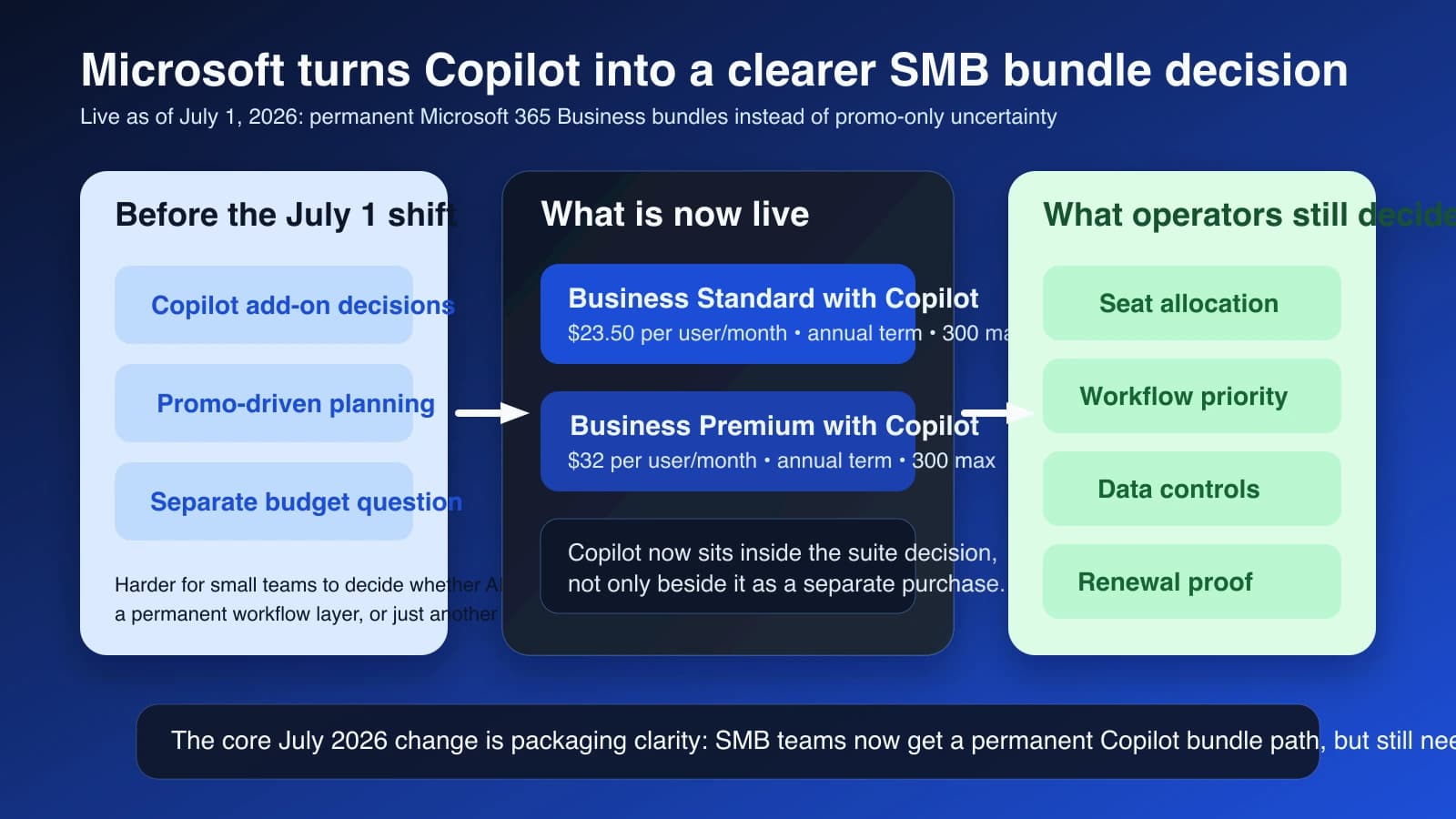
Microsoft's small-business Copilot story changed materially on July 1, 2026. Microsoft says its new Microsoft 365 Business Standard with Copilot and Microsoft 365 Business Premium with Copilot subscriptions are now generally available, which turns what had been a promotional Copilot motion into a permanent bundle SMB teams can actually standardize around. Read with Microsoft's May 28 product post, current pricing page, and July 1 pricing FAQ, the practical point is clear: Copilot for SMBs is no longer just an add-on experiment. It now has a more predictable packaging, pricing, and renewal lane.
For operators, agencies, and owner-led teams in the United States, Canada, the United Kingdom, Australia, and Europe, that matters because licensing shape often decides whether AI stays in pilot mode. If the budget, seat cap, and upgrade path are unclear, the workflow rarely scales beyond a few enthusiastic users.
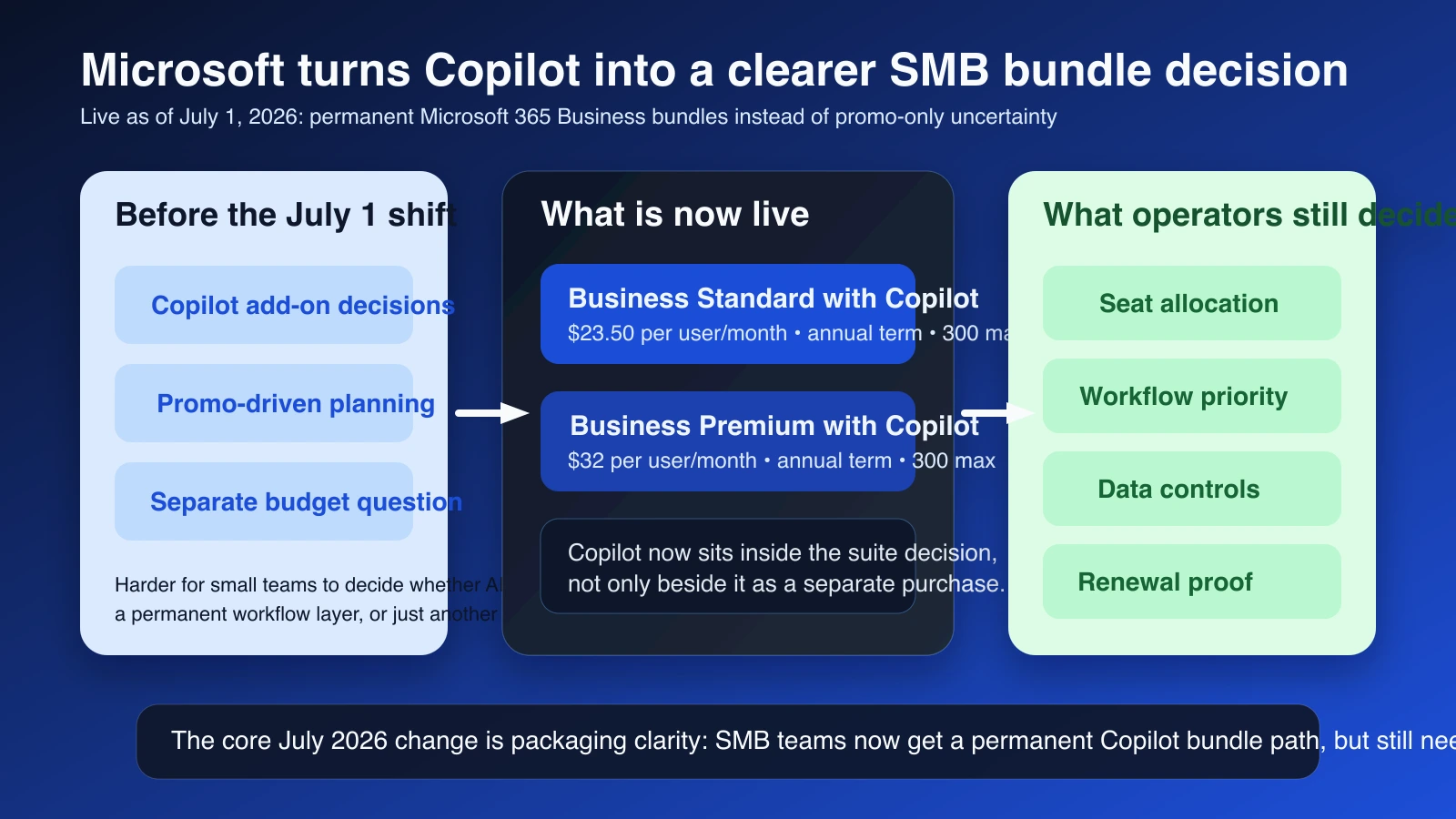
What changed
Microsoft's July 2026 Partner Center announcement says that, as of July 1, 2026, the new business-with-Copilot SKUs previewed in June are now generally available. The same page lists two live bundle prices: $23.50 per user per month for Microsoft 365 Business Standard with Copilot and $32 per user per month for Microsoft 365 Business Premium with Copilot, both with a 300-license maximum and annual subscription terms. Microsoft's public Copilot pricing page shows the same U.S. list prices.
The May 28 Microsoft 365 blog post framed the July 1 launch as a way to fit Copilot into the tools small businesses already use rather than forcing another disconnected AI product into the stack. That is product messaging, but it aligns with the operational reality many smaller teams face: Word, Excel, Outlook, PowerPoint, and Teams are already where briefs, pricing sheets, sales notes, and campaign updates live.
| Confirmed July 1 point | Official source | Operational meaning |
|---|---|---|
| Business Standard with Copilot and Business Premium with Copilot are now generally available. | Microsoft Partner Center, July 1, 2026 and Microsoft 365 Blog, May 28, 2026 | SMB teams can budget against a live bundle instead of a temporary sales motion. |
| U.S. list pricing is $23.50 for Business Standard with Copilot and $32 for Business Premium with Copilot. | Microsoft Partner Center and Microsoft pricing page | Finance and ops teams can compare bundled Copilot against standalone add-ons and existing productivity spend. |
| Microsoft positions the offer around up to 300 seats. | Microsoft Partner Center and Copilot Business FAQ | The bundle is aimed at SMB-scale rollouts, not large-enterprise license design. |
| Pricing changes for Microsoft 365 business suites took effect on July 1, 2026, globally with local market adjustments. | Microsoft licensing FAQ | Existing customers need to separate new-bundle evaluation from renewal timing and regional price differences. |
| Existing customers are not automatically switched and generally see new pricing at renewal after July 1. | Copilot Business FAQ and licensing FAQ | Migration still needs a deliberate license plan; Microsoft is simplifying packaging, not fully automating adoption. |
The most useful nuance is that Microsoft still maintains multiple paths. The Copilot Business FAQ says qualifying organizations with Microsoft 365 Business Basic, Standard, or Premium can also buy Copilot Business as an add-on, supports up to 300 seats per tenant, and are not automatically converted from existing Copilot commitments. So the July 1 story is not "one bundle replaces everything." It is that Microsoft now offers a more durable default path for SMBs that want Copilot built into the base productivity subscription itself.
Why it matters
This matters because many small and mid-market companies do not fail at AI because the models are weak. They fail because rollout decisions get trapped between procurement, IT, finance, and the people doing the work. A permanent bundle reduces one common point of friction: whether Copilot should be treated as a temporary pilot surcharge or a standard operating cost.
That has direct implications for marketing and digital-business teams. A lean team using Microsoft 365 for campaign briefs, sales proposals, reporting decks, keyword reviews, and customer follow-up can now evaluate Copilot as part of the core suite budget instead of as a separate line item with a different story. That makes it easier to map concrete use cases against internal tools like the Marketing ROI Calculator, the Digital Marketing Budget Planner, and the GEO Visibility Checklist. The question becomes: which recurring jobs justify the bundle cost, and which do not?
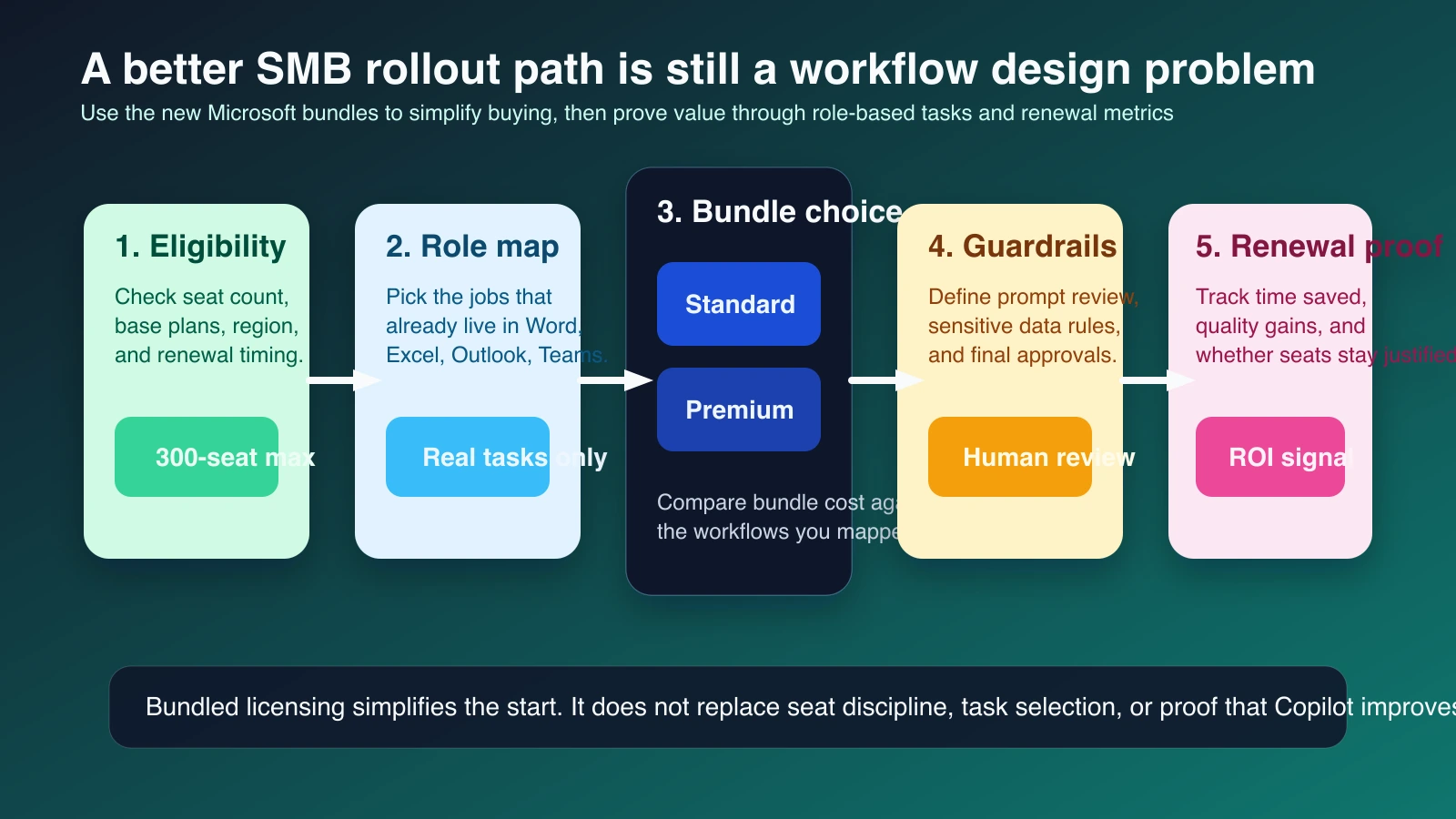
There is also a governance angle. Microsoft's FAQ says Copilot Business follows the same tenant data policies and that customers with more than 300 users should consider moving to broader Microsoft 365 Copilot plans. In other words, this is a cleaner entry point, not a removal of governance work. Teams still need to decide who gets access, which data is in scope, and whether the tasks being delegated are worth the spend.
Who is affected
The first affected group is owner-led and operations-led SMBs already standardized on Microsoft 365. The second is agencies and consultancies running delivery, proposals, reporting, and client communication inside Microsoft apps. The third is internal marketing, RevOps, and sales teams that want Copilot embedded in the tools they already use instead of juggling another standalone AI surface.
It also affects finance and procurement teams. Microsoft's pricing FAQ makes clear that pricing is effective globally from July 1, 2026 with local adjustments, and that existing customers generally experience new prices at renewal after that date. That means the right buying decision may differ depending on contract timing, region, and whether a company is already carrying Copilot add-ons.
What to do next
- List the recurring jobs in Word, Excel, Outlook, PowerPoint, and Teams that consume the most operator time each week.
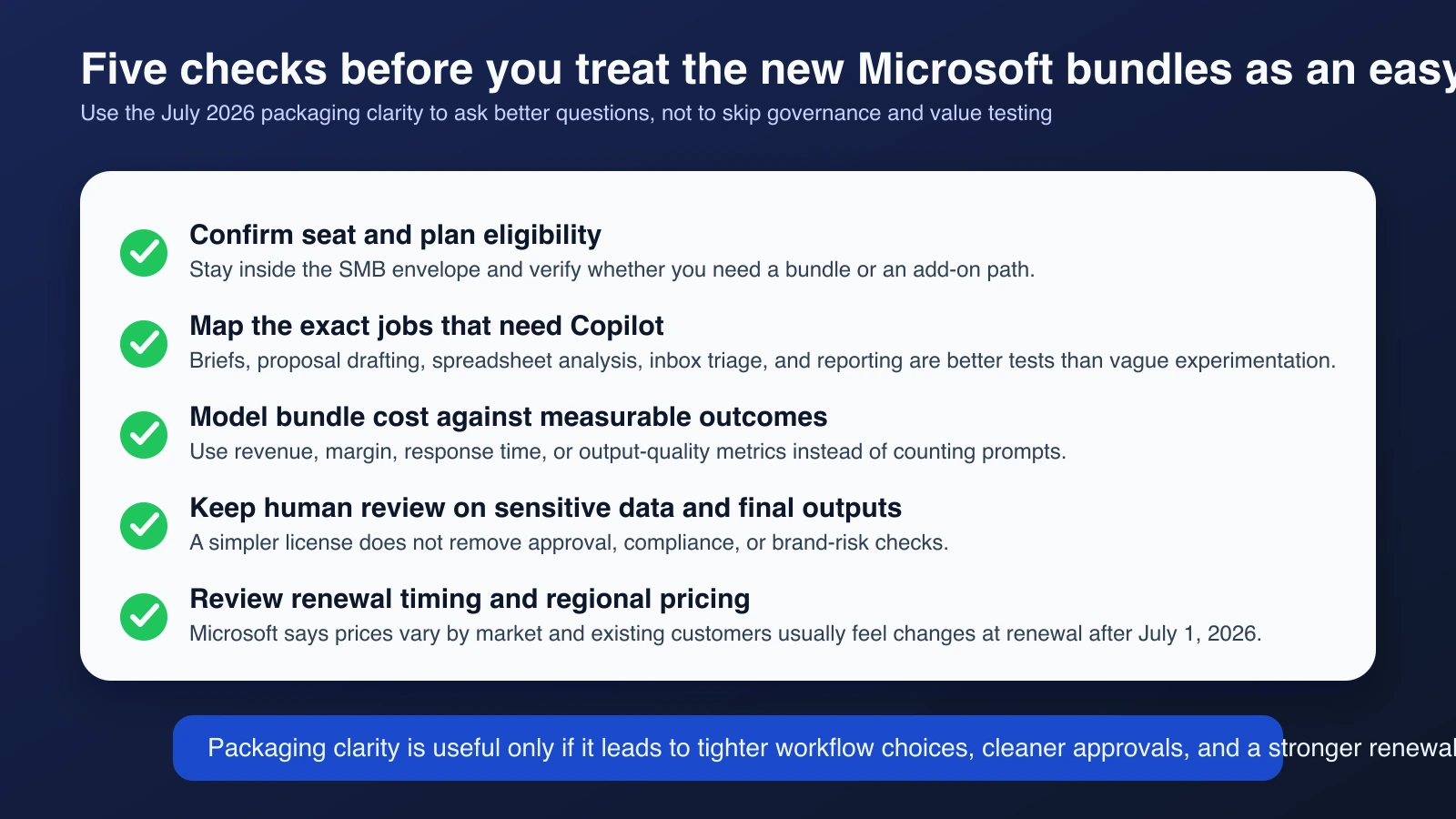
- Check whether your organization is inside Microsoft's SMB envelope by confirming seat count and plan eligibility against the Copilot Business FAQ.
- Model the bundle cost against real work outcomes, not hype, using the Marketing ROI Calculator or Digital Marketing Budget Planner.
- Decide whether a bundled SKU or a Copilot add-on better matches your current contract timing, renewal cycle, and regional pricing situation.
- Set review rules for sensitive prompts, customer data, approvals, and final outputs before you expand access beyond a narrow pilot.
What remains uncertain
Important limits are still visible on July 6, 2026. The publicly visible U.S. pricing pages show list prices, but Microsoft also says prices can vary by country and currency and that some products may not be available in every market. The partner-facing announcement clearly confirms general availability and pricing, but some of its sales language about "predictable renewal" is Microsoft framing, not an independently measured outcome. That interpretation is reasonable, but it is still an inference from the packaging change rather than a reported customer benchmark.
So the strongest conclusion is narrower than "Copilot just became standard for every small business." What happened on July 1 is that Microsoft removed some packaging ambiguity. For many SMB teams, that is enough to change the budgeting conversation from "Should we test one more AI add-on?" to "Which recurring workflows deserve a permanent Copilot seat?"