Microsoft turns Clarity into an AI visibility and citation measurement layer
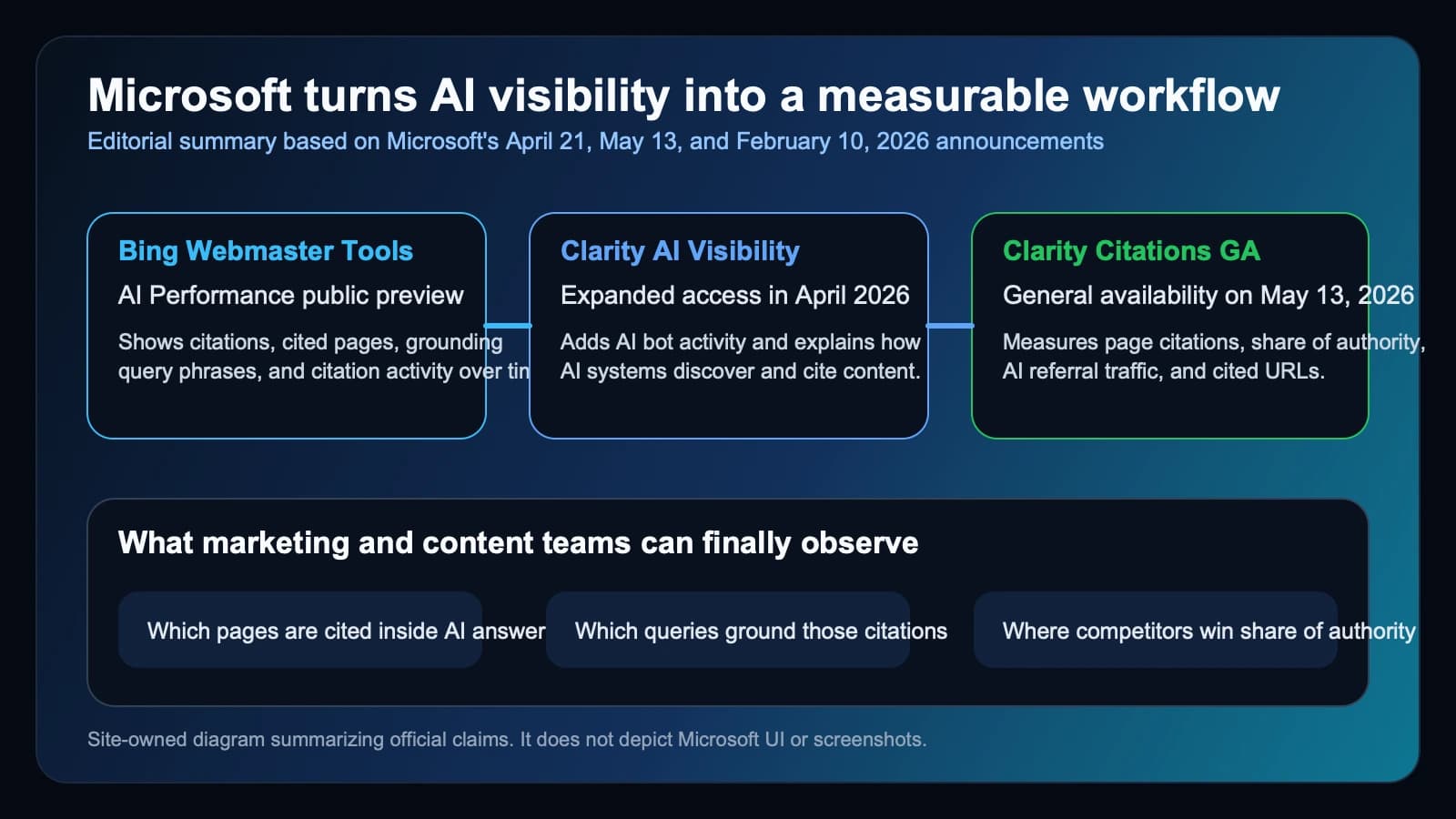
Microsoft is making a clearer product case that AI visibility should be measured like a real acquisition surface. On April 21, 2026, Microsoft Advertising said brands now need to operate across the human web, the LLM web, and the emerging agentic web, and it positioned Clarity AI Visibility as the diagnostic layer for the “help me choose” stage. That message became more concrete on May 13, 2026, when Microsoft said Citations in Microsoft Clarity is now generally available. It also started earlier on February 10, 2026, when Bing Webmaster Tools introduced AI Performance in public preview.
Taken together, these updates matter because marketers no longer only need rankings, clicks, and referral traffic. They also need to know whether their pages are being cited inside AI-generated answers, which topics create those citations, and where competitors are being selected instead.
What changed
The practical shift is that Microsoft now has multiple official surfaces for AI-answer visibility instead of one vague SEO message.
| Confirmed update | Primary source | Why it matters |
|---|---|---|
| Microsoft said on April 21, 2026 that Clarity AI Visibility is expanding access and helps businesses understand AI bot activities and citations. | Microsoft Advertising: Win across all three eras of the web | Microsoft is framing AI discovery as an observable operating problem, not just a branding trend. |
| Microsoft said on May 13, 2026 that Citations in Clarity is now generally available. | Microsoft Clarity blog: Citations now generally available | Teams can use Clarity project data to monitor AI citation behavior without waiting for a private preview. |
| The Clarity citation dashboard measures page citations, share of authority, AI referral traffic, and cited pages with associated grounding queries. | Microsoft Clarity blog: What does the citation dashboard measure? | This adds query, page, and competitive context instead of leaving AI visibility as anecdotal prompt testing. |
| Bing Webmaster Tools AI Performance launched in public preview on February 10, 2026 with citation counts, average cited pages, grounding query phrases, and top cited pages. | Bing Webmaster Blog: AI Performance public preview | Publishers can inspect citation patterns from the search infrastructure side as well as the analytics side. |
| Microsoft says some Clarity citation setups may require domain ownership verification through Bing Webmaster Tools or Google Search Console. | Microsoft Clarity blog: setup notes | This is not pure plug-and-play; teams still need data ownership and implementation discipline. |
The April 21 Microsoft Advertising post explains the product logic clearly. Microsoft says Clarity AI Visibility helps businesses understand how AI systems discover and cite information, and that future insights will help brands see why they appear or do not appear in AI responses and what to improve next. The May 13 Clarity post then adds the hard details: page citations, share of authority, AI referral traffic, my cited pages, grounding queries, ownership verification in some setups, and one selected reporting domain for multi-domain projects. The February 10 Bing Webmaster Tools announcement rounds out the stack from the search side with AI Performance metrics for total citations, average cited pages, grounding query phrases, and top cited pages.
Why it matters
This matters because AI visibility is increasingly happening before the click. A prospect can ask an assistant for a software shortlist, a service provider recommendation, a comparison, or a category explainer and never visit the sites that shaped the answer. If your brand is absent from the cited sources, traditional rankings alone will not explain that loss.
Microsoft is effectively saying the measurement layer needs to evolve. In its April 21 announcement, the company argues that brands need to win in “help me find it,” “help me choose,” and “do it for me” moments. Clarity AI Visibility is positioned for the middle layer, where AI systems synthesize choices before a person acts. That is exactly where the GEO Visibility Checklist, the guide to tracking brand mentions and visibility, the review of AI search analytics tools for marketing teams, the Marketing ROI Calculator, and the Digital Marketing Budget Planner become operational tools rather than side reading.
Who is affected
The most immediate beneficiaries are teams that publish high-intent informational pages and need better evidence about whether those pages are shaping AI answers.
- SEO and content teams trying to understand why some pages get cited and others stay invisible.
- Demand generation teams that need earlier visibility signals before traffic or conversions show up.
- Publishers and editorial operations teams whose category authority increasingly depends on being referenced by AI systems.
- Agencies and consultants who need a more defensible reporting layer for GEO or AEO work.
- Product-led software and ecommerce teams that depend on category comparisons, buyer guides, FAQs, and support content to influence discovery.
What to do next
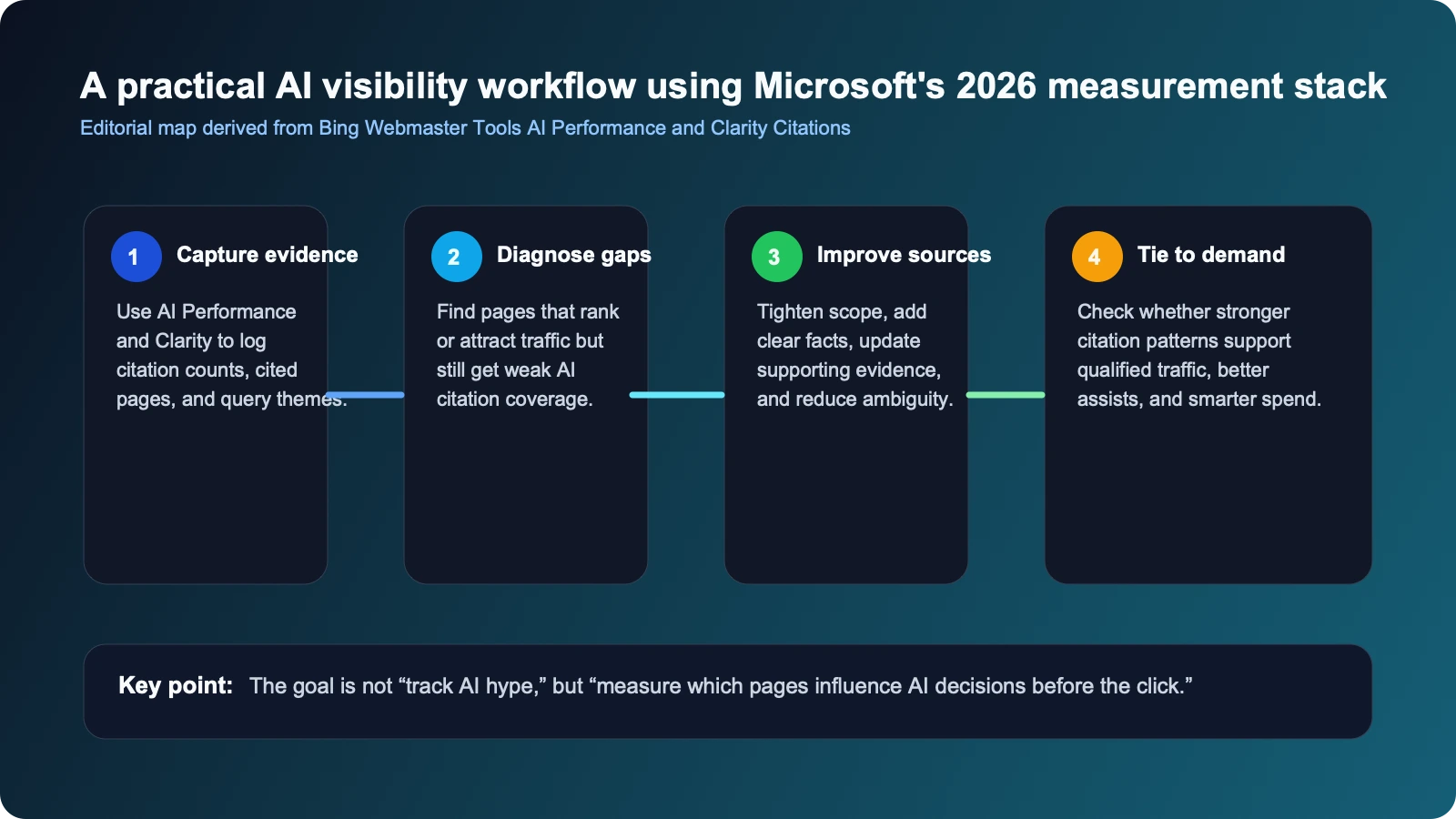
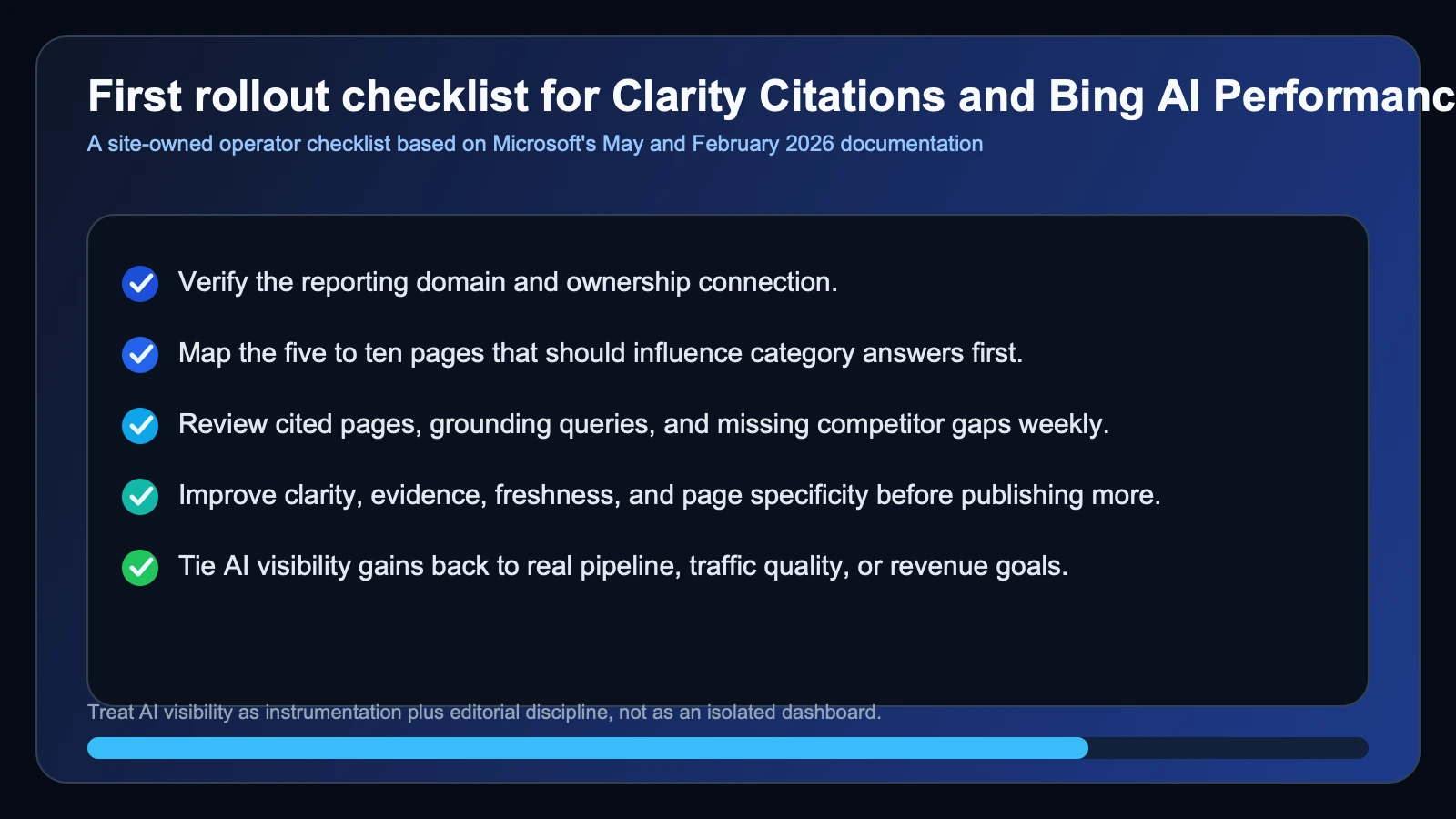
Use this workflow before treating Microsoft’s updates as a reason to chase every AI visibility dashboard at once.
- Confirm that your most important discovery pages are indexed, current, and clearly scoped around one job-to-be-done, because Bing’s AI Performance preview explicitly ties citations to grounding query phrases and referenced pages.
- Implement Clarity cleanly and verify the correct domain setup, since Microsoft’s May 13 Clarity post says some projects will require domain ownership verification and one selected domain for citation reporting.
- Compare Bing Webmaster Tools AI Performance against Clarity Citations. The first is closer to search-platform reporting, while the second adds analytics-side interpretation such as share of authority and AI-referred traffic.
- Build a weekly review around cited pages, missing topics, and competitor overlap instead of running random prompts ad hoc.
- Use the GEO Visibility Checklist to pressure-test source quality, crawlability, structured claims, and answer fitness on the pages that should be cited more often.
- Translate visibility changes into business assumptions with the Marketing ROI Calculator or Digital Marketing Budget Planner before expanding content or tooling spend.
What remains uncertain
Microsoft still leaves important gaps open. The April 21 post promises future Clarity insights that explain why brands appear or do not appear in AI responses, but not all of those diagnostic features are fully described yet. The February 10 Bing Webmaster Tools post also says grounding query phrase data is a sample of overall citation activity and that Microsoft will keep refining the metric as more data is processed.
There is also a cross-platform limitation. These dashboards improve visibility into Microsoft-connected AI experiences, but they do not solve visibility measurement across every assistant or answer engine your team cares about. You still need broader answer-engine monitoring and manual QA.
The headline on June 4, 2026 is still meaningful. Microsoft has moved beyond abstract AI-search messaging and put visibility instrumentation into Clarity and Bing Webmaster Tools, making AI citations easier to audit, compare, and act on before missing visibility becomes a revenue problem.