Microsoft turns AI visibility into a measurable marketing workflow with Clarity citations and MCP
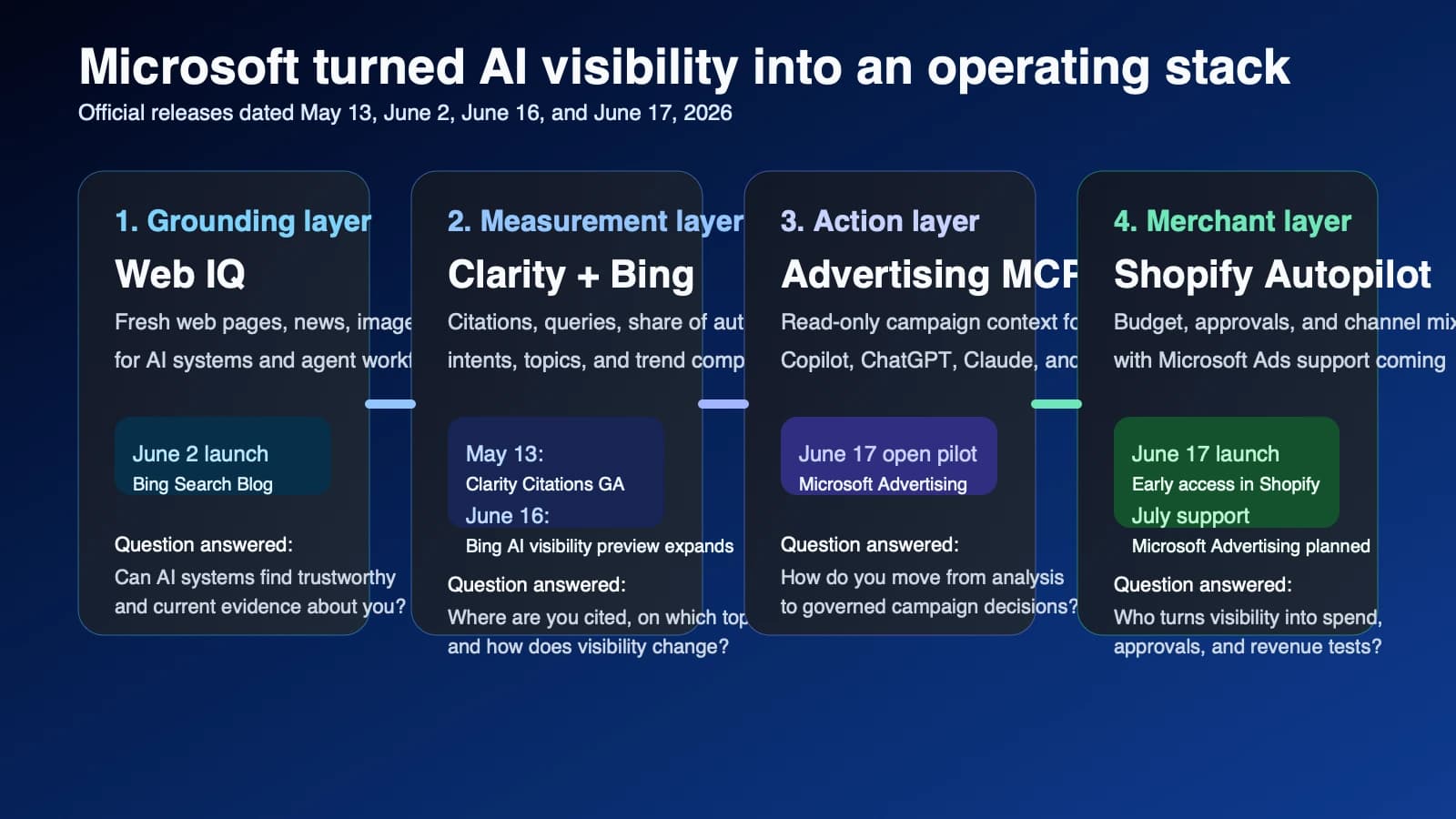
Microsoft's June 17, 2026 Microsoft Advertising announcement matters because it does more than introduce one more AI feature. Microsoft tied together Web IQ grounding, real citation reporting in Microsoft Clarity, an open-pilot Microsoft Advertising MCP server, and a new Shopify Campaign Autopilot extension for Microsoft Advertising. For marketers, SEO and GEO teams, publishers, and ecommerce operators, the practical shift is that AI visibility is becoming something you can measure, diagnose, and connect to campaign execution instead of treating it like a black box.
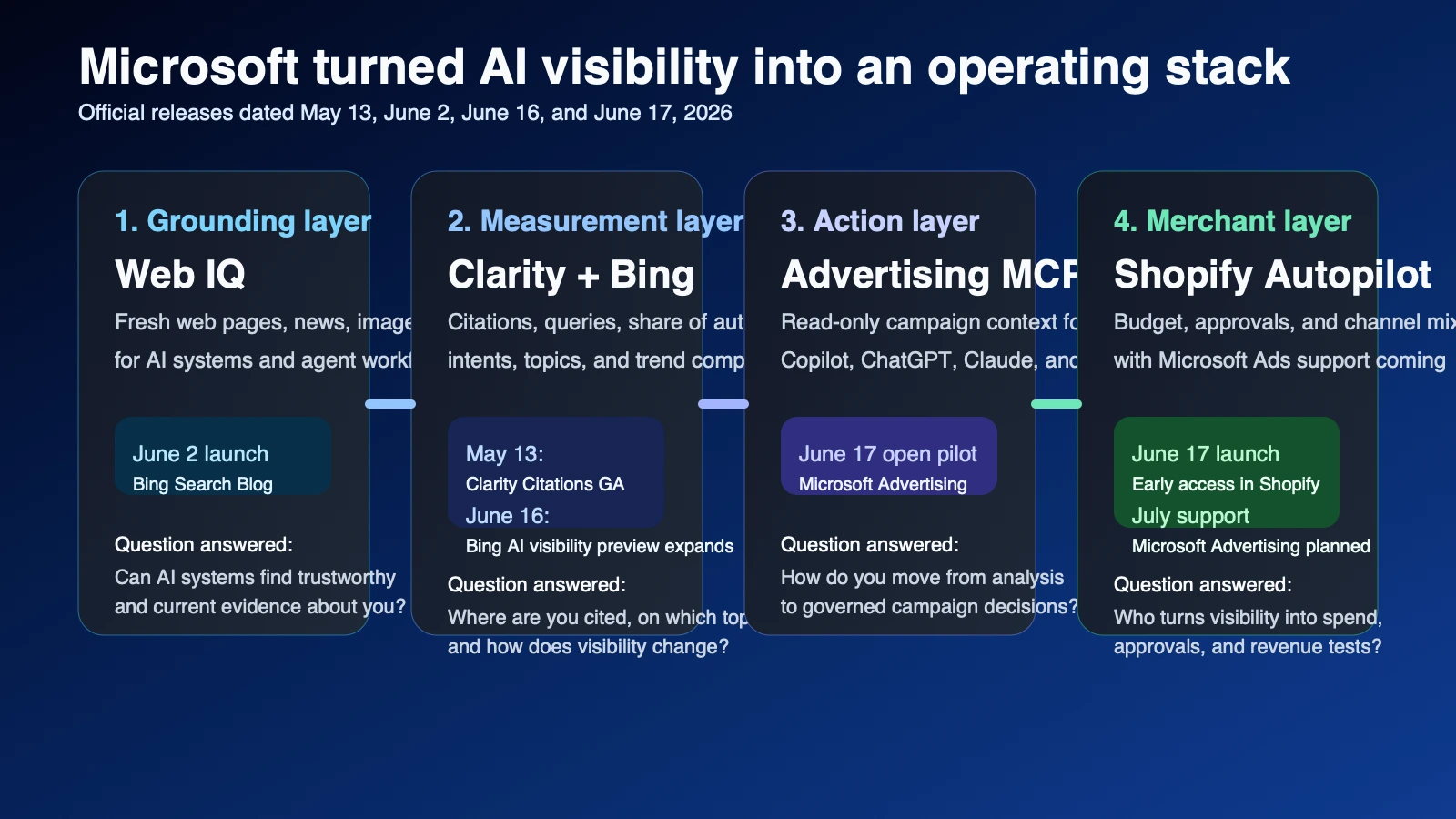
That reading is stronger when the June 17 post is paired with Microsoft's other official releases from the same month. On June 2, 2026, Bing introduced Web IQ as an AI-native grounding layer for fresh web evidence. On June 16, 2026, Bing Webmaster Tools expanded AI visibility reporting with Intents, Topics, Citation Share, and Compare. And on May 13, 2026, Microsoft Clarity moved Citations into general availability. Read together, the message is clear: Microsoft wants brands to optimize not only for rankings and clicks, but also for whether AI systems can ground on, cite, and act on their content.
What changed
| Confirmed update | Primary source | Why it matters operationally |
|---|---|---|
| Microsoft said on June 17 that Web IQ already grounds Copilot, ChatGPT, and other AI experiences, while Clarity citations reporting is available to all users. | Microsoft Advertising, June 17, 2026 | Brands can no longer separate AI discovery from measurement; the same vendor is linking retrieval and reporting. |
| Clarity Citations became generally available on May 13, 2026 and reports page citations, share of authority, AI referral traffic, grounding queries, and cited pages. | Microsoft Clarity, May 13, 2026 | Teams can inspect how their content is being used in AI answers instead of guessing from traffic changes alone. |
| Bing Webmaster Tools added Intents, Topics, Citation Share, and Compare in preview on June 16, 2026. | Bing Search Blog, June 16, 2026 | AI visibility analysis is shifting from single-query snapshots to topic, context, and trend analysis. |
| Microsoft Advertising MCP is expanding to open pilot with read-only access. | Microsoft Advertising, June 17, 2026 | Agencies and in-house teams can pull live campaign context into ChatGPT, Claude, Copilot, and similar workflows. |
| Shopify launched Campaign Autopilot on June 17, 2026 and says Microsoft Advertising support is coming in July. | Shopify, June 17, 2026 and Microsoft Advertising, June 17, 2026 | Ecommerce teams get a more direct path from AI-driven planning inside Shopify to Microsoft inventory. |
The most important detail is that Microsoft is connecting multiple layers that used to live in separate workflows. In the June 2 Web IQ launch, Bing says the system was built to give AI agents fresh web pages, news, images, and videos with production-speed retrieval. In the Clarity GA post, Microsoft says Citations now shows page citations, share of authority, AI referral traffic, and the grounding queries AI systems used to retrieve and evaluate content. Then, in the June 17 Microsoft Advertising post, the company adds the action layer: content recommendations coming to Clarity, Brand Agents, MCP access for campaign workflows, and AI Max controls for search advertisers.
Why it matters
This matters because more marketing teams are now stuck between two incomplete views of performance. Traditional analytics show clicks, sessions, and conversions after a user arrives. AI visibility tools increasingly try to show how a brand appears before that click happens, when a system decides which sources to cite or summarize. Microsoft's June sequence is notable because it links those stages together with first-party tooling.
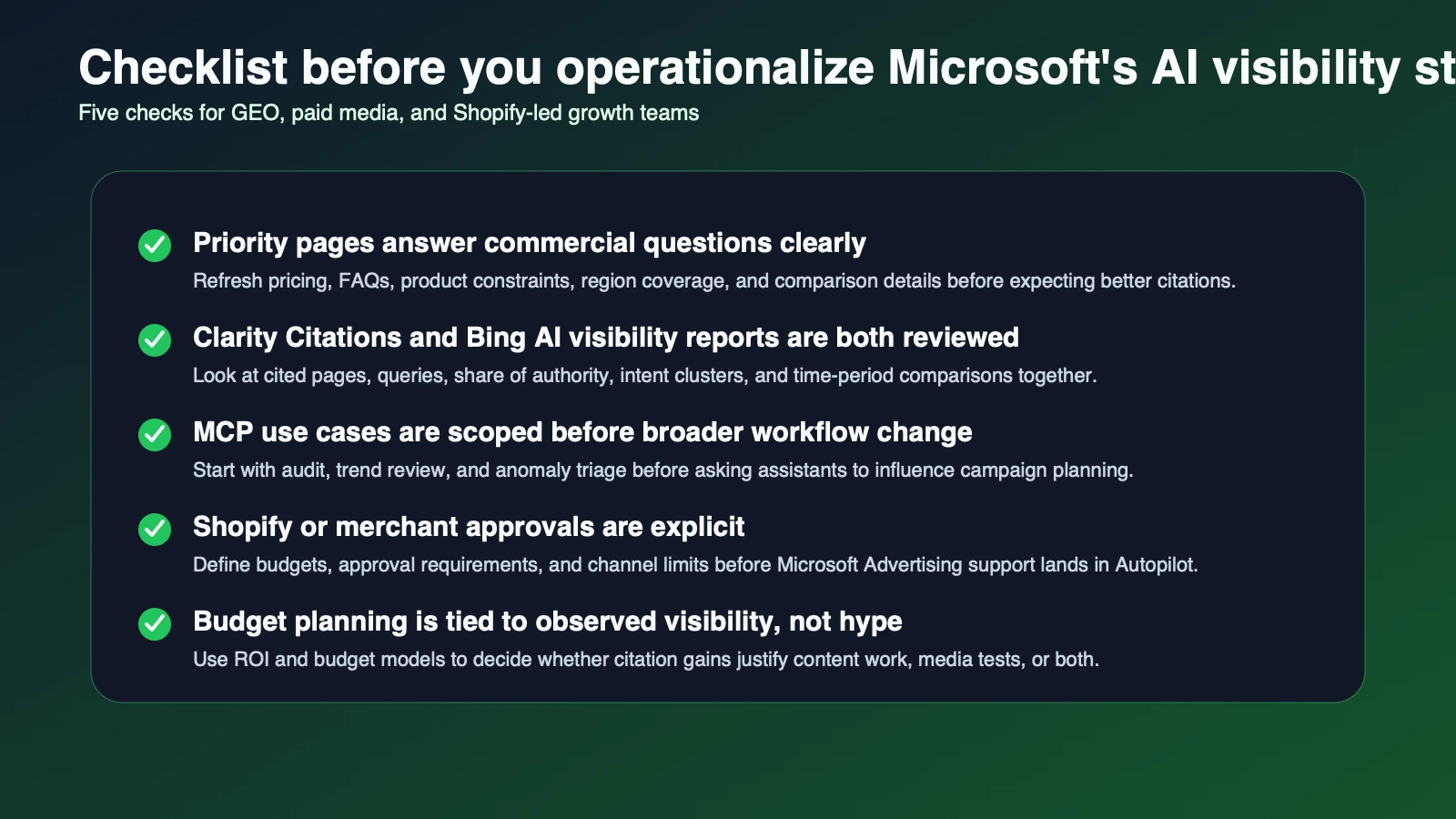
For GEO and content teams, Clarity's GA citations dashboard changes the working question from "Did our traffic move?" to "Which pages are AI systems citing, on which grounding queries, and with what share of authority?" That is more actionable for teams using pages like the GEO Visibility Checklist or guides such as how to track brand mentions and measure visibility. For paid-media teams, Microsoft's MCP announcement matters because campaign analysis can start moving into the assistant interfaces where teams already review data and write recommendations.
The Shopify connection is also more important than it may look at first glance. Shopify says Campaign Autopilot lets operators set budgets, guardrails, and approvals while the system runs campaigns across Meta, Shop, email, and eventually Microsoft Advertising in July 2026. That means smaller and mid-market merchants may soon have a tighter loop between AI-assisted content discovery, campaign orchestration, and budget deployment. Teams can then tie spend assumptions back to tools like the Marketing ROI Calculator and Digital Marketing Budget Planner instead of treating AI-era visibility as a separate experiment.
Who is affected
The first affected group is publishers and content-led brands that depend on being cited, not only clicked. The second is search, SEO, and GEO teams that need to explain why one topic is surfacing in AI answers while another is missing. The third is agencies and in-house performance teams managing Microsoft Advertising accounts across the United States, Canada, the United Kingdom, Australia, and Europe. The fourth is Shopify-based commerce operators who may get a simpler path into Microsoft inventory without adding another standalone workflow.
Smaller businesses should pay attention too. Microsoft and Shopify are both framing this stack as a way to reduce operational friction, not just as an enterprise visibility play. If AI-driven discovery increasingly determines which brands are surfaced, cited, and shortlisted, then teams without a documented content and campaign process may actually be more exposed than larger organizations.
What to do next
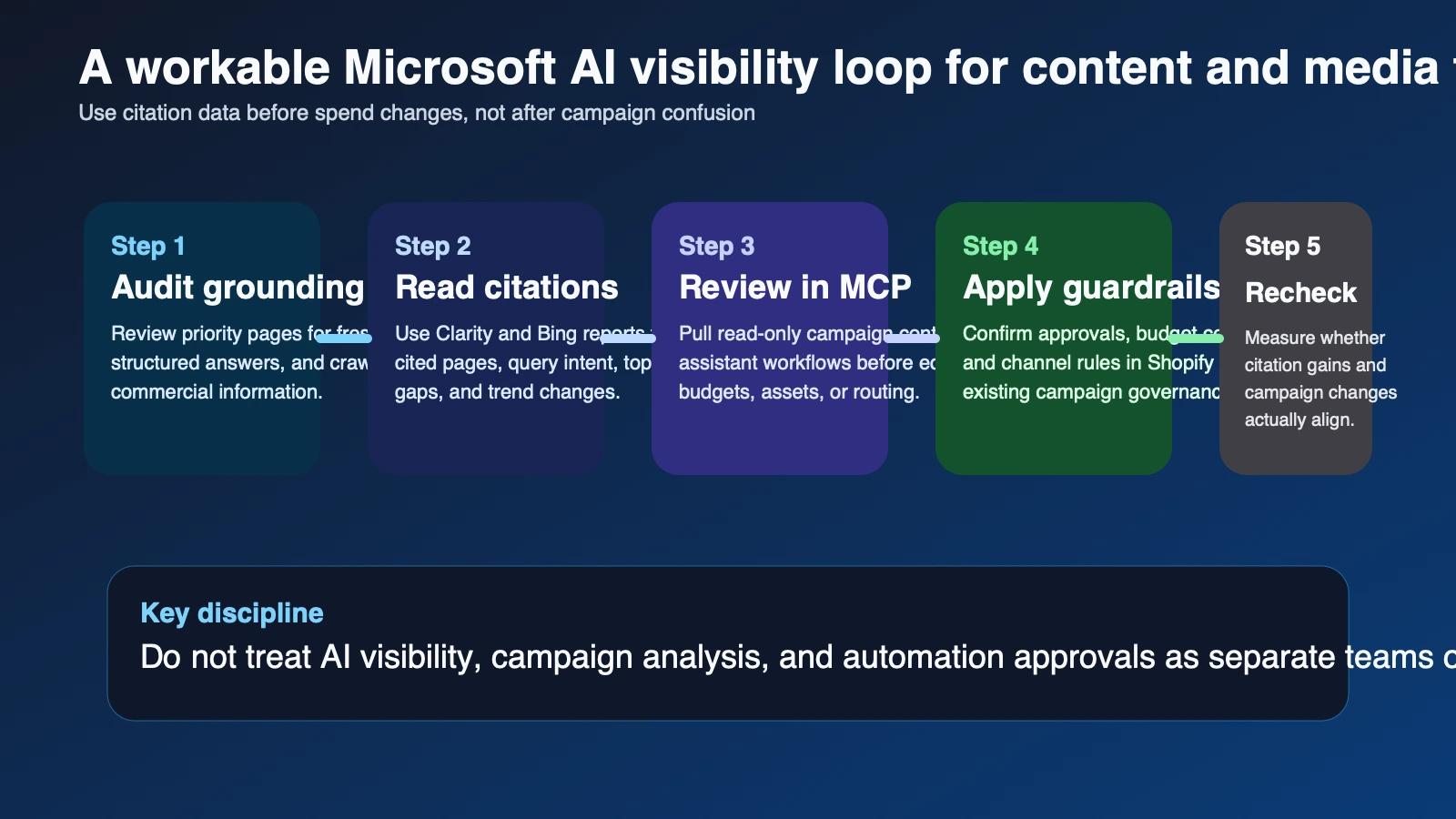
Use this five-step workflow before treating the June 17 story as automatic lift:
- Verify whether your highest-value pages are readable, current, and clearly structured enough for grounding systems, not just for human visitors.
- If you run Clarity, enable or review Citations and compare cited pages, queries, and share-of-authority patterns against your priority topics.
- In Bing Webmaster Tools, inspect the new Intents, Topics, Citation Share, and Compare views to see whether AI visibility is clustering around the commercial or informational themes you actually want.
- If your team uses Microsoft Advertising, identify which recurring analysis tasks would benefit from the read-only MCP open pilot before asking for broader workflow changes.
- If you sell on Shopify, treat Campaign Autopilot as a governance question as much as a convenience feature: define budget ceilings, approval rules, and reporting expectations before Microsoft channel support arrives.
What remains uncertain
Important limits remain on June 19, 2026. Microsoft's June 17 post says the Advertising MCP server is expanding to an open pilot with read-only access, not general availability. Bing's new Intents, Topics, Citation Share, and Compare features are still in preview. Clarity says some citation reporting setups may still require domain verification, and multi-domain projects must choose one reporting domain during setup. Shopify also says Campaign Autopilot is in early access, that results take time, and that Microsoft Advertising support is still a coming-soon July extension rather than something fully live today.
So the practical conclusion is narrower than "Microsoft solved AI marketing." What Microsoft did this month was make AI visibility more inspectable and more connected to action. That is enough to matter. Teams that win from this shift will be the ones that combine grounded content, citation analysis, campaign guardrails, and budget discipline before the rest of the market treats AI discovery as normal infrastructure.