Microsoft turns web grounding and workplace context into shared infrastructure for AI agents
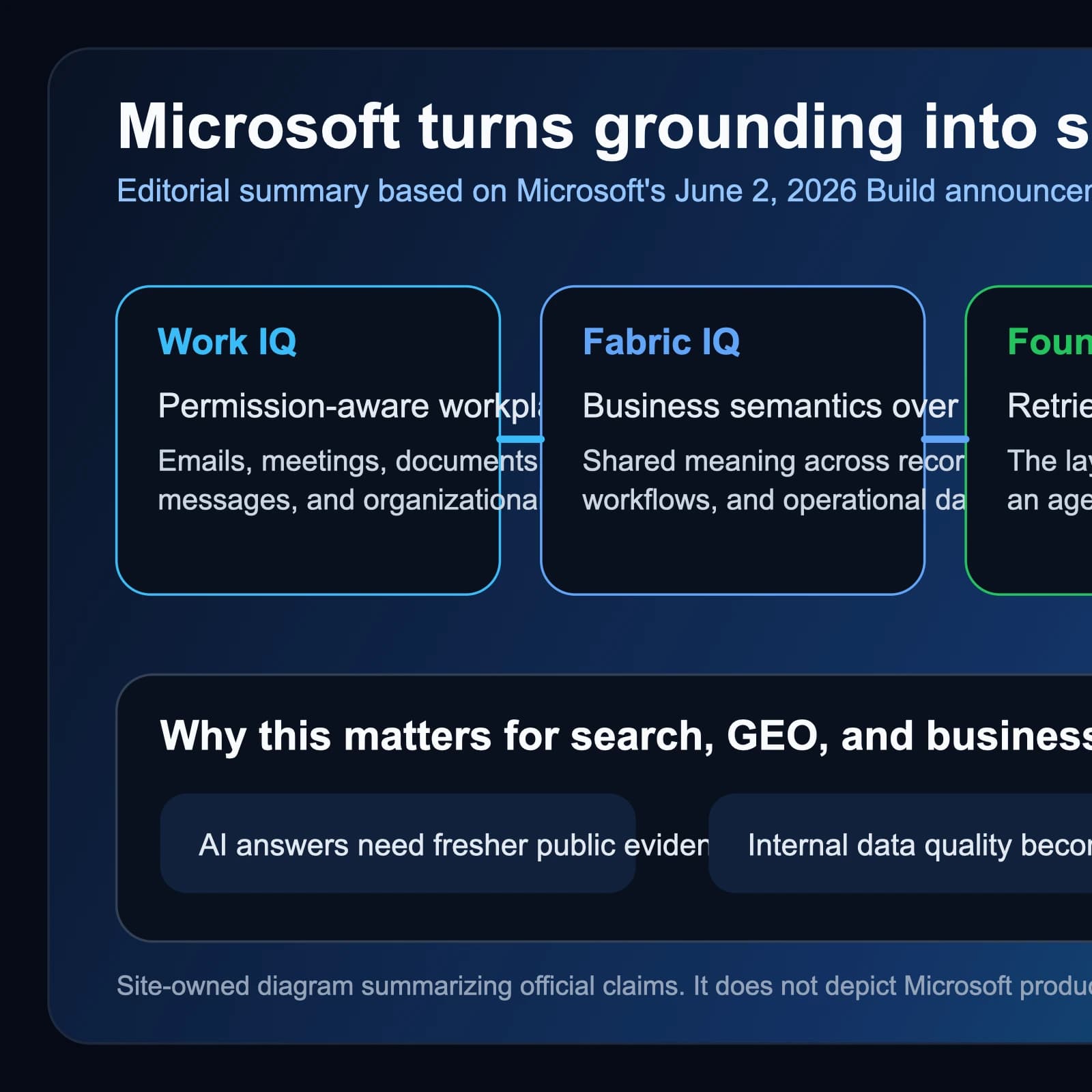
Microsoft used Build 2026 on June 2, 2026 to make a broader point than "here is one more agent framework." The company said Microsoft IQ is now generally available across GitHub Copilot, Microsoft Foundry, and Copilot Studio, combining Work IQ, Fabric IQ, Foundry IQ, and the newly announced Web IQ into one context layer for agents. In Microsoft’s own framing, the problem is no longer just model quality. It is whether an AI system can use governed internal knowledge and fresh web evidence at production speed.
That matters well beyond developer tooling. For search, GEO, brand monitoring, support, revenue ops, and enterprise marketing teams, the Build message is that grounding is becoming a product layer of its own. If AI systems increasingly decide what information gets surfaced, summarized, and acted on, then visibility is no longer only about ranking pages in a browser. It is also about being available to agentic retrieval systems that package evidence from the live web and from internal business systems together.
What changed
| June 2, 2026 announcement | Primary source | Why operators should care |
|---|---|---|
| Microsoft said Microsoft IQ is generally available across GitHub Copilot, Microsoft Foundry, and Copilot Studio. | Official Microsoft Blog and Build Live blog | Context is being positioned as shared infrastructure across multiple agent surfaces, not a one-off feature. |
| Microsoft said the Work IQ APIs will be generally available on June 16, 2026. | Official Microsoft Blog | Teams can move from keynote language to a concrete API rollout date. |
| Microsoft Learn says Work IQ preserves existing permissions, compliance, and governance controls. | Work IQ API overview | That reduces the usual fear that AI context layers bypass access rules. |
| Build Live says Web IQ connects agents to fresh web pages, news, images, and video, and that it already powers grounding for Microsoft Copilot and ChatGPT. | Build Live blog | Web visibility now affects how major AI assistants gather attributed evidence, not just how search engines crawl pages. |
| Microsoft’s engineering post says Web IQ is built around semantic-first retrieval, sub-165ms P95 latency, and token-efficient evidence packaging. | Command Line engineering post | Grounding quality is being optimized like infrastructure, which raises the operational bar for content freshness and machine-readable clarity. |
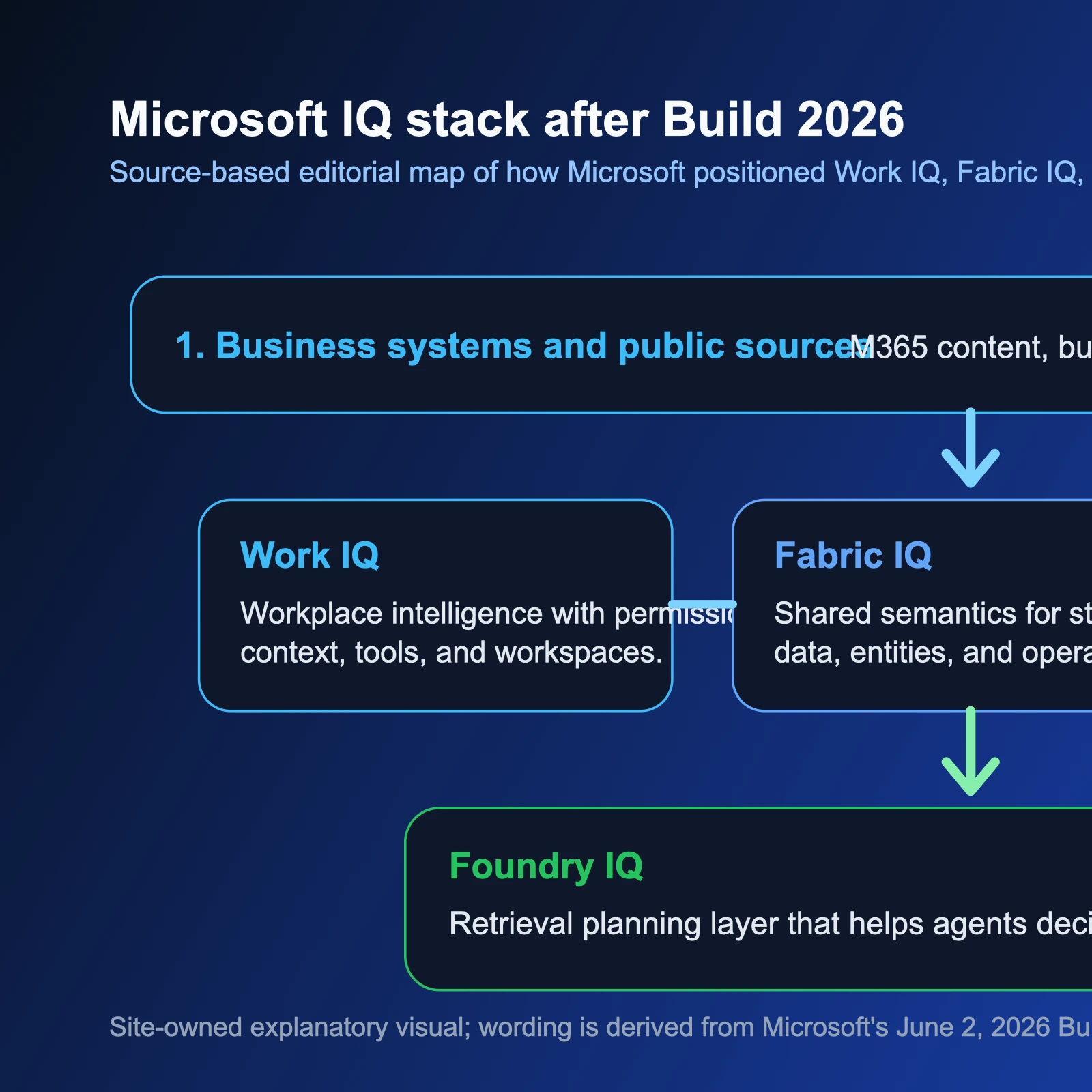
The most practical change is that Microsoft is describing a full stack for agent context. In the Build Live recap, Work IQ is the workplace intelligence layer, Fabric IQ is the semantic layer over structured business data, Foundry IQ helps agents plan retrieval across enterprise and web knowledge, and Web IQ adds live external grounding. In the Microsoft Learn overview, Work IQ is also described as a secure platform that reasons over organizational data, context, tools, and workspaces while respecting permissions.
That is a meaningful shift from the earlier "add a connector and hope the model behaves" pattern. Microsoft is turning grounding into a governed system that spans internal knowledge, business records, and live web retrieval in one path.
Why it matters
For marketers and operators, the direct implication is not "switch your stack to Microsoft tomorrow." It is that large vendors are formalizing how agent systems get grounded. When Build Live says Web IQ can discover, rank, extract, and package evidence from web pages, news, images, and video, it means AI retrieval is moving closer to an operational search layer of its own.
That creates a new overlap between enterprise AI and GEO. Teams already working through the GEO Visibility Checklist or the guide to generative engine optimization benefits should read this as a signal that machine-readable content quality, source freshness, structured evidence, and brand mention consistency are becoming more valuable. If your public pages are vague, stale, or hard to parse, that weakness may now show up not only in classic search rankings but in the evidence layer feeding assistants and agents.
There is also a workflow angle. In the Work IQ API overview, Microsoft says developers can access organizational context without building and maintaining custom vector stores, sync jobs, or their own compliance enforcement. That is the same kind of simplification marketing and revops teams want from their internal AI tooling: fewer fragile pipelines, fewer manual exports, and clearer permission boundaries.
Who is affected
The first groups affected are enterprise teams that need AI systems to reason across internal and external knowledge at the same time.
- Marketing and brand teams that want AI assistants to answer with current product, policy, campaign, or positioning information.
- SEO and GEO leads who need to understand how attributable web evidence may be selected and packaged into AI responses.
- Revenue ops, support, and success teams that need agents to use real workplace context without breaking governance rules.
- Agencies and consultants who increasingly need to explain not only search visibility, but AI retrieval visibility, to clients.
What to do next
Treat Microsoft’s June 2, 2026 announcement as a planning prompt, not as a reason to chase vendor hype.
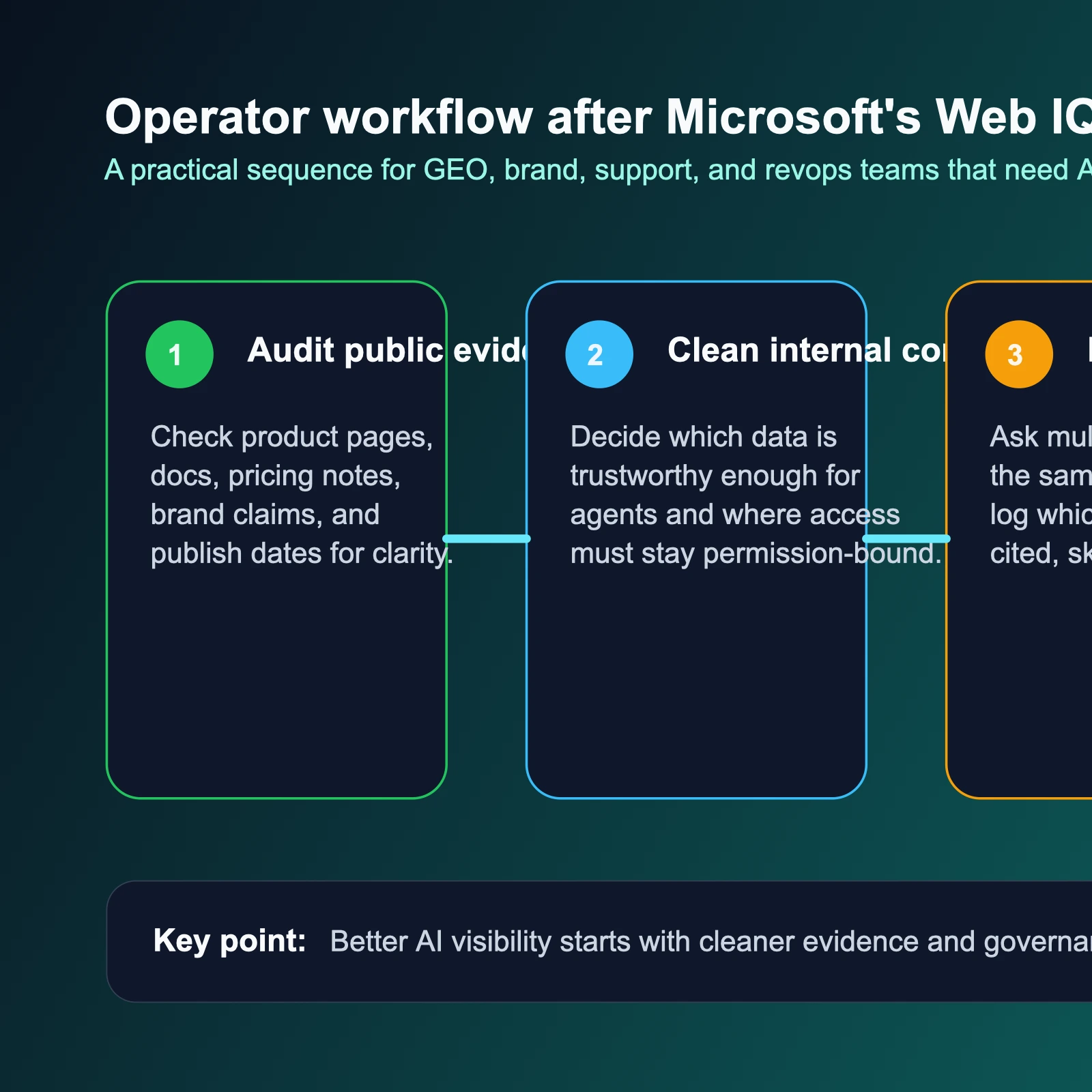
- Audit the public pages you most want cited by AI systems: product pages, documentation, pricing explanations, policy pages, case studies, and brand-level explainers.
- Identify which internal systems actually contain trustworthy context and which ones still need cleanup before any agent should use them.
- Tighten entity consistency across site copy, metadata, help content, and owned profiles using the brand mentions tracking guide.
- Define a small grounding QA loop: ask multiple AI systems for the same answer, compare which sources they cite, and log where your brand is absent, stale, or misrepresented.
- Use a commercial sanity check before building anything large. If the opportunity is demand capture, model the upside with the Marketing ROI Calculator or the Digital Marketing Budget Planner.
What remains uncertain
There are still clear unknowns. Microsoft said on June 2 that Web IQ is available in limited access to select Azure customers, so broad operator access is not here yet. The company also positioned Web IQ as already powering grounding for Microsoft Copilot and ChatGPT in the Build Live post, but it did not publish a simple field guide for how marketers should test or optimize specifically for that retrieval layer.
The other uncertainty is measurement. Even if grounding stacks become more important, most teams still lack a stable reporting system for "AI visibility" that matches the maturity of classic search analytics. That is why the strongest immediate response is operational, not speculative: improve source clarity, reduce conflicting claims, strengthen machine-readable public pages, and make internal business context cleaner before rolling more agent behavior into production.
The headline from Microsoft Build is narrow but important. On June 2, 2026, Microsoft treated workplace context, structured business semantics, and live web grounding as one shared system for agents. Teams that care about search, GEO, support, and business automation should treat that as a signal that evidence quality, governance, and visibility are converging into the same operating problem.