Mixpanel turns product analytics into a programmable control layer for AI agents
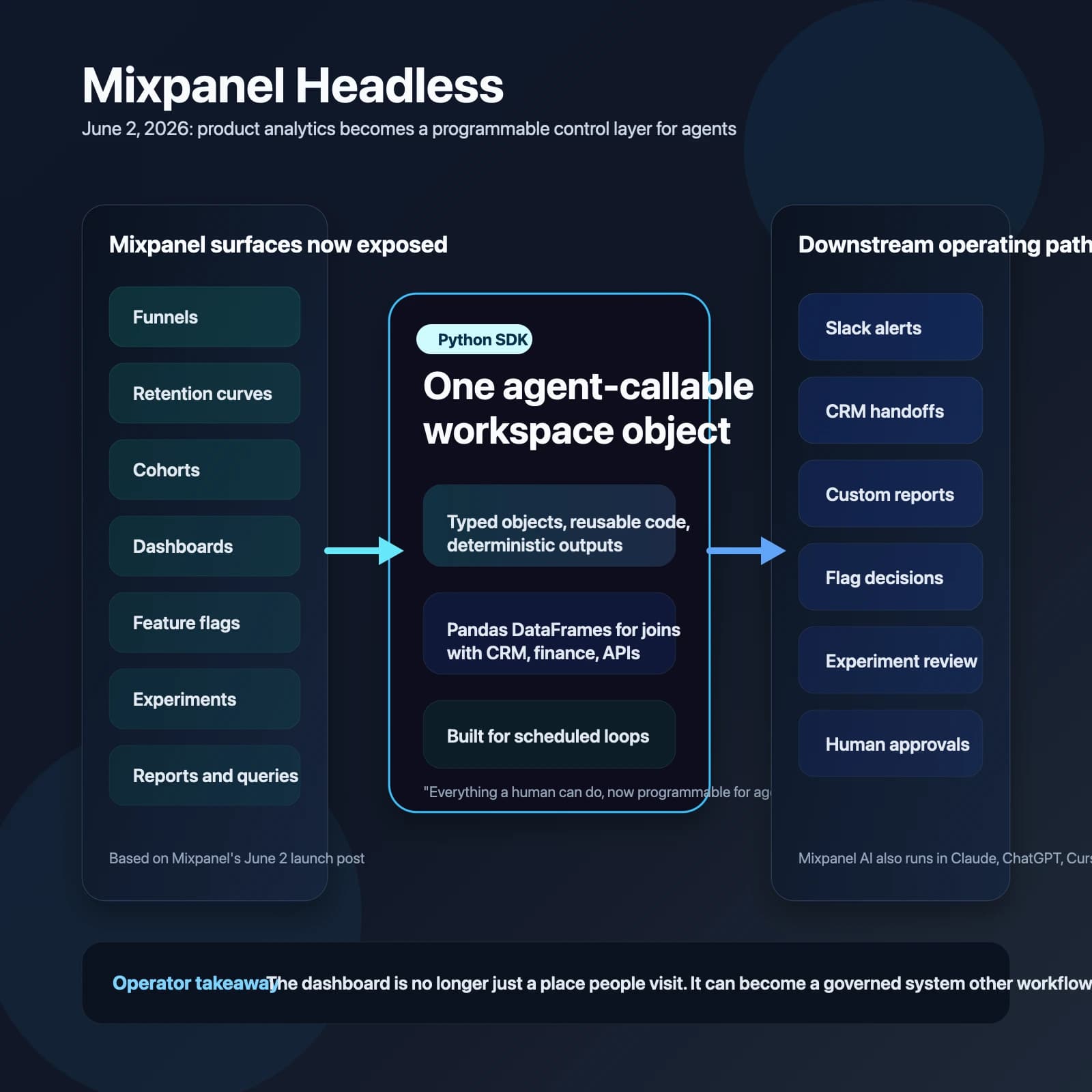
Mixpanel said on June 2, 2026 that it is launching Mixpanel Headless, a Python SDK that exposes Mixpanel's full product surface to code and AI agents. For teams that already use analytics to decide what to ship, what to pause, and where conversion is slipping, the practical change is direct: analytics can move from a dashboard humans inspect to a programmable control layer agents can run, schedule, and connect to the rest of the business.
The broader context matters. Mixpanel's May 13, 2026 Mixpanel AI launch framed the goal as "always-on product intelligence," with Mixpanel Agent in Slack, ChatGPT, Claude, and Cursor. The newer Headless product page adds the harder operating detail: full product access, Pandas DataFrame outputs, and deterministic code paths that teams can audit and rerun.
What changed
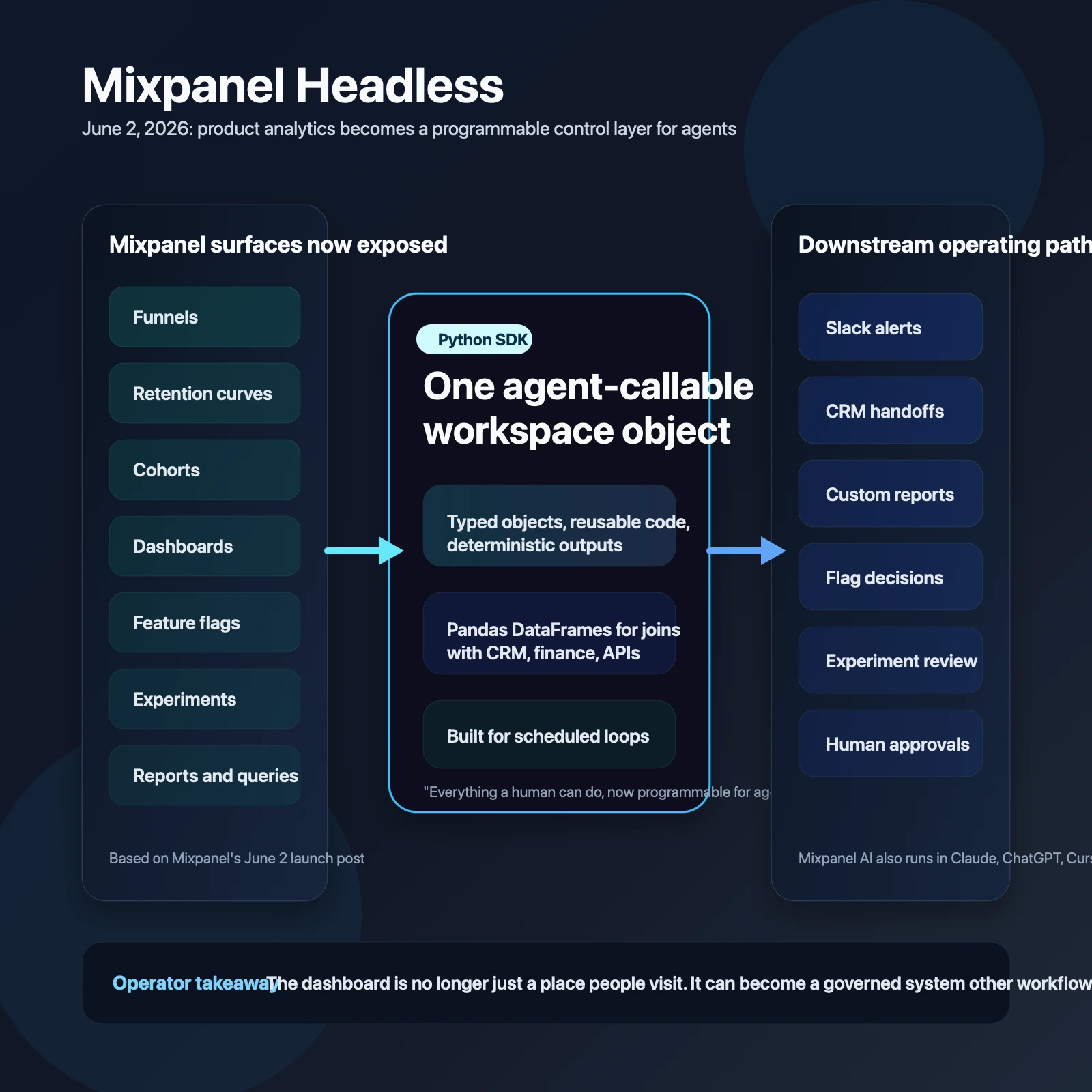
The June 2 announcement makes a sharp distinction between chat-based analytics help and analytics that an agent can actually operate. In the launch post, Mixpanel says its earlier MCP server offers a curated set of roughly 30 tools for natural-language sessions, while Headless gives code-level access to reports, cohorts, funnels, dashboards, feature flags, experiments, and more. The official product page says Headless exposes every query engine, report type, configuration, and action available in the product through Python, and returns results as Pandas DataFrames that can connect to CRM, warehouse, financial, and usage data.
| Confirmed Mixpanel detail | Primary source | Why it matters |
|---|---|---|
| Mixpanel Headless makes reports, cohorts, funnels, retention curves, dashboards, feature flags, and experiments available as typed Python objects. | Mixpanel Headless launch, June 2, 2026 | Agents can work against the real product surface instead of a narrow assistant wrapper. |
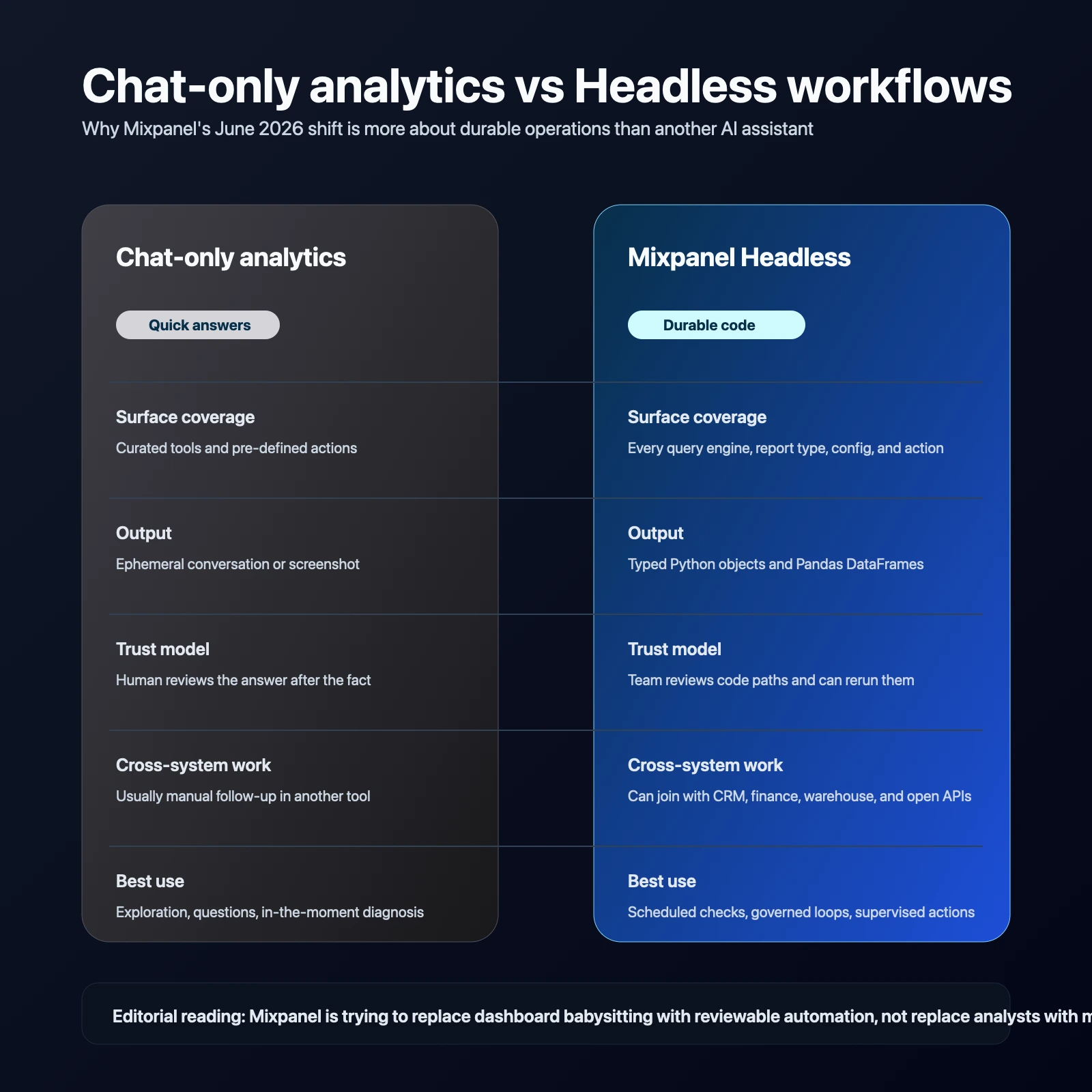
| Mixpanel says its MCP server remains useful for chat, but Headless is for systems you want to leave running. | Mixpanel Headless launch, June 2, 2026 | Teams can separate quick analysis from durable automation. |
| The Headless product page says it exposes every query engine, report type, configuration, and action available in Mixpanel. | Mixpanel Headless product page | This is broader than a reporting API and closer to an operational SDK. |
| Mixpanel says Headless results arrive as Pandas DataFrames that can join with CRM, warehouse, financial data, usage logs, or open APIs. | Mixpanel Headless product page | Analytics outputs can move directly into business workflows instead of manual exports. |
| Mixpanel says its AI layer works inside Claude, ChatGPT, Cursor, and Slack, with broader rollout through June 2026. | Mixpanel AI launch, May 13, 2026 and Mixpanel AI product page | The control layer is being paired with the surfaces where modern teams already make decisions. |
One example in the June 2 post is especially concrete. Mixpanel shows a retention script that can alert Slack when week-four retention drops below 30%, then a second example where an agent watches a checkout funnel for 24 hours and archives a feature flag if conversion falls below 5%. That is the clearest signal that Mixpanel wants analytics to move from observation toward supervised action.
Why it matters
This matters because shipping software, campaigns, and growth experiments is no longer the hard part for many teams. The bottleneck is understanding what happened quickly enough to act before the next sprint, budget cycle, or launch window. Mixpanel is arguing that the dashboard itself is becoming too slow as the primary operating surface.
That argument should resonate beyond product analytics teams. Growth marketers, lifecycle teams, paid acquisition managers, and digital product owners all depend on the same loop: detect a change, explain the cause, decide what to test, and document the result. A programmable analytics layer compresses that loop if it is trustworthy. Mixpanel's emphasis on deterministic code, auditable outputs, and reusable scripts is the key point. It is trying to make AI analysis easier to verify, not only easier to request.
The Headless page also says Python output can join Mixpanel results to CRM, warehouse, finance, or open API data. That means a growth team could ask whether paid social activation is dropping, whether the affected cohort is lower-LTV in the CRM, and whether an experiment or offer should be paused until the problem is understood. That connects naturally with Slogan.website's Marketing ROI Calculator, Digital Marketing Budget Planner, and GEO Visibility Checklist: the value is not more charts, but faster, better-governed operating decisions.
Who is affected
The first group is AI-native software teams that ship frequently and do not want product understanding to lag behind development speed. The second is growth and lifecycle teams using Mixpanel as a live operating input for onboarding, activation, retention, and experiment review. The third is agencies and consultants building internal analytics copilots or automated reporting systems for clients who care about governed outputs instead of black-box summaries.
What to do next
- Separate conversational analytics use cases from durable ones. Use chat for exploration, but identify the recurring dashboards, cohort checks, and experiment reviews that should become code.
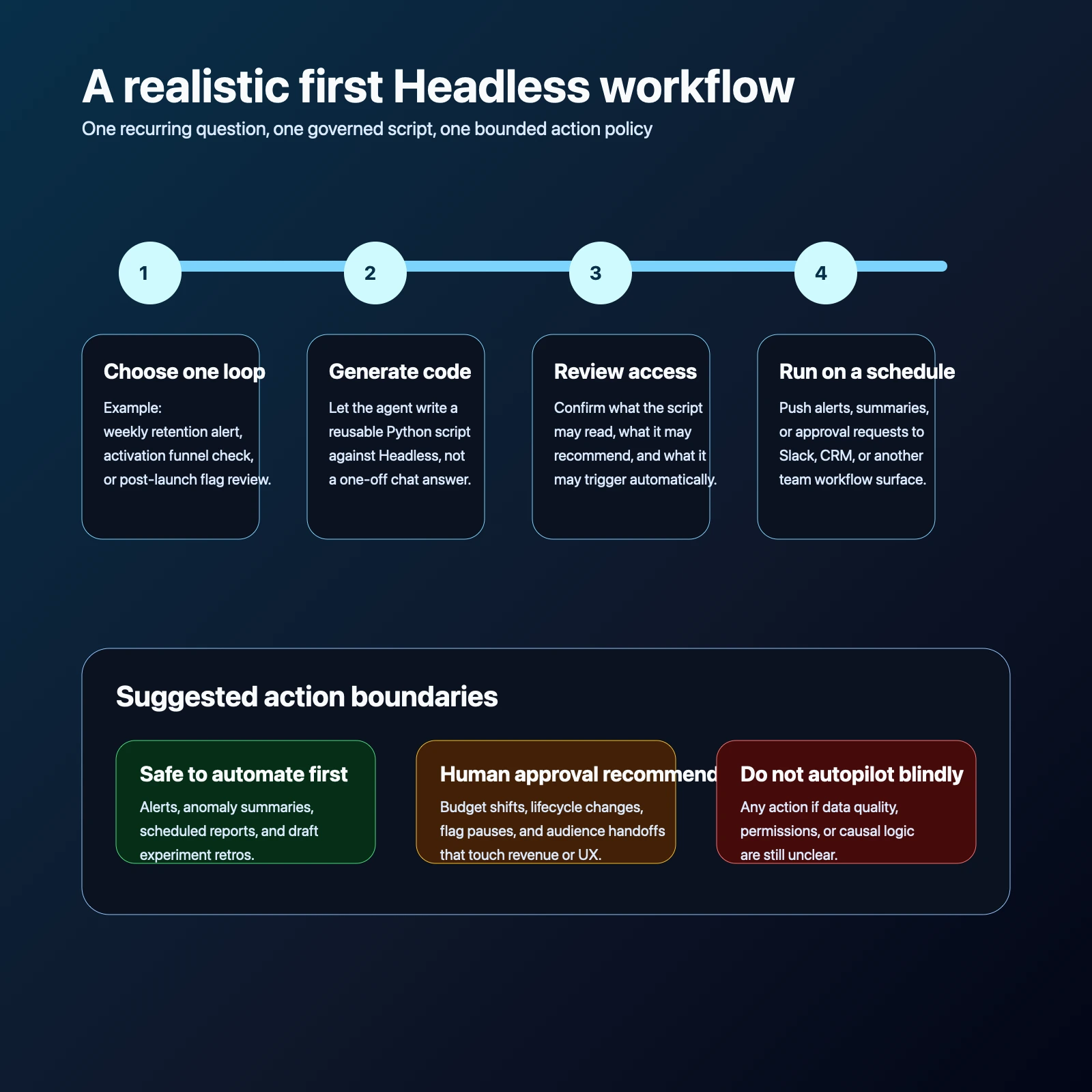
- Pick one supervised loop first, such as retention alerts, funnel drop detection, or post-launch regression checks, instead of trying to automate all analytics work at once.
- Define what an agent may only analyze versus what it may recommend versus what it may actually trigger, such as pausing a flag or sending an alert.
- Join product data with business context. If your CRM, revenue, or channel data still lives in separate silos, the analytics agent will stay half-blind.
- Use the Marketing ROI Calculator and Digital Marketing Budget Planner to decide whether faster insight loops are changing spend efficiency, not just report speed.
Teams that also care about AI-era discoverability should extend the same discipline to public content and source quality. That is the same operating logic behind Slogan.website's guide to brand mentions and visibility measurement.
What remains uncertain
Important limits remain as of June 9, 2026. Mixpanel's public materials make the product direction clear, but they do not publish broad customer benchmarks showing how much Headless reduces analyst workload, improves experiment speed, or changes business outcomes across industries.
It is also not yet clear how many teams will be comfortable letting agents take actions beyond alerting and recommendation. Deterministic code helps, but governance still depends on access design, review rules, and whether the surrounding business data is clean enough to trust.
The defensible takeaway is narrower. On June 2, 2026, Mixpanel gave AI agents a more durable analytics contract than a chat window. For product, marketing, and growth teams, that is a meaningful operational shift because it turns analytics from a place you visit into a system other workflows can call.