MoEngage turns lifecycle automation into a guardrailed agent workflow for CRM teams
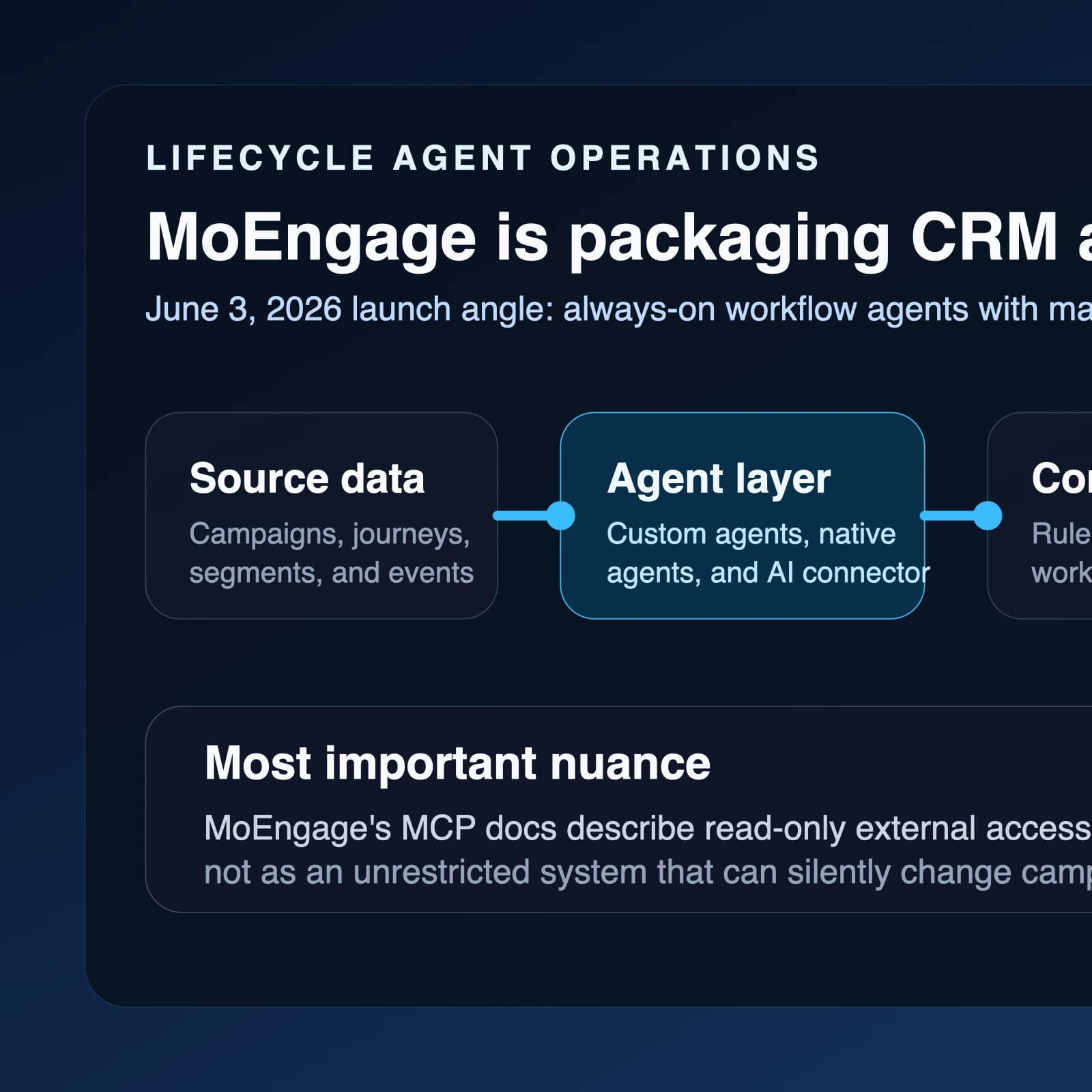
MoEngage said on June 3, 2026 that it is launching Merlin AI Custom Agents, giving lifecycle marketers and CRM teams a way to build always-on workflow agents on top of their own campaign data, tools, and operating rules. The practical shift is not another AI writing assistant. It is a move toward agent-style execution for recurring marketing work such as campaign QA, journey setup, and analytics reporting, with activity logs and marketer-defined boundaries built into the pitch from day one.
That makes this a more useful story for operators than a generic "AI for marketing" announcement. MoEngage's product update page frames the release as the first truly autonomous marketing workforce, built to let teams create custom agents, use native ones, and connect the wider stack through its AI connector. Its official MCP server documentation adds an important nuance: the current connector is read-only, OAuth-based, and scoped to the authenticated user's workspace and role. In other words, the new model is about governed access and explainable automation, not blind autopilot.
What changed
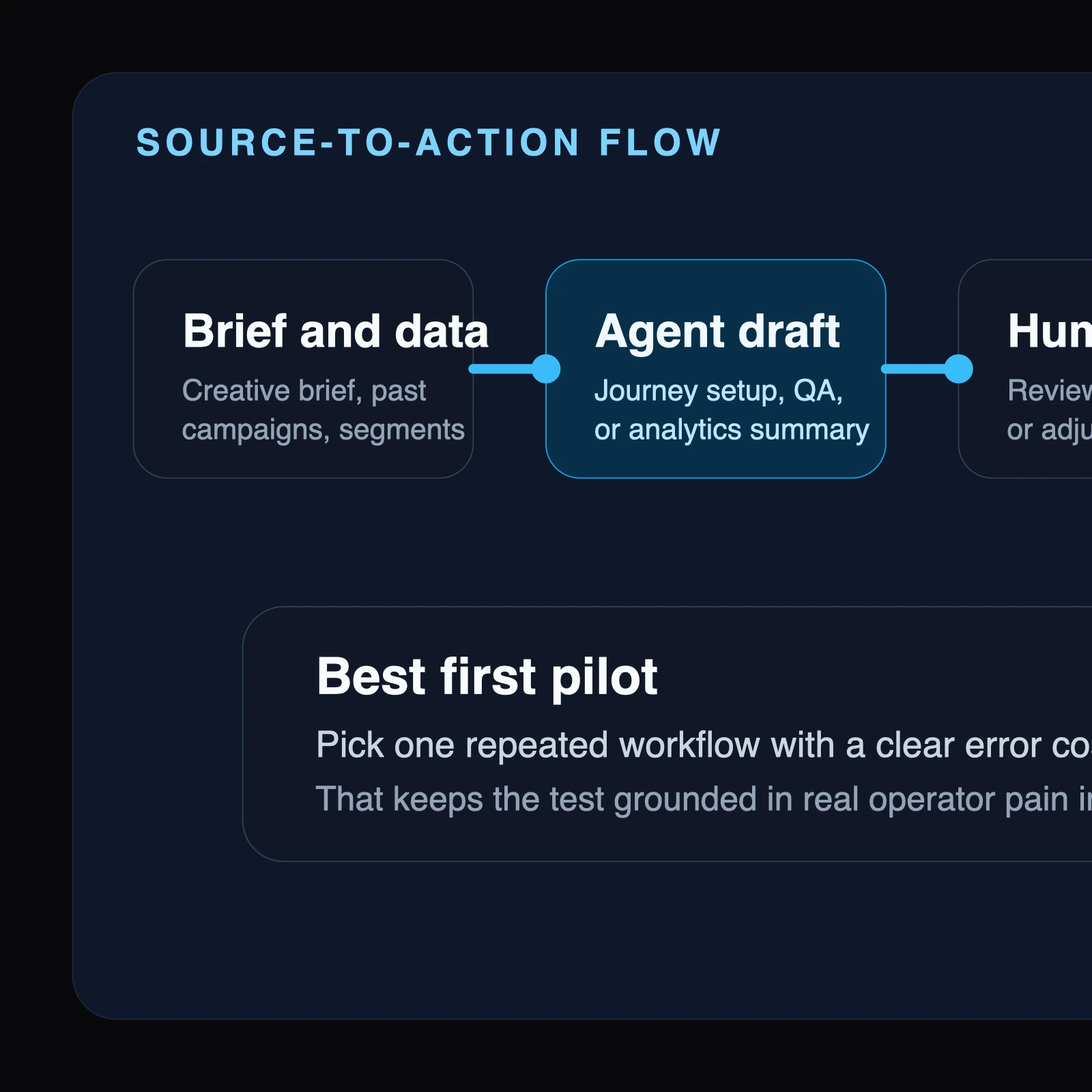
The June 3 release makes three product claims that matter in practice. First, MoEngage says lifecycle and CRM teams can build custom agents that run on MoEngage data and tools, with marketer-defined rules and full activity logs. Second, it says those agents can cover concrete use cases such as pre-send QA, turning a creative brief into a review-ready journey, and generating analytics reports without someone opening a dashboard. Third, it says teams can connect MoEngage to external AI systems such as Claude and ChatGPT through an MCP server and related agent-callable APIs.
| Confirmed release detail | Primary source | Operational takeaway |
|---|---|---|
| Merlin AI Custom Agents launched on June 3, 2026 for lifecycle and CRM teams | MoEngage release | Customer engagement teams are the explicit buyer, not only data science or engineering. |
| MoEngage says agents can run on its data and tools inside marketer-defined rules with a full activity log | MoEngage release | Governance and traceability are being treated as product requirements, not optional add-ons. |
| The MCP server gives AI assistants access to campaign search, analytics, and content review | MoEngage MCP docs | Teams can start with analysis and diagnosis before trusting action-oriented automation. |
| The MCP connector is read-only, OAuth-based, and scoped to the user's workspace and role | MoEngage MCP docs | External AI access is currently designed for governed visibility, not unrestricted campaign changes. |
| MoEngage positions the release as an autonomous marketing workforce connected through its AI connector | MoEngage product updates | The company is selling an operating model, not just a set of prompt features. |
The read-only point matters more than the marketing language. According to MoEngage's docs, the MCP server currently offers campaign search and analytics tools, enforces workspace- and role-scoped access, and limits analytics queries to a maximum of 30 days. That means the product is strongest today as a trusted diagnostic and orchestration layer around customer engagement work, not as a fully autonomous black box that can silently rewrite your lifecycle program.
Why it matters
Most martech AI launches still live inside one narrow box: write copy faster, summarize a dashboard, or answer a question in a chat panel. MoEngage is pushing toward something more operational. It is trying to make recurring lifecycle work agent-callable, explainable, and stack-aware. For teams running email, push, SMS, in-app, and WhatsApp journeys across the United States, Canada, the United Kingdom, Australia, and Europe, that is potentially more valuable than another content generator because the expensive problem is usually coordination, not ideation.
There is also a budget argument here. Many CRM teams do not need infinite new channels. They need fewer preventable mistakes, faster review cycles, and better reuse of campaign context. If an agent can catch campaign misconfiguration before launch, assemble a draft journey from a creative brief, or produce a first-pass performance summary for review, the gain shows up in labor efficiency and speed to market. That is the kind of workflow where teams can model expected savings with the Marketing ROI Calculator and set a realistic automation budget inside the Digital Marketing Budget Planner instead of buying into broad AI hype.
Who is affected
The clearest near-term audience is B2C lifecycle and CRM teams using MoEngage in ecommerce, apps, marketplaces, subscriptions, and loyalty-led businesses. Agencies or consultants running retained CRM operations for those brands should also pay attention, especially if they are under pressure to deliver more testing and reporting without adding headcount.
This is also relevant for AI governance owners. MoEngage's documentation says the MCP server uses OAuth-based authentication and inherits the current workspace, environment, and role from the active account session. That means security, approval, and access design are part of the rollout decision. Teams that already care about message quality, segmentation hygiene, and attribution reliability should treat agent rollout the same way they treat a major channel expansion: as an operating controls project, not just a feature toggle.
What to do next
Use the launch as a prompt to tighten the foundation before turning on more autonomy.
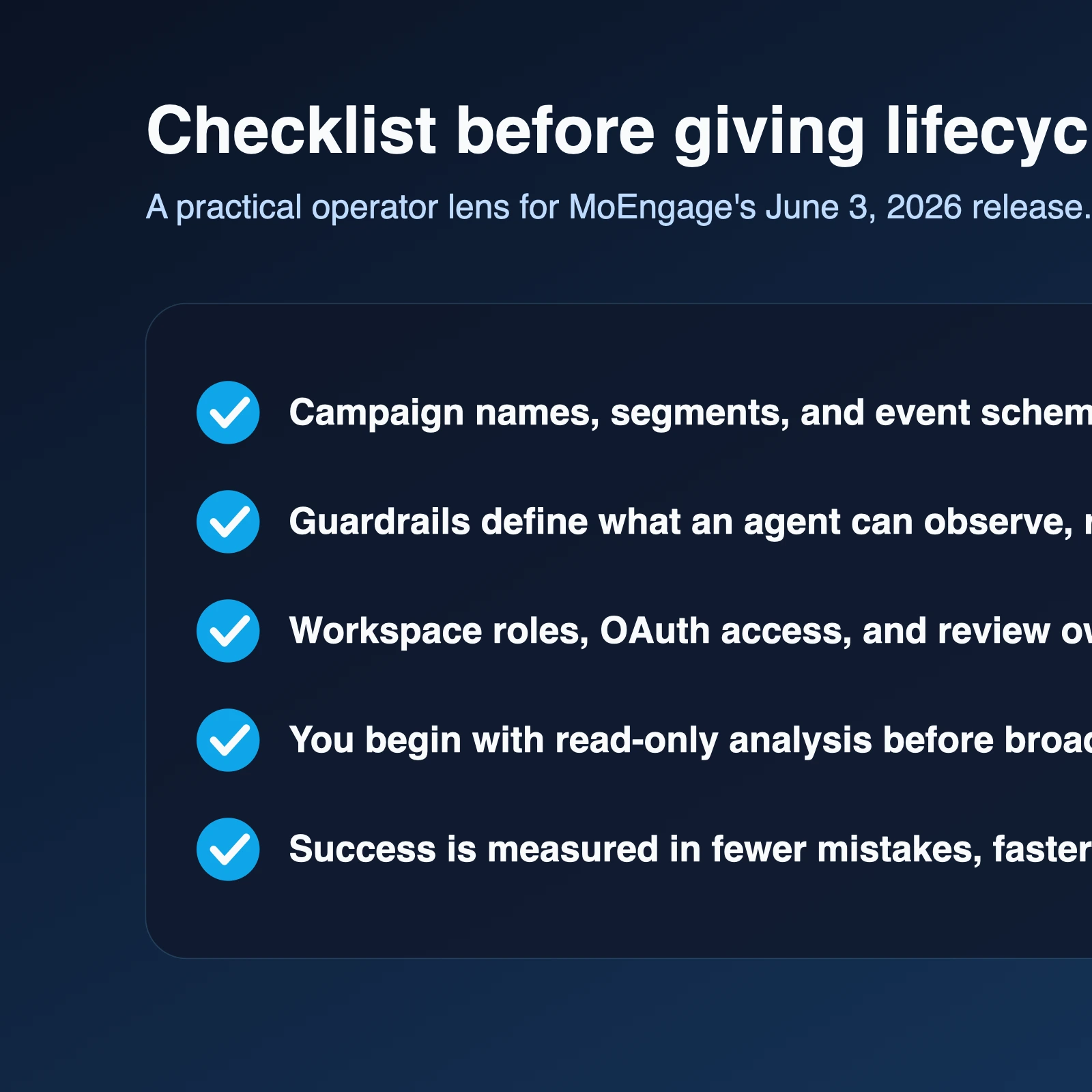
- Start with one recurring task such as pre-send QA, weekly campaign reporting, or journey draft assembly.
- Audit whether campaign naming, segmentation logic, event schemas, and suppression rules are clean enough for an agent to interpret safely.
- Define what the agent can observe, what it can recommend, and what still needs human approval.
- Use read-only analysis first through campaign search and performance review before expanding into more complex orchestration.
- Track outcomes that matter to operators: fewer launch errors, shorter review cycles, faster analysis turnaround, or better conversion from existing journeys.
That same discipline matches how Slogan.website approaches workflow tools more broadly. If your team is still working through AI-era discovery and trust questions, the GEO Visibility Checklist and the guide to tracking brand mentions and visibility are useful companions because they force you to separate observability from action before scaling automation.
What remains uncertain
Important questions are still open. MoEngage has described the release, but it has not publicly detailed broad customer rollout depth, pricing, or independent performance benchmarks for the new custom-agent layer. The docs also note that the MCP server is currently available only in specific data center environments and that marketplace-style one-click installation for Claude and ChatGPT is still being worked on rather than fully shipped today.
That leaves a sensible conclusion for June 6, 2026: this is a credible workflow signal, not a proven default architecture for every CRM team. MoEngage is clearly betting that lifecycle marketing will move from prompt help to governed, semi-autonomous execution. The teams that benefit most will likely be the ones that treat the launch as permission to formalize rules, review, and measurement first, then add autonomy where the operational payoff is real.