OpenAI turns AI training into a workflow adoption playbook with new Academy courses

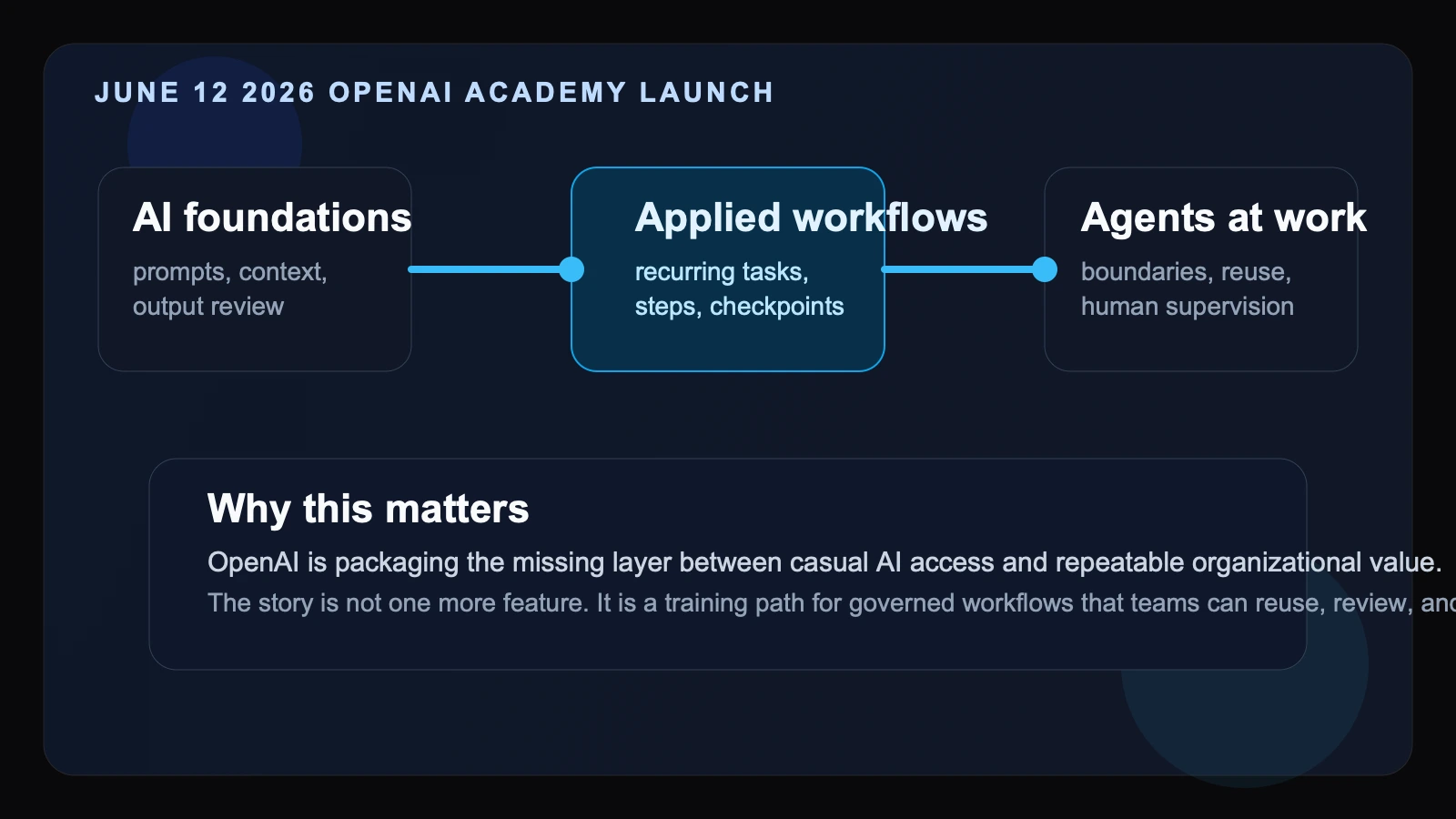
OpenAI used an official June 12, 2026 announcement to launch three new Academy courses: AI Foundations, Applied AI Foundations, and Agents and Workflows. The company says the goal is to move teams from basic AI fluency to repeatable working methods, not just one-off prompting. The companion OpenAI Academy courses page makes that progression explicit: learn the basics, turn recurring tasks into structured workflows, then practice directing agent-assisted work with context, boundaries, and review.
That makes this more than a training announcement. For enterprise marketing teams, agencies, RevOps leaders, growth operators, and software-enabled business teams in the United States, Canada, the United Kingdom, Australia, and Europe, the practical issue is not whether staff can get one impressive output from AI. It is whether a company can turn scattered individual usage into repeatable, reviewable, measurable operating routines. OpenAI is now packaging that adoption layer as a productized curriculum.
What changed
OpenAI's announcement says the new courses create a shared path from understanding AI, to applying it to recurring work, to directing more structured workflows with agents. The company also says the courses are meant for employee onboarding, enterprise learning programs, and broader AI adoption efforts, not just personal experimentation.
The Academy courses page adds useful operator-level detail. AI Foundations is framed for people new to AI and covers clear instructions, useful context, output review, and responsible use in everyday work. Applied AI Foundations is for people with some experience and focuses on turning a recurring task into a repeatable workflow with defined steps and review points. Agents and Workflows is for users already comfortable with AI and focuses on structured agent direction: context, expected outputs, boundaries, review, and reuse.
OpenAI also says learners who complete a course receive a certificate, and that organizations can use the curriculum to recognize participation, encourage champions, and build a common operating language across teams. The same June 12 announcement says OpenAI is working with partners including BCG, Accenture, and BBVA to help organizations apply these skills in day-to-day work.
| Confirmed June 12, 2026 detail | Primary source | Why operators should care |
|---|---|---|
| OpenAI introduced three new Academy courses: AI Foundations, Applied AI Foundations, and Agents and Workflows. | OpenAI announcement | The company is defining an official learning path from basic AI use to reusable agent workflows. |
| AI Foundations covers prompting, context, output review, and responsible use. | Academy courses page | OpenAI is teaching usage habits, not only feature awareness. |
| Applied AI Foundations focuses on turning recurring work into a repeatable workflow. | Academy courses page | The middle layer is process design, which is where many teams still break down. |
| Agents and Workflows focuses on directing agent-assisted work with boundaries and review. | OpenAI announcement and Academy courses page | Governed agent use is moving into mainstream enterprise enablement. |
| OpenAI says organizations can use the courses for onboarding, enterprise learning, and broader adoption initiatives. | OpenAI announcement | The target customer is the operating organization, not just the curious individual user. |
Why it matters
The significance is operational. Most companies now have some AI usage, but much less agreement on workflow quality. One employee uses AI for meeting prep, another for copy drafts, another for SQL help, and nobody shares the same prompt structure, review standards, handoff logic, or measurement model. OpenAI's June 12 framing says the distance between "deployment" and "value" closes when people know how to apply AI in context and turn success into repeatable ways of working.
That matters directly to marketing, SEO, GEO, analytics, and digital operations teams. If your team is using AI to draft campaign angles, analyze competitor visibility, plan reporting, rewrite landing pages, or prepare executive summaries, then quality depends less on novelty and more on repeatability. The same discipline shows up in Slogan.website's own GEO Visibility Checklist, the guide to generative engine optimization benefits, and the workflow for tracking brand mentions and visibility. Better AI adoption usually comes from clearer inputs, clearer review points, and clearer accountability.
There is also a management signal here. On June 12, OpenAI did not announce one more assistant feature and leave enablement to consultants. It presented learning as part of deployment. That is important for upper-midmarket and enterprise teams because it suggests AI adoption budgets will increasingly include training systems, participation signals, workflow documentation, and internal champions, not just model access.
Who is affected
The first group is enterprise marketing and growth leadership. These teams often need AI to improve output quality and speed without turning review and brand governance into chaos.
The second group is operations-heavy functions such as RevOps, analytics, customer success, content operations, and internal enablement. They are the teams most likely to benefit from the middle course layer where recurring work gets mapped into explicit workflow steps.
The third group is agencies, consultancies, and software-enabled service firms. Many already sell AI strategy decks; fewer can show a durable operating method for how teams should brief, review, refine, and reuse AI-backed work. OpenAI is now giving buyers a vendor-backed language for that expectation.
What to do next
Use the June 12 launch as a prompt to audit whether your team's AI usage is actually reusable.
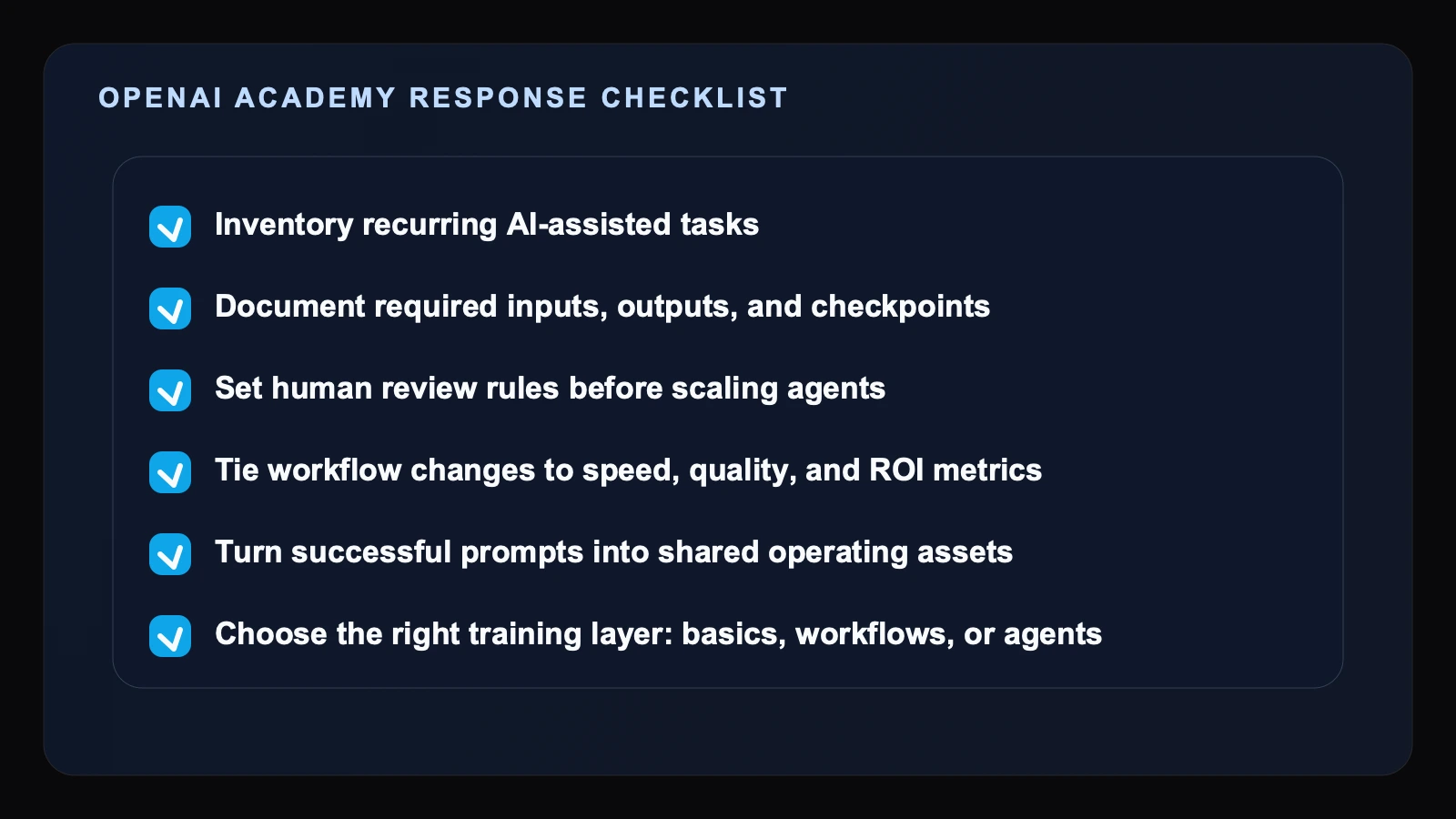
- List the five to ten recurring tasks where AI already saves time, such as reporting summaries, landing-page drafts, campaign analysis, keyword clustering, or support-response preparation.
- Separate basic skill gaps from workflow gaps. If staff can prompt but cannot define inputs, checkpoints, and review rules, you have a process problem rather than an access problem.
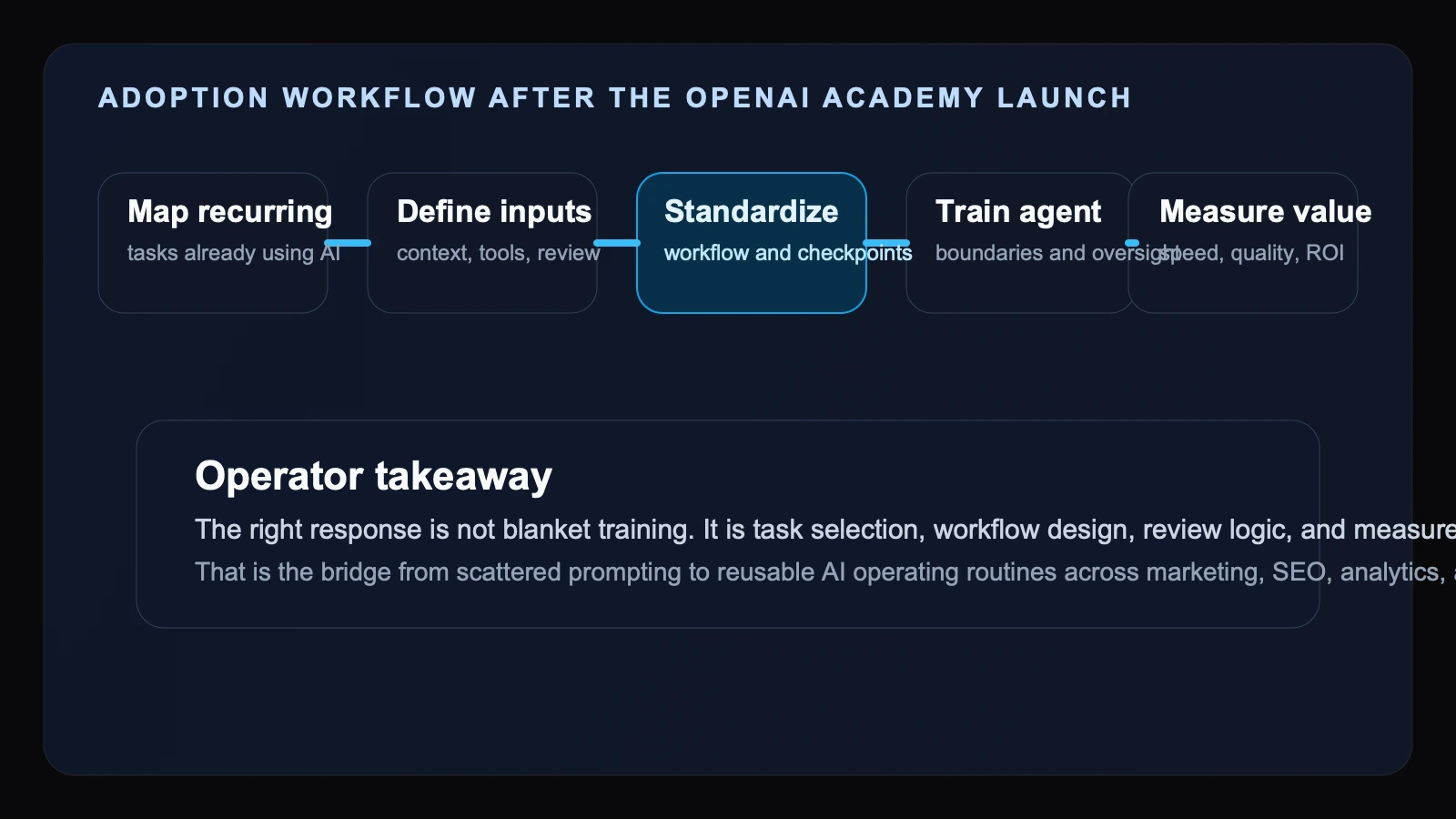
- Choose one workflow to standardize first and document the context, tools, expected outputs, quality checks, and human approval points.
- Connect that workflow to measurable business outcomes using tools like the Marketing ROI Calculator and Digital Marketing Budget Planner.
- Decide whether your organization needs broad AI foundations training, workflow design training, or agent-supervision training first, instead of treating all AI education as the same purchase.
- Build an internal library of approved prompts, examples, failure modes, and review notes so successful experiments become reusable operating assets.
What remains uncertain
OpenAI's public materials still leave some enterprise details open. The company says these courses are the beginning of a broader Academy roadmap and that it will continue to expand reporting capabilities for organizations, which implies the management layer is still developing. It also does not publicly spell out how organizations should benchmark course completion against business outcomes such as faster campaign cycles, better QA, lower review overhead, or stronger conversion performance.
There is also a familiar adoption risk. Certificates can make progress visible, but they do not guarantee that teams will redesign real workflows. A company can easily end up with trained individuals and unchanged process debt. That is why the strongest part of the June 12 announcement is not the credential. It is the explicit move from prompting basics to repeatable workflows and agent supervision.
The practical conclusion on June 14, 2026 is straightforward. OpenAI is trying to standardize the learning layer that sits between casual AI access and durable organizational value. Teams that use the courses to clarify workflow design, review boundaries, and measurement will get more than training. Teams that treat them as a badge program will probably get much less.