OpenAI reframes AI ROI around useful intelligence per dollar
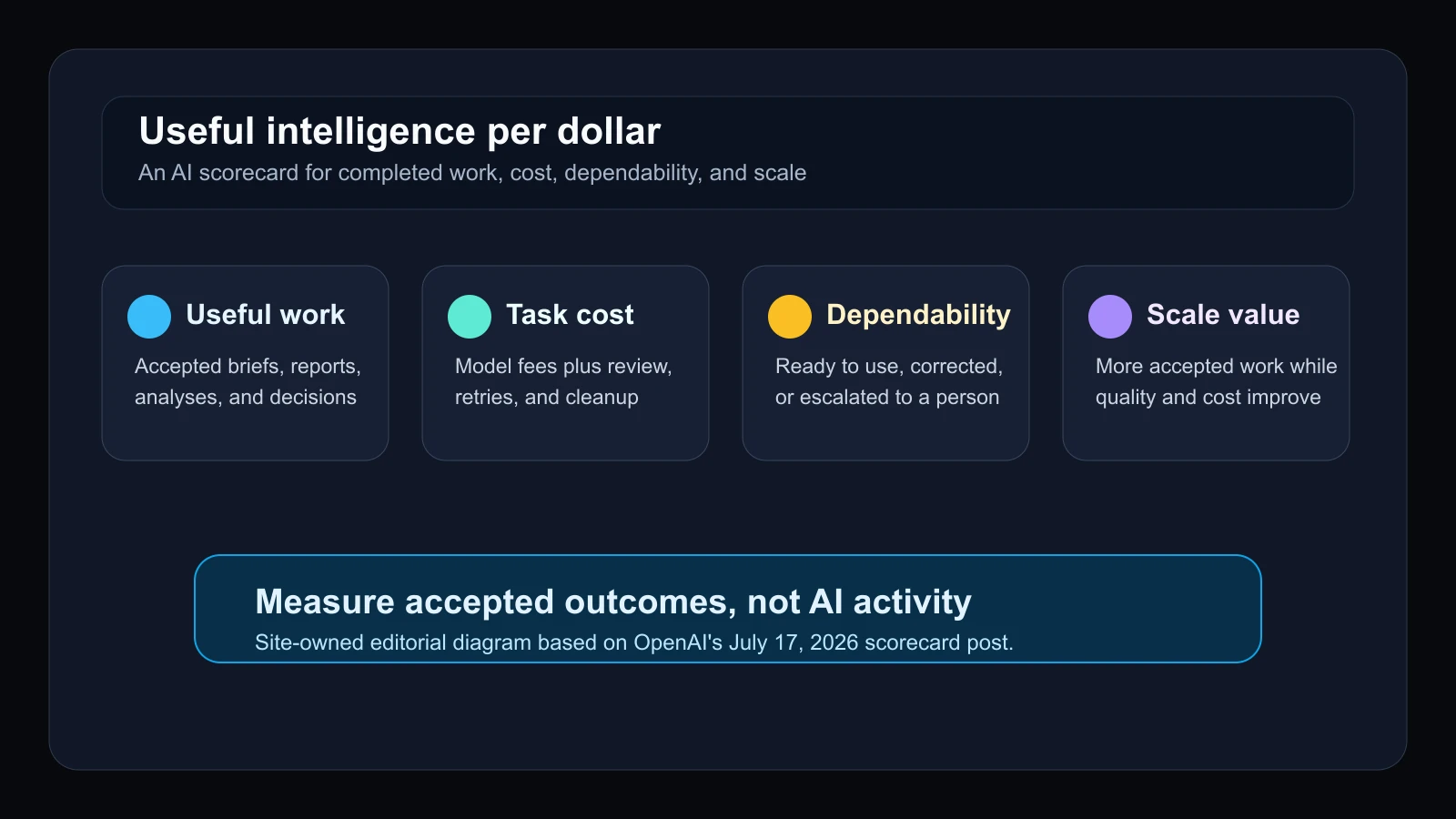
OpenAI published a new AI business measurement framework on July 17, 2026, arguing that companies should move beyond adoption metrics and judge AI by "useful intelligence per dollar": how much dependable work gets completed for the money spent. For marketing, growth, finance, and operations leaders, the practical news is not a new model feature. It is a clearer scorecard for deciding whether AI workflows are actually improving output, review time, and business results.
That matters because many teams still measure AI by seat count, prompt volume, token price, or anecdotal time saved. OpenAI's post says the better question is whether the value of completed AI-assisted work grows faster than the full cost of producing it, including compute, employee time, retries, human review, and rework. The framework gives teams a way to connect AI experiments to the same discipline they already apply in tools like the Marketing ROI Calculator, Digital Marketing Budget Planner, and GEO Visibility Checklist.
What changed
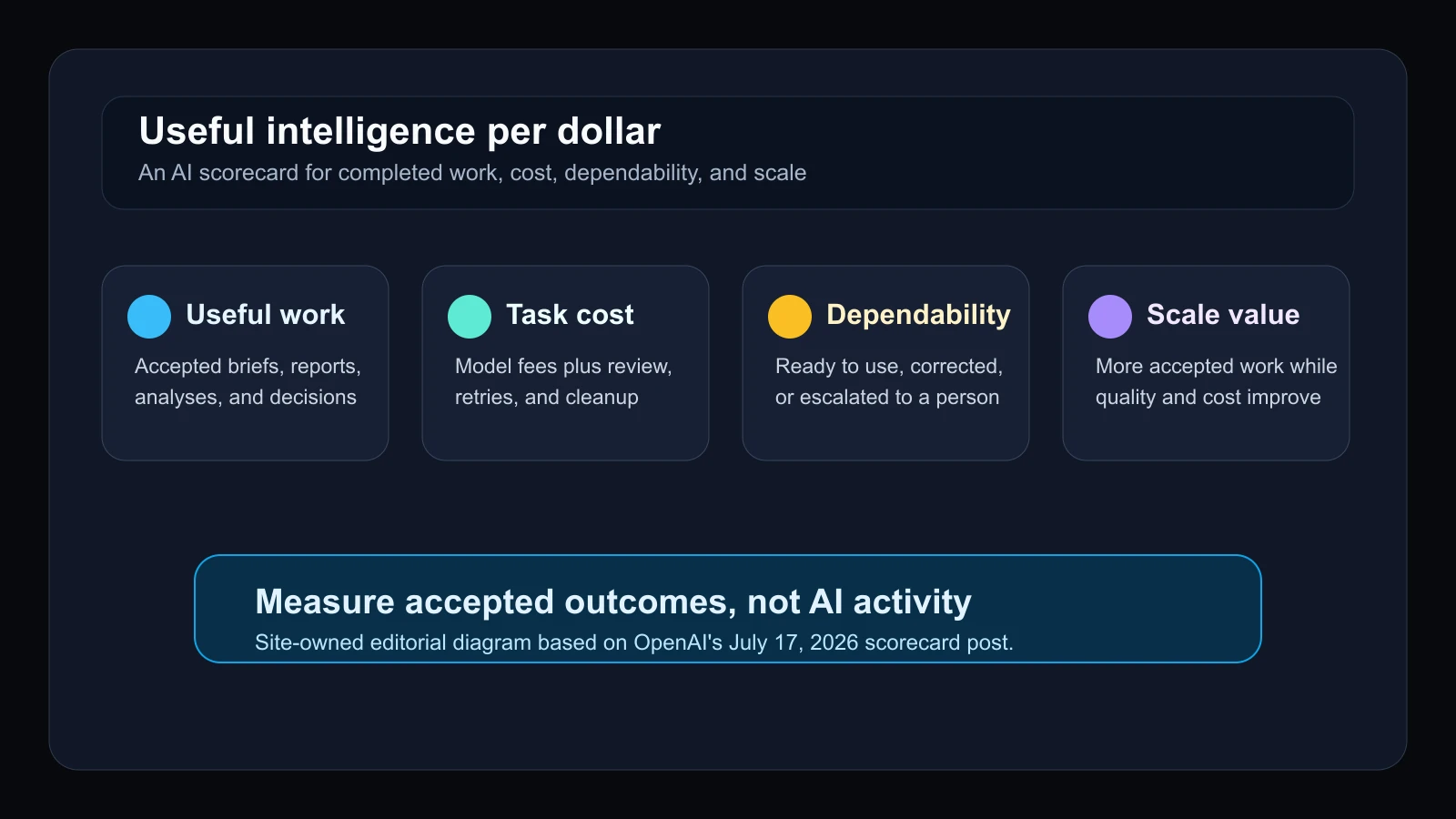
OpenAI's July 17 post names four questions for AI economics: whether AI completes work that matters, what each successful task costs, whether people can depend on the result, and whether each AI dollar produces more value as usage grows. The post says software adoption metrics such as seats purchased, active users, and renewed licenses are not enough because AI value depends on useful work accomplished.
The company also ties the scorecard to its newer product direction. OpenAI's separate July 9, 2026 GPT-5.6 announcement says the GPT-5.6 family includes Sol, Terra, and Luna tiers, with different tradeoffs for frontier reasoning, balanced everyday work, and lower-cost high-volume tasks. In the scorecard post, OpenAI uses that tiered model family to make a broader point: the cheapest token is not always the cheapest successful outcome if a weaker run creates more retries, latency, or review work.
The framework is especially relevant after OpenAI's July 9 launch of ChatGPT Work, which positioned ChatGPT as a cross-app work agent for longer projects, connected files, and finished artifacts. The measurement question now becomes concrete: if an agent prepares campaign reports, creative briefs, sales follow-up summaries, or finance review materials, what percentage is ready to use and what did each accepted output really cost?
| Scorecard question | Marketing or operations translation | What to measure first |
|---|---|---|
| Is AI completing work that matters? | Does the workflow produce a usable brief, report, checklist, landing-page draft, or analysis? | Number of accepted outputs per workflow. |
| What does each successful task cost? | Do model fees, staff review, retries, and cleanup still beat the old process? | Total cost divided by accepted outputs. |
| Can people depend on the result? | Can the team use the output without heavy correction or escalation? | Ready to use, needs correction, needs escalation. |
| Does each AI dollar produce more value as usage grows? | Does scaling the workflow increase completed work faster than cost? | Accepted output volume, quality rate, and cost trend over time. |
Why it matters
The scorecard gives AI buyers a more practical language than model rankings alone. A marketing team may be tempted to choose a cheaper model for every writing, research, or reporting task. OpenAI's argument is that the right comparison is cost per successful task, not cost per token, because a more capable model can be cheaper overall if it finishes the work in one pass and reduces human cleanup.
That is a real operating issue for agencies, B2B teams, ecommerce operators, and software companies in the United States, Canada, the United Kingdom, Australia, and Europe. AI is moving from individual drafting into recurring workflows: campaign measurement, AI search visibility checks, customer research synthesis, content refreshes, reporting packs, and budget planning. Those workflows need financial controls before they expand.
The framework also helps teams avoid a common trap: counting output volume as progress. More briefs, more variants, or more dashboards do not automatically improve marketing performance. The useful metric is whether the AI-assisted work meets a defined quality bar and helps a team make a better decision, launch faster, reduce rework, or improve a measurable outcome.
Who is affected
Finance leaders are the first audience because the post opens with the CFO question: how does the company get more value from AI spend? Instead of approving broad AI budgets on faith, finance teams can ask each function to define the workflow, the cost of successful completion, and the quality threshold.
Marketing operations teams are also affected. A GEO monitoring workflow, for example, should not be scored by how many AI-generated summaries it produces. It should be scored by how many brand mentions, answer-engine citations, competitive gaps, and source fixes were found and acted on. Slogan.website's guide to tracking brand mentions and visibility is a natural place to apply that discipline.
Agencies and consultants can use the scorecard to defend AI-enabled service design. If AI helps produce client reports, landing-page diagnostics, paid media QA, or content refresh plans, the deliverable should show a lower cost per accepted output, a faster review cycle, or a higher quality rate. Otherwise, the AI layer is just extra production noise.
What to do next
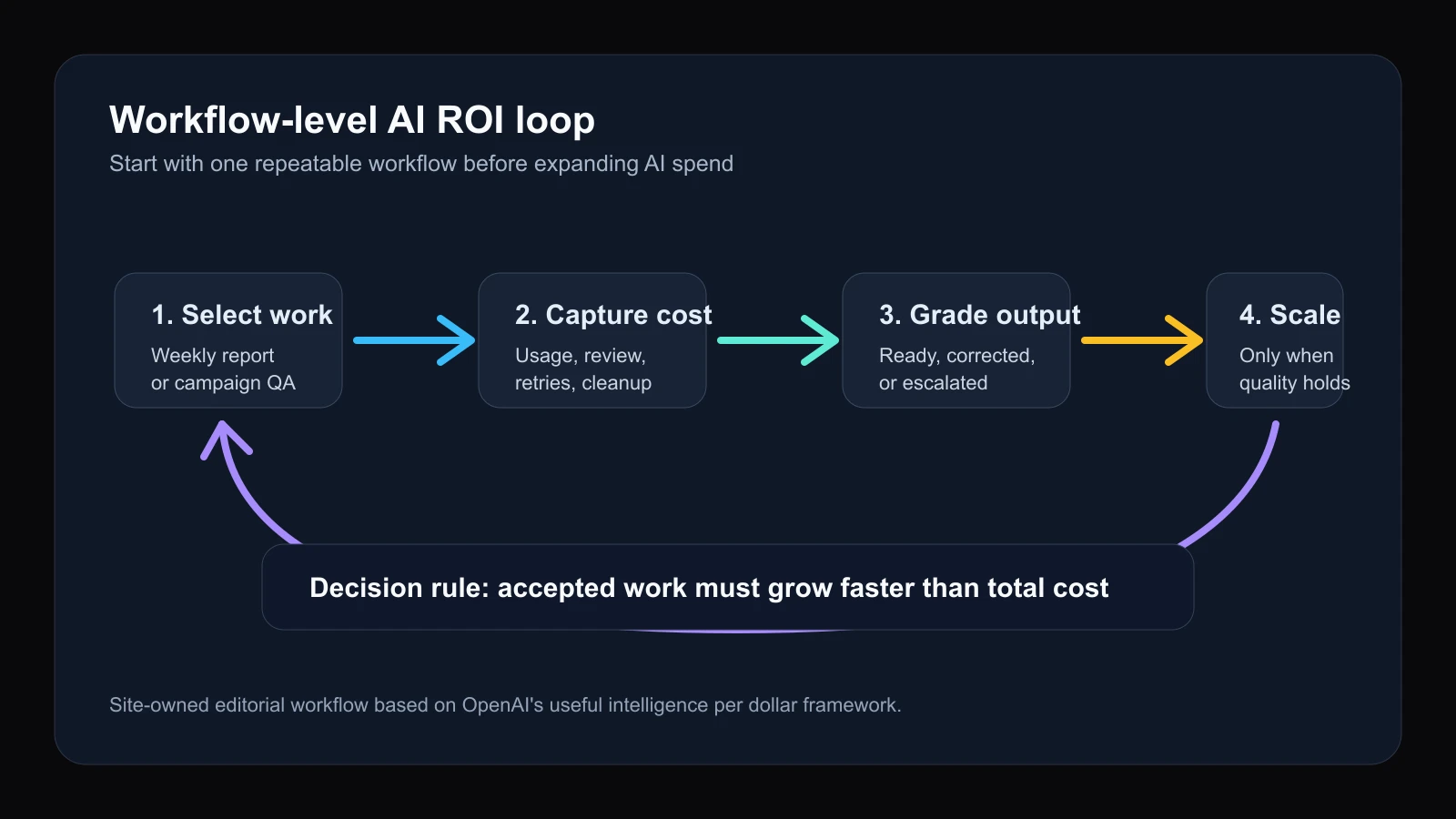
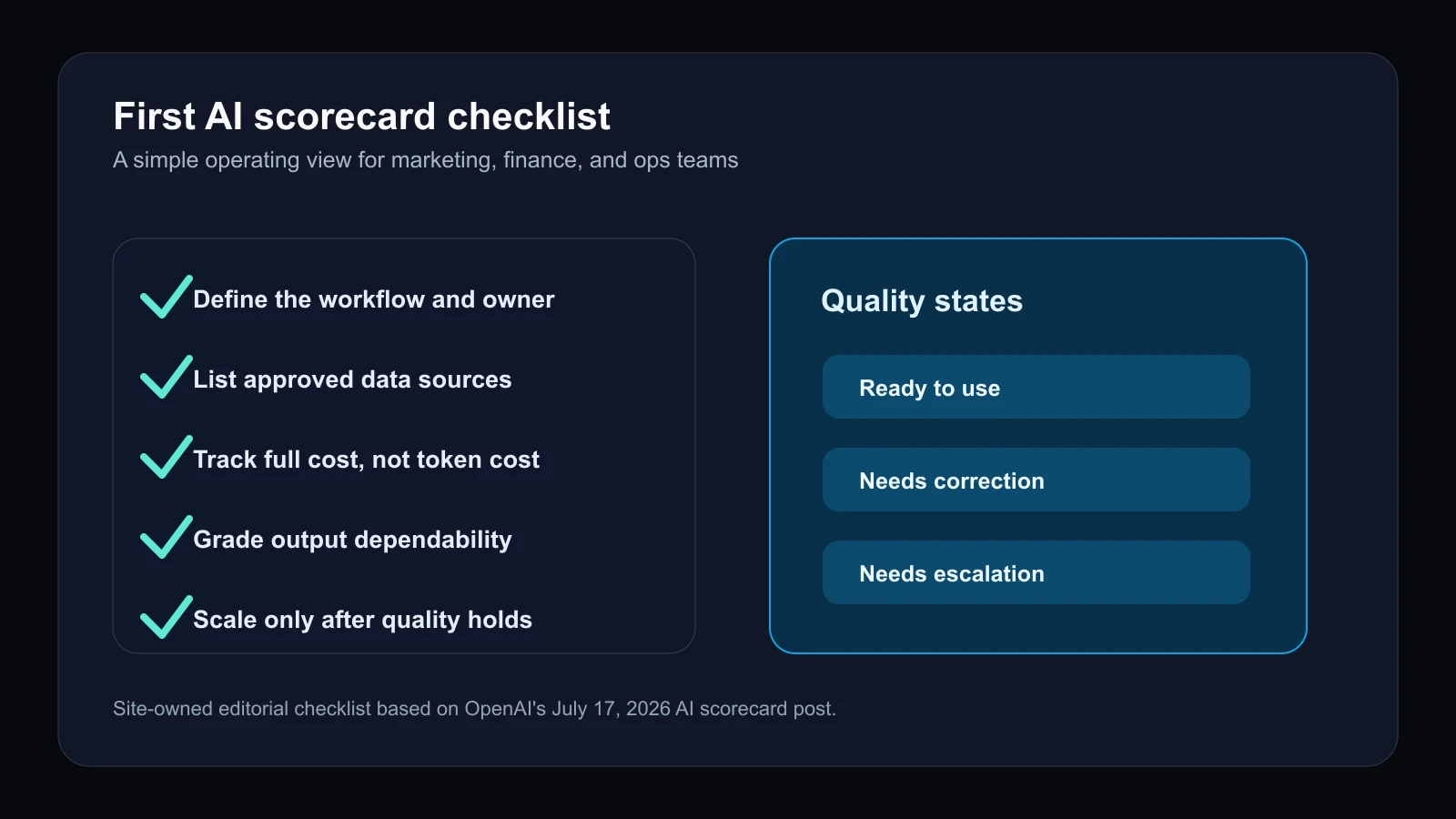
- Pick one repeatable workflow, such as weekly campaign reporting, creative QA, GEO visibility checks, lead follow-up review, or budget variance analysis.
- Define "done" before running AI: accepted report, approved brief, corrected dashboard, updated page, or shipped recommendation.
- Track the full cost: model usage, staff review time, retries, corrections, latency, and final production work.
- Grade each output as ready to use, needs correction, or needs escalation, matching the dependability categories in OpenAI's post.
- Compare models or workflow designs by cost per accepted output, not only monthly license cost or token price.
- Scale only after quality holds steady while accepted output grows faster than total cost.
What remains uncertain
OpenAI's July 17 post is a framework, not a standardized accounting rule. It does not define a universal formula for the value of a completed task across every department, and teams will still need to choose their own quality bars, review thresholds, and business outcomes. A lead-scoring workflow, a paid media reporting workflow, and a contract-review workflow should not share the same definition of success.
The vendor comparison problem also remains open. OpenAI argues that capable models can reduce total cost through fewer attempts and less review, but every team must test that claim against its own workflows, data access, compliance rules, and user behavior. Model benchmarks can inform the shortlist; workflow scorecards should decide the budget.
The useful takeaway on July 18, 2026 is narrow but important: AI ROI should be measured where work actually gets done. For marketing and digital business teams, the next mature step is to stop asking whether employees are using AI and start asking which AI-assisted workflows reliably create accepted work at a lower total cost.