OpenAI turns ChatGPT into a work agent for marketing operations
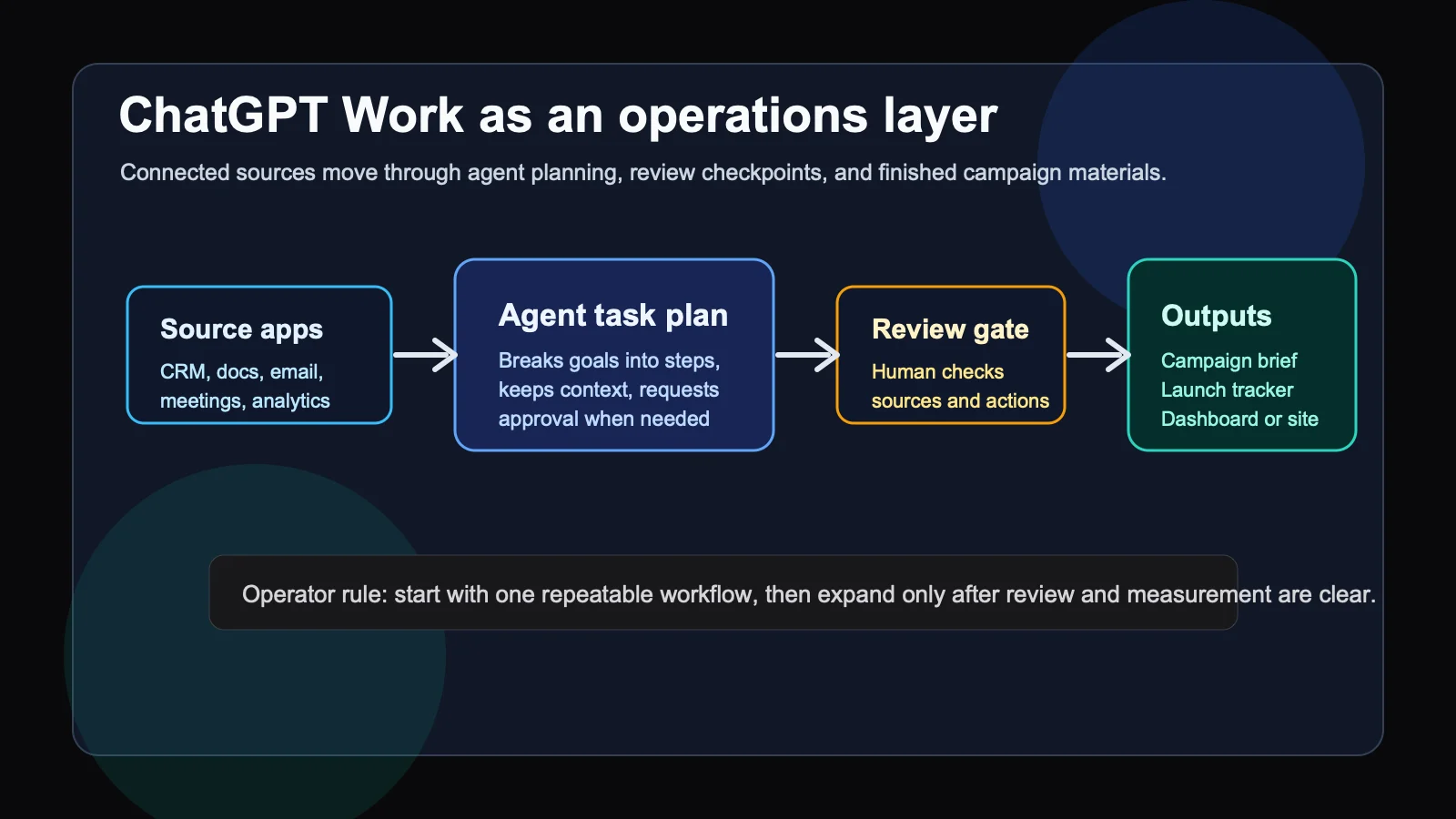
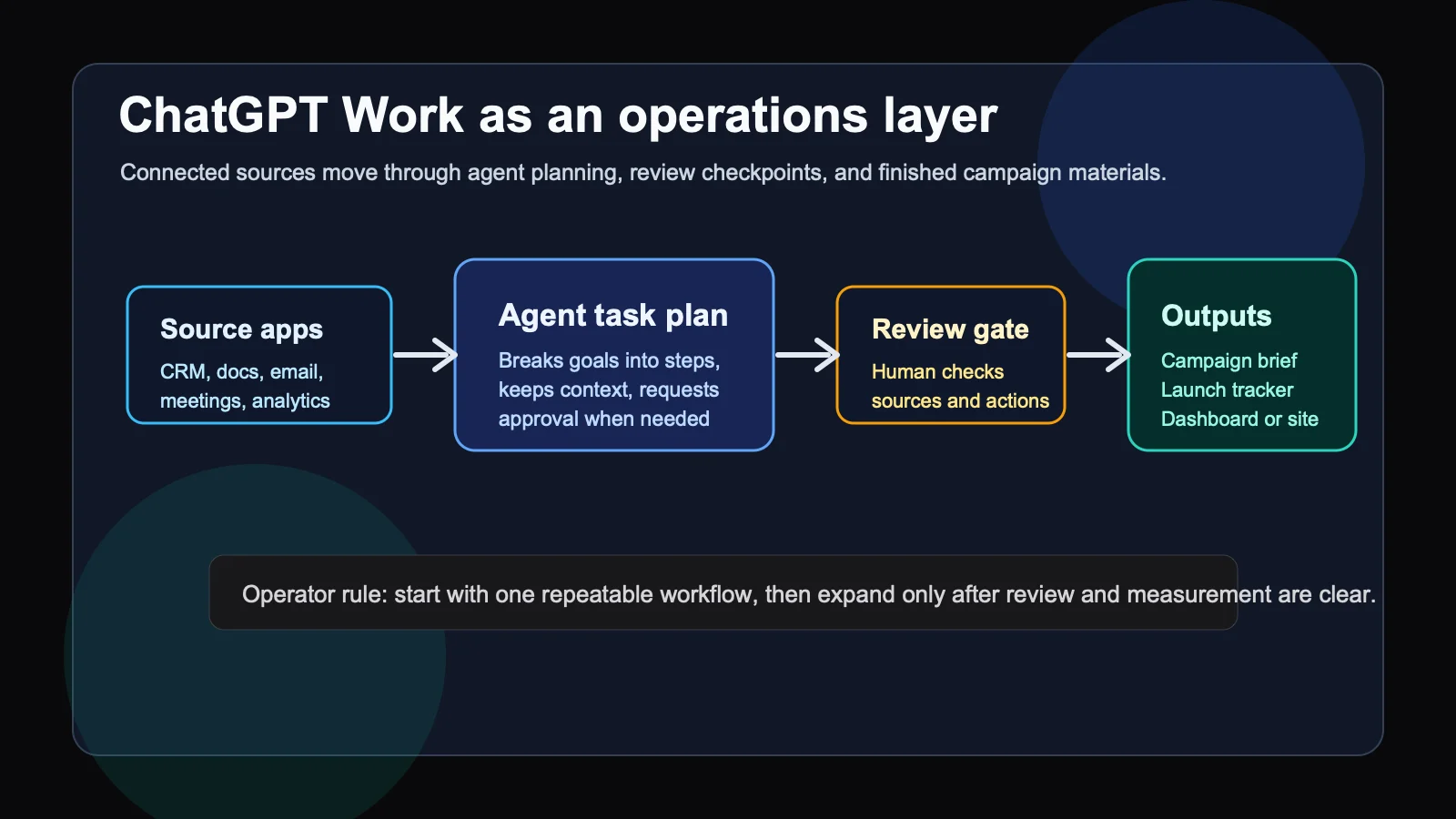
OpenAI made a notable product shift on July 9, 2026: ChatGPT is no longer being positioned only as a place to ask questions, draft copy, or analyze files. The company introduced ChatGPT Work, an agentic mode that can gather context from connected apps, build finished materials, continue longer projects, and ask for approvals before important actions. For marketing, sales, RevOps, finance, and digital operations teams, the practical story is a move toward governed work execution across apps, files, browsers, and scheduled workflows.
The launch sits directly inside Slogan.website's core concern: how small and mid-sized teams turn AI from occasional output into a repeatable operating system. If your team already uses the GEO Visibility Checklist, Digital Marketing Budget Planner, or Marketing ROI Calculator, the next question is whether those planning routines can become monitored, source-backed workflows instead of one-off reports.
What changed
OpenAI's launch post says ChatGPT Work can work across apps and workflows to create materials such as sheets, slides, docs, and web apps, and can stay with complex projects for hours by breaking them into smaller tasks. The same post says ChatGPT Work is powered by GPT-5.6, and OpenAI's separate GPT-5.6 announcement frames that model family around multi-step knowledge work, stronger computer use, and more efficient long-running tasks.
The product surface is broader than one chat box. OpenAI says users can connect tools through plugins, including workplace systems such as Slack, Microsoft Teams, Google Drive, SharePoint, email, calendars, CRMs, and project trackers. The company also introduced Sites in ChatGPT in public beta for interactive sites, dashboards, project trackers, launch calendars, internal portals, and reports. Scheduled Tasks can monitor recurring inputs, refresh agendas, summarize website or dashboard changes, and update presentations when new feedback arrives.
OpenAI's Apps in ChatGPT help page adds a governance detail that matters for operators: as of July 9, 2026, the app directory moved to the Plugin directory, where plugins help users discover workflow capabilities across ChatGPT and Codex while admins manage installation and underlying app access.
| Confirmed change | Official source | Operator meaning |
|---|---|---|
| ChatGPT Work launched on July 9, 2026 as an agent that can work across apps, files, and workflows. | OpenAI launch post | Teams can start designing repeatable outcomes, not only prompts. |
| OpenAI says ChatGPT Work can create sheets, slides, docs, web apps, and longer-running project outputs. | OpenAI launch post | Campaign briefs, planning trackers, client reports, and launch hubs can sit in the same workflow. |
| Sites in ChatGPT entered public beta for interactive sites, trackers, dashboards, and reports. | OpenAI launch post | Internal marketing artifacts can become live tools instead of static documents. |
| The Plugin directory became the discovery layer for workflow capabilities across ChatGPT and Codex. | OpenAI Help Center | Workflow adoption now depends on app permissions, plugin policy, and admin review. |
| Business release notes say ChatGPT for PowerPoint is generally available for Business workspaces as of July 6, 2026. | OpenAI Business release notes | Presentation production is becoming part of the same agentic usage and governance pool. |
Why it matters
The most important change is workflow continuity. Marketing teams often lose time between research, messaging, budget planning, creative review, campaign setup, executive reporting, and post-launch analysis. ChatGPT Work is aimed at carrying context across those steps, pulling from connected systems, and producing artifacts that a team can review.
That matters for high-value audiences in the United States, Canada, the United Kingdom, Australia, and Europe because adoption is shifting from individual experimentation to organizational process. An agency can ask for a campaign brief, but the real gain appears when the agent checks source docs, pulls recent customer feedback, updates a launch tracker, drafts slides, and flags unanswered approvals.
The launch also makes governance more visible. OpenAI says organizations can manage access to plugins, connected tools, browser use, network access, and sensitive actions. That means the buying decision is no longer only "Which model writes better?" It becomes "Which workflows are safe enough to connect, schedule, and delegate?"
Who is affected
Marketing operations teams are the first affected group. They now have a clearer reason to document campaign processes as step-by-step workflows with source inputs, approval points, and measurable outputs.
Agencies and consultants are next. Client work often spans shared folders, CRM notes, meeting transcripts, creative decks, and launch calendars. ChatGPT Work could reduce handoff labor, but only if permissions and review rules are explicit.
RevOps, sales, finance, and analytics teams are also affected because the launch examples are cross-functional. OpenAI describes workflows that turn customer research into campaign briefs, update account plans, and refresh recurring reports. Those are not isolated content tasks; they are operating routines.
What to do next
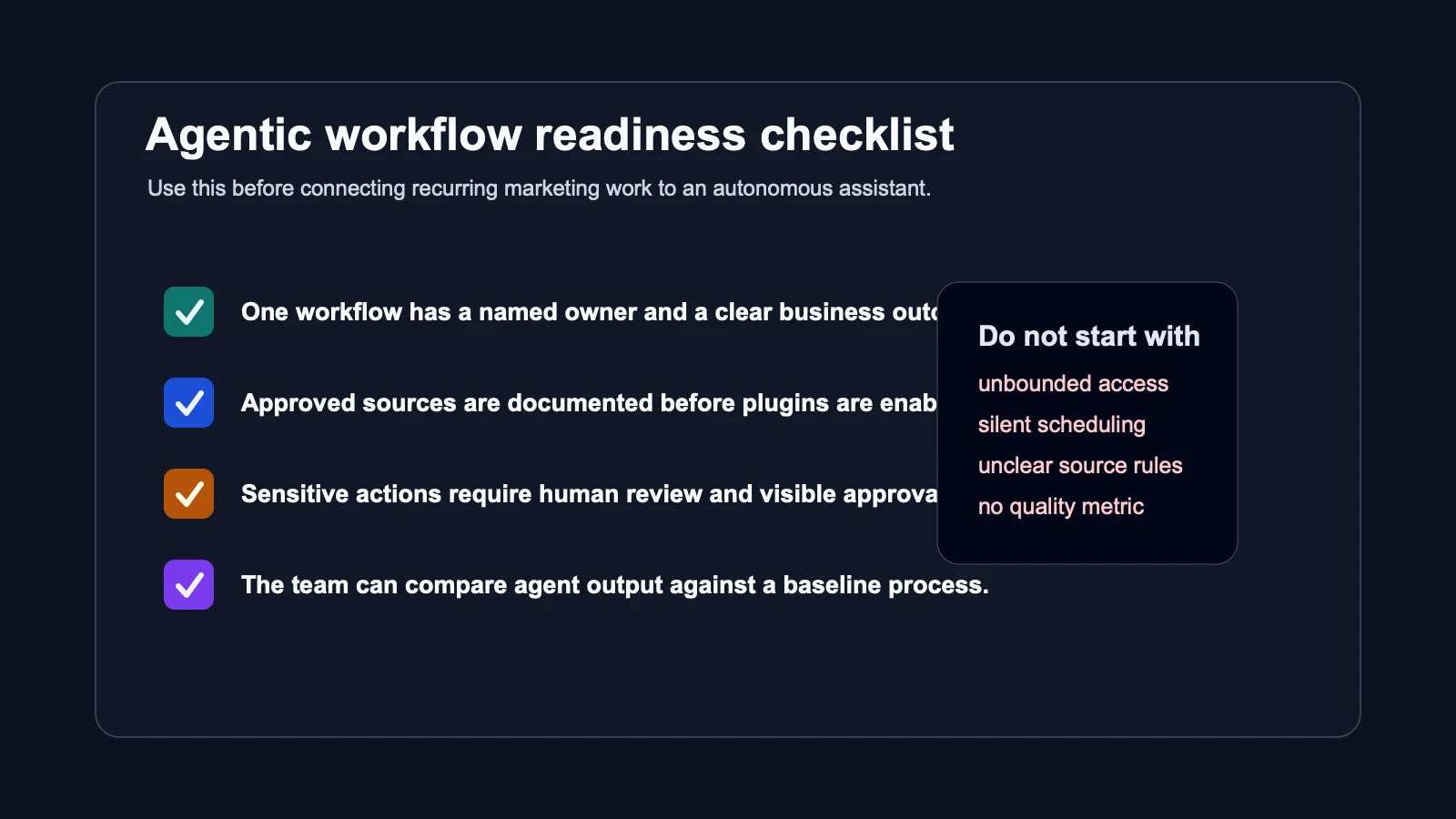
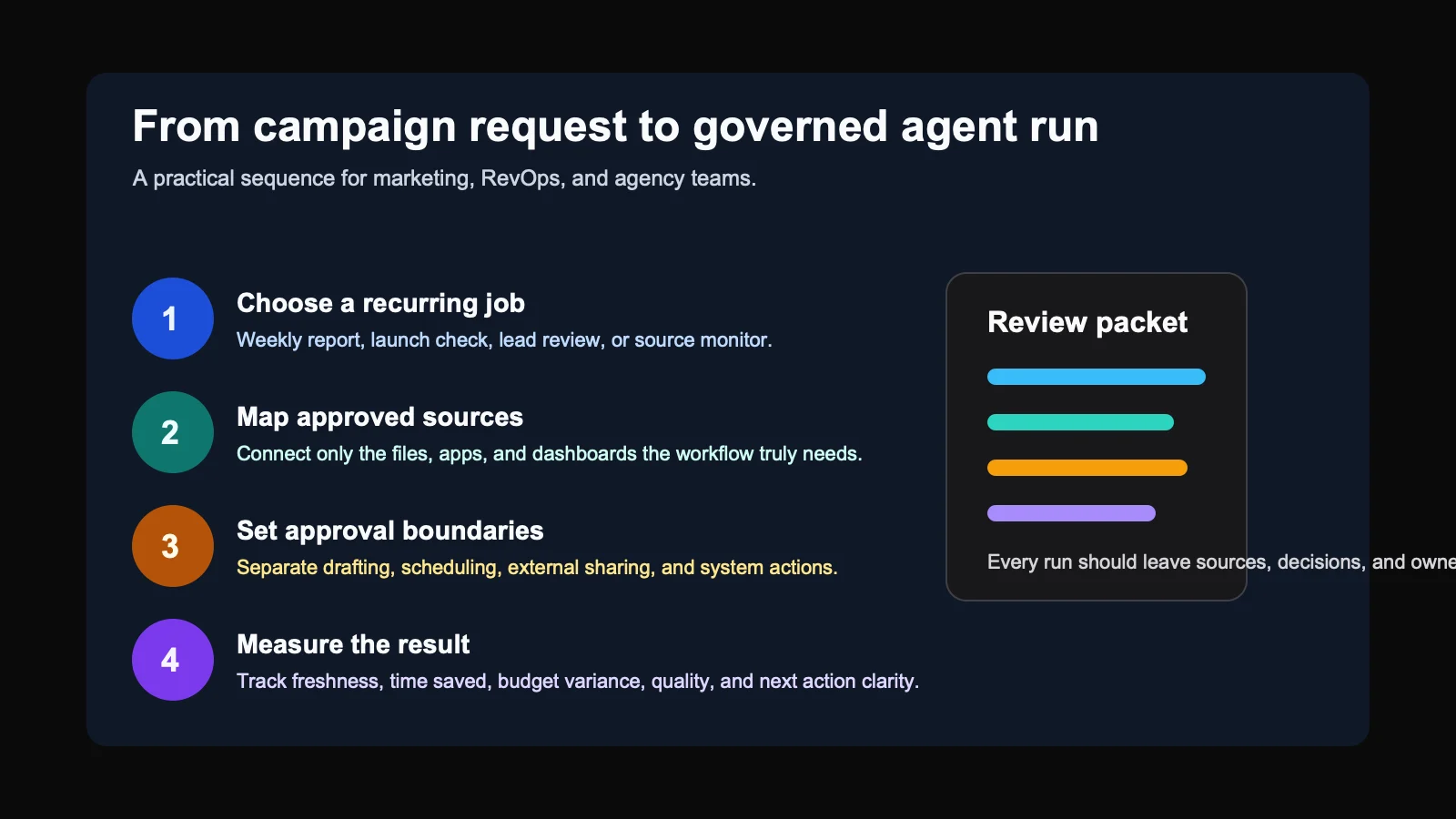
- Pick one recurring workflow before connecting every tool. Good candidates include weekly campaign reporting, launch readiness checks, lead follow-up review, or GEO source monitoring.
- Define the approved sources the agent may use: CRM records, analytics dashboards, meeting notes, briefs, spreadsheets, or source URLs.
- Write the human approval rules before the first run. Decide which actions can be drafted, which can be scheduled, and which always need review.
- Pair the workflow with a measurable outcome, such as time saved, report freshness, conversion quality, budget variance, or brand-message consistency.
- Use the brand mentions visibility guide and GEO benefits guide to decide which sources and answer-engine signals should be monitored over time.
What remains uncertain
Several practical details remain unsettled on July 14, 2026. OpenAI says ChatGPT Work is rolling out across plans, but account-level access, plugin availability, admin settings, and usage limits can differ by workspace. The company also says usage varies with the amount of work required, which means teams should test cost and credit behavior before moving important operations into scheduled runs.
There is also an adoption risk. A connected agent can produce more finished work, but more output is not automatically better operations. Teams still need named owners, version control, source review, compliance checks, and a way to measure whether the generated work improved a real business process. The useful conclusion is specific: ChatGPT Work gives marketing and operations teams a stronger execution surface, but the teams that benefit most will be the ones that turn messy recurring work into small, governed, measurable workflows.