OpenAI turns Codex into a cross-functional work layer with plugins, Sites and annotations
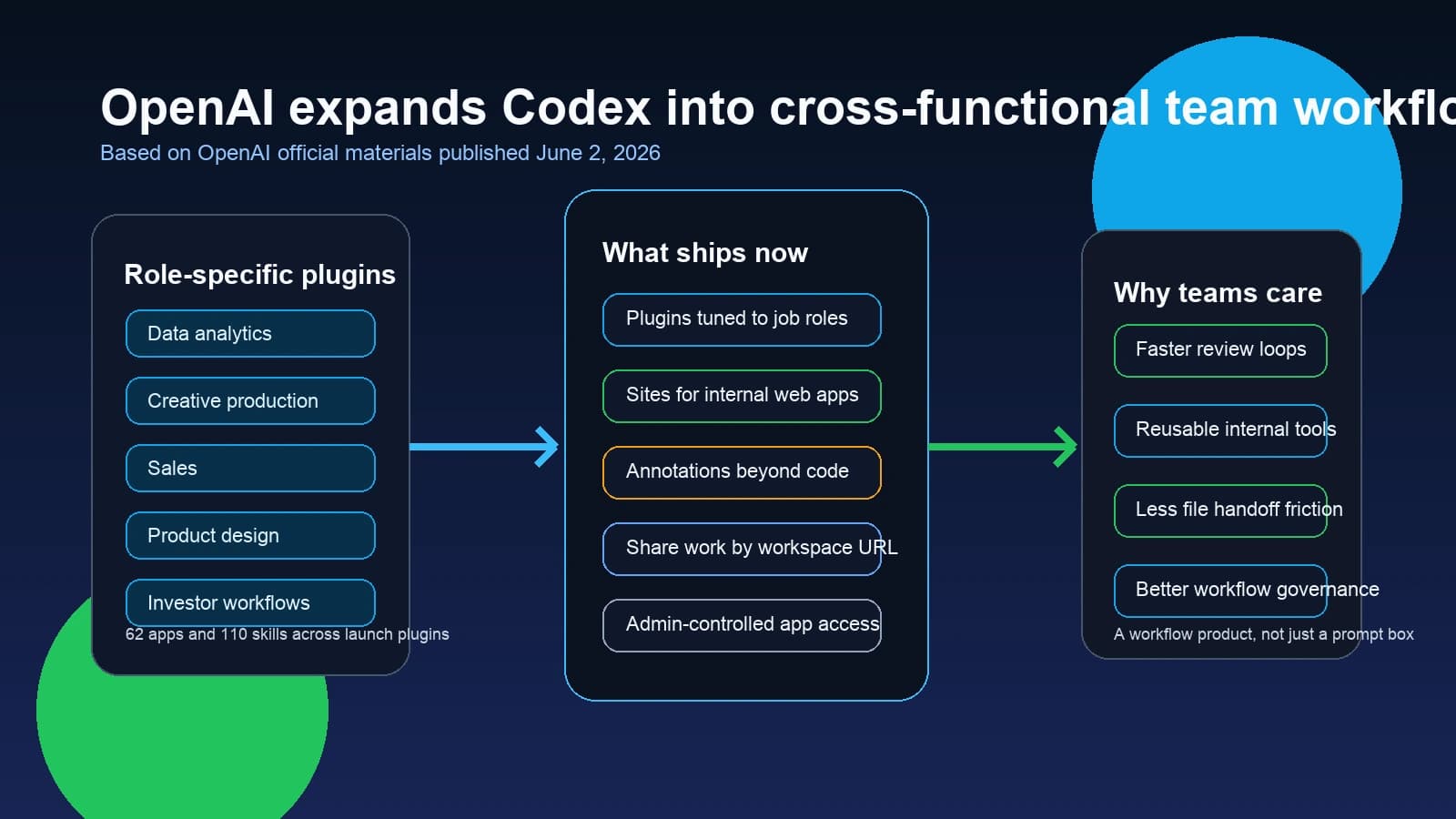
OpenAI said on June 2, 2026 that Codex is no longer being positioned only as a software engineering agent. The company introduced six role-specific plugins, a preview of shareable workspace Sites, and broader annotation workflows meant to help non-developers refine documents, dashboards, slides, and internal tools. For marketing, growth, analytics, creative, and web teams, the practical shift is simple: Codex is now being sold as an operating layer for cross-functional work, not just code generation.
That matters because OpenAI also said on June 2 that Codex now has more than 5 million weekly users and that non-developers account for about 20% of usage while growing more than three times faster than developers. If that pattern holds, teams deciding how to organize AI work will need better controls for tools, permissions, review, and reusable workflows, not just prompt access.
What changed
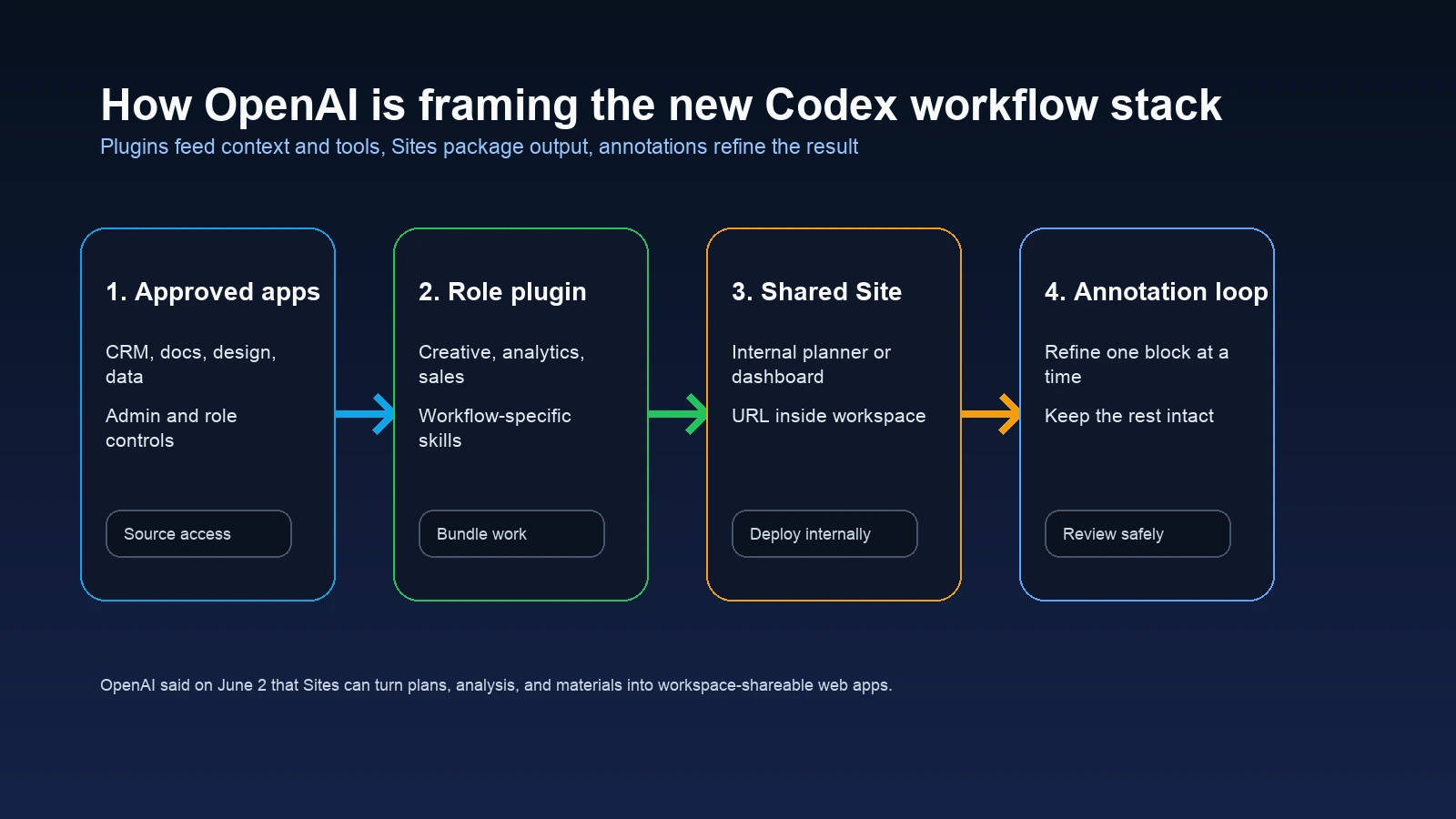
The official launch has three parts: packaged plugins for specific business jobs, workspace-internal Sites, and annotations that extend beyond code files.
| Confirmed June 2 detail | Official source | Why it matters |
|---|---|---|
| OpenAI launched six role-specific Codex plugins on June 2, 2026. | OpenAI product announcement | Codex is moving into repeatable knowledge-work flows, not only developer tasks. |
| OpenAI said the launch includes 62 apps and 110 skills across those plugins. | OpenAI product announcement | Adoption will depend on tool coverage, setup discipline, and admin approval, not just model quality. |
| The creative production plugin is aimed at marketing and creative teams using tools like Figma and Canva. | OpenAI product announcement | AI-assisted campaign production is being packaged as an operational workflow with reviewable outputs. |
| OpenAI said Sites are rolling out in preview for Business and Enterprise teams. | OpenAI product announcement and OpenAI Help Center | Teams can turn prompts, plans, and analysis into shareable internal web apps instead of static docs. |
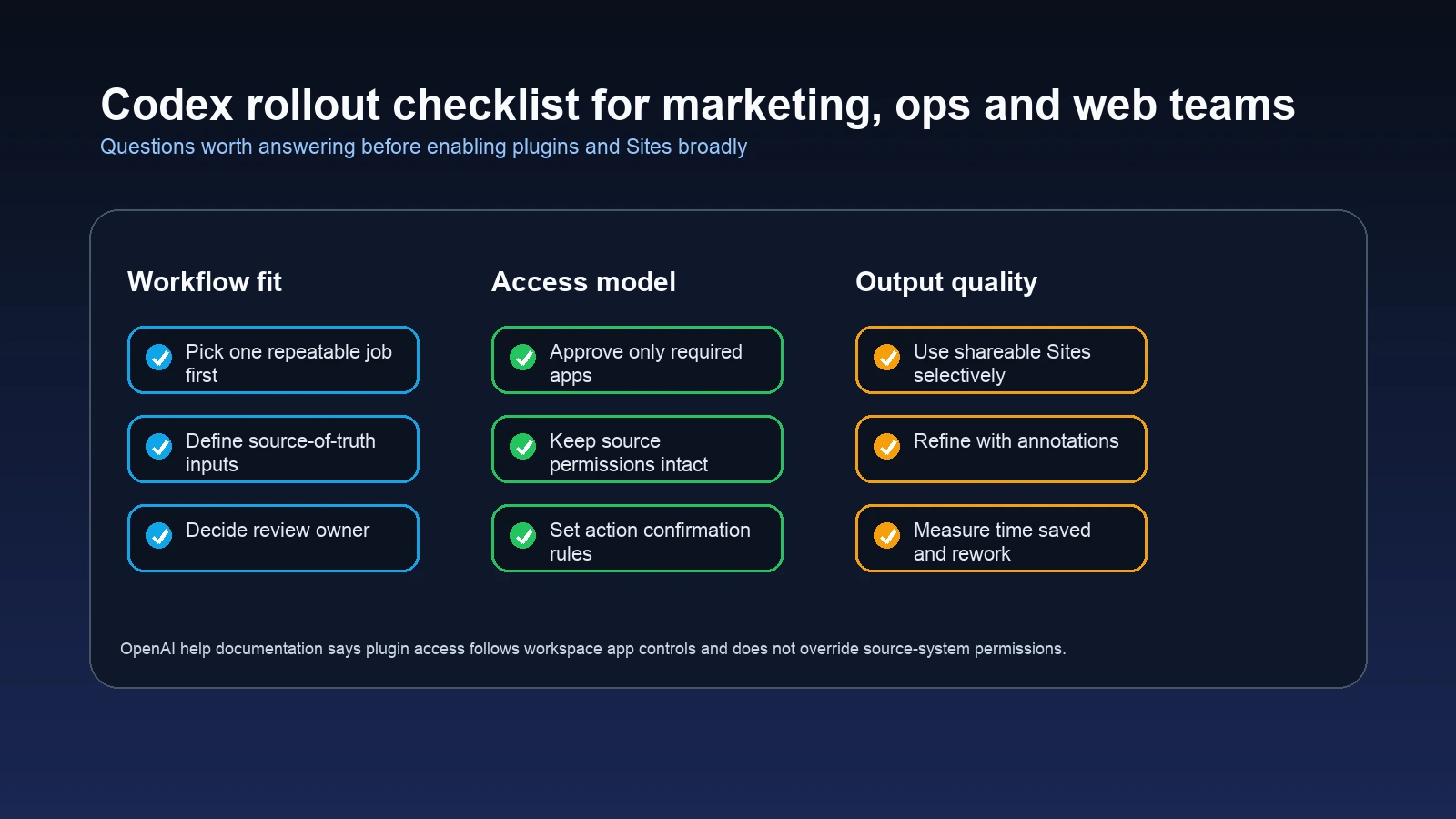
| OpenAI's help center says plugin access follows workspace app controls and does not override source-system permissions. | Plugins in Codex | Rollout is as much an IT, security, and governance project as a productivity story. |
OpenAI's June 2 announcement says the launch starts with plugins for data analytics, creative production, sales, product design, public equity investing, and investment banking. The same post says more role-specific plugins are coming, including Marketing Strategy, Strategy Consulting, Legal, Corporate Finance, and Private Equity Investing. That makes this a platform-expansion story, not a one-off feature drop.
The Sites piece is arguably the most important operational change. OpenAI says Codex can now create interactive hosted websites and apps that can be shared within a workspace by URL. Its June 2 help documentation says Sites are available in preview for eligible Business and Enterprise workspaces, are enabled by default for Business, and can be toggled in Early Access for Enterprise workspaces.
Why it matters
This matters because many organizations still treat AI access as an individual productivity perk. OpenAI is instead packaging Codex around team roles, approved tools, and workspace-sharing. That changes the buying and implementation conversation.
For marketing and creative operations, the creative production plugin is the clearest signal. OpenAI says it can turn a brief into reviewable assets, display ad variations, product lifestyle shots, and ecommerce-ready image sets with tools such as Figma, Canva, Shutterstock, Picsart, and Fal. That is closer to a managed production lane than a generic chatbot prompt box.
For operations and analytics leaders, the data analytics plugin matters because OpenAI is explicitly tying Codex to reporting, dashboards, and business question workflows. That overlaps with the same measurement discipline behind Slogan.website's Marketing ROI Calculator and Digital Marketing Budget Planner: the value is not "AI wrote something" but whether teams can turn data into action faster and with fewer handoff delays.
There is also a GEO and brand-control angle. If more internal planning, content review, and campaign assembly happen in AI-mediated workflows, teams need cleaner source material, clearer claims, and better visibility standards. That is the same foundation behind the GEO Visibility Checklist and brand mention tracking. AI workflows get more useful when the inputs are structured, current, and easy to verify.
Who is affected
The most affected teams are the ones already stretched across briefs, approvals, and tool fragmentation.
- Creative and lifecycle marketing teams evaluating whether AI can compress campaign production without losing brand review.
- Marketing operations and analytics teams that need dashboards, summaries, and scenario tools to be shareable, not trapped in slide decks.
- Revenue and sales teams that want AI help with follow-up, meeting prep, and account planning while preserving CRM permission boundaries.
- Product, web, and design teams that need lightweight internal tools or review surfaces faster than a full engineering cycle.
- IT, security, and workspace admins who now need to decide which apps, actions, and user roles Codex can access.
What to do next
Use the June 2 launch as a workflow audit trigger instead of assuming broad deployment is automatically safe.
- List the repeatable jobs where teams lose time today: campaign briefing, reporting, account prep, design review, or internal microsite creation.
- Map which of those jobs depend on tools that would need admin approval, because OpenAI's plugin documentation says app access and source permissions still govern what Codex can do.
- Decide whether a shared
Sitewould replace a static document, dashboard export, or launch brief more effectively for your team. - Pressure-test claims, inputs, and source quality before scaling AI-created outputs, especially if those outputs will influence content, budget, or customer-facing work.
- Pilot one narrow workflow first, then compare its speed and review burden against your current process using the best AI search and analytics tools guide and your existing reporting stack.
What remains uncertain
Important limits are still visible on June 2, 2026. OpenAI says role-specific plugins are rolling out in supported regions, which means availability is not universal on day one. The company also says in its help center overview that plugins depend on workspace settings, approved apps, feature access, and source-system permissions, so the product surface a team sees may differ sharply from the launch headline.
There are also unanswered commercial questions. OpenAI has not published a single standard implementation pattern for every department, and the plan overview says usage limits vary by plan. That means procurement, security review, and operating model choices will still shape whether Codex becomes a daily work layer or a narrow pilot.
The strongest conclusion is narrower than the hype. On June 2, 2026, OpenAI made Codex more relevant to marketing, analytics, design, and operations by bundling role-specific workflows, internal app sharing, and in-place refinement into one official launch. Teams that respond well will probably be the ones that treat this as workflow architecture, permission design, and source-quality work, not just another AI feature announcement.